粤港澳大湾区港口群参与全球航运网络特征
|
王琪(1997—),女,黑龙江人,硕士研究生,主要研究方向为全球城市网络、港口城市与发展,(E-mail)wangq265@mail2.sysu.edu.cn; |
收稿日期: 2021-05-06
修回日期: 2021-09-04
网络出版日期: 2022-01-28
基金资助
国家自然科学基金项目(42001178)
国家自然科学基金项目(41930646)
南方海洋科学与工程广东省实验室(珠海)创新团队建设项目(311021018)
Participation of the Global Shipping Network in the Guangdong- Hong Kong-Macao Greater Bay Area
Received date: 2021-05-06
Revised date: 2021-09-04
Online published: 2022-01-28
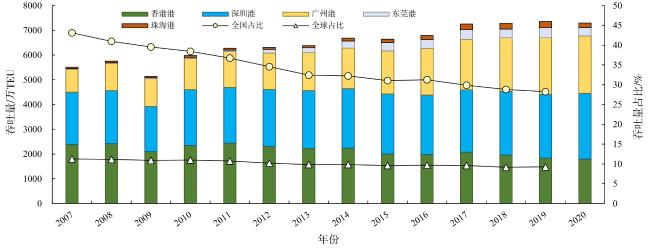
以粤港澳大湾区港口群为研究对象,结合区域港口集装箱吞吐量数据、全球航运网络航线数据,运用社会网络分析方法相关指标,对粤港澳大湾区港口群内部港口吞吐量占比变化、港口群内部结构变化、湾区港口群参与全球八大区域航运网络格局等进行分析。结果表明:1)2007—2020年粤港澳大湾区港口总吞吐量增长率达到32.3%,并且在2020年总吞吐量达到7 294万TEU,占全球的9.2%,占中国的28.3%。其中,深圳港、广州港增长速度较快;2)在参与全球航运网络方面,粤港澳大湾区出现以深圳港、香港港为核心参与全球八大航运区域的层级结构,湾区整体与东亚、东南亚区域联系最为紧密,与欧洲、美洲、非洲等区域的航线联系则局限于区域核心港口间的直接联系;3)粤港澳大湾区港口群内部深圳港、香港港、广州港三港鼎立,主要业务错位化发展,国际集装箱中转枢纽港香港港、外贸港口深圳港与内贸综合大港广州港以及区域其他支线港珠海港、东莞港等港口共同发展。粤港澳大湾区的港口亟待以港口群为整体,积极参与到全球航运网络的建设中,以应对全球化进程中未知的机遇和挑战。
王琪 , 陈炜 , 韦春竹 . 粤港澳大湾区港口群参与全球航运网络特征[J]. 热带地理, 2022 , 42(2) : 236 -246 . DOI: 10.13284/j.cnki.rddl.003431
This paper focuses on the internal hierarchical structure of the port group in the Guangdong-Hong Kong-Macao Greater Bay Area and the external connection patterns of the region. This article considers the Greater Bay Area port cluster as its research object, uses regional container port throughput data , global shipping network route data, and social network analysis methods to study the relative indicators of the cluster's internal port throughput. The results show that: (1) the total port throughput of the Greater Bay Area increased by 32.3% from 2007 to 2020, and reached 72.94 million TEU(Twenty-foot Equivalent Unit) in 2020, accounting for 9.2% worldwide and 28.3% for China. Among them, Shenzhen and Guangzhou ports are experiencing rapid growth. The port group of the Greater Bay Area occupies an important position in national and global maritime markets. (2) In terms of participation in the global shipping network, the Greater Bay Area has emerged as a hierarchical structure with Shenzhen and Hong Kong ports as the core in the eight global shipping regions. The Greater Bay Area has the closest connection with East and Southeast Asia, while its routes to Europe, America, Africa, and other regions are limited to the direct connection between regional core ports. (3) Shenzhen, Hong Kong, and Guangzhou within the Greater Bay Area port group will be firmly established, and their major businesses will be developed simultaneously. Shenzhen port, an international container transport hub in Hong Kong, a foreign trade port and a comprehensive domestic trade port in Guangzhou, and other regional ports, such as Zhuhai and Dongguan, will be jointly developed. The rapid development of the port group in the Greater Bay Area has provided important support to the country's construction of the 21st-century Maritime Silk Road Economic Belt. It has formed a multi-level structure with Shenzhen, Hong Kong, and Guangzhou as the core, and the leading ports play an important role in the internal market and external shipping links. In the future, the positioning and regional coordinated development among Hong Kong, Shenzhen, and Guangzhou ports will become the key to the overall competitiveness of the port group in the Greater Bay Area. In future development, the regional integration of port groups will surpass the competitive pattern among them. Instead of competing, Shenzhen, Guangzhou, and Hong Kong should break down barriers and integrate port resources to combine the advantages and allocate them efficiently. The port group of the Greater Bay Area urgently needs to adjust its internal development pattern to meet the unknown opportunities and challenges of globalization.
表1 全球排名前十班轮运输公司Table 1 List of global top 10 liner shipping companies |
| 排名 | 班轮运输公司 | 国家(地区) | |
|---|---|---|---|
| 1 | APM-Maersk | 马士基 | 丹麦 |
| 2 | Mediterranean Shg Co. | 地中海航运 | 瑞士 |
| 3 | COSCO Group | 中国远洋海运 | 中国 |
| 4 | CMA CGM Group | 法国达飞 | 法国 |
| 5 | Hapag-Lloyd | 赫罗伯特 | 德国 |
| 6 | ONE(Ocean Network Express) | 日本邮船 | 日本 |
| 7 | Evergreen Line | 长荣海运 | 中国台湾 |
| 8 | Yang Ming Marine Transport Corp. | 阳明海运 | 韩国 |
| 9 | Hyundai M.M. | 现代商船 | 韩国 |
| 10 | PIL(Pacific Int. Line) | 太平商务 | 新加坡 |
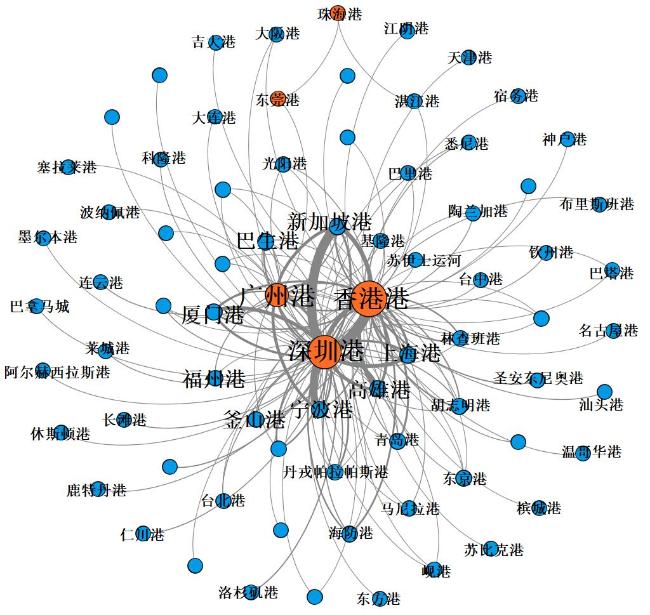
图3 粤港澳大湾区与全球港口航运联系拓扑Fig.3 Topological diagram of the shipping network between the Guangdong-Hong Kong-Macao Greater Bay Area and the global port |
表2 粤港澳大湾区主要港口全球航运网络建设主要参数Table 2 Main parameters of the global shipping network in the Guangdong-Hong Kong-Macao Greater Bay Area |
| 港口 | 度数中心性 | 入度 | 出度 | 接近中心性(排名) | 主要联系港口(港口间联系次数) | 所在区域 |
|---|---|---|---|---|---|---|
| 香港港 | 73 | 42 | 31 | 0.708 333(2) | 深圳港(170)高雄港(65)新加坡港(58)上海港(37) | 东亚、东南亚 |
| 深圳港 | 65 | 26 | 39 | 0.796 875(1) | 香港港(170)新加坡港(127)宁波港(93)高雄港(61) | 东亚、东南亚 |
| 广州港 | 29 | 16 | 13 | 0.573 034(3) | 深圳港(40)新加坡港(36)、宁波港(29) | 东亚、东南亚 |
| 东莞港 | 2 | 1 | 1 | 0.368 794(48) | 广州港、珠海港 | 东亚(粤港澳) |
| 珠海港 | 2 | 1 | 1 | 0.273 196(52) | 东莞港、湛江港 | 东亚 |
表3 粤港澳大湾区港口与全球八大区域港口间联系网络相关参数Table 3 Main parameters of the global shipping network between the GBA and Eight regions in the world |
| 地理分区 | 港口 总数 | 港口间 联系对数 | 平均度 | 平均路径长度 |
|---|---|---|---|---|
| 东亚—粤港澳大湾区 | 30 | 63 | 2.100 | 2.228 |
| 东南亚—粤港澳大湾区 | 23 | 57 | 2.478 | 2.113 |
| 北美—粤港澳大湾区 | 9 | 8 | 0.889 | 1.385 |
| 大洋洲—粤港澳大湾区 | 10 | 9 | 0.900 | 1.182 |
| 非洲—粤港澳大湾区 | 3 | 3 | 1.000 | 1.250 |
| 拉丁美洲—粤港澳大湾区 | 4 | 2 | 0.500 | 1.000 |
| 欧洲—粤港澳大湾区 | 6 | 5 | 0.833 | 1.600 |
| 中东中南亚—粤港澳大湾区 | 6 | 4 | 0.667 | 1.000 |
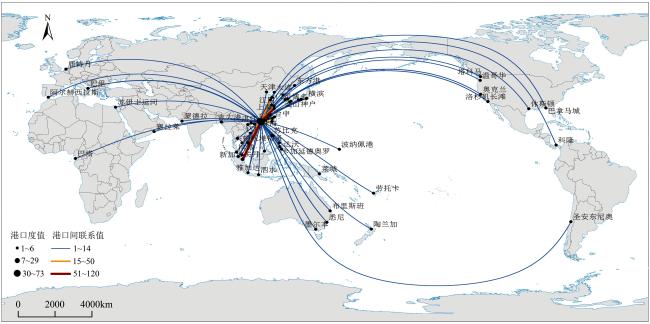
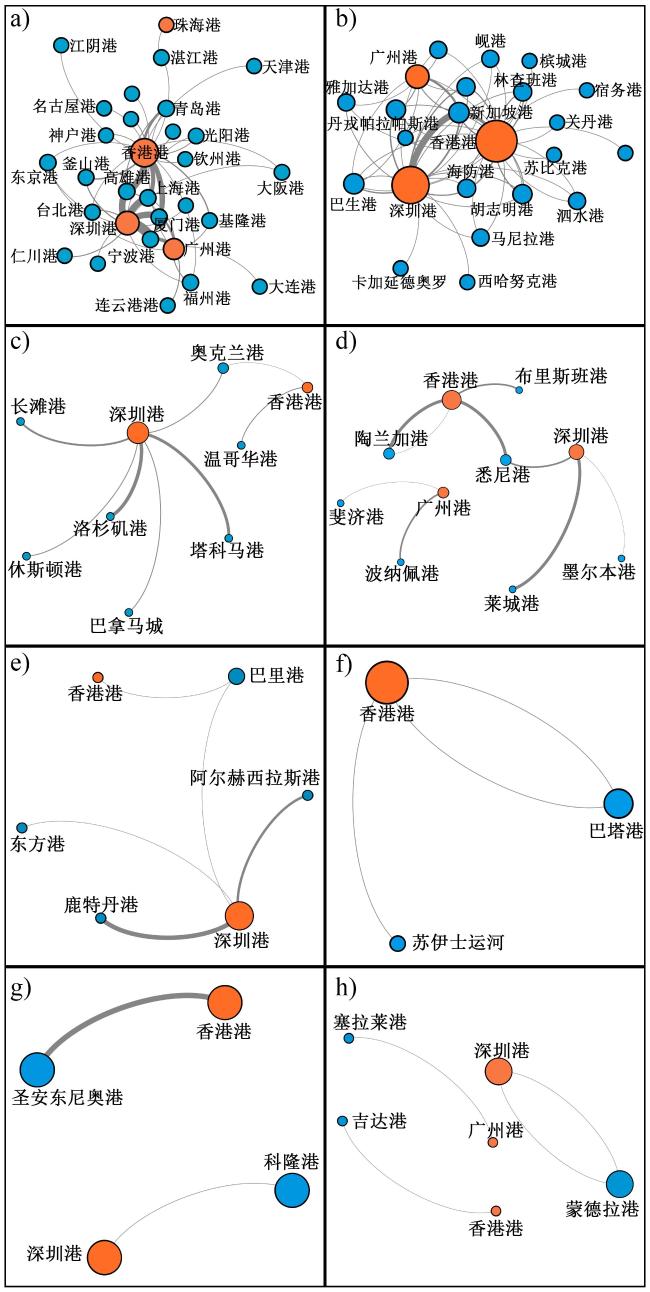
图5 大湾区与全球航运网络联系拓扑关系(a. 东亚;b. 东南亚;c. 北美洲;d. 大洋洲;e. 欧洲;f. 非洲;g. 拉丁美洲;h. 中东中南亚)Fig.5 The topological relationship of the shipping network between the GBA and the eight major regions of the world(a. East Asia; b. Southeast Asia; c. North America; d. Oceania; e. Europe; f. Africa; g. Latin America; h. Middle East, Central Asia and South Asia) |

1 数据来源:中国港口官网. http://www.port.org.cn/datainfo/index.htm
王 琪:主要撰稿人,完成相关数据收集、文献资料的整理与分析,完成论文初稿的写作;
陈 炜:参与数据资料的收集整理,文章图件的调整;
韦春竹:指导论文的写作,审阅。
|
陈朝萌. 2016. 粤港澳大湾区港口群定位格局实证分析. 深圳大学学报(人文社会科学版),33(4):32-35. [Chen Zhaomeng. 2016. Empirical Analysis of Port Group Positioning in the Guangdong-Hong Kong-Macau Big Bay Area. Journal of Shenzhen University (Humanities&Social Sciences), 33(4): 32-35. ]
|
|
陈芙英,胡志华. 2016. 海上丝绸之路东南亚航运网络空间格局研究. 大连海事大学学报,42(4):91-96. [ Chen Fuying and Hu Zhihua. 2016. Research on the Spatial Pattern of Southeast Asian Shipping Network on the Maritime Silk Road. Journal of Dalian Maritime University, 42(4): 91-96. ]
|
|
程佳佳,王成金. 2015. 珠江三角洲集装箱港口体系演化及动力机制. 地理学报,70(8):1256-1270. [Cheng Jiajia and Wang Chengjin. 2015. The Evolution and Dynamic Mechanism of the Container Port System in the Pearl River Delta. Acta Geographica Sinica, 70(8): 1256-1270. ]
|
|
Ducruet C and Notteboom T. 2012. The Worldwide Maritime Network of Container Shipping: Spatial Structure and Regional Dynamics. Global Networks (Oxford), 12(3): 395-423.
|
|
丁丽君. 2012. 我国环渤海港口群与区域经济互动发展研究. 青岛:中国海洋大学. [Ding Lijun. 2012. Research on the Interactive Development of my Country's Bohai Sea Rim Port Group and Regional Economy. Qingdao: Ocean University of China. ]
|
|
范斐,刘承良,游小珺,肖泽磊. 2015. 全球港口间集装箱运输贸易网络的时空分异. 经济地理,35(6):109-115. [ Fan Fei, Liu Chengliang, You Xiaojun and Xiao Zelei. 2015. The Temporal and Spatial Differentiation of Container Transportation and Trade Networks among Global Ports. Economic Geography, 35(6): 109-115. ]
|
|
郭建科,何瑶,王绍博,吴陆陆. 2019. 1985年以来中国大陆沿海集装箱港口体系位序-规模分布及其网络联系. 地理研究,38(4):869-883. [Guo Jianke, He Yao, Wang Shaobo and Wu Lulu. 2019. Rank-Size Distribution Changes and Transportation Network Connections of the Coastal Container Port Network Connections of the Coastal Container Port. Geographical Research, 38(4): 869-883. ]
|
|
郭建科,侯雅洁,何瑶. 2020. “一带一路”背景下中欧港口航运网络的演化特征. 地理科学进展,39(5):716-726. [ Guo Jianke, Hou Yajie and He Yao. 2020. Spatial Connections and Regional Differences of China's Coastal Container Port Shipping Network. Progress in Geography, 37(11): 716-726. ]
|
|
黄小彪. 2011. 关于粤港澳共建珠三角国际航运中心的思考. 港口经济,(12):28-32. [Huang Xiaobiao. 2011. Thoughts on Guangdong, Hong Kong and Macao's Joint Construction of the Pearl River Delta International Shipping Center. Port Economy, (12): 28-32. ]
|
|
蹇令香,李东兵,刘玲玲. 2012. 我国集装箱港口体系演进规律研究. 经济地理,32(12):91-96. [Jian Lingxiang, Li Dongbin and Liu Lingling. 2012. Research on the Evolution Law of China Container Port System. Economic Geography, 32(12): 91-96. ]
|
|
Jiang J, Lee L H, Chew E P and Gan C C . 2015. Port Connectivity Study: An Analysis Framework from a Global Container Liner Shipping Network Perspective. Transportation Research Part E: Logistics and Transportation Review, 73: 47-64.
|
|
李振福,李漪. 2014. 北极航线的世界航运网络格局影响分析. 世界地理研究,23(1):1-9. [Li Zhenfu and Li Yi. 2014. Analysis of the Influence of the Arctic Route on the World Shipping Network Pattern. World Regional Studies, 23(1): 1-9. ]
|
|
刘婵娟,胡志华. 2018. “21世纪海上丝绸之路”海运网络空间格局及其复杂性研究. 世界地理研究,27(3):11-18. [Liu Chanjuan and Hu Zhihua. 2018. "21st Century Maritime Silk Road" Maritime Network Spatial Structure and Complexity Research. World Regional Studies, 27(3): 11-18. ]
|
|
潘峰华,赖志勇,葛岳静. 2015. 经贸视角下中国周边地缘环境分析——基于社会网络分析方法. 地理研究,34(4):775-786. [Pan Fenghua, Lai Zhiyong and Ge Yuejing. 2015. Analysis of China's Surrounding Geo-Environment from the Perspective of Economy and Trade—Based on Social Network Analysis Method. Geographical Research, 34(4): 775-786. ]
|
|
秦奇,吴良,李飞,成升魁,张丹,陈晓鹏. 2018. 基于社会网络分析的东南亚地缘关系研究. 地理学报,73(10):2014-2030. [Qin Qi, Wu Liang, Li Fei, Cheng Shengkui, Zhang Dan and Chen Xiaopeng. 2018. Research on the Geopolitical Relations of Southeast Asia Based on Social Network Analysis. Acta Geographica Sinica, 73(10): 2014-2030. ]
|
|
沈玉芳,刘曙华,张婧,王能洲. 2010. 长三角地区产业群、城市群和港口群协同发展研究. 经济地理,30(5):778-783. [Shen Yufang, Liu Shuhua, Zhang Jin and Wang Nengzhou. 2010. The Correspondence among Industrial Cluster, City Group and Port Group on the Yangtze Delta Area. Economic Geography, 30(5): 778-783. ]
|
|
宋长利. 2019. 中国沿海港口群经济发展研究. 沈阳:辽宁大学. [Song Changli. 2019. Research on the Economic Development of China's Coastal Port Groups. Shenyang: Liaoning University. ]
|
|
王爱虎,匡桂华. 2014. 中国沿海集装箱港口群体系结构演化与竞争态势. 经济地理,34(6):92-99. [Wang Aihu and Kuang Guihua. 2014. The Evolution and Competition Situation of China's Coastal Container Port Group System Structure. Economic Geography, 34(6): 92-99. ]
|
|
王列辉,洪彦. 2016. 直航背景下海峡两岸集装箱港口体系空间结构——基于复杂网络的视角. 地理学报,71(4):605-620. [Wang Liehui and Hong Yan. 2016. The Spatial Structure of the Container Port System on Both Sides of the Taiwan Strait under the Background of Direct Shipping—Based on the Perspective of Complex Networks. Acta Geographica Sinica, 71(4): 605-620. ]
|
|
Valentine V F, Benamara H and Hoffmann J. 2013. Maritime Transport and International Seaborne Trade. Maritime Policy and Management, 40(3): 226-242.
|
|
Xu M, Li Z, Shi Y, Zhang X and Jiang S . 2015. Evolution of Regional Inequality in the Global Shipping Network. Journal of Transport Geography, 44: 1-12.
|
|
张国强. 2019. 粤港澳大湾区港口群优化协调发展研究. 综合运输,41(1):1-6. [Zhang Guoqiang. 2019. Research on the Optimization and Coordinated Development of the Port Group in the Guangdong-Hong Kong-Macao Greater Bay Area. China Transportation Review, 41(1): 1-6. ]
|
|
张新放,吕靖. 2019. 21世纪海上丝绸之路港口体系时空格局演变. 经济地理,39(11):33-40. [Zhang Xinfang and Lu Jing. 2019. The Evolution of the Time and Space Pattern of the Port System on the Maritime Silk Road in the 21st Century. Economic Geography, 39(11): 33-40. ]
|
|
中共中央国务院.2019.粤港澳大湾区发展规划纲要.(2019-02-18)[2021-12-15]. http://www.gov.cn/zhengce/2019-02/18/content_5366593.htm#1.[The CPC Central Committee and the State Council. 2019. Outline Development Plan for the Guangdong-Hong Kong-Macao Greater Bay Area.(2019-02-18) [2021-12-15]. http://www.gov.cn/zhengce/2019-02/18/content_5366593.htm#1. ]
|
/
| 〈 |
|
〉 |