尺度重构视角下的土地再开发增值空间分配
|
何冬华(1978—),男,广东湛江人,教授级高级工程师,国家注册城市规划师,研究方向为国土空间规划、土地政策研究,(E-mail)276063590@qq.com; |
收稿日期: 2021-11-22
修回日期: 2022-01-04
网络出版日期: 2022-04-25
基金资助
国家自然科学基金项目(41771175)
广东省城市感知与监测预警企业重点实验室基金项目(2020B121202019)
广州市城市规划勘测设计研究院科技基金项目(RDI220200202129)
Land Value Increment Allocation in Land Redevelopment from the Perspective of Rescaling:A Case Study of the Haizhu Bay Hub Area in Guangzhou
Received date: 2021-11-22
Revised date: 2022-01-04
Online published: 2022-04-25
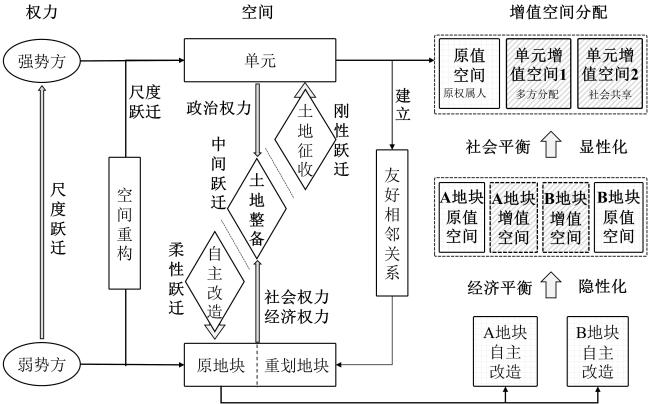
在存量土地再开发过程中,产生的新增价值(增值空间)分配的合理性,成为影响土地再开发运行效率的关键。从尺度重构视角,构建土地再开发增值空间分配研究框架,以广州海珠湾枢纽地区为例,对自主改造、土地征收和土地整备3种再开发模式,进行尺度跃迁观察,并剖析相应的增值空间分配成效及再开发项目推进情况。研究表明,柔性跃迁的自主改造与刚性跃迁的土地征收,均是基于经济平衡进行的增值空间分配,容易挤压为社会共享的单元增值空间,导致再开发工作难以推进。而中间跃迁的土地整备,通过权力与空间的适配调整,以“储改结合”促进多方合作改造,以“单元”社会平衡为原则,促进增值空间分配的“显性化”,保障为社会共享的单元增值空间。基于此,提出土地再开发增值空间分配合理化的路径,包括:构建上级政府权威的土地整备统筹机制,构建成片连片的土地整备单元载体,构建社会平衡的显性化分配机制。
何冬华 , 杜金莹 , 刘玉亭 , 杨恒 , 赵楠楠 . 尺度重构视角下的土地再开发增值空间分配[J]. 热带地理, 2022 , 42(4) : 509 -518 . DOI: 10.13284/j.cnki.rddl.003468
The key factor that influences the progress and operational efficiency of a reserved land redevelopment program is the rationality of land value increment allocation. Scaling-up has become a type of spatial governance instrument. During land redevelopment, there are three types of scaling-up statuses: self-transformation as flexible scaling-up, land acquisition as rigid scaling-up, and land consolidation as medium scaling-up. This paper establishes a framework for research on land value increment allocation in land redevelopment from the perspective of rescaling, taking Guangzhou Haizhu Bay Transport Hub and its surroundings as a case study. Three redevelopment pattern types (self-transformation, land acquisition, and land consolidation) were observed based on the scope of scaling-up, the effectiveness of land value increment allocation, and progress of redevelopment programs under different scaling-up models. On a plot with single ownership, flexible scaling-up can be regarded as a financially oriented self-transformation. The non-transparent mechanism of land value increment allocation is likely to squeeze society-shared benefits derived from land appreciation of a "unit", which tends to make it difficult to promote self-transformation programs. Rigid scaling-up can be considered as land acquisition under government control. It focuses on land as a "unit" and financial balance, compiling land acquisition and banking proposals. The powers of multiple stakeholders are not equal during the processes of land acquisition. The non-transparent allocation mechanism of land value increments, led by the local government, is likely to induce new conflict from original landowners, leading to impediments of such programs. In medium scaling-up, land consolidation is based on interactions among the multiple stakeholders. It satisfies practical demands of land redevelopment programs by coordinating interrelationships between power and space. The "banking-transforming" land consolidation approach promotes cooperation on land redevelopment among the multiple stakeholders, and synergistic value-added effects can be attained. The establishment of transparent mechanisms aims to improve fairness and rationality in land value increment allocation, achieving balance between societal and financial benefits in a "unit", and guaranteeing its land supply. This paper proposes three rational paths for land value increment allocation in land redevelopment. From the point of power, it establishes a coordinated mechanism of land consolidation based on authoritativeness of upper governments. From the point of space, it constructs a carrier for a land consolidation "unit". On the aspect of land value increment allocation, it builds up a transparent mechanism with societal-financial benefit balance. In further study on land redevelopment, more attention should be paid to utilizing scaling-up instruments rationally, to transforming space reconstruction patterns, and to innovating transparent allocation mechanisms for land value increments. This application of rescaling theory provides a reference to practical programs for improving the efficiency of land redevelopment, and for promoting area integral high-quality development.
表 1 海珠湾枢纽地区再开发尺度跃迁与增值空间分配Table 1 Scaling-up and land value increment allocation of redevelopment in the Haizhu Bay |
| 模式 | 尺度 跃迁 | 时间 | 主体 | 尺度跃迁 | 尺度跃迁行动 | 再开发项目 开展情况 | 增值空间 分配方式 | 增值空间分配 |
|---|---|---|---|---|---|---|---|---|
| 自主 改造 | 柔性 跃迁 | 2011—2019年 | 旧村原土地 权属人 | 社会与经济权力跃迁 | 沥滘村引进社会资本 | 历时8年启动 开发建设 | 隐性化的 “地块”经济 平衡 | 挤压为社会共享的单元增值空间2 |
| 2015年 | 广州市JT集团 | 基于政府的信任,启动三滘立交地块的控规调整 | 未得到实质性开发 | |||||
| 2020年 | 旧厂原土地 权属人 | 通过市政协委员,对大干围化工仓库地块提出改造意向 | 未能成功开发 | |||||
| 土地 征收 | 刚性 跃迁 | 2013年 | 区政府 | 强势政治权力介入的“单元”征收储备方案 | 对“越秀·天悦湾”地块等周边进行收储与开发 | 获得很高的土地财政 | 隐性化的“单元”经济平衡 | 挤压为社会共享的单元增值空间2 |
| 2016年 | 区政府 | 将片区规划为“商业商务中心” | 区政府妥协,划为“规划待定区” | |||||
| 土地 整备 | 中间 跃迁 | 2019 | 广州市JT集团 | 权力与空间的适配调整 | 市国资委将广州市GJ集团土地无偿划转;市级政府部门主导实施土地整备工作 | 海珠湾过江隧道重点工程顺利落地 | 显性化的“单元”社会平衡 | 保障为社会共享的单元增值空间2 |

1 2010年初广州市“三旧”改造办公室(简称广州市“三旧”办)挂牌成立,2015年2月广州市城市更新局正式挂牌成立,2019年机构改革后组建广州市规划和自然资源局,原广州市城市更新局的大部分职能划转至广州市住房和城乡建设局,广州市规划和自然资源局只保留城市更新有关的用地与控规相关职能。
何冬华:论文选题,论文设计,提出论文研究方法,制图,论文撰写与修改;
杜金莹:数据收集,论文撰写及修改;
刘玉亭:指导研究过程,提出修改意见,提升论文质量等;
杨 恒:参与论文案例的规划设计项目;
赵楠楠:参与尺度重构综述的资料收集与撰写。
|
陈易. 2018. 后增长主义时期社区社企合作空间治理模式的思考. 规划师,34(6):12-18. [Chen Yi. 2018. Community Public Private Cooperation in Post Growth Supremacism. Planner, 34(6): 12-18.]
|
|
邓毛颖,邓策方. 2021. 利益统筹视角下的城市更新实施路径——以广州城中村改造为例. 热带地理,41(4):760-768. [Deng Maoying and Deng Cefang. 2021. Assessment of the Implementation Path of Urban Renewal from the Perspective of Interest Coordination: A Case Study on Guangzhou Urban Village Redevelopment. Tropical Geography, 41(4): 760-768.]
|
|
郭淑芬,郭金花,赵国浩. 2019. 县域创新水平时空跃迁路径与趋同演化规律分析——基于山西省县级尺度专利数据的证据. 科技进步与对策,36(4):50-57. [Guo Shufen, Guo Jinhua and Zhao Guohao. 2019. The Analysis of Spatial and Temporal Transition Paths and Convergence Evolution of County Innovation Level Evidence-Based on the Patent Data of County Scale in Shanxi Province. Science &Technology Progress and Policy, 36(4): 50-57.]
|
|
贺辉文,廖远涛,安东琪. 2018. 尺度调整的第三条道路——广州空港地区的空间治理实践//中国城市规划学会,杭州市人民政府. 共享与品质——2018中国城市规划年会论文集(12城乡治理与政策研究). 杭州:中国城市规划学会. [He Huiwen, Liao Yuantao and An Dongqi. 2018. The Third Way of Scale Adjustment-The Practice of Spatial Governance in Guangzhou Airport Area. In: China Urban Planning Society and Hangzhou Municipal People's Government. Sharing and Quality-Proceedings of 2018 China Urban Planning Annual Conference (12 Urban and Rural Governance and Policy Research). Hangzhou: China Urban Planning Society.]
|
|
后雪峰,陶伟. 2021. 西方尺度研究进展:概念化框架、实践路径及启示. 热带地理,41(5):881-891. [Hou Xuefeng and Tao Wei. 2021. Progress of Western Scale Research: Conceptualization Framework, Practice Approach and Enlightenment. Tropical Geography, 41 (5): 881-891.]
|
|
黄柔柔,洪世键. 2020.“空间—权力”动态匹配:尺度跃迁视野下珠三角地方政区空间治理模式与变革展望. 公共行政评论,13(4):41-57,205-206. [Huang Rourou and Hong Shijian. 2020.'Space-Power' Dynamic Matching: Spatial Governance Patterns and Prospects of Local Governments in the Pearl River Delta from the Perspective of Scaling-Up. Public Administration Review, 13(4): 41-57, 205-206.]
|
|
刘金程,赵燕菁. 2021. 旧城更新:成片改造还是自主更新?——以厦门湖滨片区改造为例. 城市发展研究,28(3):1-6. [Liu Jincheng and Zhao Yanjing. 2021. Urban Renewal: Reconstruction or Self-Renewal?—A Case Study of Xiamen Lakeside Transformation. Urban Development Studies, 28(3): 1-6.]
|
|
刘媛. 2018. 广州市“城中村”自主改造模式下的风险管理研究. 广州:广州大学. [Liu Yuan. 2018. Research on the Risk Management of Urban and Rural Transformation on the Self-Transformation Mode in Guangzhou. Guangzhou: Guangzhou University.]
|
|
Smith N. 1990. Uneven Development: Nature, Capital, and the Production of Space. Oxford: Basil Blackwell.
|
|
Smith N. 1992. Contours of a Spatialized Politics: Homeless Vehicles and the Production of Geographical Scale. Social Text, 33: 54-81.
|
|
沈建法. 2006. 中国城市化与城市空间的再组织. 城市规划,(S1):36-40. [Shen Jianfa. 2006. Urbanization and Urban Space Reorganization in China. City Planning Review, (S1): 36-40.]
|
|
Taylor P J. 1982. A Materialist Framework for Political Geography. Transactions of the Institute of British Geographers, 7(1): 15-34.
|
|
王丰龙,刘云刚. 2017. 尺度政治理论框架. 地理科学进展,36(12):1500-1509. [Wang Fenglong and Liu Yungang. 2017. Towards a Theoretical Framework of 'Politics of Scale'. Progress in Geography, 36(12): 1500-1509.]
|
|
王吉勇. 2013. 分权下的多规合一——深圳新区发展历程与规划思考. 城市发展研究,20(1):23-29,48. [Wang Jiyong. 2013. Decentralization and Fragmentation: Development Stages and Trend of Metropolitan Area in China. Urban Development Studies, 20(1): 23-29, 48.]
|
|
吴军,孟谦. 2021a. 珠三角半城市化地区国土空间治理的困境与转型——基于土地综合整备的破解之道. 城市规划学刊,(3):66-73. [Wu Jun and Meng Qian. 2021a. The Dilemma and Paradigm Shift of Land Spatial Governance in Semi-Urbanized Areas of the Pearl River Delta. Urban Planning Forum, (3): 66-73.]
|
|
吴军,叶颖,陈嘉平. 2021b. 尺度重组视角下粤港澳大湾区同城化地区跨界治理机制研究——以广佛同城为例. 热带地理,41(4):723-733. [Wu Jun, Ye Ying and Chen Jiaping. 2021b. Cross-Border Governance Mechanism in the City Integration Areas of Guangdong-Hong Kong-Macao Greater Bay Area from the Perspective of Rescaling: A Case Study of Guangzhou-Foshan City Integration Area. Tropical Geography, 41(4): 723-733.]
|
|
杨廉,袁奇峰. 2010. 珠三角“三旧”改造中的土地整合模式——以佛山市南海区联滘地区为例. 城市规划学刊,(2):14-20. [Yang Lian and Yuan Qifeng. 2010. Research on Patterns of Land Integration in a Context of "San-Jiu" Reconstruction in Pearl River Delta Region: A Case Study of Lianjiao District in Nanhai, Foshan. Urban Planning Forum, (2): 14-20.]
|
|
叶林,杨宇泽. 2017. 中国城市行政区划调整的三重逻辑:一个研究述评. 公共行政评论,10(4):158-178,196. [Ye Lin and Yang Yuze. 2017. The Three Logics of Chinese Urban Administrative Divisions Adjustments: A Literature Review. Public Administration Review, 10(4): 158-178, 196.]
|
|
张践祚,李贵才,王超. 2016. 尺度重构视角下行政区划演变的动力机制——以广东省为例. 人文地理,31(2):74-82. [Zhang Jianzuo, Li Guicai and Wang Chao. 2016. Dynamic Mechanism of Administrative Division Adjustment Under the Context of Scale Rescaling: The Case of Guangdong Province. Human Geography, 31(2): 74-82.]
|
|
张京祥,王旭. 2012. 内生型城市营销推动下的城市尺度跃迁——基于盱眙的实证研究. 城市规划学刊,(2):33-38. [Zhang Jingxiang and Wang Xu. 2012.The Scaling up of Cities in the Process of Endogenous City Marketing—A Case Study of Xuyi County. Urban Planning Forum, (2): 33-38.]
|
|
周武夫,谢继昌. 2014. 有机更新视角下城镇低效用地再开发思路——以温州为例. 规划师,30(S3):203-207. [Zhou Wufu and Xie Jichang. 2014. The Inefficient Land Redevelopment in the Organic Renewal View: Wenzhou Case. Planner, 30(S3): 203-207.]
|
/
| 〈 |
|
〉 |