“流空间”视角下中国电子商务快递物流网络结构与机理
|
李苑君(1995—),女,湖北襄阳人,助理研究员,博士,研究方向为交通流网络,(E-mail)geoliyuanjun@gdas.ac.cn; |
收稿日期: 2023-01-18
修回日期: 2023-03-21
网络出版日期: 2023-05-08
基金资助
国家自然科学基金项目(42071165)
广东省科学院打造综合产业技术创新中心行动资金项目(2023GDASZH-2023010101)
Exploring the Structure and Mechanism of China's E-Commerce Express Logistics Network: Based on Space of Flows
Received date: 2023-01-18
Revised date: 2023-03-21
Online published: 2023-05-08
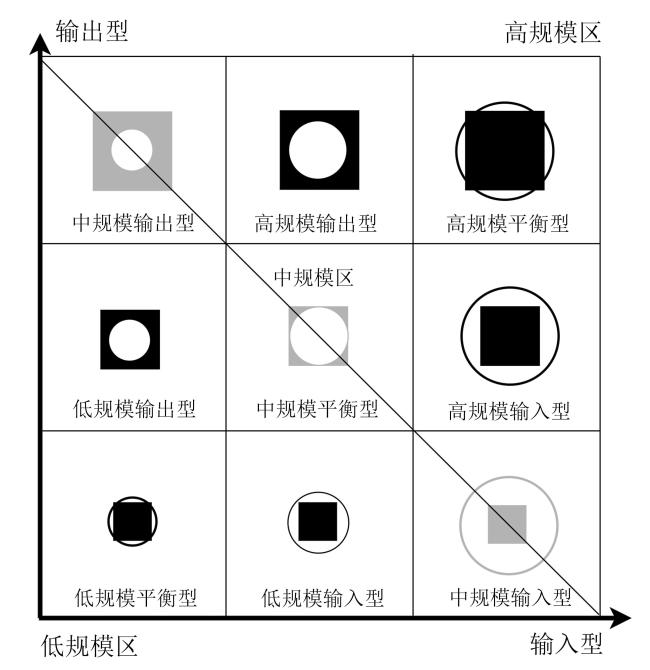
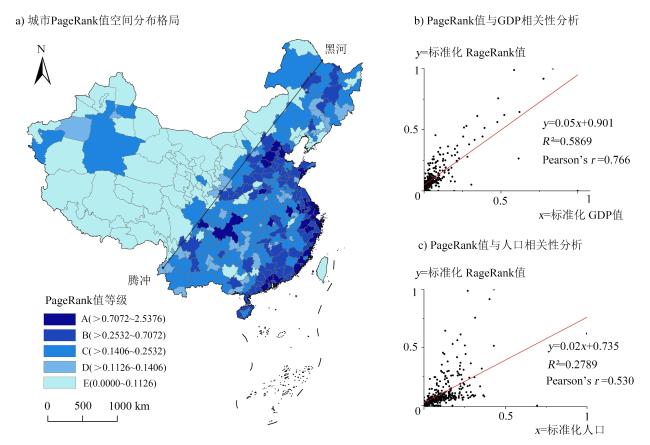
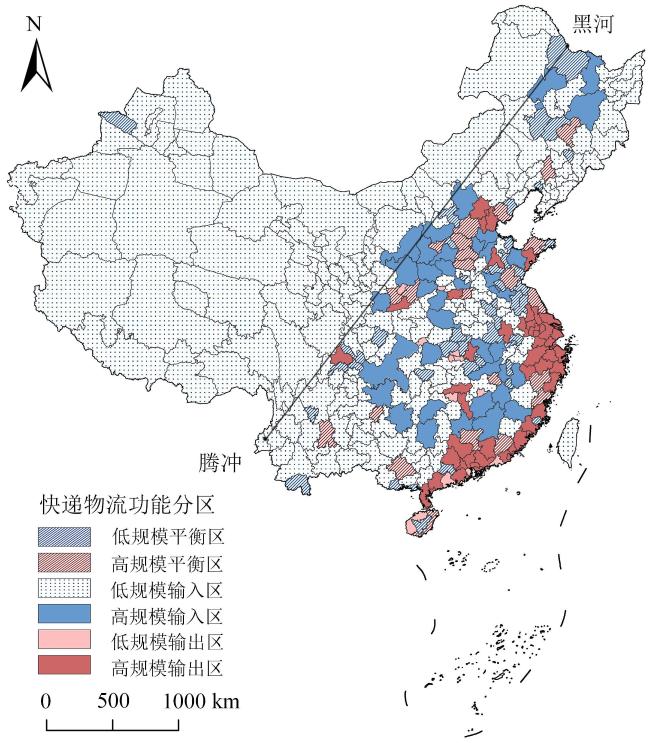
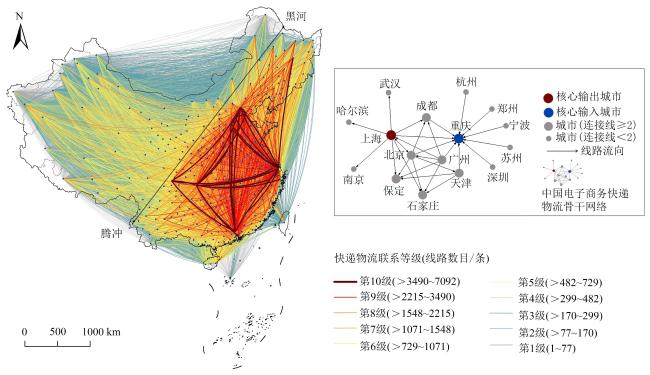
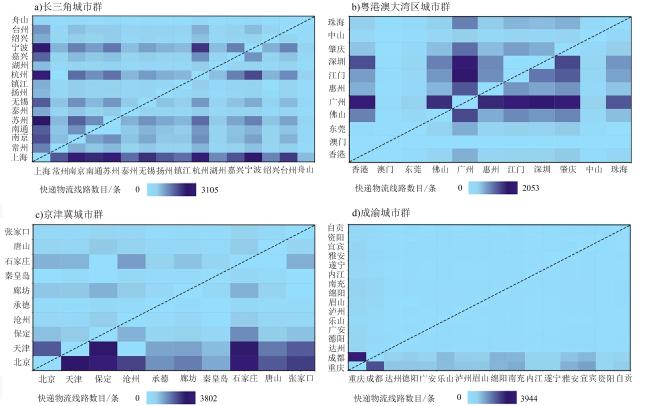
基于“流空间”理论,利用中国智能物流骨干网大数据构建电子商务快递物流网络,采用复杂网络分析、机器学习算法等,探究电商快递物流网络空间结构特征,分析快递物流要素空间流动规律性,揭示网络形成机理。研究发现:1)城市电商快递物流重要性的空间非均衡特征显著,重要性最高的城市分布于胡线以东四大城市群内部。随机森林结果显示,快递物流外向输出型城市在东南沿海形成“电商快递物流输出带”,澳门和台湾分别以小规模接收京津冀、长三角城市群的快递物流输入为主,香港作为快递物流高平衡区在网络中承担着重要的物流集散功能。2)电商快递物流网络覆盖范围广泛,城市间快递物流线路较为完整,且网络具有小世界效应,要素流动效率较高。网络中的优势流以上海、广州、重庆和北京为核心形成“钻石结构”。3)长三角城市群电商快递物流发展较为均衡;京津冀和成渝城市群对内部核心城市依赖性较强;粤港澳大湾区城市群的网络凝聚力最低,香港、澳门与珠三角9市之间的快递物流联系较为薄弱。4)物流网络形成受城市群发展影响,在信息技术、传统与新型基础设施建设等推动下,网络对距离因素依赖性较弱,快递物流要素主要遵循等级扩散机制。
李苑君 , 吴旗韬 , 李苑庭 , 梁木新 , 武俊强 , 金双泉 . “流空间”视角下中国电子商务快递物流网络结构与机理[J]. 热带地理, 2023 , 43(4) : 657 -668 . DOI: 10.13284/j.cnki.rddl.003671
Based on the space of flows theory, this study adopts China Smart Logistics Network big data to build China's e-commerce express logistics network, and explores the spatial structure characteristics of the e-commerce express logistics network, summarizes the regularity of the express logistics flows, finally reveals the formation mechanism of the network through complex network analysis, machine learning algorithms and other methods. The results are as follows: From the node dimension,the spatial inequality characteristics of the importance of e-commerce express logistics in Chinese cities are significant. Taking Heihe-Tengchong Line(Hu Line) as the boundary, the most important cities in the network are distributed within the four major urban agglomerations east of the boundary. The results based on random forest method show that express logistics export-oriented cities form the "e-commerce express logistics export belt" in the southeast coast. Macau and Taiwan receive express logistics input from Beijing-Tianjin-Hebei Urban Agglomeration and Yangtze River Delta Urban Agglomeration respectively on a small scale while Hong Kong plays an important role in logistics distribution function in the network as a high-equilibrium express logistics area. Additionally, from the dimensions of edges and overall network, the network density value is 0.927 0, and the average least connections value is 1.1375, indicating a wide network coverage and relatively complete express logistics routes between cities. Besides, China's e-commerce express logistics network has a small-world effect and high efficiency of the factor flows. A diamond-structured network is also formed with Shanghai, Guangzhou, Chongqing, and Beijing as the four core nodes. In comparison, the Yangtze River Delta Urban Agglomeration is more balanced in the development of e-commerce express logistics; Beijing-Tianjin-Hebei and Chengdu-Chongqing Urban Agglomerations are more dependent on the internal core cities; Guangdong-Hong Kong-Macao Greater Bay Area has the lowest network cohesion, and the express logistics links among Hong Kong, Macao and the other nine cities in the Pearl River Delta are weak. Overall, the network formation is influenced by the development of urban agglomerations. Driven by information technology, traditional and new infrastructure construction, etc., the network is less dependent on the distance factor. Express logistics elements mainly follow the hierarchical diffusion mechanism. This research expands the application of logistics big data in the field of urban network research, reveals the structural characteristics and formation mechanism of China's e-commerce express logistics network, helps enrich the theory of "space of flows", and is also of great significance for understanding the city correlation under the digital economy and the shaping of urban space by modern logistics elements, and promoting the digital transformation and high-quality development of express logistics.

1 https://x56.1688.com/
李苑君:负责物流大数据处理、中国地图绘制和文稿写作;
吴旗韬:负责快递物流“流空间”理论总结,提供基金资助;
李苑庭:负责部分图集绘制、快递物流网络分析、论文格式调整和文本校正;
梁木新:负责图表英文标题、英文摘要的写作和校正;
武俊强:负责PageRank、随机森林、KPP-Pos机器学习算法的程序编译;
金双泉:提供数据处理指导和文本润色。
|
Akhavan M, Ghiara H, Mariotti I, and Sillig C. 2020. Logistics Global Network Connectivity and Its Determinants. A European City Network Analysis. Journal of Transport Geography, 82: 102624.
|
|
安頔,胡映洁,万勇. 2022. 中国城市信息流网络空间结构特征研究——基于降噪处理与有向网络分析方法. 世界地理研究,1-17.(2022-07-19)[2023-01-05]. http://kns.cnki.net/kcms/detail/31.1626.p.20220718.1534.002.html.
An Di, Hu Yingjie, and Wan Yong. 2022. Analysis on Characteristics of Urban Information Network Structure in China: A Method Based on Denoising and Directed Network. World Regional Studies, 1-17.(2022-07-19)[2023-01-05]. http://kns.cnki.net/kcms/detail/31.1626.p.20220718.1534.002.html.
|
|
Borgatti S P. 2006. Identifying Sets of Key Players in a Social Network. Computational & Mathematical Organization Theory, 12(1): 21-34.
|
|
Castells M. 1999. Grassrooting the Space of Flows. Urban Geography, 20(4): 294-302.
|
|
Doran D, and Fox A. 2016. Operationalizing Central Place and Central Flow Theory with Mobile Phone Data. Annals of Data Science, 3(1): 1-24.
|
|
方匡南,吴见彬,朱建平,谢邦昌. 2011. 随机森林方法研究综述. 统计与信息论坛,26(3):32-38.
Fang Kuangnan, Wu Jianbin, Zhu Jianping, and Xie Bangchang. 2011. A Review of Technologies on Random Forests. Statistics&Information Forum, 26(3): 32-38.
|
|
冯春,芶韩丹,杨玄,郭倩芸. 2020. 基于复杂网络理论的快递网络脆弱性分析. 交通运输工程与信息学报,18(1):9-15.
Feng Chun, Gou Handan, Yang Xuan, and Guo Qianyun. 2020. A Vulnerability Analysis of the Express Network Based on Complex Network Theory. Journal of Transportation Engineering and Information, 18(1): 9-15.
|
|
冯树民. 2019. 交通复杂网络方法. 北京:人民交通出版社股份有限公司.
Feng Shumin. 2019. Traffic Complex Network Method. Beijing: China Communications Press Co., Ltd.
|
|
高鑫,孙峰华,李山,谢利娟. 2018. 渤海海峡跨海通道建设对环渤海陆路物流网络格局的影响. 经济地理,38(11):141-149.
Gao Xin, Sun Fenghua, Li Shan, and Xie Lijuan. 2018. Influence of the Construction of the Bohai Strait Cross-Sea Channel to the Land Logistics Network Pattern in the Bohai Rim Region. Economic Geography, 38(11): 141-149.
|
|
Ghaffari-Nasab N, Ghazanfari M, and Teimoury E. 2015. Hub-And-Spoke Logistics Network Design for Third Party Logistics Service Providers. International Journal of Management Science and Engineering Management, 11(1): 49-61.
|
|
龚亚男,魏宗财,刘玉亭. 2021. 广州市保障房住区居民网购行为特征及其影响因素. 经济地理,41(4):74-81.
Gong Yanan, Wei Zongcai, and Liu Yuting. 2021. Online Consumption Behavior Characteristics of the Affordable Housing Residents and Their Influencing Factors in Guangzhou. Economic Geography, 41(4): 74-81.
|
|
郭建科,喻铄琪. 2022. 中国沿海港口物流网络空间结构演化及其影响因素. 热带地理,42(10):1640-1650.
Guo Jianke, and Yu Shuoqi. 2022. Evolution of the Spatial Structure of Coastal Port Logistics Network and Its Influencing Factors in China. Tropical Geography, 42(10): 1640-1650.
|
|
黄雨珊,李钢,金安楠,于悦. 2021. 社区化新零售末端物流网络的对接与优化——以深圳市盒马鲜生与菜鸟驿站为例. 地理研究,40(9):2542-2557.
Huang Yushan, Li Gang, Jin Annan, and Yu Yue. 2021. Connection Modeling and Optimization Strategies of Terminal Logistics Network of Community-Oriented New Retail Stores: A Case Study of Freshippo Stores and Cainiao Stations in Shenzhen City. Geographical Research, 40(9): 2542-2557.
|
|
Kashiwagi K, Yamna E, and Arfa L. 2020. Growing Olive Oil Export and Intra-Industry Trade in Mediterranean Countries: Application of Gravity Model. Sustainability, 12(17): 7027.
|
|
柯文前,陆玉麒,陈伟,丁毅辉,杨青. 2016. 高速交通网络时空结构的阶段性演进及理论模型——以江苏省高速公路交通流网络为例. 地理学报,71(2):281-292.
Ke Wenqian, Lu Yuqi, Chen Wei, Ding Yihui, and Yang Qing. 2016. Evolutionary Stages and Theoretical Model of High-Speed Traffic Network Spatio-Temporal Structure: A Case Study of Expressway Traffic Flow Network in Jiangsu Province. Acta Geographica Sinica, 71(2): 281-292.
|
|
李鲁奇,马学广. 2019. 基于运单数据的中国快递型物流网络格局、结构与功能——以宅急送为例. 地理科学,39(1):89-97.
Li Luqi, and Ma Xueguang. 2019. Pattern, Structure and Function of China's Express Logistics Network Based on Waybill Data: A Case Study of ZJS Express. Scientia Geographica Sinica, 39(1): 89-97.
|
|
李苑君,吴旗韬,张玉玲,吴康敏,张虹鸥,金双泉. 2021. 中国三大城市群电子商务快递物流网络空间结构及其形成机制研究. 地理科学,41(8):1398-1408.
Li Yuanjun, Wu Qitao, Zhang Yulin, Wu Kangmin, Zhang Hong'ou, and Jin Shuangquan. 2021. Spatial Structure and Formation Mechanism of E-Commerce Express Logistics Network in the Three Major Urban Agglomerations of China. Scientia Geographica Sinica, 41(8): 1398-1408.
|
|
刘荷,王健. 2014. 基于轴辐理论的区域物流网络构建及实证研究. 经济地理,34(2):108-113.
Liu He, and Wang Jian. 2014. The Construction of Regional Logistics Networks and Its Empirical Research Based on Hub-and-Spoke Theory. Economic Geography, 34(2): 108-113.
|
|
倪玲霖,王姣娥,胡浩. 2012. 中国快递企业的空间组织研究——以顺丰速运为例. 经济地理,32(2):82-88,159.
Ni Linglin, Wang Jiao'e, and Hu Hao. 2012. Spatial Organization of Express Delivery Enterprise in China: A Case Study of Shunfeng Express. Economic Geography, 32(2): 82-88, 159.
|
|
Prajapati D, Kumar M M, Pratap S, Chelladurai H, and Zuhair M. 2021. Sustainable Logistics Network Design for Delivery Operations with Time Horizons in B2B E-Commerce Platform. Logistics, 5(3): 61.
|
|
任梦瑶,肖作鹏,王缉宪. 2020. 中国城际专线物流网络空间格局. 地理学报,75(4):820-832.
Ren Mengyao, Xiao Zuopeng, and Wang James J. 2020. Spatial Pattern of Intercity Less-Than-Truckload Logistics Networks in China. Acta Geographica Sinica, 75(4): 820-832.
|
|
沈丽珍,席广亮,秦萧,汪侠. 2018. 基于快递物流测度的区域流动空间特征——以江苏省为例. 人文地理,33(1):102-108.
Shen Lizhen, Xi Guangliang, Qin Xiao, and Wang Xia. 2018. The Research on the Characteristics of the Regional Space of Flows Based on Measurement of the Express Logistic of Flows: A Case Study of Jiangsu Province. Human Geography, 33(1): 102-108.
|
|
唐承辉,马学广. 2020. 中国城市网络化物流联系空间格局与结构——基于快递网点数据的研究. 地理科学进展,39(11):1809-1821.
Tang Chenghui, and Ma Xueguang. 2020. Spatial Pattern and Structure of Networked Logistics Connection of Cities in China Based on Express Logistics Branch Data. Progress in Geography, 39(11): 1809-1821.
|
|
Taylor P J, Hoyler M, and Verbruggen R. 2010. External Urban Relational Process: Introducing Central Flow Theory to Complement Central Place Theory. Urban Studies, 47(13): 2803-2818.
|
|
王成金. 2008. 中国物流企业的空间组织网络. 地理学报,63(2):135-146.
Wang Chengjin. 2018. Spatial Organizational Network of Logistic Company in China. Acta Geographica Sinica, 63(2): 135-146.
|
|
王姣娥,杜德林,金凤君. 2019. 多元交通流视角下的空间级联系统比较与地理空间约束. 地理学报,74(12):2482-2494.
Wang Jiao'e, Du Delin, and Jin Fengjun. 2019. Comparison of Spatial Structure and Linkage Systems and Geographic Constraints: A Perspective of Multiple Traffic Flows. Acta Geographica Sinica, 74(12): 2482-2494.
|
|
魏冶,修春亮,王绮,杨开先. 2018. 中国春运人口流动网络的富人俱乐部现象与不平衡性分析. 人文地理,33(2):124-129.
Wei Ye, Xiu Chunliang, Wang Qi, and Yang Kaixian. 2018. Rich-Club Phenomenon and Disequilibrium of China's Population Flow Network during Spring Festival Travel Period. Human Geography, 33(2): 124-129.
|
|
吴康,方创琳,赵渺希. 2015. 中国城市网络的空间组织及其复杂性结构特征. 地理研究,34(4):711-728.
Wu Kang, Fang Chuanglin, and Zhao Miaoxi. 2015. The Spatial Organization and Structure Complexity of Chinese Intercity Networks. Geographical Research, 34(4): 711-728.
|
|
吴自强. 2015. 生鲜农产品网购意愿影响因素的实证分析. 统计与决策,(20):100-103.
Wu Ziqiang. 2015. An Empirical Analysis of the Factors Influencing the Willingness to Purchase Fresh Produce Online. Statistics & Decision, (20): 100-103.
|
|
伍景琼,贺海艳,苏娜,邓荣莉. 2019. 云南省水果产业空间格局及其物流网络设计. 经济地理,39(5):135-142.
Wu Jingqiong, He Haiyan, Su Na, and Deng Rongli. 2019. The Spatial Pattern of Fruit Industry and Its Logistics Network Design in Yunnan Province. Economic Geography, 39(5): 135-142.
|
|
肖作鹏,王缉宪,孙永海. 2015. 网络零售对物流供应链的重组效应及其空间影响. 经济地理,35(12):98-104.
Xiao Zuopeng, Wang Jixian, and Sun Yonghai. 2015. The Geographical Impact of E-Retailing and Supply Chain Reconfiguration. Economic Geography, 35(12): 98-104.
|
|
肖作鹏,邹海翔,孙永海. 2017. 利用货车GPS数据推演城市内部物流联系——以深圳市为例. 西部人居环境学刊,32(1):9-15.
Xiao Zuopeng, Zou Haixiang, and Sun Yonghai. 2017. Using GPS Data to Visualize the Intra-City Freight Mobility: The Case of Shenzhen. Journal of Human Settlements in West China, 32(1): 9-15.
|
|
修春亮,孙平军,王绮. 2013. 沈阳市居住就业结构的地理空间和流空间分析. 地理学报,68(8):1110-1118.
Xiu Chunliang, Sun Pingjun, and Wang Qi. 2013. Residence-Employment Structure Analysis on Spaces of Geography and Flows in Shenyang City. Acta Geographica Sinica, 68(8): 1110-1118.
|
|
闫婧. 2019. 曼纽尔·卡斯特“流动的空间”思想研究. 上海:学林出版社. [Yan Jing. 2019. Study of Manuel Castel's Idea of Space of Flows. Shanghai: Academia Press.]
|
|
Zhang Weili, Chong Zhaohui, Li Xiaojian, and Nie Guibo. 2020. Spatial Patterns and Determinant Factors of Population Flow Networks in China: Analysis on Tencent Location Big Data. Cities, 99(C):102640
|
|
甄峰,李哲睿,谢智敏. 2022. 基于人口流动的城市内部空间结构特征及其影响因素分析——以南京市为例. 地理研究,41(6):1525-1539.
Zhen Feng, Li Zherui, and Xie Zhimin. 2022. Analysis of Urban Internal Spatial Structure Characteristics and Its Influencing Factors Based on Population Flow: A Case Study of Nanjing. Geographical Research, 41(6): 1525-1539.
|
|
中华人民共和国商务部. 2021.“十四五”电子商务发展规划.(2021-10-09)[2023-01-05]. http://dzsws.mofcom.gov.cn/ [Ministry of Commerce of the People's Republic. 2021. 14th Five-Year Plan (2021-2025) for E-Commerce Development. (2021-10-09)[2023-01-05]. http://dzsws.mofcom.gov.cn/.]
|
|
中华人民共和国商务部. 2022. 中国电子商务报告(2021). (2022-11-16)[2022-11-16] http://www.mofcom.gov.cn.
Ministry of Commerce of the People's Republic. 2022. E-Commerce in China (2021). (2022-11-16) [2022-11-16]. http://www.mofcom.gov.cn.
|
|
周建平,刘程军,徐维祥,李露,周梦瑶,侯和宏. 2021. 电子商务背景下快递企业物流网络结构及自组织效应——以中通快递为例. 经济地理,41(2):103-112.
Zhou Jianping, Liu Chengjun, Xu Weixiang, Li Lu, Zhou Mengyao, and Hou Hehong. 2021. Logistics Network Structure of Express Delivery Companies and Their Self-Organization Effect under the Background of E-Commerce: Taking ZTO Express as an Example. Economic Geography, 41(2): 103-112.
|
|
宗会明,吕瑞辉. 2020. 基于企业数据的中国汽车物流网络组织特征及影响因素分析. 世界地理研究,29(1):130-139.
Zong Huiming, and Lyu Ruihui. 2020. Organization Network of Chinese Automobile Logistics and Its Influencing Factors from the Perspective of enterprises data. World Regional Studies, 29(1): 130-139.
|
/
| 〈 |
|
〉 |