边际化背景下的耕地非粮化研究进展与展望
|
李升发(1986—),男,广东三水人,博士,副研究员,研究方向为土地利用与土地边际化,(E-mail)li_shengfa@126.com。 |
收稿日期: 2024-08-08
修回日期: 2025-01-18
网络出版日期: 2025-05-23
基金资助
国家自然科学基金(41930757)
广东省科学院打造综合产业技术创新中心行动资金项目(2023GDASZH-2023010101)
广州大学研究生创新能力培养项目(JCCX2024-033)
Research Progress and Prospects of Non-Grain Use of Cultivated Land in Marginalized Contexts
Received date: 2024-08-08
Revised date: 2025-01-18
Online published: 2025-05-23
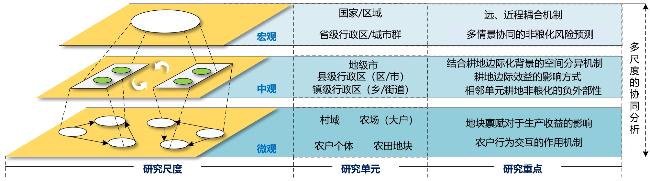
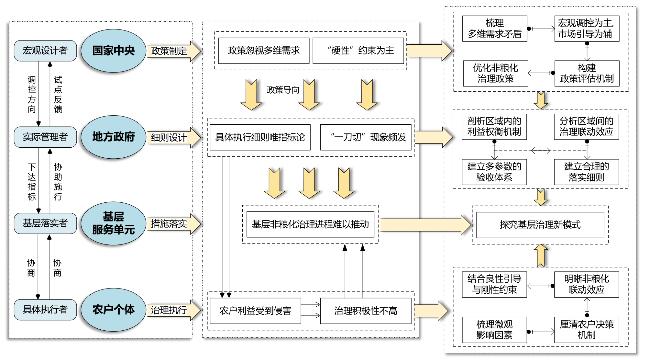
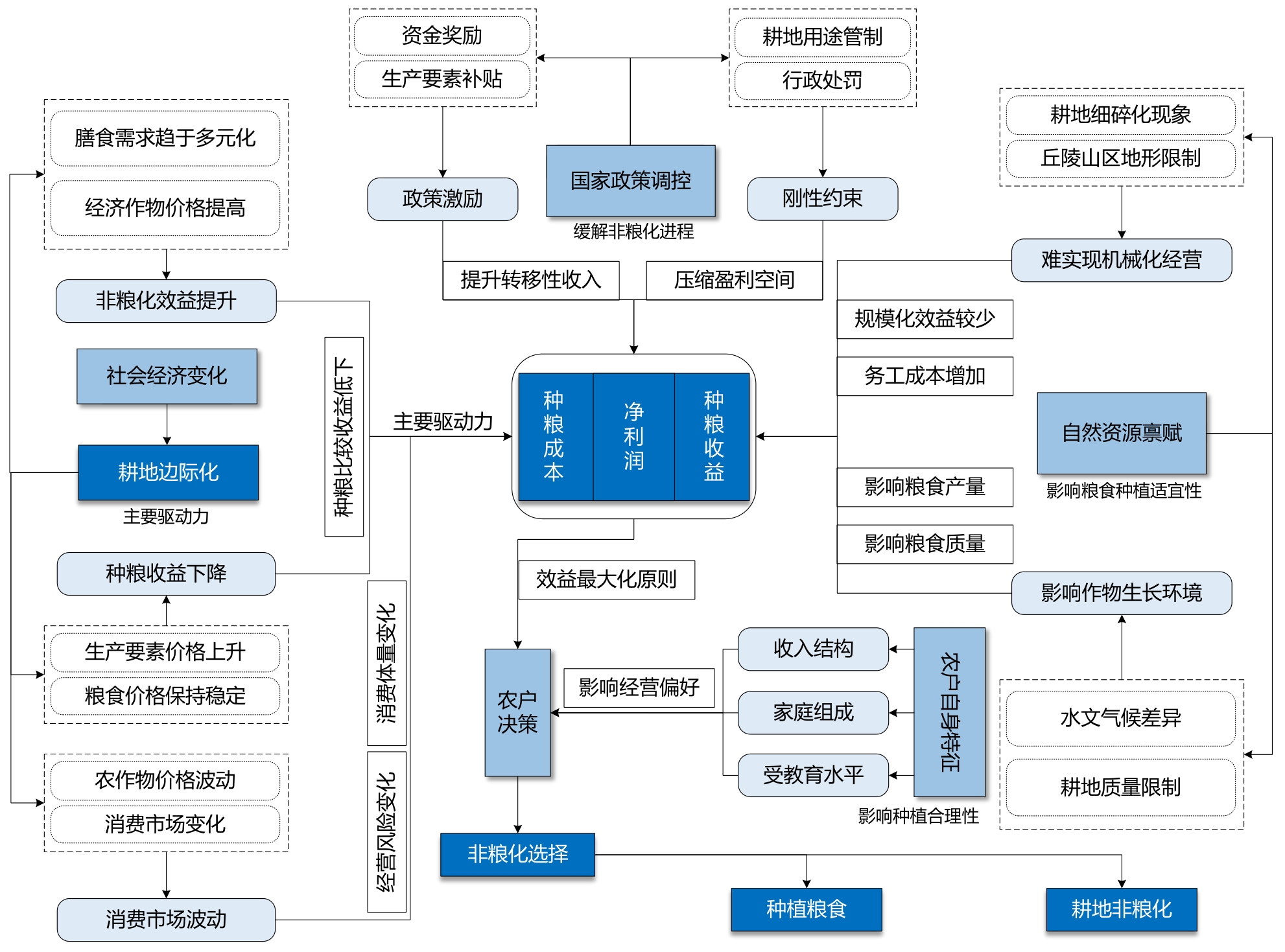
受劳动力成本快速上涨和种粮比较收益下降的影响,中国耕地非粮化现象日益显著。文章基于耕地边际化视角,在解析耕地非粮化发生理论的基础上,系统梳理耕地非粮化的研究进展,最后提出研究展望。研究表明:1)理论解析层面,耕地边际化理论明晰了耕地非粮化的核心驱动力与现实背景,在此背景下地租理论能解释非粮化区位的选择逻辑,农户行为理论阐述了农户特征差异会影响耕地非粮化的发生;2)耕地非粮化的定义不断演化与深化,现阶段仍主要以“粮作比”为测算指标,但该种测算方式存在一定局限性;3)在生产要素约束和政策激励下,非粮化程度呈现波动上升,并具有显著的空间分异特征,山区、粮食产销区与产销平衡区、城区与近郊区域属于耕地非粮化的多发区域;4)耕地边际化是耕地非粮化的主要驱动力,但耕地非粮化的发生还受到多因素综合影响,如自然禀赋会影响种植的适宜性、农户特征影响农户的非粮化需求程度、国家政策逐渐减缓耕地非粮化进程;5)耕地非粮化为生态环境、粮食安全与农民生计带来复杂的影响;6)用途管制是中国调控耕地非粮化的主要措施,但该措施的可持续性有待商榷。面对中国耕地边际化快速扩张的趋势和多元化食物供给体系构建的新要求,传统的耕地非粮化认知与研究范式亟需重构,需聚焦于多阶段、多尺度与多主体的协同分析,分别探讨耕地非粮化的演变过程、发生机制与治理模式等重点内容。
李升发 , 吴钊骏 , 吴大放 , 杜建会 , 林彤 , 马畅 , 高子雅 . 边际化背景下的耕地非粮化研究进展与展望[J]. 热带地理, 2025 , 45(5) : 758 -775 . DOI: 10.13284/j.cnki.rddl.20240524
Influenced by the rapid increase in labor costs and the decline in the comparative benefits of grain planting, the phenomenon of Non-Grain Use of Cultivated Land (NGUCL) in China has become increasingly prominent. Firstly, from the perspective of cultivated land marginalization, this study combines the theory of cultivated land marginalization, the theory of land rent, and the theory of farmers' behavior to jointly analyze the theoretical basis for the occurrence of NGUCL. Secondly, it systematically reviews the research progress regarding NGUCL, and finally presents prospects for future research. The study shows that: (1) At the level of theoretical analysis, the theory of cultivated land marginalization clarifies the core driving force and the realistic background of NGUCL. In the context of marginalization, the theory of land rent can explain the logic of choosing the location of NGUCL, and the theory of farmers' behavior can explain how differences in farmers' characteristics affect the occurrence of NGUCL. (2) The definition of NGUCL has been evolving and deepening, and at the present stage, the "food-crop ratio" is still the main indicator, but there are certain limitations in this way of measurement. (3) Under the constraints of production factors and policy incentives, the degree of NGUCL shows a fluctuating increase and is characterized by significant spatial differentiation. Among them, mountainous areas, food production and marketing zones, production and marketing balance zones, urban and peri-urban areas are among the areas in which NGUCL happens all the time. (4) While cultivated land marginalization is the main driving force of NGUCL, the occurrence of NGUCL is also affected by a combination of factors, such as natural endowment, which affects the appropriateness of cultivation, the characteristics of farmers, which affects the degree of farmers' demand for NGUCL, and national policies, which gradually slow down the process of NGUCL. (5) NGUCL has complex implications for ecosystems, food security and farmers' livelihoods. 6. The use control of cultivated land is the main measure in China to regulate NGUCL, but the sustainability of this measure is open to question. In the face of the rapid expansion of the cultivated land marginalization in China and the new requirements for the construction of a diversified food supply system, it is urgent to reconstruct the traditional cognition and research paradigm of NGUCL. In the future, we need to focus on the synergistic analysis of multi-stage, multi-scale and multi-subjects, and explore the evolution process, occurrence mechanism and governance mode of NGUCL.
表1 中国耕地非粮化演变历程Table 1 Evolution of non-grain production of cropland in China |
| 演变历程 | 持续时间 | 主要变化原因 | 主要特征 |
|---|---|---|---|
| “波动扩张” 阶段 | 1978—2004年 | 劳动力、耕地等农业要素约束与生产资料价格上升(王善高 等,2017; 罗必良 等,2018b;周维 等,2019),致使粮食生产效益下降。 | 非粮作物以蔬菜瓜果、油料、棉花为主(杜国明 等,2022) |
| “相对稳定” 阶段 | 2005—2016年 | 包括“减免”(农业税与特产税减免)、“补贴”(种粮、良种、农机补贴)和 “保障”(粮食最低保护价格、严格保护耕地、严控农资价格、增加农民 收入)(全世文,2022;邹金浪 等,2022)等政策调控有效地缓解了耕地 边际化影响,激励农户种植粮食。 | 粮食播种面积保持大致稳定(黄祖辉 等,2022) |
| “小幅上升” 阶段 | 2017年至今 | 土地流转市场化与居民膳食消费升级等多因素影响(叶思菁 等,2023; 靳卫东 等,2023;杨慧琳 等,2024),粮食生产与其他农业生产之间的 收益差距进一步扩大。 | 蔬菜、油类和瓜果的播种面积占比增加,蔬菜种植面积大幅扩张(孟菲 等,2022) |
1 原版出版时间为1978年,此处参考自中译本(雷利·巴洛维,1989)。
李升发:论文选题、整体框架设计与撰写;
吴钊骏:研究内容梳理与论文撰写;
吴大放:研究热点与研究思路梳理;
杜建会:论文撰写指导,提出修改建议;
林 彤:文献收集与梳理分析;
马 畅:论文校对与审稿意见修改;
高子雅:论文校对与检查。
|
Assa B S K. 2021. The Deforestation-Income Relationship: Evidence of Deforestation Convergence across Developing Countries. Environment and Development Economics, 26(2): 131-150.
|
|
毕雪昊,周佳宁,邹伟. 2020. 家庭劳动力约束下经营规模对农户种植结构选择的影响. 中国土地科学,34(12):68-77.
Bi Xuehao, Zhou Jianing, and Zou Wei. 2020. The Impact of Operating Scale on Farmers' Choice of Cropping Structure under Household Labor Constraints. China Land Sciences, 34(12): 68-77.
|
|
边天夏,王梦成,黄贤金,戴劲. 2023. 大食物观视角下耕地“非粮化”治理逻辑与策略. 规划师,39(11):14-19.
Bian Tianxia, Wang Mengcheng, Huang Xianjin, and Dai Jin. 2023. Governance Logic and Strategies of "Non-Grain" Cultivation on Cultivated Land from The Perspective of The Great Food Concept. Planners, 39(11): 14-19.
|
|
曹瑞芬,张安录,苑韶峰. 2023. 耕地保护财政转移支付制度体系重构——以浙江省新增建设用地使用费为例. 自然资源学报,38(7):1880-1895.
Cao Ruifen, Zhang Anlu, and Yuan Shaofeng. 2023. Reconstruction of the Fiscal Transfer Payment System for Cultivated Land Protection: A Case Study of The Newly-Added Construction Land Use Fee in Zhejiang Province. Journal of Natural Resources, 38(7): 1880-1895.
|
|
曹宇,李国煜,王嘉怡,方晓倩,孙凯颖. 2022. 耕地非粮化的系统认知与研究框架:从粮食安全到多维安全. 中国土地科学,36(3):1-12.
Cao Yu, Li Guoyu, Wang Jiayi, Fang Xiaoqian, and Sun Kaiying. 2022. Systematic Cognition and Research Framework of Non-Grain Cultivation of Cultivated Land: From Food Security to Multidimensional Security. China Land Sciences, 36(3): 1-12.
|
|
曹振. 2024. 耕地“非粮化”治理的实践困境及法治进路. 西北农林科技大学学报(社会科学版),24(2):43-53.
Cao Zhen. 2024. Practical Dilemmas and Legal Approaches in the Governance of "Non-Grain" Cultivation of Cultivated Land. Journal of Northwest A&F University (Social Science Edition), 24(2): 43-53.
|
|
陈浮,刘俊娜,常媛媛,张琦,于昊辰,张绍良. 2021. 中国耕地非粮化空间格局分异及驱动机制. 中国土地科学,35(9):33-43.
Chen Fu, Liu Junna, Chang Yuanyuan, Zhang Qi, Yu Haochen, and Zhang Shaoliang. 2021. Spatial Differentiation and Driving Mechanism of Non-Grain Cultivation of Cultivated Land in China. China Land Sciences, 35(9): 33-43.
|
|
陈菁,孔祥智. 2016. 土地经营规模对粮食生产的影响——基于中国十三个粮食主产区农户调查数据的分析. 河北学刊,36(3):122-128.
Chen Jing and Kong Xiangzhi. 2016. The Impact of Land Management Scale on Grain Production: An Analysis Based on Survey Data from Farmers in Thirteen Major Grain Producing Regions in China. Hebei Academic Journal, 36(3): 122-128.
|
|
陈美球. 2021. 耕地“非粮化”现象剖析与对策建议. 中国土地,(4):9-10.
Chen Meiqiu. 2021. Analysis and Countermeasures Suggestions on the Phenomenon of "Non-Grain" Cultivation of Cultivated Land. China Land, (4): 9-10.
|
|
Chen Qianru, Wu Manyu, Zeng Hongchen, and Luo Shilong. 2023. The Impact of Residents' Dietary Structure Upgrading on Non-Grain Cultivation of Cultivated Land. Journal of Resources and Ecology, 14(6): 1350-1360.
|
|
陈文广,廖宇波,孔祥斌,雷鸣,温良友,张蚌蚌. 2023. 基于地块尺度的永久基本农田非粮化特征、驱动与管控. 农业机械学报,54(6):114-124.
Chen Wenguang, Liao Yubo, Kong Xiangbin, Lei Ming, Wen Liangyou, and Zhang Bangbang. 2023. Characteristics, Driving Factors, and Management of Non-Grain Cultivation in Permanent Basic Farmland at the Parcel Scale. Transactions of the Chinese Society for Agricultural Machinery, 54(6): 114-124.
|
|
程宪波,刘琼,陶宇,刘敬杰,王飞,陶芹,欧维新. 2022. 快速城镇化地区的耕地非粮化特征及其机理. 中国人口·资源与环境,32(10):172-182.
Cheng Xianbo, Liu Qiong, Tao Yu, Liu Jingjie, Wang Fei, Tao Qin, and Ou Weixin. 2022. Characteristics and Mechanisms of Non-Grain Cultivation of Cultivated Land in Rapidly Urbanizing Areas. China Population, Resources and Environment, 32(10): 172-182.
|
|
仇童伟,彭嫦燕. 2023. 农业人口老龄化对农地配置与种粮决策的影响:来自中国家庭金融调查的证据. 中国农村观察,(4):129-150.
Qiu Tongwei and Peng Changyan. 2023. The Impact of Aging Agricultural Population on Farmland Allocation and Grain Cropping Decisions: Evidence from the China Household Finance Survey. China Rural Survey, (4): 129-150.
|
|
Czyżewski B and Matuszczak A. 2016. A New Land Rent Theory for Sustainable Agriculture. Land Use Policy, 55: 222-229.
|
|
D'andrimont R, Taymans M, Lemoine G, Ceglar A, Yordanov M, and Van Der Velde M. 2020. Detecting Flowering Phenology in Oil Seed Rape Parcels with Sentinel-1 and-2 Time Series. Remote Sensing of Environment, 239: 111660.
|
|
定光平,刘成武,黄利民. 2009. 惠农政策下丘陵山区农地边际化的理论分析与实证——以湖北省通城县为例. 地理研究,28(1):109-117.
Ding Guangping, Liu Chengwu, and Huang Limin. 2009. Theoretical Analysis and Empirical Study on the Marginalization of Farmland in Hilly and Mountainous Areas under Favorable Agricultural Policies: A Case Study of Tongcheng County, Hubei Province. Geographical Research, 28(1): 109-117.
|
|
董晓霞,黄季焜,Rozelle S,王红林. 2006. 地理区位、交通基础设施与种植业结构调整研究. 管理世界,(9):59-63,79.
Dong Xiaoxia, Huang Jikun, Rozelle Scott, and Wang Honglin. 2006. Research on the Impact of Geographic Location and Transportation Infrastructure on the Structural Adjustment of Planting Industry. Management World, (9): 59-63, 79.
|
|
杜国明,李宁宁,张娜,秦雯. 2022. 全国耕地“非粮化”时空格局分析. 东北农业大学学报(社会科学版),20(2):17-27.
Du Guoming, Li Ningning, Zhang Na, and Qin Wen. 2022. Spatio-Temporal Pattern Analysis of "Non-Grain Cultivation" of Cultivated Land Nationwide. Journal of Northeast Agricultural University (Social Science Edition), 20(2): 17-27.
|
|
杜蓉,柳思维,蔡荣. 2023. 中国粮食空间生产格局演变特征及其驱动机制. 经济问题,(8):92-102.
Du Rong, Liu Siwei, and Cai Rong. 2023. Characteristics of the Evolution of China's Grain Spatial Production Pattern and Its Driving Mechanism. Economic Issues, (8): 92-102.
|
|
樊志远,孙云舒. 2023. 论大食物观的科学内涵、价值意蕴与实践要求. 西北农林科技大学学报(社会科学版),23(6):68-75.
Fan Zhiyuan and Sun Yunshu. 2023. On the Scientific Connotation, Value Implications, and Practical Requirements of the Grand Food Concept. Journal of Northwest A&F University (Social Sciences Edition), 23(6): 68-75.
|
|
范乔希,应寿英. 2017. 丘陵区农户土地流转意愿调查——以重庆市为例. 调研世界,(8):32-37.
Fan Qiaoxi and Ying Shouying. 2017. A Survey on Farmers' Willingness to Transfer Land in Hilly Areas: A Case Study of Chongqing. Research World, (8): 32-37.
|
|
封志明,肖池伟,李鹏. 2017. 中国-东盟自由贸易区粮食生产与贸易的时空格局演变. 自然资源学报,32(6):937-950.
Feng Zhiming, Xiao Chiwei, and Li Peng. 2017. Evolution of Spatio-Temporal Patterns of Grain Production and Trade in the China-ASEAN Free Trade Area. Journal of Natural Resources, 32(6): 937-950.
|
|
冯应斌,杨溪源. 2023. 基于土地利用变化的贵州省耕地显性边际化时空演变及其影响因素. 水土保持通报,43(6):263-271.
Feng Yingbin and Yang Xiyuan. 2023. Spatio-Temporal Evolution and Influencing Factors of Explicit Marginalization of Cultivated Land in Guizhou Province Based on Land Use Change. Bulletin of Soil and Water Conservation, 43(6): 263-271.
|
|
国务院. 2020. 国务院办公厅关于防止耕地“非粮化”稳定粮食生产的意见. 国办发[2020]44号. (2020-11-17)[2025-05-12]. https://www.gov.cn/zhengce/content/2020-11/17/content_55620 53.htm.
State Council General Office. 2020. Opinions on Preventing the "Non-Grain" Production of Cultivated land and Stabilizing Grain Production. Guobanfa [2020] No.44.(2020-11-17)[2025-05-12]. https://www.gov.cn/zhengce/content/2020-11/17/content_5562053.htm.
|
|
国务院. 2021. 中华人民共和国土地管理法实施条例(2021年修订). 国令[2021]743号. (2021-07-30)[2025-05-12]. https://www.gov.cn/zhengce/content/2021-07/30/content_5628461.htm.[State Council of the People's Republic of China. 2021. Regulations for the Implementation of the Land Administration Law of the People's Republic of China (2021 Revision). State Council Order [2021] No.743. (2021-07-30)[2025-05-12]. https://www.gov.cn/zhengce/content/2021-07/30/content_562846 1.htm.]
|
|
高延雷,张正岩,王志刚. 2021. 农地转入、农户风险偏好与种植结构调整——基于CHFS微观数据的实证分析. 农业技术经济,(8):66-80.
Gao Yanlei, Zhang Zhengyan, and Wang Zhigang. 2021. Farmland Acquisition, Farmers' Risk Preferences, and Planting Structure Adjustment: An Empirical Analysis Based on Microdata from the China Household Finance Survey (CHFS). Agricultural Technology and Economics, (8): 66-80.
|
|
耿仲钟,肖海峰. 2018. 我国农业支持保护补贴效果与问题——基于浙江、山东两省调研. 地方财政研究,(4):80-86.
Geng Zhongzhong and Xiao Haifeng. 2018. The Effects and Issues of China's Agricultural Support and Protection Subsidies: Based on a Survey of Zhejiang and Shandong Provinces. Local Finance Research, (4): 80-86.
|
|
关鑫,魏琨翔,姜文来. 2025. 水-能源-粮食关联的中国粮食安全:保障能力、因素与趋势. 农林经济管理学报,24(1):13-23.
Guan Xin, Wei Kunxiang, and Jiang Wenlai. 2025. China's Food Security in the Context of Water-Energy-Food Nexus: Safeguarding Capacity, Factors, and Trends. Journal of Agriculture and Forestry Economics and Management, 24(1): 13-23.
|
|
官卫华,江璇,杨梦丽. 2023. 国土空间规划视角下农用地用途管制方法——以南京市为例. 城市规划学刊,(1):96-103.
Guan Weihua, Jiang Xuan, and Yang Mengli. 2023. Methods for Regulating the Use of Agricultural Land from the Perspective of Territorial Spatial Planning: A Case Study of Nanjing City. Urban Planning Forum, (1): 96-103.
|
|
郭耀辉,况嘉欣,杜兴端,刘宗敏,王永志. 2024. 中国西南地区粮食增产潜力、影响因素与策略研究. 资源开发与市场,40(6):843-850.
Guo Yaohui, Kuang Jiaxin, Du Xingduan, Liu Zongmin, and Wang Yongzhi. 2024. Grain Yield Increase Potential, Influencing Factors, and Strategies in Southwest China. Resource Development & Market, 40(6): 843-850.
|
|
韩振兴,常向阳. 2022. 劳动力成本上升、主产区优势与中国大豆种植面积变化——基于1991―2019年的省级面板数据. 农业现代化研究,43(2):296-305.
Han Zhenxing and Chang Xiangyang. 2022. Rising Labor Costs, Advantages of Main Producing Areas, and Changes in Soybean Cultivated Area in China: Based on Provincial Panel Data from 1991 to 2019. Research of Agricultural Modernization, 43(2): 296-305.
|
|
郝林钢,于静洁,王平,韩春辉. 2023. 面向可持续发展的水—能源—粮食纽带关系系统解析及其研究框架. 地理科学进展,42(1):173-184.
Hao Lingang, Yu Jingjie, Wang Ping, and Han Chunhui. 2023. Systematic Analysis and Research Framework of the Water-Energy-Food Nexus for Sustainable Development. Progress in Geography, 42(1): 173-184.
|
|
胡雪萍,史倩倩,向华丽. 2023. 中国农村劳动力人口变动趋势研究. 人口与经济,(2):27-44.
Hu Xueping, Shi Qianqian, and Xiang Huali. 2023. Research on the Changing Trends of Rural Labor Force Population in China. Population & Economics, (2): 27-44.
|
|
胡逸文,霍学喜. 2016. 农户禀赋对粮食生产技术效率的影响分析——基于河南农户粮食生产数据的实证. 经济经纬,33(2):42-47.
Hu Yiwen and Huo Xuexi. 2016. Analysis of the Impact of Farmer Households' Endowments on Technical Efficiency in Grain Production: An Empirical Study Based on Grain Production Data from Farmer Households in Henan Province. Economic Survey, 33(2): 42-47.
|
|
黄峰,杨晓琳,方瑜,王素芬,康绍忠. 2022. 适应水土资源条件的华北地区农业种植布局研究. 中国工程科学,24(5):89-96.
Huang Feng, Yang Xiaolin, Fang Yu, Wang Sufen, and Kang Shaozhong. 2022. Research on Agricultural Cropping Patterns in North China in Adaptation to Soil and Water Resources Conditions. Engineering Sciences, 24(5): 89-96.
|
|
黄利民,张安录,刘成武. 2008. 农地边际化进程理论和实证研究. 生态经济,(8):28-32.
Huang Limin, Zhang Anlu, and Liu Chengwu. 2008. Theoretical and Empirical Research on the Process of Agricultural Land Marginalization. Ecological Economy, (8): 28-32.
|
|
黄宗智,彭玉生. 2007. 三大历史性变迁的交汇与中国小规模农业的前景. 中国社会科学,(4):74-88,205-206.
Huang Zongzhi and Peng Yusheng. 2007. The Convergence of Three Major Historical Changes and the Prospects for Small-Scale Agriculture in China. Social Sciences in China, (4): 74-88, 205-206.
|
|
黄祖辉,李懿芸,毛晓红. 2022. 我国耕地“非农化”“非粮化”的现状与对策. 江淮论坛,(4):13-21.
Huang Zuhui, Li Yiyun, and Mao Xiaohong. 2022. The Current Situation and Countermeasures of "Non-agriculturalization" and "Non-grain Orientation" of Cultivated Land in China. Jianghuai Tribune, (4): 13-21.
|
|
黄祖辉,李懿芸,毛晓红. 2024. 我国乡村老龄化现状及其对粮食生产的影响与应对. 西北农林科技大学学报(社会科学版),24(2):35-42.
Huang Zuhui, Li Yiyun, and Mao Xiaohong. 2024. The Current Situation of Rural Aging in China and Its Impact on Grain Production, as Well as Corresponding Countermeasures. Journal of Northwest A&F University (Social Science Edition), 24(2): 35-42.
|
|
姜长云. 2015. 农户分化对粮食生产和种植行为选择的影响及政策思考. 理论探讨,(1):69-74.
Jiang Changyun. 2015. The Impact of Farmer Household Differentiation on Grain Production and Cropping Behavior Choices, and Policy Considerations. Theoretical Inquiry, (1): 69-74.
|
|
蒋和平,郭超然,蒋黎. 2020. 乡村振兴背景下我国农业产业的发展思路与政策建议. 农业经济与管理,(1):5-14.
Jiang Heping, Guo Chaoran, and Jiang Li. 2020. Development Ideas and Policy Suggestions for China's Agricultural Industry Against the Background of Rural Revitalization. Agricultural Economics and Management, (1): 5-14.
|
|
靳卫东,房芳,陈佩奇. 2023. 土地流转有助于提升粮食安全吗——基于土地经营方式转变的分析. 中国地质大学学报(社会科学版),23(4):105-121.
Jin Weidong, Fang Fang, and Chen Peiqi. 2023. Does Land Circulation Contribute to Enhancing Food Security?—An Analysis Based on the Transformation of Land Management Practices. Journal of China University of Geosciences (Social Sciences Edition), 23(4): 105-121.
|
|
李冰强,张小康. 2024. 耕地保护补偿制度的定位反思与规范重构. 中国土地科学,38(3):10-17,70.
Li Bingqiang and Zhang Xiaokang. 2024. Reflection on the Positioning and Normative Reconstruction of the Farmland Protection Compensation System. China Land Sciences, 38(3): 10-17, 70.
|
|
李超,程锋. 2021. “非粮化”对耕作层破坏的认定问题思考. 中国土地,(7):12-14.
Li Chao and Cheng Feng. 2021. Thoughts on the Identification of Cultivated Layer Damage Caused by "Non-Grain Cultivation". China Land, (7): 12-14.
|
|
李俊高,李萍. 2016. 我国农地撂荒及其分类治理:基于马克思地租理论的拓展分析. 财经科学,(12):47-54.
Li Jungao and Li Ping. 2016. Abandoned Farmland in China and Its Classified Governance: An Expanded Analysis Based on Marx's Theory of Land Rent. Finance & Economics, 12: 47-54.
|
|
李升发,李秀彬. 2016. 耕地撂荒研究进展与展望. 地理学报,71(3):20.
Li Shengfa and Li Xiubin. 2016. Research Progress and Prospects on Cultivated Land Abandonment. Acta Geographica Sinica, 71(3): 20.
|
|
李升发,李秀彬. 2018. 中国山区耕地利用边际化表现及其机理. 地理学报,73(5):803-817.
Li Shengfa and Li Xiubin. 2018. Marginalization of Cultivated Land Use in Mountainous Regions of China and Its Mechanisms. Acta Geographica Sinica, 73(5): 803-817.
|
|
李廷强,郝点. 2023. 我国耕地“非粮化”现状及其复耕培肥技术研究进展. 应用生态学报,34(6):1703-1712.
Li Tingqiang and Hao Dian. 2023. Current Status of "Non-Grain Cultivation" of Cultivated Land in China and Research Progress on Technologies for Reclamation and Fertilization. Chinese Journal of Applied Ecology, 34(6): 1703-1712.
|
|
李维维,陈田,马晓龙. 2019. 城市旅游综合体土地利用空间格局演变及驱动机制——以西安曲江为例. 地理研究,38(5):1103-1118.
Li Weiwei, Chen Tian, and Ma Xiaolong. 2019. Evolution and Driving Mechanism of Spatial Pattern of Land Use in Urban Tourism Complex: A Case Study of Qujiang in Xi'an. Geographical Research, 38(5): 1103-1118.
|
|
李武艳,张艺弘,王华,朱从谋,徐保根. 2018. 农户耕地保护补偿方式选择偏好分析. 中国土地科学,32(7):42-48.
Li Wuyan, Zhang Yihong, Wang Hua, Zhu Congmou, and Xu Baogen. 2018. Analysis of Farmers' Preferences for Compensation Methods for Cultivated Land Protection. China Land Sciences, 32(7): 42-48.
|
|
李欣宇,方斌,李怡,李冬杰,何莎莎. 2022. 中国粮耕价值比与种植结构时空耦合演化及分区调控. 地理学报,77(11):2721-2737.
Li Xinyu, Fang Bin, Li Yi, Li Dongjie, and He Shasha. 2022. Spatio-Temporal Coupling Evolution and Zoning Regulation of Grain Cropping Value Ratio and Cropping Structure in China. Acta Geographica Sinica, 77(11): 2721-2737.
|
|
李秀彬. 2002. 土地利用变化的解释. 地理科学进展,21(3):195-203.
Li Xiubin. 2002. Interpretation of Land Use Change. Progress in Geography, 21(3): 195-203.
|
|
李雨凌,马雯秋,姜广辉,李广泳,周丁扬. 2021. 中国粮食主产区耕地撂荒程度及其对粮食产量的影响. 自然资源学报,36(6):1439-1454.
Li Yuling, Ma Wenqiu, Jiang Guanghui, Li Guangyong, and Zhou Dingyang. 2021. The Extent of Cultivated Land Abandonment and Its Impact on Grain Production in China's Major Grain-Producing Areas. Journal of Natural Resources, 36(6): 1439-1454.
|
|
刘成武,李秀彬. 2005. 农地边际化的表现特征及其诊断标准. 地理科学进展,24(2):106-113.
Liu Chengwu and Li Xiubin. 2005. Manifestation Characteristics and Diagnostic Criteria of Farmland Marginalization. Progress in Geography, 24(2): 106-113.
|
|
刘闯,仝志辉,陈传波. 2019. 小农户现代农业发展的萌发:农户间土地流转和三种农地经营方式并存的村庄考察——以安徽省D村为个案分析. 中国农村经济,(9):30-47.
Liu Chuang, Tong Zhihui, and Chen Chuanbo. 2019. The Emergence of Small Farmers in Modern Agricultural Development: An Investigation of Village with Land Circulation Among Farmers and the Coexistence of Three Farming Modes—A Case Study of Village D in Anhui Province. Chinese Rural Economy, (9): 30-47.
|
|
刘大千,刘世薇,温鑫. 2019. 东北地区粮食生产结构时空演变. 经济地理,39(5):163-170.
Liu Daqian, Liu Shiwei, and Wen Xin. 2019. Spatio-Temporal Evolution of Grain Production Structure in Northeast China. Economic Geography, 39(5): 163-170.
|
|
刘静,连煜阳. 2019. 种植业结构调整对化肥施用量的影响. 农业环境科学学报,38(11):2544-2552.
Liu Jing and Lian Yuyang. 2019. Impact of Planting Industry Structural Adjustment on Fertilizer Application. Journal of Agricultural and Environmental Sciences, 38(11): 2544-2552.
|
|
刘锐,房昀玮. 2023. 耕地发展权制度构建研究. 中国土地科学,37(4):23-31.
Liu Rui and Fang Yunwei. 2023. Research on the Construction of Farmland Development Rights System. China Land Sciences, 37(4): 23-31.
|
|
刘威,郑雪丽. 2024. 生产者补贴政策对我国粮食安全的影响研究——基于玉米省级面板数据. 中国农业资源与区划,45(5):64-73.
Liu Wei and Zheng Xueli. 2024. Research on the Impact of Producer Subsidy Policies on China's Food Security—Based on Provincial Panel Data of Corn. Chinese Journal of Agricultural Resources and Regional Planning, 45(5): 64-73
|
|
Liu Zhenhuan, Yang Peng, and Wu Wenbin, You Liangzhi. 2018. Spatio-Temporal Changes of Crop Planting Structure in China from 1980 to 2011. Journal of Geographical Sciences, 28(11): 1659-1671.
|
|
雷利·巴洛维. 1989. 土地资源经济学:不动产经济学. 谷树忠,译. 北京:北京农业大学出版社.
Barlowe R. 1989. Land Resource Economics. The Economics of Real Estate. Gu Shuzhong, Trans. Beijing: Beijing Agricultural University Press.
|
|
罗必良,江雪萍,李尚蒲,仇童伟. 2018a. 农地流转会导致种植结构“非粮化”吗. 江海学刊,(2):94-101,238.
Luo Biliang, Jiang Xueping, Li Shangpu, and Qiu Tongwei. 2018a. Will Farmland Circulation Lead to the "Non-Grain" Trend in Cropping Structure?. Journal of Jianghai Tribune, (2): 94-101, 238.
|
|
罗必良,张露,仇童伟. 2018b. 小农的种粮逻辑——40年来中国农业种植结构的转变与未来策略. 南方经济,(8):1-28.
Luo Biliang, Zhang Lu, and Qiu Tongwei. 2018b. The Logic of Smallholders in Grain Cultivation: The Transformation of China's Agricultural Planting Structure Over the Past 40 Years and Future Strategies. South China Journal of Economics, (8): 1-28.
|
|
罗建利,赵子路,李佳,胡振华. 2022. 粮食安全背景下“非粮化”的演化特征、形成机理及突破路径. 云南农业大学学报(社会科学),16(3):87-93.
Luo Jianli, Zhao Zilu, Li Jia, and Hu Zhenhua. 2022. Evolution Characteristics, Formation Mechanism, and Breakthrough Path of "Non-Grain Cultivation" in the Context of Food Security. Journal of Yunnan Agricultural University (Social Sciences), 16(3): 87-93.
|
|
罗前程,王月甜,迟文峰,秦良. 2023. 内蒙古黑土区农作物种植结构演化影响因素. 资源科学,45(5):994-1005.
Luo Qiancheng, Wang Yuetian, Chi Wenfeng, and Qin Liang. 2023. Influencing Factors of Crop Planting Structure Evolution in the Black Soil Region of Inner Mongolia. Resources Science, 45(5): 994-1005.
|
|
吕欣彤,郝士横,吴克宁,冯喆,赵煜炜,马金亮,李晓亮. 2023. 耕地“非粮化”管控路径梳理与展望. 土壤通报,54(3):713-720.
Lyu Xintong, Hao Shiheng, Wu Kening, Feng Zhe, Zhao Yuwei, and Ma Jinliang, Li Xiaoliang. 2023. Review and Prospect of Control Paths for "Non-Grain Cultivation" of Cultivated Land. Chinese Journal of Soil Science, 54(3): 713-720.
|
|
马良灿. 2014. 理性小农抑或生存小农——实体小农学派对形式小农学派的批判与反思. 社会科学战线,(4):165-172.
Ma Liangcan. 2014. Rational Peasants or Subsistence Peasants: Criticism and Reflection of the Substantive Peasant School on the Formalist Peasant School. Frontiers of Social Sciences, (4): 165-172.
|
|
马骁骏. 2023. 耕地用途管制的法律本位观. 中国土地科学,37(3):20-27.
Ma Xiaojun. 2023. The Legal Standard View of Cultivated Land Use Regulation. China Land Sciences, 37(3): 20-27.
|
|
马玉婷,高强. 2023. 粮食安全视角下农业机械化对农业种植结构的影响研究. 现代经济探讨,(10):98-111.
Ma Yuting and Gao Qiang. 2023. Research on the Impact of Agricultural Mechanization on Agricultural Planting Structure from the Perspective of Food Security. Modern Economic Research, (10): 98-111.
|
|
马志雄,丁士军. 2013. 基于农户理论的农户类型划分方法及其应用. 中国农村经济,(4):8-38.
Ma Zhixiong and Ding Shijun. 2013. Classification Method of Farmer Households Based on Farmer Household Theory and Its Application. Chinese Rural Economy, (4): 8-38.
|
|
孟菲,谭永忠,陈航,熊雯颖. 2022. 中国耕地“非粮化”的时空格局演变及其影响因素. 中国土地科学,36(1):97-106.
Meng Fei, Tan Yongzhong, Chen Hang, and Xiong Wenying. 2022. Spatio-Temporal Evolution and Influencing Factors of "Non-Grain Cultivation" of Cultivated Land in China. China Land Sciences, 36(1): 97-106.
|
|
戚渊,李瑶瑶,朱道林. 2021. 农地资本化视角下的耕地非粮化研究. 中国土地科学,35(8):47-56.
Qi Yuan, Li Yaoyao, and Zhu Daolin. 2021. Research on the Non-Grain Cultivation of Cultivated Land from the Perspective of Agricultural Land Capitalization. China Land Sciences, 35(8): 47-56.
|
|
齐蘅,吴玲. 2017. 我国粮食主产区粮食生产与收入水平的协调度分析. 经济地理,37(6):156-163.
Qi Heng and Wu Ling. 2017. Analysis on the Coordination Degree between Grain Production and Income Level in Major Grain Producing Areas of China. Economic Geography, 37(6): 156-163.
|
|
钱龙,袁航,刘景景,曹宝明. 2018. 非农就业、农地流转与粮食种植结构调整——基于固定观察点农户层面的微观实证. 农业现代化研究,39(5):789-797.
Qian Long, Yuan Hang, Liu Jingjing, and Cao Baoming. 2018. Off-Farm Employment, Farmland Circulation, and Grain Planting Structure Adjustment-Micro-Empirical Evidence Based on Fixed Observation Point Household Data. Research of Agricultural Modernization, 39(5): 789-797.
|
|
全世文. 2022. 论农业政策的演进逻辑——兼论中国农业转型的关键问题与潜在风险. 中国农村经济,(2):15-35.
Quan Shiwen. 2022. On the Evolutionary Logic of Agricultural Policy-Concurrent Discussion on the Key Issues and Potential Risks of Agricultural Transformation in China. Chinese Rural Economy, (2): 15-35.
|
|
全世文,胡历芳,曾寅初,朱勇. 2018. 论中国农村土地的过度资本化. 中国农村经济,(7):2-18.
Quan Shiwen, Hu Lifang, Zeng Yinchu, and Zhu Yong. 2018. On the Over-Capitalization of Rural Land in China. Chinese Rural Economy, (7): 2-18.
|
|
Ran D, Zhang Z, and Jing Y. 2022. A Study on the Spatial-Temporal Evolution and Driving Factors of Non-Grain Production in China's Major Grain-Producing Provinces. International Journal of Environmental Research and Public Health, 19(24): 16630.
|
|
任大鹏,彭博. 2022. 防止耕地“非粮化”的法律规制研究. 中国土地科学,36(7):1-9.
Ren Dapeng and Peng Bo. 2022. Research on Legal Regulation to Prevent "Non-Grain Cultivation" of Cultivated Land. China Land Sciences, 36(7): 1-9.
|
|
Ren G, Song G, Wang Q, and Sui H. 2023. Impact of "Non-Grain" in Cultivated Land on Agricultural Development Resilience: A Case Study from the Major Grain-Producing Area of Northeast China. Applied Sciences, 13(6): 3814.
|
|
邵景安,张仕超,李秀彬. 2014. 山区耕地边际化特征及其动因与政策含义. 地理学报,69(2):227-242.
Shao Jing'an, Zhang Shichao, and Li Xiubin. 2014. Characteristics, Driving Forces, and Policy Implications of Marginalization of Cultivated Land in Mountainous Areas. Acta Geographica Sinica, 69(2): 227-242.
|
|
宋戈,张文琦. 2020. 粮食作物种植视角下东北粮食主产区耕地利用的时空分化特征. 农业工程学报,36(15):1-8.
Song Ge and Zhang Wenqi. 2020. Spatio-Temporal Differentiation Characteristics of Cultivated Land Use in Northeast China's Major Grain Producing Areas from the Perspective of Grain Crop Cultivation. Transactions of the Chinese Society of Agricultural Engineering, 36(15): 1-8.
|
|
宋恒飞,辛良杰. 2021. 中国耕地利用强度分化特征及影响因素研究. 农业工程学报,37(16):12.
Song Hengfei and Xin Liangjie. 2021. Research on the Differentiation Characteristics and Influencing Factors of Cultivated Land Use Intensity in China. Transactions of the Chinese Society of Agricultural Engineering, 37(16): 12.
|
|
宋红梅,李廷亮,刘洋,黄璐,杨立帆. 2023. 我国近20年主要粮食作物产量、进出口及化肥投入变化特征. 水土保持学报,37(1):332-339.
Song Hongmei, Li Tingliang, Liu Yang, Huang Lu, and Yang Lifan. 2023. Characteristics of Changes in Production, Imports and Exports, and Fertilizer Input of Major Grain Crops in China Over the Past 20 Years. Journal of Soil and Water Conservation, 37(1): 332-339.
|
|
苏芳,刘钰,汪三贵,尚海洋. 2022. 气候变化对中国不同粮食产区粮食安全的影响. 中国人口·资源与环境,32(8):140-152.
Su Fang, Liu Yu, Wang Sangui, and Shang Haiyang. 2022. Impact of Climate Change on Food Security in Different Grain Production Regions of China. China Population, Resources and Environment, 32(8): 140-152.
|
|
Su S, Zhou X, Wan C, Li Y, and Kong W. 2016. Land Use Changes to Cash Crop Plantations: Crop Types, Multilevel Determinants and Policy Implications. Land Use Policy, 50: 379-389.
|
|
Su Y, Li C, Wang K, Deng J, Shahtahmassebi A R, Zhang L, Ao W, Guan T, Pan Y, and Gan M. 2019. Quantifying the Spatiotemporal Dynamics and Multi-Aspect Performance of Non-Grain Production during 2000–2015 at a Fine Scale. Ecological Indicators, 101: 410-419.
|
|
陶建斌,赵睿一,王松,张洪艳. 2023. 基于时序Sentinel-2影像物候特征的江汉平原耕地非粮化监测. 武汉大学学报(信息科学版),50(5):907-916.
Tao Jianbin, Zhao Ruiyi, Wang Song, and Zhang Hongyan. 2023. Monitoring of Non-Grain Cultivation of Cultivated Land in Jianghan Plain Based on Phenological Features Derived from Time-Series Sentinel-2 Imagery. Geomatics and Information Science of Wuhan University, 50(5): 907-916.
|
|
唐铭灿,王香香,缪怡,马志,王先挺,李冠军,葛体达,祝贞科,陈俊辉.2024.不同种植模式下微生物养分限制调节土壤有机碳积累.农业资源与环境学报,42(2):349-359.
Tang Mingcan, Wang Xiangxiang, Miao Yi, Ma Zhi, Wang Xianting, Li Guanjun, Ge Tida, Zhu Zhenke, and Chen Junhui. 2024. Regulation of Soil Organic Carbon Accumulation by Microbial Nutrient Limitation under Different Cropping Systems. Journal of Agricultural Resources and Environment, 42(2): 349-359.
|
|
王成,梁鑫,豆浩健,黄宇航. 2023. 乡村多元价值实现视角下的耕地“非粮化”演变及其驱动机制——以重庆市为例. 经济地理,43(4):144-153.
Wang Cheng, Liang Xin, Dou Haojian, and Huang Yuhang. 2023. Evolution and Driving Mechanism of "Non-Grain Cultivation" of Cultivated Land from the Perspective of Realizing Rural Multi-Value: A Case Study of Chongqing. Economic Geography, 43(4): 144-153.
|
|
王凤,刘艳芳,孔雪松,陈奕云,潘佳威. 2018. 中国县域粮食产量时空演变及影响因素变化. 经济地理,38(5):142-151.
Wang Feng, Liu Yanfang, Kong Xuesong, Chen Yiyun, and Pan Jiawei. 2018. Spatial-Temporal Evolution of Grain Output and Changes in Influencing Factors at County Level in China. Economic Geography, 38(5): 142-151.
|
|
王静,方锋,王莺. 2021. 中国西南和华南粮食作物播种面积时序变化特征及其影响因素分析. 生态环境学报,30(10):2010-2025.
Wang Jing, Fang Feng, and Wang Ying. 2021. Temporal Variation Characteristics and Influencing Factors Analysis of Crop Sowing Area in Southwest and South China. Ecology and Environmental Sciences, 30(10): 2010-2025.
|
|
王凯澄,韩桐,臧华栋,陈阜,薄晓智,褚庆全. 2021. 基于地貌分区的近30年中国粮食生产空间分异研究. 作物学报,47(12):2501-2510.
Wang Kaicheng, Han Tong, Zang Huadong, Chen Fu, Bo Xiaozhi, and Chu Qingquan. 2021. Study on Spatial Differentiation of Grain Production in China Over the Past 30 Years Based on Geomorphic Regions. Acta Agronomica Sinica, 47(12): 2501-2510.
|
|
王可超,肖武,余晨,陈航,谭永忠. 2023. 我国耕地边际化研究现状与展望. 中国农业大学学报,28(4):183-194.
Wang Kechao, Xiao Wu, Yu Chen, Chen Hang, and Tan Yongzhong. 2023. Research Status and Prospects of Cultivated Land Marginalization in China. Journal of China Agricultural University, 28(4): 183-194.
|
|
王丽惠,赵晓峰. 2021. “非粮化”整治的负外部性及政策优化. 学术论坛,44(6):11-23.
Wang Lihui and Zhao Xiaofeng. 2021. The Negative Externalities of "Non-Grain Cultivation" Rectification and Policy Optimization. Academic Forum, 44(6): 11-23.
|
|
王鹏程,张利国,卢玉兰,赵杨洋,罗双. 2023. 广西耕地“非粮化”时空演变及影响因素研究. 中国农业资源与区划,44(5):187-197.
Wang Pengcheng, Zhang Liguo, Lu Yulan, Zhao Yangyang, and Luo Shuang. 2023. Study on the Spatio-Temporal Evolution and Influencing Factors of "Non-Grain Cultivation" of Cultivated Land in Guangxi. Chinese Journal of Agricultural Resources and Regional Planning, 44(5): 187-197.
|
|
王善高,田旭. 2017. 中国粮食生产成本上升原因探究——基于稻谷、小麦、玉米的实证分析. 农业现代化研究,38(4):571-580.
Wang Shangao and Tian Xu. 2017. An Exploration of the Reasons for the Rising Costs of Grain Production in China: An Empirical Analysis Based on Rice, Wheat, and Maize. Research of Agricultural Modernization, 38(4): 571-580.
|
|
王善高,田旭. 2018. 农村劳动力老龄化对农业生产的影响研究——基于耕地地形的实证分析. 农业技术经济,(4):15-26.
Wang Shangao and Tian Xu. 2018. Research on the Impact of Aging Rural Labor Force on Agricultural Production: An Empirical Analysis Based on Farmland Terrain. Journal of Agrotechnical Economics, (4): 15-26.
|
|
王世磊,金晓斌,张辛欣,石师,施釉超,刘晶,周寅康. 2023. 粮食主产区非粮化耕地整治潜力与分区调控——以成都平原为例. 地理科学进展,42(11):2172-2185.
Wang Shilei, Jin Xiaobin, Zhang Xinxin, Shi Shi, Shi Youchao, Liu Jing, and Zhou Yinkang. 2023. Potential for Rectification and Zoning Regulation of Non-Grain Cultivated Land in Major Grain Producing Areas: A Case Study of Chengdu Plain. Progress in Geography, 42(11): 2172-2185.
|
|
王舒琪,马铃. 2023. 粮食主销区耕地非粮化对粮食生产技术效率的影响及区域差异——以广东省为例. 中国农业大学学报,28(8):38-51.
Wang Shuqi and Ma Ling. 2023. The Impact of Non-Grain Cultivation of Cultivated Land on Grain Production Technical Efficiency and Regional Differences in Major Grain Marketing Regions: A Case Study of Guangdong Province. Journal of China Agricultural University, 28(8): 38-51.
|
|
Wang X, Song X, Wang Y, Xu H, and Ma Z. 2024. Understanding the Distribution Patterns and Underlying Mechanisms of Non-Grain Use of Cultivated Land in Rural China. Journal of Rural Studies, 106: 103223.
|
|
Wang Y, Li X, Xin L, and Tan M. 2020. Farmland Marginalization and Its Drivers in Mountainous Areas of China. Science of the Total Environment, 719: 135132.
|
|
王勇,陈印军,易小燕,肖碧林. 2011. 耕地流转中的“非粮化”问题与对策建议. 中国农业资源与区划,32(4):13-16.
Wang Yong, Chen Yinjun, Yi Xiaoyan, and Xiao Bilin. 2011. Issues and Countermeasures of "Non-Grain Cultivation" in Farmland Circulation. Chinese Journal of Agricultural Resources and Regional Planning, 32(4): 13-16.
|
|
翁贞林. 2008. 农户理论与应用研究进展与述评. 农业经济问题,(8):93-100.
Weng Zhenlin. 2008. Research Progress and Review of Farmer Household Theory and Its Application. Issues in Agricultural Economy, (8): 93-100.
|
|
吴大放,吴钊骏,李升发,梁逸璇,马佩芳,李昭铖,林添华. 2023. 粤北山区耕地非粮化演变特征及其影响因素. 经济地理,43(8):144-153.
Wu Dafang, Wu Zhaojun, Li Shengfa, Liang Yixuan, Ma Peifang, Li Zhaocheng, and Lin Tianhua. 2023. Characteristics of the Evolution of Non-Grain Cultivation of Cultivated Land and Its Influencing Factors in the Mountainous Regions of Northern Guangdong. Economic Geography, 43(8): 144-153.
|
|
吴娜琳,卫怡珂,李立,杨涵璐. 2023. 县域非粮作物空间格局及其形成机制——来自河南省宁陵县的实证分析. 地理科学进展,42(7):1298-1310.
Wu Nalin, Wei Yike, Li Li, and Yang Hanlu. 2023. Spatial Pattern and Formation Mechanism of Non-Grain Crops at the County Level: An Empirical Analysis from Ningling County, Henan Province. Progress in Geography, 42(7): 1298-1310.
|
|
吴郁玲,张佩,于亿亿,谢锐莹. 2021. 粮食安全视角下中国耕地“非粮化”研究进展与展望. 中国土地科学,35(9):116-124.
Wu Yuling, Zhang Pei, Yu Yiyi, and Xie Ruiying. 2021. Research Progress and Prospects on "Non-Grain Cultivation" of Cultivated Land in China from the Perspective of Food Security. China Land Sciences, 35(9): 116-124.
|
|
Wu Z, Li S, Wu D, Song J, Lin T, and Gao Z. 2024. Analysis of Characteristics and Driving Mechanisms of Non-Grain Production of Cropland in Mountainous Areas at The Plot Scale—A Case Study of Lechang City. Foods, 13(10): 1459.
|
|
习近平. 2022. 高举中国特色社会主义伟大旗帜 为全面建设社会主义现代化国家而团结奋斗—在中国共产党第二十次全国代表大会上的报告. (2022-10-16)[2025-05-12]. https://link.cnki.net/doi/10.28655/n.cnki.nrmrb.2022.011568.
Xi Jinping. 2022. Hold High the Great Banner of Socialism with Chinese Characteristics and Strive in Unity to Comprehensively Build a Modern Socialist Country—Report Delivered at the 20th National Congress of the Communist Party of China. People's Daily. (2022-10-16) [2025-05-12]. https://link.cnki.net/doi/10.28655/n.cnki.nrmrb.2022.011568.
|
|
谢花林,黄萤乾. 2022a. 非农就业与土地流转对农户耕地撂荒行为的影响——以闽赣湘山区为例. 自然资源学报,37(2):408-423.
Xie Hualin and Huang Yingqian. 2022a. The Impact of Non-Agricultural Employment and Farmland Circulation on Farmers' Abandonment Behavior of Cultivated Land: A Case Study of Mountainous Areas in Fujian, Jiangxi, and Hunan Provinces. Journal of Natural Resources, 37(2): 408-423.
|
|
谢花林,欧阳振益,陈倩茹. 2022b. 耕地细碎化促进了耕地“非粮化”吗——基于福建丘陵山区农户的微观调查. 中国土地科学,36(1):47-56.
Xie Hualin, Ouyang Zhenyi, and Chen Qianru. 2022b. Does Farmland Fragmentation Promote "Non-Grain Cultivation" of Farmland? Based on a Micro Survey of Farmers in Hilly and Mountainous Areas of Fujian Province. China Land Sciences, 36(1): 47-56.
|
|
谢玲红. 2021. “十四五”时期农村劳动力就业:形势展望、结构预测和对策思路. 农业经济问题,(3):28-39.
Xie Linghong. 2021. Rural Labor Employment during the "14th Five-Year Plan" Period: Situation Outlook, Structural Forecast, and Countermeasure Ideas. Issues in Agricultural Economy, (3): 28-39.
|
|
辛良杰. 2021. 中国居民膳食结构升级、国际贸易与粮食安全. 自然资源学报,36(6):1469-1480.
Xin Liangjie. 2021. Dietary Structure Upgrade, International Trade, and Food Security in China. Journal of Natural Resources, 36(6): 1469-1480.
|
|
薛选登,谷秀云. 2022. 非粮化对粮食绿色全要素生产率的门槛效应研究. 中国农业资源与区划,43(7):17-26.
Xue Xuandeng and Gu Xiuyun. 2022. Research on the Threshold Effect of Non-Grain Cultivation on Green Total Factor Productivity of Grain Production. Chinese Journal of Agricultural Resources and Regional Planning, 43(7): 17-26.
|
|
闫周府,吴方卫,袁凯彬. 2021. 劳动禀赋变化、技术选择与粮食种植结构调整. 财经研究,47(4):79-93.
Yan Zhoufu, Wu Fangwei, and Yuan Kaibin. 2021. Changes in Labor Endowments, Technological Choices, and Adjustments to Grain Cropping Structures. Journal of Finance and Economics, 47(4): 79-93.
|
|
杨慧琳,冯淑怡,袁凯华,张兰,陈尧. 2024. 土地流转视角下耕地“非粮化”时空格局演变及驱动因素. 中国人口·资源与环境,34(2):189-200.
Yang Huilin, Feng Shuyi, Yuan Kaihua, Zhang Lan, and Chen Yao. 2024. Evolution of Spatio-Temporal Pattern and Driving Factors of Cultivated Land "Non-Grain Cultivation" from the Perspective of Land Circulation. China Population, Resources and Environment, 34(2): 189-200.
|
|
杨伦,刘某承,闵庆文,田密,张永勋. 2017. 哈尼梯田地区农户粮食作物种植结构及驱动力分析. 自然资源学报,32(1):26-39.
Yang Lun, Liu Moucheng, Min Qingwen, Tian Mi, and Zhang Yongxun. 2017. Analysis of the Cropping Structure of Grain Crops and Its Driving Forces Among Farmers in the Hani Terraced Fields Area. Journal of Natural Resources, 32(1): 26-39.
|
|
杨瑞珍,陈印军,易小燕,方琳娜. 2012. 耕地流转中过度“非粮化”倾向产生的原因与对策. 中国农业资源与区划,33(3):14-17.
Yang Ruizhen, Chen Yinjun, Yi Xiaoyan, and Fang Linna. 2012. The Reasons and Countermeasures for the Excessive "Non Grain" Tendency in the Transfer of Cultivated Land. Chinese Journal of Agricultural Resources and Regional Planning, 33(3): 14-17.
|
|
叶思菁,宋长青,程昌秀,高培超,沈石,穆望舒. 2023. 中国耕地资源利用的“五化”态势与治理对策. 中国科学院院刊,38(12):1962-1976.
Ye Siqing, Song Changqing, Cheng Changxiu, Gao Peichao, Shen Shi, and Mu Wangshu. 2023. Five Issues and Countermeasures of China Cropland Resource Use. Bulletin of Chinese Academy of Sciences, 38(12): 1962-1976.
|
|
余慧容,杜鹏飞. 2022. 城乡居民膳食结构变迁对耕地资源的影响——基于1981—2019年中国城乡居民食物消费数据. 中国土地科学,36(8):98-108.
Yu Huirong and Du Pengfei. 2022. The Impact of Dietary Structure Changes of Urban and Rural Residents on Cultivated Land Resources: Based on Food Consumption Data of Urban and Rural Residents in China from 1981 to 2019. China Land Sciences, 36(8): 98-108.
|
|
袁源,王亚华,徐萍. 2024. “非粮化”治理视角下的耕地用途管制:应对逻辑与体系构建. 自然资源学报,39(4):942-959.
Yuan Yuan, Wang Yahua, and Xu Ping. 2024. Cultivated Land Use Regulation from the Perspective of "Non-Grain Cultivation" Governance: Coping Logic and System Construction. Journal of Natural Resources, 39(4): 942-959.
|
|
臧俊梅,郑捷航,农殷璇,苏少青,李利番. 2020. 耕地保护及其必要性:不同兼业程度农户的认知与意愿——基于珠三角的调查与实证. 中国农业资源与区划,41(2):82-90.
Zang Junmei, Zheng Jiehang, Nong Yinxuan, Su Shaoqing, and Li Lifan. 2020. Farmland Protection and Its Necessity: Cognition and Willingness of Farmers with Different Degrees of Concurrent Occupations—Based on a Survey and Empirical Study in the Pearl River Delta. Chinese Journal of Agricultural Resources and Regional Planning, 41(2): 82-90.
|
|
曾雅婷,吕亚荣,蔡键. 2018. 农地流转是农业生产“非粮化”的诱因吗? 西北农林科技大学学报(社会科学版),18(3):123-130.
Zeng Yating, Lyu Yarong, and Cai Jian. 2018. Is Farmland Circulation an Inducement to the "Non-Grain Cultivation" of Agricultural Production? Journal of Northwest A&F University (Social Science Edition), 18(3): 123-130.
|
|
张佰林,高江波,高阳,蔡为民,张凤荣. 2018. 中国山区农村土地利用转型解析. 地理学报,73(3):503-517.
Zhang Bailin, Gao Jiangbo, Gao Yang, Cai Weimin, and Zhang Fengrong. 2018. Analysis of Rural Land Use Transition in Mountainous Areas of China. Acta Geographica Sinica, 73(3): 503-517.
|
|
张惠中,宋文,张文信,李新举,刘佳琦,李俊颖. 2021. 山东省耕地“非粮化”空间分异特征及其影响因素分析. 中国土地科学,35(10):94-103.
Zhang Huizhong, Song Wen, Zhang Wenxin, Li Xinju, Liu Jiaqi, and Li Junying. 2021. Spatial Variation Characteristics and Influencing Factors of "Non-Grain Cultivation" of Cultivated Land in Shandong Province. China Land Sciences, 35(10): 94-103.
|
|
张婕,刘玉洁,张二梅,陈洁,谭清华. 2023. 中国县域耕地动态演变及其驱动机制. 地理学报,78(9):2105-2127.
Zhang Jie, Liu Yujie, Zhang Ermei, Chen Jie, and Tan Qinghua. 2023. Dynamic Evolution and Driving Mechanisms of Cultivated Land at the County Level in China. Acta Geographica Sinica, 78(9): 2105-2127.
|
|
张学珍,赵彩杉,董金玮,葛全胜. 2019. 1992—2017年基于荟萃分析的中国耕地撂荒时空特征. 地理学报,74(3):411-420.
Zhang Xuezhen, Zhao Caishan, Dong Jinwei, and Ge Quansheng. 2019. Spatial-Temporal Characteristics of Abandoned Farmland in China Based on Meta-Analysis from 1992 to 2017. Acta Geographica Sinica, 74(3): 411-420.
|
|
张晏维,卢新海. 2022. 差异化政策工具对耕地保护效果的影响. 资源科学,44(4):660-673.
Zhang Yanwei and Lu Xinhai. 2022. The Impact of Differentiated Policy Tools on the Effectiveness of Farmland Protection. Resources Science, 44(4): 660-673.
|
|
张宗毅,杜志雄. 2015. 土地流转一定会导致“非粮化”吗?——基于全国1740个种植业家庭农场监测数据的实证分析. 经济学动态,(9):63-69.
Zhang Zongyi and Du Zhixiong. 2015. Will Farmland Circulation Inevitably Lead to "Non-grain Cultivation"?—An Empirical Analysis Based on Monitoring Data from 1740 Family Farms Engaged in Crop Farming Across China. Economic Trends, (9): 63-69.
|
|
赵晓峰,刘子扬. 2021. “非粮化”还是“趋粮化”:农地经营基本趋势辨析. 华南农业大学学报(社会科学版),20(6):78-87.
Zhao Xiaofeng and Liu Ziyang. 2021. "Non-Grain Cultivation" or "Trending Towards Grain Cultivation": An Analysis of the Basic Trends in Farmland Management. Journal of South China Agricultural University (Social Science Edition), 20(6): 78-87.
|
|
赵祖军,郑田甜,赵筱青,普军伟,卢飞飞. 2018. 云南高原湖泊流域种植业面源污染物的流失特征分析. 农业资源与环境学报,35(1):40-47.
Zhao Zumin, Zheng Tiantian, Zhao Xiaoqing, Pu Junwei, and Lu Feifei. 2018. Analysis of the Loss Characteristics of Agricultural Non-Point Source Pollutants from Cropping Systems in the Catchment Areas of Plateau Lakes in Yunnan Province. Journal of Agricultural Resources and Environment, 35(1): 40-47.
|
|
郑亚楠,张凤荣,谢臻,张天柱,李超,王秀丽. 2019. 中国粮食生产时空演变规律与耕地可持续利用研究. 世界地理研究,28(6):120-131.
Zheng Ya'nan, Zhang Fengrong, Xie Zhen, Zhang Tianzhu, Li Chao, and Wang Xiuli. 2019. Study on the Spatial-Temporal Evolution of Grain Production and the Sustainable Use of Cultivated Land in China. World Geographic Studies, 28(6): 120-131.
|
|
Zhi J, Cao X, Liu W, Sun Y, Xu D Da C, Jin L, Wang J, Zheng Z, and Lai S. 2023. Remote Sensing Monitoring and Spatial Pattern Analysis of Non-Grain Production of Cultivated Land in Anhui Province, China. Land, 12(8): 1497.
|
|
Zhong T, Si Z, Shi L, Ma L, and Liu S. 2020. Impact of State-Led Food Localization on Suburban Districts' Farmland Use Transformation: Greenhouse Farming Expansion in Nanjing City Region, China. Landscape and Urban Planning, 202: 103872.
|
|
周曙东,李幸子. 2020. 要素价格上涨对要素投入结构的影响研究——以花生生产为例. 农业现代化研究,41(1):125-134.
Zhou Shudong and Li Xingzi. 2020. Research on the Impact of Factor Price Increases on Factor Input Structure: A Case Study of Peanut Production. Research of Agricultural Modernization, 41(1): 125-134.
|
|
周维,段建南,李萍. 2019. 中国耕地变化研究的知识图谱分析. 土壤通报,50(5):1085-1090.
Zhou Wei, Duan Jiannan, and Li Ping. 2019. Knowledge Map Analysis of Research on Cultivated Land Change in China. Chinese Journal of Soil Science, 50(5): 1085-1090.
|
|
周杨,邵喜武. 2019. 改革开放40年中国粮食价格支持政策的演变及优化分析. 华中农业大学学报(社会科学版),(4):15-24,169-170.
Zhou Yang and Shao Xiwu. 2019. Evolution and Optimization Analysis of China's Grain Price Support Policies in the 40 Years of Reform and Opening-up. Journal of Huazhong Agricultural University (Social Sciences Edition), (4): 15-24, 169-170.
|
|
周应恒,李娜. 2023. “大食物观”与我国食物安全保障新思路. 中国农业大学学报(社会科学版),40(4):147-158.
Zhou Yingheng and Li Na. 2023. "The Grand View of Food" and New Ideas for Food Security Guarantee in China. Journal of China Agricultural University(Social Sciences Edition), 40(4): 147-158.
|
|
朱晶,臧星月,李天祥. 2021. 新发展格局下中国粮食安全风险及其防范. 中国农村经济,(9):2-21.
Zhu Jing, Zang Xingyue, and Li Tianxiang. 2021. Grain Security Risks and Their Prevention in China under the New Development Paradigm. Chinese Rural Economy, (9): 2-21.
|
|
朱兰兰,蔡银莺,刘小庆. 2016. 基本农田用途管制对农民福利的影响及区域差异——基于成都和武汉的比较. 地域研究与开发,35(4):143-148.
Zhu Lanlan, Cai Yinying, and Liu Xiaoqing. 2016. The Impact of Prime Farmland Use Regulation on Farmers' Welfare and Its Regional Differences: A Comparison between Chengdu and Wuhan. Areal Research and Development, 35(4): 143-148.
|
|
邹金浪,刘陶红,张传,姚冠荣. 2022. 中国耕地食物生产变迁及“非粮化”影响评估. 中国土地科学,36(9):29-39.
Zou Jinlang, Liu Taohong, Zhang Chuan, and Yao Guanrong. 2022. Assessment of Changes in Food Production on Cultivated Land and the Impact of "Non-Grain Cultivation" in China. China Land Sciences, 36(9): 29-39.
|
/
| 〈 |
|
〉 |