中西批判地名学研究脉络对比与中国本土化研究框架建构
|
纪小美(1987—),女,福建福州人,副教授,硕士生导师,主要从事社会与文化地理研究,E-mail:jixiaomei@ncu.edu.cn |
收稿日期: 2025-09-22
修回日期: 2025-10-25
网络出版日期: 2026-01-23
版权
Comparative Analysis of Sino-Western Critical Toponymy Research Trajectories and the Construction of a Chinese Localization Research Framework
Received date: 2025-09-22
Revised date: 2025-10-25
Online published: 2026-01-23
Copyright
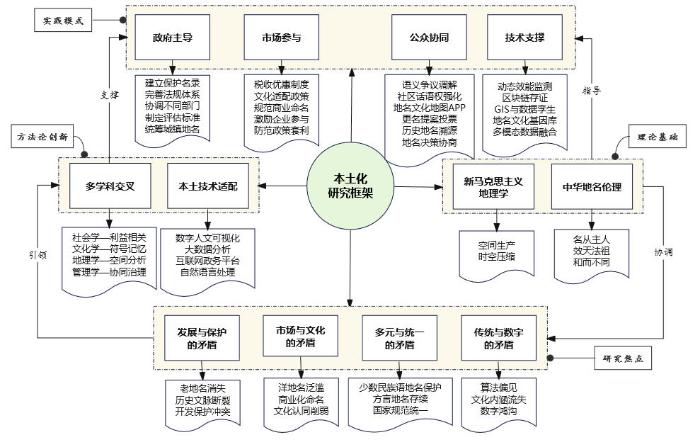
批判地名学作为人文地理学与文化研究的交叉领域,旨在揭示地名命名、更名与使用过程中隐含的权力关系、文化政治与身份认同问题。通过系统梳理中西方批判地名学的研究脉络,文章揭示了二者在理论框架、研究重点与实践路径方面的本质差异。研究发现,西方研究根植于殖民历史与自由主义城市语境,历经“权力批判—文化记忆—数字化”的演进脉络,强调通过社会运动解构地名权力的结构性不平等;中国本土化探索嵌入其独特的社会制度与文化背景,形成“制度嵌入性—文化根植性—价值导向性”的研究取向,并力求通过协同治理平衡发展与保护、市场与文化、多元与统一、数字与传统等矛盾。文章最后从理论基础、研究焦点、方法论创新与实践模式4个维度构建本土化研究框架,并立足该框架引出前沿议题,包括少数民族语地名在国家标准化要求下的存续机制、乡村空心化问题中乡土地名群落的存续机制、边缘群体在地名知识生产中的话语权保障机制、历史地名保护名录的动态评估与退出机制等。
纪小美 . 中西批判地名学研究脉络对比与中国本土化研究框架建构[J]. 热带地理, 2026 : 1 -9 . DOI: 10.13284/j.cnki.rddl.20250653
As the spatial mnemonics of human civilization, place names transcend their basic function as geographical identifiers to embody historical narratives, cultural genes, and societal values. Within the contemporary context of globalization and urbanization, place names participate dynamically in socio-spatial construction, reflecting power dynamics and shaping the formation of identity. Since the 1980s, the emergence of critical toponymy influenced by neo-Marxist geography has challenged the traditional perception of place names as neutral signifiers, reconceptualizing them as spatial representations of power struggles. Despite the long tradition of toponymic study in China, modern critical inquiry gained momentum only in the early 21st century, primarily in response to urban toponymic chaos. However, this development is embedded in China’s unique institutional and cultural contexts, navigating between market-driven cultural development and state-led principles of historical preservation. In this study, the author systematically compared the research trajectories of Sino-Western critical toponymy and analyzed their divergent theoretical frameworks, research priorities, and practical pathways rooted in distinct historical experiences and sociocultural backgrounds. With its origins in post-colonial and liberal urban contexts, Western critical toponymy has evolved from a macro-level political critique to incorporating cultural memory and spatial justice, focusing on deconstructing power and amplifying marginalized voices. By contrast, Chinese scholarship has progressed from initial institutional reflection toward analyzing power–culture relationships and, more recently, to addressing cultural heritage preservation and cross-cultural dialogue, demonstrating a problem-solving orientation aimed at balancing development with tradition under state guidance. Building on this comparative analysis, a systematic and prospective localized research framework for China was constructed in this study. This framework integrates the spatial critique of neo-Marxist geography with traditional Chinese toponymic ethics, focusing on four core practical contradictions inherent to Chinese toponymic governance: development versus preservation, market forces versus cultural integrity, diversity versus standardization, and digital technology versus traditional continuity. It proposes methodological innovation through interdisciplinary approaches and context-adapted technologies and advocates for a practical governance model characterized by multi-stakeholder collaboration and digital empowerment. The primary contribution of this study lies in its systematic delineation of Sino-Western differences, moving beyond isolated theoretical discussions. The proposed framework not only facilitates theoretical innovation and practical application within China but also challenges Western theoretical hegemony by offering a non-Western perspective. It provides valuable insights for other developing countries seeking compatible paths for cultural continuity and modernization, thereby enriching the global discourse on critical toponymy.
| 1 |
Addleton J. The Fate of British Place Names in Pakistan[J]. Asian Affairs, 1987, 8 (1): 25- 35.
|
| 2 |
安惠娟. 地名中的文化边界: 人口较少民族文化涵化研究: 以裕固族鄂金尼部落居住地的地名变迁为视点[J]. 西北民族研究, 2016 (2): 176- 182.
An Huijuan. Cultural Boundaries in Place Names: A Study of Acculturation among Ethnic Minorities: From the Perspective of Toponymic Changes in the Ejine Tribe's Homeland of the Yugur People[J]. Northwest Ethno-National Studies, 2016 (2): 176- 182.
|
| 3 |
Alderman D H. A Street Fit for a King: Naming Places and Commemoration in the American South[J]. Professional Geographer, 2000, 52 (4): 672- 684.
|
| 4 |
Alderman D H. Street Names and the Scaling of Memory: The Politics of Commemorating Martin Luther King, Jr. within the African American community[J]. Area, 2003, 35 (2): 163- 173.
|
| 5 |
Bigon L. Towards Creating a Global Urban Toponymy: A Comment[J]. Cities, 2020, 105 (3): 75- 83.
|
| 6 |
陈晨, 汪丽, 程林. 微观个体认知视角下北方农牧交错带少数民族语聚落地名的汉化进程: 从文化符号向空间指位符号的衰变[J]. 地域研究与开发, 2022, 41 (6): 170- 176.
Chen Chen, Wang Li, and Cheng Lin. Sinicization Process of Minority Settlement Place Names in the Farming-pastoral Ecotone of Northern China from the Perspective of Micro-individual Cognition: The Decay from Cultural Symbols to Spatial Signifiers[J]. Areal Research and Development, 2022, 41 (6): 170- 176.
|
| 7 |
Choi Suh Hee and Wong Cora Un In. Toponymy, Place Name Conversion and Wayfinding: South Korean Independent Tourists in Macau[J]. Tourism Management Perspectives, 2018, 25: 13- 22.
|
| 8 |
邓慧蓉. 从中国地名透视汉族人的思维方式和社会心理[J]. 学术交流, 2003 (12): 138- 141.
Deng Huirong. Probing the Thinking Mode and Social Psychology of the Hans in the View of Chinese Place Name[J]. Academic Exchange, 2003 (12): 138- 141.
|
| 9 |
Guyot S and Seethal C. Identity of Place, Places of Identities: Change of Place Names in Post-Apartheid South Africa[J]. South African Geographical Journal, 2007, 89 (1): 55- 63.
|
| 10 |
龚花萍. 论汉语地名的政治思想价值[J]. 江西社会科学, 2002, 22 (10): 93- 96.
Gong Huaping. On the Political Thought Value of Chinese Place Names[J]. Jiangxi Social Sciences, 2002, 22 (10): 93- 96.
|
| 11 |
郭舒, 李修远. 符号视角下城市街巷地名的空间特征及旅游化利用: 以沈阳市为例[J]. 经济地理, 2024, 44 (6): 232- 240.
Guo Shu and Li Xiuyuan. Spatial Characteristics and Tourism Utilization of Street Names in Urban Areas from the Perspective of Symbols: A Case Study of Shenyang[J]. Economic Geography, 2024, 44 (6): 232- 240.
|
| 12 |
哈维. 2003. 后现代的状况: 对文化变迁之缘起的探究. 周宪, 许钧, 译. 北京: 商务印书馆, 240-287. [Harvey D. 2003. The Condition of Post-Modernity: An Enquiry into the Origins of Cultural Change. Zhou Xian and Xu Jun, Trans. Beijing: The Commercial Press, 240-287.]
Harvey D. 2003. The Condition of Post-Modernity: An Enquiry into the Origins of Cultural Change. Zhou Xian and Xu Jun, Trans. Beijing: The Commercial Press, 240-287.
|
| 13 |
华林甫. 2010. 中国地名学源流. 北京: 人民出版社, 2010. [Hua Linfu. 2010. The Origin and Development of Chinese Toponymy. Beijing: People's Publishing House.]
Hua Linfu. 2010. The Origin and Development of Chinese Toponymy. Beijing: People's Publishing House.
|
| 14 |
黄丰富. 政治形塑与学术重构: 近代以来中国“中南半岛”地名变迁研究[J]. 南海学刊, 2025, 11 (2): 45- 56.
Huang Fengfu. Political Shaping and Academic Reconstruction: A Study on the Changes of Geographical Names in China's ‘Indochina (Zhongnan) Peninsula’ Since Modern Times[J]. The Journal of South China Sea Studies, 2025, 11 (2): 45- 56.
|
| 15 |
纪小美, 王卫平, 陈洁, 陶卓民, 付业勤 2016. 批判转向以来地名学研究回顾与展望. 地理科学进展, 35(7): 910-919. [Ji Xiaomei, Wang Weiping, Chen Jie, Tao Zhuomin, and Fu Yeqin. 2016. Review and Prospect of Toponymy Research since the 1980s. Progress in Geography, 35(7): 910-919.]
Ji Xiaomei, Wang Weiping, Chen Jie, Tao Zhuomin, and Fu Yeqin. 2016. Review and Prospect of Toponymy Research since the 1980s. Progress in Geography, 35(7): 910-919.
|
| 16 |
纪小美, 崔会芳, 陶卓民. 2019. 社会记忆视角下的南京城市街巷地名变迁. 地理科学进展, 38(11): 1692-1700. [Ji Xiaomei, Cui Huifang, and Tao Zhuomin. 2016. Changes in Nanjing Street Names from the Perspective of Social Memory. Progress in Geography, 38(11): 1692-1700.]
Ji Xiaomei, Cui Huifang, and Tao Zhuomin. 2016. Changes in Nanjing Street Names from the Perspective of Social Memory. Progress in Geography, 38(11): 1692-1700.
|
| 17 |
纪小美. 批判视角下徽州地名变迁的社会响应与内在机理研究[J]. 人文地理, 2020, 35 (6): 44- 49,105.
Ji Xiaomei. Study on the Social Response and Internal Mechanism of Huizhou Place-Name Based on the Capital and Field Theory[J]. Human Geography, 2020, 35 (6): 44- 49,105.
|
| 18 |
Kadmon N. Toponymy and Geopolitics: The Political Use and Misuse of Geographical Names[J]. The Cartographic Journal, 2013, 41 (2): 85- 87.
|
| 19 |
Kolodney Z. Contested Urban Memoryscape Strategies and Tactics in Post-1948 Haifa[J]. Israel Studies, 2016, 21 (1): 109- 131.
|
| 20 |
Light D and Young C. Toponymy as Commodity: Exploring the Economic Dimensions of Urban Place Names[J]. International Journal of Urban and Regional Research, 2014, 38 (3): 435- 450.
|
| 21 |
蓝勇. 中国近古以来的乡村地名[J]. 中国社会科学, 2021 (10): 188- 203.
Lan Yong. Place Names in Rural China since late Antiquity[J]. Social Sciences in China, 2021 (10): 188- 203.
|
| 22 |
李鹏, 封丹. 地名变迁中的文化政治阐释: 以从化温泉为例[J]. 人文地理, 2015, 30 (2): 58- 64.
Li Peng and Feng Dan. The Politics of Place Naming: Changing Place Names and Reproduction of Meaning for Conghua Hot Spring[J]. Human Geography, 2015, 30 (2): 58- 64.
|
| 23 |
列斐伏尔. 2015. 空间的生产. 刘怀玉, 译. 北京: 商务印书馆. [Lefebvre H. 2015. The Production of Space. Liu Huaishu, Trans. Beijing: The Commercial Press.]
Lefebvre H. 2015. The Production of Space. Liu Huaishu, Trans. Beijing: The Commercial Press.
|
| 24 |
刘博, 朱竑. 批判视角下广州地铁站命名与更名研究[J]. 地理科学, 2014, 34 (9): 1139- 1144.
Liu Bo and Zhu Hong. Naming and Renaming: A Critical Study on Guangzhou Metro Stations[J]. Geographical Science, 2014, 34 (9): 1139- 1144.
|
| 25 |
刘南威. 1996. 中国南海诸岛地名论稿. 北京: 科学出版社. [Liu Nanwei. 1996. A Study on the Place Names of China's South China Sea Islands. Beijing: Science Press.]
Liu Nanwei. 1996. A Study on the Place Names of China's South China Sea Islands. Beijing: Science Press.
|
| 26 |
龙景科, 刘晓洪. 族群记忆与族群认同危机: 社会语言学视域下黔东南侗族地名的调查与研究[J]. 贵州民族研究, 2017, 38 (9): 77- 80.
Long Jingke and Liu Xiaohong. The Crisis of Ethnic Memory and Ethnic Identity: An Investigation and Study of the Names of Dong Nationality in Southeast Guizhou from the Perspective of Sociolinguistic[J]. Journal of Mudanjiang College of Education, 2017, 38 (9): 77- 80.
|
| 27 |
罗桂林. 地名与日常生活的政治: 以福州历史上的地名兴替为中心[J]. 城市史研究, 2016 (1): 128- 153,300-301.
Luo Guilin. Toponym and Politics of Everyday Life: A Case Study on the Toponyms in Fuzhou's History[J]. Urban History Research, 2016 (1): 128- 153,300-301.
|
| 28 |
罗桂林. 地名治理与更名政治: 民国时期北京街巷地名的演变[J]. 北京社会科学, 2024 (5): 44- 56.
Luo Guilin. Toponym Governance and Renaming Politics: A Case Study on the Evolution of Street Toponyms in Beijing During the Republic of China[J]. Social Sciences of Beijing, 2024 (5): 44- 56.
|
| 29 |
Mamvura Z, Muwati I, and Mutasa D E. 'Toponymic Commemoration is Not for One Sex': The Gender Politics of Place Renaming in Harare[J]. African Identities, 2018, 16 (4): 429- 443.
|
| 30 |
Mitchelson M L, Alderman D H, and Popke E J. Branded: The Economic Geographies of Streets Named in Honor of Reverend Dr. Martin Luther King, Jr[J]. Social Science Quarterly, 2012, 93 (3): 810- 826.
|
| 31 |
Paunonen H, Vuloteenaho J and Ainiala T. Industrial Urbanization, Working-Class Lads and Slang Toponyms in Early Twentieth-Century Helsinki[J]. Urban History, 2009, 36 (3): 449- 472.
|
| 32 |
Perrem J G. Materialized Disagreements: Interpreting Urban Dual Language Signage and Murals in Northern Ireland[J]. City Territ Archit, 2025, 12 (1): 258- 265.
|
| 33 |
Rose-Redwood R, Alderman D, and Azaryahu M. Geographies of Toponymic Inscription: New Directions in Critical Place-Name Studies[J]. Progress in Human Geography, 2010, 34 (4): 453- 470.
|
| 34 |
Rose-Redwood R, Vuloteenaho J, and Young C. Naming Rights, Place Branding and the Tumultuous Cultural Landscapes of Neoliberal Urbanism[J]. Urban Geography, 2019, 40 (6): 747- 761.
|
| 35 |
Rusu M S. Gendering Urban Namescapes: The Gender Politics of Street Names in an Eastern European City[J]. Names: A Journal of Onomastics, 2022, 70 (2): 12- 25.
|
| 36 |
Shields R. 'Rename the Streets': The Challenges of Decolonizing Toponymy in Toronto Canada[J]. Ukrainian Historical Review, 2023, 2: 139- 153.
|
| 37 |
Swanepoel N. Capital Letters: Material Dissent and Place Name Change in the 'New' South Africa, 2005-2006[J]. Anthropology Southern Africa, 2009, 32 (3/4): 95- 105.
|
| 38 |
孙九霞, 王心蕊. 丽江大研古城文化变迁中的“虚无”与“实在”: 以酒吧发展为例[J]. 旅游学刊, 2012, 27 (9): 73- 83.
Sun Jiuxia and Wang Xinrui. The “Nothing” and “Something” during the Cultural Changes in Lijiang Ancient Town: A Case Study of Lijiang Ancient Town's Bars[J]. Tourism Tribune, 2012, 27 (9): 73- 83.
|
| 39 |
Wanjiru-Mwita M and Giraut F. Toponymy, Pioneership and the Politics of Ethnic Hierarchies in the Spatial Organization of British Colonial Nairobi[J]. Urban Science, 2020, 4 (3): 6- 19.
|
| 40 |
韦谢. 城市地名变迁与社会记忆的建构: 基于《紫堤村志》的分析[J]. 中国名城, 2016 (3): 53- 56.
Wei Xie. Urban Toponymic Changes and the Construction of Social Memory: An Analysis Based on Zidi Village Chronicles[J]. China Ancient City, 2016 (3): 53- 56.
|
| 41 |
吴俊范. 景观更替与城市区片地名的生命力: 以上海棚户区地名为例[J]. 中国历史地理论丛, 2014, 29 (3): 34- 47.
Wu Junfan. Landscape, Level and the Living-on Capability of Rural Place Names Transferring into Urban: A Case Study of Shanghai Downtown Area[J]. Journal of Chinese Historical Geography, 2014, 29 (3): 34- 47.
|
| 42 |
徐红罡, 任燕. 旅游对纳西东巴文语言景观的影响[J]. 旅游学刊, 2015, 30 (1): 102- 111.
Xu Honggang and Ren Yan. Tourism Impact on the Naxi Dongba Linguistic Landscape[J]. Tourism Tribune, 2015, 30 (1): 102- 111.
|
| 43 |
宣朝庆. 中华优秀传统文化视域下地名文化的生产机制研究[J]. 学习与探索, 2025 (4): 130- 137.
Xuan Chaoqing. A Study on the Production Mechanism of Geographical Name Culture from the Perspective of Chinese Excellent Traditional Culture[J]. Study & Exploration, 2025 (4): 130- 137.
|
| 44 |
杨小法. 地名商品化亟待正确引导[J]. 中国地名, 1996 (1): 37- 38.
Yang Xiaofa. The Commercialization of Place Names Urgently Requires Proper Guidance[J]. China Place Names, 1996 (1): 37- 38.
|
| 45 |
Yeoh B S A. Street Names in Colonial Singapore[J]. Geographic Review, 1992, 82 (3): 345- 360.
|
| 46 |
岳升阳, 余常虹. 北京地名管理工作中的历史地名保护[J]. 北京社会科学, 2009 (6): 77- 82.
Yue Shengyang and Yu Changhong. The Protection of Historical Place Names in the Management of Beijing[J]. Social Sciences of Beijing, 2009 (6): 77- 82.
|
| 47 |
张本效, 刘玉保. 重构小城镇社会结构的实证研究: 以临安市地名规划中的民意差异为例[J]. 城市问题, 2008 (12): 53- 57.
Zhang Benxiao and Liu Yubao. An Empirical Study on the Reconstruction of Small Town Social Structures: A Case Study of Public Opinion Differences in the Place Name Planning of Lin'an City[J]. Urban issue, 2008 (12): 53- 57.
|
| 48 |
张佳蕾, 杨效忠, 李冬花, 彭敏. 符号学视角下地名文化旅游的研究框架[J]. 中国生态旅游, 2024, 14 (5): 935- 950.
Zhang Jialei, Yang Xiaozhong, Li Donghua, and Peng Min. Research Framework for Toponymic Cultural Tourism from the Semiotic Perspective[J]. Chinese Ecotourism, 2024, 14 (5): 935- 950.
|
| 49 |
郑佳佳. 通往文化空间消费的地名: 云南红河哈尼梯田核心区地名标识的人类学考察[J]. 北方民族大学学报(哲学社会科学版), 2017 (3): 49- 54.
Zheng Jiajia. Leading to Cultural Space Consumption of Place Names: an Anthropological Study of the Place Names in the Core Area of Red River Hani Terrace[J]. Journal of North Minzu University (Philosophy and Social Sciences Edition), 2017 (3): 49- 54.
|
| 50 |
战赤嘉. 茂名市地名与地形关系[J]. 热带地理, 2015, 35 (3): 437- 442.
Zhan Chijia. Relationship between Place Names in Maoming and Terrain[J]. Tropical Geography, 2015, 35 (3): 437- 442.
|
| 51 |
张治弘, 张争胜, 张念杰, 段银平, 叶宇杭. 2025. 海南岛黎语村落地名的文化表征、空间分布及影响因素分析. 地理研究, 44(3): 809-824. [Zhang Zhihong, Zhang Zhengsheng, Zhang Nianjie, Duan Yinping, and Ye Yuhang 2025. Cultural Representation, Spatial Distribution, and Influencing Factors of Li Language Village Names in Hainan Island. Geographical Research, 44(3): 809-824.]
Zhang Zhihong, Zhang Zhengsheng, Zhang Nianjie, Duan Yinping, and Ye Yuhang 2025. Cultural Representation, Spatial Distribution, and Influencing Factors of Li Language Village Names in Hainan Island. Geographical Research, 44(3): 809-824.
|
/
| 〈 |
|
〉 |