典型设计暴雨下深圳市内涝空间分异与承灾体风险评估
图件制作与修改
|
靳超(1990—),男,河南滑县人,硕士,工程师,主要研究方向为城市洪涝灾害、应急管理、防灾减灾,E-mail:jinchaoe@163.com |
收稿日期: 2025-12-10
修回日期: 2026-02-26
网络出版日期: 2026-03-07
基金资助
广东省基础与应用基础研究基金(2022A1515110049)
版权
Spatial Differentiation of Urban Waterlogging and Risk Assessment of Exposed Elements in Shenzhen Under Typical Design Rainstorm Scenarios
Received date: 2025-12-10
Revised date: 2026-02-26
Online published: 2026-03-07
Copyright
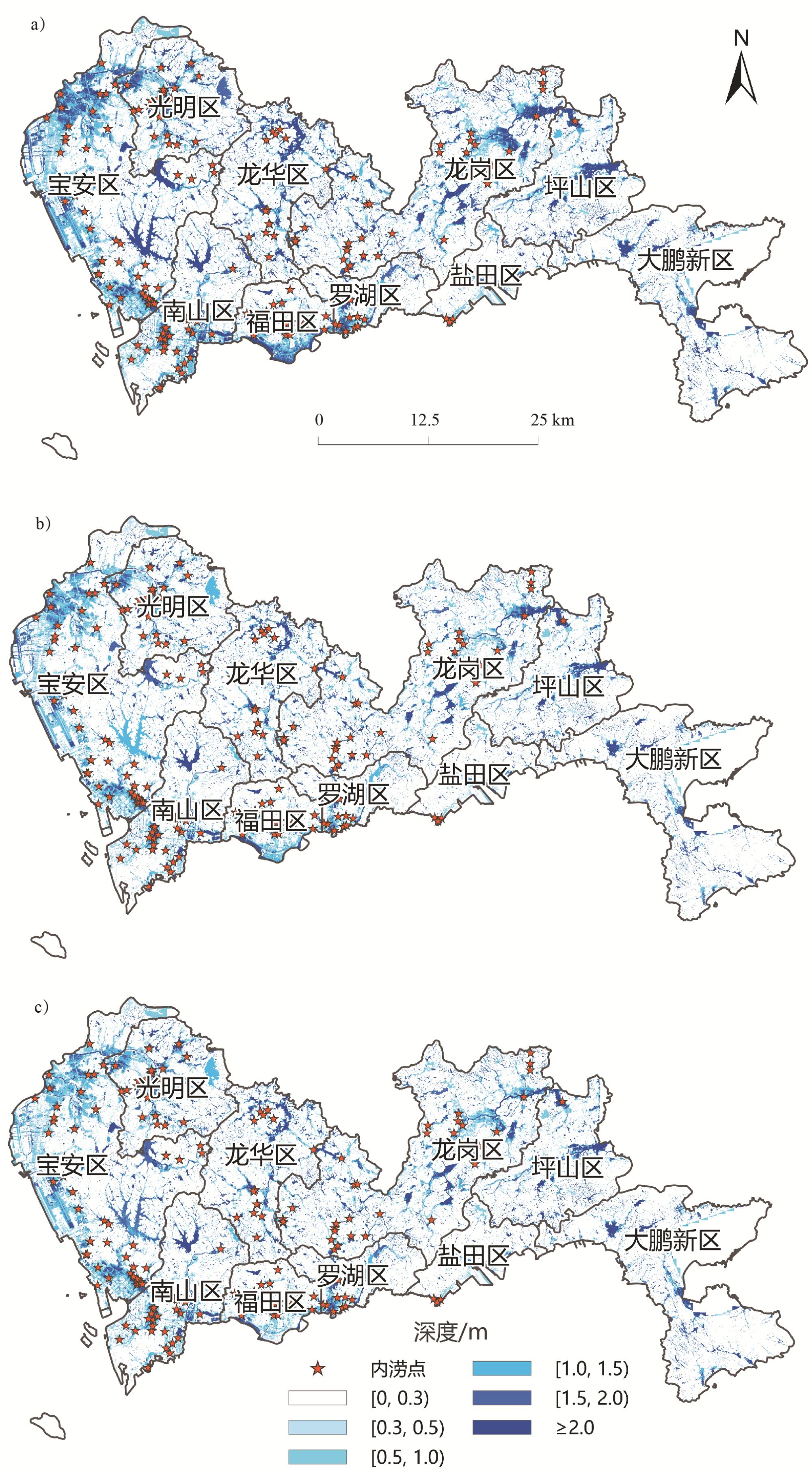
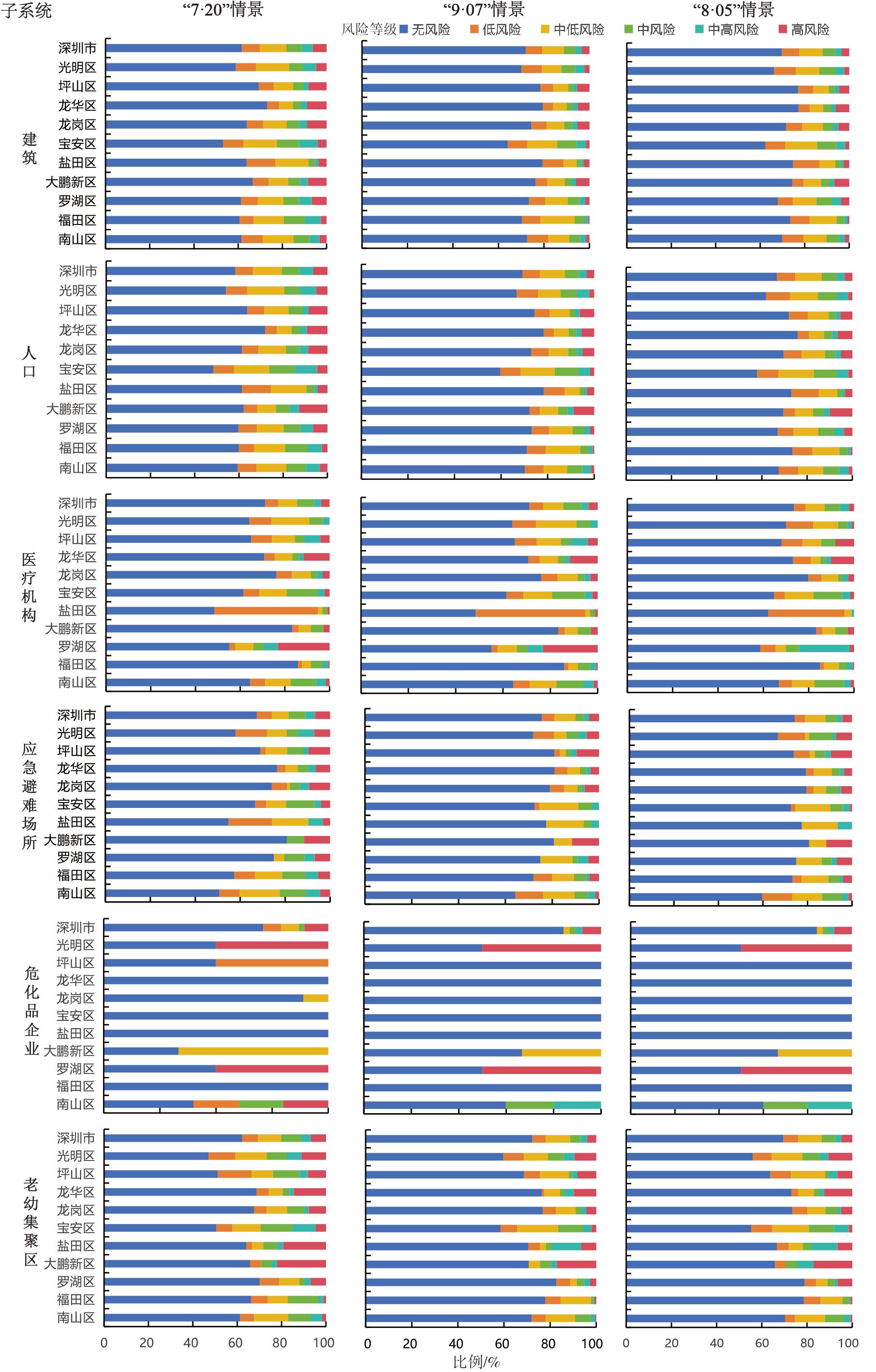
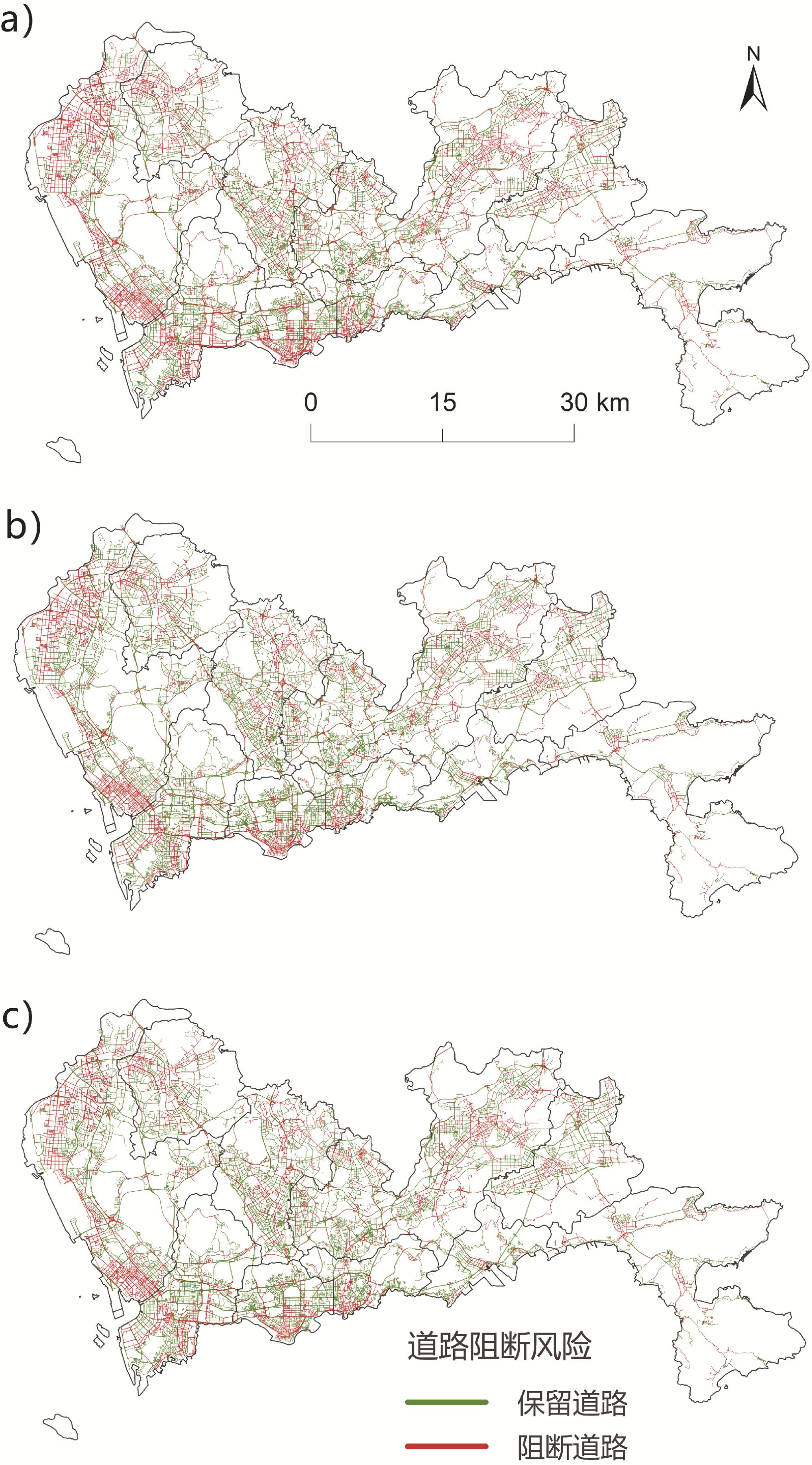
为揭示不同设计暴雨情景下深圳市内涝风险特征,文章基于LISFLOOD-FP模型,构建郑州“7·20”、深圳“9·07”及“8·05”3种典型设计暴雨情景,开展内涝模拟与城市系统暴露风险评估。结果表明:深圳市内涝积水呈现“西部深、东部浅,城区深、郊区浅”的空间格局,西部核心城区为高风险集聚区;经183个历史内涝点验证,模型模拟结果可信度较高。3种设计情景中,“7·20”设计暴雨情景风险最高,积水超0.3 m的风险区域占比26.55%,建筑、人口、道路及重点目标暴露风险均最显著;“9·07”和“8·05”设计暴雨情景内涝风险相对温和,但局部区域仍存在集中性高风险。重点目标对积水深度高度敏感,且不同区域暴露风险特征与防控短板各异,因此需聚焦差异化防护,强化专项防护措施与针对性施策。
关键词: 典型设计暴雨; 内涝模拟; 风险评估; LISFLOOD-FP模型; 深圳市
靳超 , 王园园 , 李晨溪 , 李娟 . 典型设计暴雨下深圳市内涝空间分异与承灾体风险评估[J]. 热带地理, 2026 , 46(3) : 471 -482 . DOI: 10.13284/j.cnki.rddl.20250873
Global climate change and rapid urbanization have intensified the occurrence of extreme rainstorm events, and urban waterlogging has emerged as a critical disaster risk constraining the sustainable development of high-density cities, posing serious threats to life, property, and urban resilience. To characterize urban waterlogging risk in Shenzhen under different design rainstorm scenarios, this study constructed three representative scenarios with distinct return periods and rainfall characteristics—Zhengzhou “7·20”, Shenzhen “9·07” and Shenzhen “8·05” —using the two-dimensional hydrodynamic model LISFLOOD-FP and conducted systematic waterlogging simulations and exposure risk assessments of urban systems. Model validation using 183 historical waterlogging points demonstrated high reliability: within 50-m buffers of these points, maximum simulated water depths generally exceeded 0.3 m (with extreme values exceeding 10 m), effectively reproducing the spatial distribution and severity of severe waterlogging. The results indicate that waterlogging in Shenzhen exhibits a distinct spatial pattern characterized as “deeper in the west, shallower in the east; deeper in urban cores, shallower in suburbs,” driven by the “higher southeast, lower northwest” topography, high impervious surface coverage in western districts, and uneven drainage system loading. Among the three scenarios, the “7·20” design scenario poses the highest risk due to its high rainfall intensity, pronounced peak discharge, and extended duration, with areas experiencing water depths > 30 cm accounting for 26.55% of the study area. Specifically, more than 74,000 buildings and approximately 4.68 million people were exposed to water depth exceeding 1 m, and 46.76% of the total road network (8,966.25 km) was inundated. The “9·07” scenario is characterized by nocturnally concentrated short-duration heavy rainfall, resulting in localized water accumulation in low-lying areas such as Longgang. The “8·05” design scenario exhibits a multi-peak pattern with a pronounced surge and a mid-event rainfall lull that temporarily alleviates accumulation, producing an intermediate risk level relative to the other two scenarios. Critical infrastructure elements exhibit high sensitivity to water depth, with significant differences in risk response. Under the “7·20” design scenario, 1,028 medical institutions, 823 elderly and childcare facilities and 106 emergency shelters, were exposed to high risk, potentially compromising emergency medical services and vulnerable populations; more than eight hazardous chemical enterprises faced potential secondary disasters at water depths exceeding 0.5 m. Spatially, risk to critical infrastructure exhibits a pattern of “western concentration and eastern dispersion.” High-risk clusters are concentrated in Luohu and Longhua (medical and elderly-care facilities), Bao'an (moderate risk), and Nanshan, Luohu, and Guangming (hazardous chemical enterprises). Eastern districts exhibit generally low risk, with localized high-risk pockets confined to elderly-care facilities in Dapeng and Yantian. Futian District demonstrates the strongest protective performance, likely attributable to higher construction standards and more scientifically informed site selection. This study advances the literature by constructing cross-regional and locally representative design rainstorm scenarios and elucidating the coupling mechanism between rainfall characteristics and waterlogging risk in high-density urban environments. The findings provide a scientific basis for hierarchical disaster prevention planning and offer a transferable framework for waterlogging risk management in similar high-density cities nationwide.
表1 不同设计暴雨情景下积水面积占比Table 1 Proportion of water accumulation area under different typical designed rainstorm scenarios |
| 积水深度/m | 风险等级 | “7·20”情景 | “9·07”情景 | “8·05”情景 |
| [0, 0.3) | 无风险 | 73.45 | 78.75 | 77.65 |
| [0.3, 0.5) | 低风险 | 4.02 | 3.69 | 3.89 |
| [0.5, 1.0) | 中低风险 | 6.64 | 5.90 | 6.33 |
| [1.0, 1.5) | 中风险 | 4.35 | 3.86 | 3.90 |
| [1.5, 2.0) | 中高风险 | 3.23 | 2.24 | 2.57 |
| ≥2.0 | 高风险 | 8.30 | 5.55 | 5.66 |
表2 不同设计暴雨情景下建筑暴露数量Table 2 Number of buildings exposed under different typical designed rainstorm scenarios |
| 积水深度/m | 风险等级 | “7·20”情景 | “9·07”情景 | “8·05”情景 |
| [0, 0.3) | 无风险 | 190 325 | 212 193 | 219 511 |
| [0.3, 0.5) | 低风险 | 19 122 | 20 007 | 18 894 |
| [0.5, 1.0) | 中低风险 | 33 543 | 33 558 | 30 402 |
| [1.0, 1.5) | 中风险 | 25 227 | 13 157 | 19 880 |
| [1.5, 2.0) | 中高风险 | 20 111 | 13 157 | 12 640 |
| ≥2.0 | 高风险 | 28 743 | 16 275 | 15 744 |
表3 不同设计暴雨情景下人口暴露比例Table 3 Proportion of population exposed under different typical designed rainstorm scenario |
| 积水深度/m | 风险等级 | “7·20”情景 | “9·07”情景 | “8·05”情景 |
| [0, 0.3) | 无风险 | 67.11 | 75.98 | 74.02 |
| [0.3, 0.5) | 低风险 | 6.50 | 5.84 | 6.22 |
| [0.5, 1.0) | 中低风险 | 10.24 | 8.64 | 9.36 |
| [1.0, 1.5) | 中风险 | 6.43 | 4.67 | 5.14 |
| [1.5, 2.0) | 中高风险 | 4.78 | 2.37 | 2.58 |
| ≥2.0 | 高风险 | 4.94 | 2.50 | 2.68 |
表4 不同设计暴雨情景下医疗机构暴露数量Table 4 Number of medical institutions exposed under different typical designed rainstorm scenarios |
| 积水深度/m | 风险等级 | “7·20”情景 | “9·07”情景 | “8·05”情景 |
| [0, 0.3) | 无风险 | |||
| [0.3, 0.5) | 低风险 | 394 | 298 | 409 |
| [0.5, 1.0) | 中低风险 | 965 | 592 | 594 |
| [1.0, 1.5) | 中风险 | 485 | 243 | 272 |
| [1.5, 2.0) | 中高风险 | 274 | 189 | 150 |
| ≥2.0 | 高风险 | 269 | 92 | 186 |
表5 不同设计暴雨情景下应急避难场所暴露数量Table 5 Number of emergency shelters exposed under different typical designed rainstorm scenarios |
| 积水深度/m | 风险等级 | “7·20”情景 | “9·07”情景 | “8·05”情景 |
| [0, 0.3) | 无风险 | 394 | 451 | 433 |
| [0.3, 0.5) | 低风险 | 44 | 40 | 45 |
| [0.5, 1.0) | 中低风险 | 81 | 73 | 80 |
| [1.0, 1.5) | 中风险 | 27 | 27 | 14 |
| [1.5, 2.0) | 中高风险 | 43 | 14 | 30 |
| ≥2.0 | 高风险 | 39 | 23 | 26 |
表6 不同设计暴雨情景下危化品企业暴露数量Table 6 Number of hazardous chemical enterprises exposed under different typical designed rainstorm scenarios |
| 积水深度/m | 风险等级 | “7·20”情景 | “9·07”情景 | “8·05”情景 |
| [0, 0.3) | 无风险 | 29 | 34 | 33 |
| [0.3, 0.5) | 低风险 | 4 | 2 | 3 |
| [0.5, 1.0) | 中低风险 | 4 | 1 | 1 |
| [1.0, 1.5) | 中风险 | 0 | 1 | 1 |
| [1.5, 2.0) | 中高风险 | 1 | 0 | 1 |
| ≥2.0 | 高风险 | 3 | 3 | 2 |
表7 不同设计暴雨情景下老幼集聚区暴露数量Table 7 Number of elderly and child-care facilities exposed under different typical designed rainstorm scenarios |
| 积水深度/m | 风险等级 | “7·20”情景 | “9·07”情景 | “8·05”情景 |
| [0, 0.3) | 无风险 | 2 532 | 3 430 | 3 256 |
| [0.3, 0.5) | 低风险 | 345 | 249 | 357 |
| [0.5, 1.0 | 中低风险 | 883 | 458 | 446 |
| [1.0, 1.5) | 中风险 | 358 | 213 | 239 |
| [1.5, 2.0) | 中高风险 | 250 | 164 | 127 |
| ≥2.0 | 高风险 | 215 | 69 | 158 |
|
Bates P D and De Roo A P J 2000. A Simple Raster-Based Model for Flood Inundation Simulation. Journal of Hydrology, 236(1/2): 54-77.
|
|
陈金林, 赵雨荷, 李鑫, 任小虎, 李一哲. 不同降雨情景下城市内涝风险研究——以兰州市某区域为例. 灾害学, 2025, 40 (4): 62- 70.
Chen Jinlin, Zhao Yuhe, Li Xin, Ren Xiaohu, and Li Yizhe. Risk Analysis of Urban Waterlogging Under Different Rainfall Scenarios: A Case Study of a District in Lanzhou. Journal of Catastrophology, 2025, 40 (4): 62- 70.
|
|
Ding Y, Wang H, Liu Y, and Lei X. Urban Waterlogging Structure Risk Assessment and Enhancement. Journal of Environmental Management, 2024, 352, 120074.
|
|
广东省统计局. 2025. 广东统计年鉴. 北京: 中国统计出版社.
Guangdong Provincial Bureau of Statistics. 2025. Guangdong Statistical Yearbook. Beijing: China Statistics Press.
|
|
黄国如, 李碧琦. 基于InfoWorks ICM的深圳市内涝灾害居民室内财产损失研究. 自然灾害学报, 2021, 30 (2): 71- 79.
Huang Guoru and Li Biqi. Residential Indoor Property Losses from Urban Waterlogging in Shenzhen Based on InfoWorks ICM. Journal of Natural Disasters, 2021, 30 (2): 71- 79.
|
|
赖成光, 廖耀星, 王兆礼. 不同暴雨情景下的城市内涝响应特征分析. 水资源保护, 2023, 39 (3): 101- 108.
Lai Chengguang, Liao Yaoxing, and Wang Zhaoli. Analysis of Urban Waterlogging Response Characteristics Under Different Rainstorm Scenarios. Water Resources Protection, 2023, 39 (3): 101- 108.
|
|
Li C, Yang X, Ni X, and Ma X. Urban Waterlogging Susceptibility Assessment Based on Feature Selection Optimization and Interpretable Machine Learning. Journal of Environmental Management, 2025, 393, 127126.
|
|
李智, 张倩, 兰双双. 基于SWMM和LISFLOOD-FP的城市内涝耦合模型研究. 水电能源科学, 2024, 42 (2): 202- 206.
Li Zhi, Zhang Qian, and Lan Shuangshuang. Research on Urban Waterlogging Coupling Model Based on SWMM and LISFLOOD-FP. Water Resources and Power, 2024, 42 (2): 202- 206.
|
|
Li J, Yuan L, Hu Y, Xu A, Cheng Z, Song Z, Zhang X, Zhu W, Shang W, Liu J, and Liu M. Flood Simulation Using LISFLOOD and Inundation Effects: A Case Study of Typhoon In-Fa in Shanghai. Science of The Total Environment, 2024, 954, 176372.
|
|
李涛, 夏润亮, 李冰, 俞彦, 徐志恒, 杨无双. 洪水预报研究与展望. 中国农村水利水电, 2022 (12): 107- 114.
Li Tao, Xia Runliang, Li Bing, Yu Yan, Xu Zhiheng, and Yang Wushuang. Research on Flood Forecasting and Its Prospect. China Rural Water and Hydropower, 2022 (12): 107- 114.
|
|
梁鑫, 侯精明, 陈光照, 李东来, 潘鑫鑫, 吕佳豪, 马越, 姬国强. 考虑降雨空间分布的城市内涝对模式雨型响应特征分析. 水利水运工程学报, 2024 (2): 44- 54.
Liang Xin, Hou Jingming, Chen Guangzhao, Li Donglai, Pan Xinxin, Lyu Jiahao, Ma Yue, and Ji Guoqiang. Investigation of the Response Characteristics of Urban Waterlogging to Model Rainfall Patterns Considering the Spatial Distribution of Rainfall. Hydro-Science and Engineering, 2024 (2): 44- 54.
|
|
Lin T, Liu X, Song J, Zhang G, Jia Y, Tu Z, Zheng Z, and Liu C. Urban Waterlogging Risk Assessment Based on Internet Open Data: A Case Study in China. Habitat International, 2018, 71, 88- 96.
|
|
刘明阳, 王群英, 徐向舟, 李敏, 吴润祺. 考虑内涝周期的郑州市内涝韧性评估. 水资源保护, 2024, 40 (4): 48- 55.
Liu Mingyang, Wang Qunying, Xu Xiangzhou, Li Min, and Wu Runqi. Assessment of Waterlogging Resilience in Zhengzhou City Considering the Waterlogging Cycle. Water Resources Protection, 2024, 40 (4): 48- 55.
|
|
刘勇, 张韶月, 柳林, 王先伟, 黄华兵. 智慧城市视角下城市洪涝模拟研究综述. 地理科学进展, 2015, 34 (4): 494- 504.
Liu Yong, Zhang Shaoyue, Liu Lin, Wang Xianwei, and Huang Huabing. A Review of Urban Flood Simulation from the Perspective of Smart City. Progress in Geography, 2015, 34 (4): 494- 504.
|
|
卢培骏. 2025. 基于复合水灾害的湾区风险识别与韧性城市设计评估研究. 广州: 华南理工大学.
Lu Peijun. 2025. Risk Identification of Bay Area Based on Compound Water Disasters and Evaluation of Resilient Urban Design. Guangzhou: South China University of Technology.
|
|
卢兴超, 徐宗学, 李永坤, 胡小红, 唐清竹, 宋鹏越. 基于SWMM与LISFLOOD-FP耦合模型的城市街区内涝模拟研究. 水资源保护, 2024, 40 (3): 98- 105.
Lu Xingchao, Xu Zongxue, Li Yongkun, Hu Xiaohong, Tang Qingzhu, and Song Pengyue. Simulation of Urban Waterlogging in a Block Based on Coupled SWMM and LISFLOOD-FP Models. Water Resources Protection, 2024, 40 (3): 98- 105.
|
|
沈涣焕, 胡恒智, 辛辰, 温家洪, 杨雨露. 上海汛期暴雨内涝时空分异及文旅集聚区影响评价. 热带地理, 2025, 45 (4): 605- 620.
Shen Huanhuan, Hu Hengzhi, Xin Chen, Wen Jiahong, and Yang Yulu. Spatiotemporal Variability of Rainstorm Waterlogging and Its Impact on Cultural-Tourism Agglomeration Areas in Shanghai during Flood Season. Tropical Geography, 2025, 45 (4): 605- 620.
|
|
石小芳, 赵明洁, 杨青青, 张菲菲, 吴燕娟, 高超. 基于降雨情景模拟的城市社区尺度暴雨内涝研究. 水利水运工程学报, 2021 (1): 26- 35.
Shi Xiaofang, Zhao Mingjie, Yang Qingqing, Zhang Feifei, Wu Yanjuan, and Gao Chao. Urban Rainstorm Waterlogging Study at the Community Scale Based on Rainfall Scenario Simulation. Journal of Hydraulic Engineering, 2021 (1): 26- 35.
|
|
宋英华, 张哲, 方丹辉. 城市洪涝下承灾体暴露性及行人失稳风险分析. 中国安全科学学报, 2020, 30 (10): 105- 111.
Song Yinghua, Zhang Zhe, and Fang Danhui. Analysis on Exposure of Disaster-Bearing Bodies and Pedestrians' Instability Risk under Urban Waterlogging. China Safety Science Journal, 2020, 30 (10): 105- 111.
|
|
王峤, 李含嫣, 臧鑫宇. 京津冀典型区域应对暴雨内涝的城市建成环境韧性研究——基于韧性单元类型谱系的分析. 城市问题, 2022 (9): 4- 14.
Wang Qiao, Li Hanyan, and Zang Xinyu. Research on the Resilience of Urban Built Environment in Typical Areas of Beijing-Tianjin-Hebei Region in Response to Rainstorm Waterlogging: An Analysis Based on the Type Spectrum of Resilience Units. Urban Problems, 2022 (9): 4- 14.
|
|
吴辉明, 陈文龙, 杨芳, 薛冰贤. 深圳龙岗区2023年“9·7”极端特大暴雨洪涝灾害风险评估与对策. 中国防汛抗旱, 2024, 34 (1): 36- 40.
Wu Huiming, Chen Wenlong, Yang Fang, and Xue Bingxian. Risk Assessment and Countermeasures for the "9·7" Extreme Rainstorm Flood Disaster in Longgang District, Shenzhen in 2023. China Flood & Drought Management, 2024, 34 (1): 36- 40.
|
|
许镇, 赵玉杰, 唐福妍, 田源, 顾栋炼, 施钟洪, 金楠. 基于倾斜摄影和Mohid-Land模型的深圳“4·11”暴雨高精度情景再现. 河北工业大学学报, 2025, 54 (1): 87- 93.
Xu Zhen, Zhao Yujie, Tang Fuyan, Tian Yuan, Gu Donglian, Shi Zhonghong, and Jin Nan. High-Precision Scenario Reproduction of Shenzhen "4·11" Rainstorm Based on Oblique Photography and Mohid-Land Model. Journal of Hebei University of Technology, 2025, 54 (1): 87- 93.
|
|
严心如. 2025. 城市化背景下内涝风险演化研究——以深圳市为例. 深圳: 哈尔滨工业大学(深圳).
Yan Xinru. 2025. Study on the Evolution of Waterlogging Risk Under Urbanization—Taking Shenzhen as an Example. Shenzhen: Harbin Institute of Technology, Shenzhen.
|
|
曾照洋, 王兆礼, 吴旭树, 赖成光, 陈晓宏. 基于SWMM和LISFLOOD模型的暴雨内涝模拟研究. 水力发电学报, 2017, 36 (5): 68- 77.
Zeng Zhaoyang, Wang Zhaoli, Wu Xushu, Lai Chengguang, and Chen Xiaohong. Study on Rainstorm Waterlogging Simulation Based on SWMM and LISFLOOD Models. Journal of Hydroelectric Engineering, 2017, 36 (5): 68- 77.
|
|
张弛, 钟华, 江衍铭, 俞鸿杰, 刘莉, 许月萍. 不同雨型降雨对城市内涝的影响研究. 自然灾害学报, 2025, 34 (3): 88- 98.
Zhang Chi, Zhong Hua, Jiang Yanming, Yu Hongjie, Liu Li, and Xu Yueping. Impacts of Different Rainfall Patterns on Urban Waterlogging. Journal of Natural Disasters, 2025, 34 (3): 88- 98.
|
|
Zhang C, Wang W, Huang L, Zhang P, and Lai C. Analysis of Driving Factors for Waterlogging Points in Shenzhen City under High Urbanization Background. Water Resources Protection, 2024, 40 (2): 35- 45.
|
|
张菲菲, 谭琳珊, 赵强强, 吴燕娟, 徐羽, 高超. 基于水动力模型的城市内涝灾害研——以宁波市白鹤社区为例. 自然灾害学报, 2021, 30 (6): 209- 218.
Zhang Feifei, Tan Linshan, Zhao Qiangqiang, Wu Yanjuan, Xu Yu, and Gao Chao. Study on Urban Waterlogging Disaster Based on Hydrodynamic Model: A Case Study of Baihe Community in Ningbo City. Journal of Natural Disasters, 2021, 30 (6): 209- 218.
|
|
张江波, 王熠, 杨晓柳, 姜立智, 周翔, 陈莹, 高路. 基于水动力模型的台风—暴雨—积涝时空演变过程研究. 灾害学, 2025, 41 (1): 226- 234.
Zhang Jiangbo, Wang Yi, Yang Xiaoliu, Jiang Lizhi, Zhou Xiang, Chen Ying, and Gao Lu. Spatio-Temporal Evolution of Typhoon-Rainstorm-Waterlogging Processes Based on Hydrodynamic Modeling. Journal of Catastrophology, 2025, 41 (1): 226- 234.
|
|
张金萍, 张朝阳, 左其亭. 极端暴雨下城市内涝模拟与应急响应能力评估. 郑州大学学报(工学版), 2023, 44 (2): 30- 37.
Zhang Jinping, Zhang Chaoyang, and Zuo Qiting. Simulation of Urban Waterlogging and Evaluation of Emergency Response Capacity under Extreme Rainstorms. Journal of Zhengzhou University(Engineering Science), 2023, 44 (2): 30- 37.
|
|
Zhang M, Xu M, Wang Z, and Lai C. Assessment of the Vulnerability of Road Networks to Urban Waterlogging Based on a Coupled Hydrodynamic Model. Journal of Hydrology, 2021, 603, 127446.
|
|
Zhang Z, Jian X, Chen Y, Huang Z, Liu J, and Yang L. Urban Waterlogging Prediction and Risk Analysis Based on Rainfall Time Series Features: A Case Study of Shenzhen. Frontiers in Environmental Science, 2023, 11, 1131954.
|
|
Zhu H, Jiang Z, and Li L. Projection of Climate Extremes in China, an Incremental Exercise from CMIP5 to CMIP6. Science Bulletin, 2021, 66 (24): 2528- 2537.
|
|
郑杨坤, 王锋, 韦秋莹, 张云, 杨芳, 胡茂川. 广州市雨潮遭遇组合风险及其空间分布特征. 热带地理, 2025, 45 (4): 567- 574.
Zheng Yangkun, Wang Feng, Wei Qiuying, Zhang Yun, Yang Fang, and Hu Maochuan. Spatial Distribution Characteristics and Co-Occurrence Risk of Rainstorms and High Tide Levels in Guangzhou. Tropical Geography, 2025, 45 (4): 567- 574.
|
/
| 〈 |
|
〉 |