基于复杂网络的快速公交-轨道交通站点分级研究
|
陈烨(1996—),男,广西梧州人,硕士,研究方向为智慧交通与大数据,(E-mail)20014085037@stu.hqu.edu.cn; |
收稿日期: 2022-06-24
修回日期: 2022-11-18
网络出版日期: 2023-08-02
基金资助
国家自然科学基金项目:面向复杂网络的城市大运量公交站点影响区空间关系识别与土地利用模式研究(52078224)
Classification of Bus Rapid Transit-Rail Transit Stations Using Complex Network Analysis
Received date: 2022-06-24
Revised date: 2022-11-18
Online published: 2023-08-02
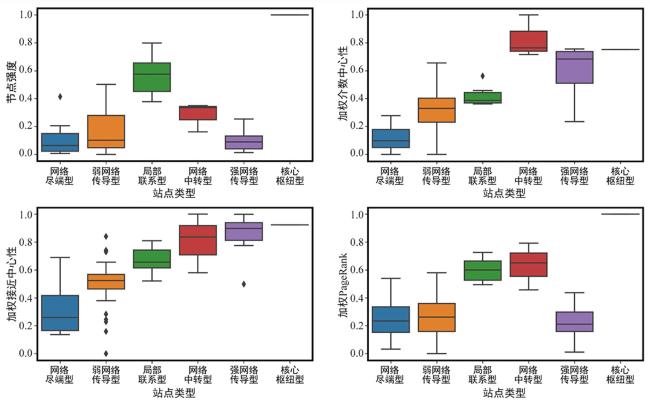
为研究大运量交通站点精细化管理问题,构建复杂网络,分析站点分级。通过构建Space-L有向加权复杂网络模型,并基于站点客流提取节点强度、加权介数中心性、加权接近中心性以及加权PageRank4项指标,运用系统聚类方法进行站点分级。以厦门快速公交(BRT)-轨道双模式网络系统为研究对象,从复杂网络视角分析站点网络特征和层级关系。结果表明:1)在复杂网络模型下,网络站点可分为核心枢纽型、局部联系型、网络中转型、强网络传导型、弱网络传导型和网络尽端型6类。2)各类换乘站点呈现不同特点,单模式换乘站具有调节网络客流的能力,双模式换乘站具有吸引网络客流的能力,单-双模式结合的换乘站具有辐射网络客流的能力。3)在BRT-轨道交通网络的单模式站点中,岛内的BRT站点发挥效果优于轨道站点。文章提出的站点分级指标和方法能很好地揭示站点网络特性,有助于提高城市BRT-轨道网络系统运营效率。
陈烨 , 高悦尔 , 沈晶晶 . 基于复杂网络的快速公交-轨道交通站点分级研究[J]. 热带地理, 2023 , 43(7) : 1234 -1246 . DOI: 10.13284/j.cnki.rddl.003715
Mass traffic stations are key nodes in integrated traffic networks. The scientific definition of station types is of great significance for the refined management of stations and network operations. Using the Xiamen BRT track double-mode network system as the research object, this study analyzed the characteristics and hierarchical relationships of the station network and used complex network analysis to classify stations within the network. By constructing a Space-L-directed weighted complex network model based on station passenger flows, this study proposes four indicators: node strength, weighted betweenness centrality, weighted closeness centrality, and weighted PageRank. A system-clustering method was used to classify the stations. The results are as follows: (1) In the complex network model, the network sites can be divided into six types: core-hub type, local connection, network transition, strong network conduction, weak network conduction, and network-end. The important sites of the network are gathered at the center of Xiamin island, and the secondary sites of the network are distributed on the periphery of the regular spatial network. The important sites of the network outside the island are distributed in mature urban construction areas, and the secondary sites are scattered in preliminary urban construction development areas. (2) All transfer station types have different characteristics. Single-mode transfer stations have the ability to adjust network passenger flow and accommodate the transfer capacity of passenger flow between various regions of the city, whereas double-mode transfer stations have the ability to attract network passenger flow, and the station and other stations on the network. It is closely connected and has high accessibility; single-mode and double-mode combined transfer stations have the ability to promote network passenger flow, and have high passenger flow connection strength and global passenger flow influence ability. (3) Among the single-mode stations in the BRT-metro transit network, the BRT stations perform better than the metro stations. This feature is more obvious in the island area owing to the unbalanced development of the east and west areas of the island. The station classification index and method proposed in this study can reveal the characteristics of station networks, which can improve the operational efficiency of urban BRT-rail network systems.
表1 厦门市各类公共交通进出站客流量数据Table 1 The inbound and outbound data passenger flow statistics of Xiamen's various public transportation stations |
| 客流类型 | 客流量/人次 |
|---|---|
| 合计 | 7 529 753 |
| BRT_OD客流 | 4 397 943 |
| 轨道_OD客流 | 2 989 792 |
| 轨道换乘BRT_OD客流 | 68 187 |
| BRT换乘轨道_OD客流 | 73 831 |
表2 站点指标共线性检验结果Table 2 Collinearity test results of stations' index |
| 模型 | 非标准化系数 | 标准化系数Beta | T | 显著性 | 共线性统计资料 | ||
|---|---|---|---|---|---|---|---|
| B | 标准错误 | 允差 | VIF | ||||
| (常数) | 31.707 | 8.346 | 3.799 | 0.000 | |||
| 节点强度 | -72.700 | 21.951 | -0.467 | -3.312 | 0.001 | 0.473 | 2.112 |
| 加权介数中心性 | -46.470 | 18.432 | -0.401 | -2.521 | 0.014 | 0.372 | 2.690 |
| 加权接近中心性 | 46.612 | 17.230 | 0.424 | 2.705 | 0.008 | 0.383 | 2.614 |
| 加权PageRank | 75.438 | 22.795 | 0.474 | 3.309 | 0.001 | 0.458 | 2.184 |
表3 站点聚类结果Table 3 Clustering results of stations |
| 站点类别 | 站点名称 |
|---|---|
| 核心枢纽型 | 蔡塘(1处) |
| 局部联系型 | 莲坂、嘉庚体育馆站、湖滨中路站、文灶、金山站、市行政服务中心站(6处) |
| 网络中转型 | 吕厝、T4候机楼站、厦门北站(3处) |
| 强网络传导型 | 乌石浦、塘边、火炬园、殿前、高崎、集美学村、园博苑、杏林村、杏锦路、官任、诚毅广场、集美软件园、集美大道、天水路、田厝站、东宅站(BRT站)、中科院站、莲花路口、湖滨东路、产业研究院站、大学城站、华侨大学站、诚毅学院站、育秀东路站、体育中心站、江头站、后埔站(27处) |
| 弱网络传导型 | 火车站、金榜公园站、凤林站、东垵站、后田站、东亭站、美峰站、蔡店站、潘涂站、古地石站、滨海新城西柯站、岭兜站、高崎机场站、县后站、官浔站、建业路站、软件园二期站、双十中学站、轻工食品园站、邮轮中心站、何厝站、东芳山庄站、龙山桥站、海沧湾公园站、观音山、卧龙晓城站、两岸金融中心站、马青路站、五通站、将军祠、洪文站、中山公园、海沧商务中心站、海沧行政中心站、二市站、东宅站(地铁站)(36处) |
| 网络尽端型 | 四口圳站、工业集中区站、第三医院站、斗西路站、城南站、思北站、同安枢纽站、岩内、湿地公园站、开禾路口站、天竺山站、新垵站、钟宅站、第一码头站、镇海路、东孚站、新阳大道站、五缘湾站、翁角路站、前埔枢纽站(20处) |
表4 重要站点指标分析Table 4 Index analysis of important stations |
| 站名 | 强度 | 加权介数中心性 | 加权接近中心性 | 加权PR | 换乘模式 | 换乘方式 | 站点类型 |
|---|---|---|---|---|---|---|---|
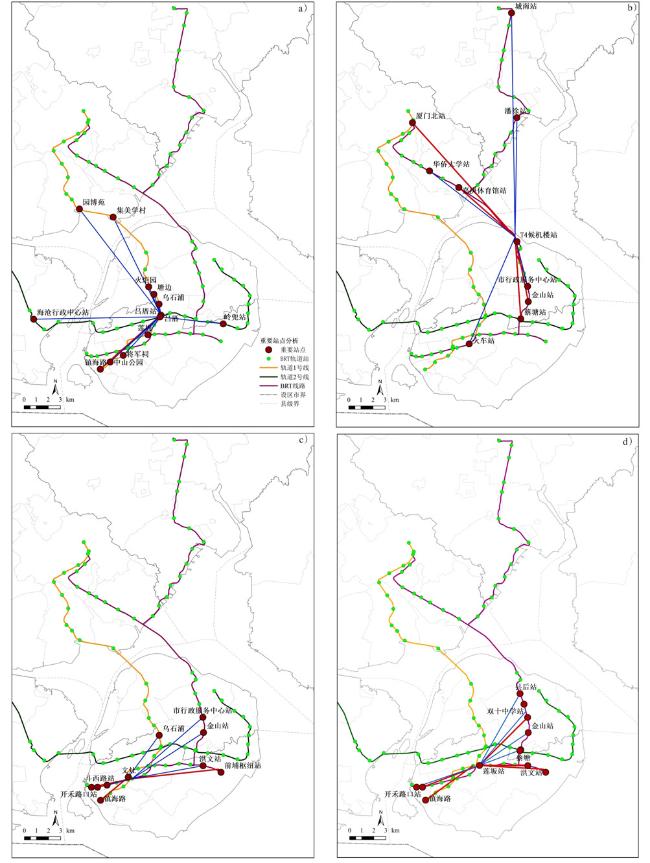
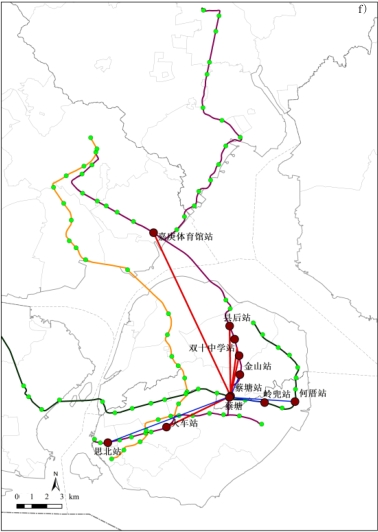
| 吕厝站 | 0.33 | 1 | 1 | 0.67 | 单模式 | 轨道-轨道 | 网络中转型 |
| T4候机楼站 | 0.35 | 0.76 | 0.58 | 0.65 | 单模式 | BRT-BRT | 网络中转型 |
| 厦门北站 | 0.16 | 0.71 | 0.83 | 0.79 | 双模式 | 轨道-BRT | 网络中转型 |
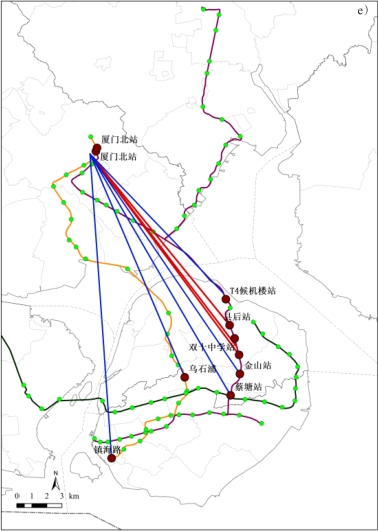
| 莲坂站 | 0.54 | 0.56 | 0.76 | 0.58 | 双模式 | 轨道-BRT | 局部联系型 |
| 文灶站 | 0.60 | 0.37 | 0.72 | 0.68 | 双模式 | 轨道-BRT | 局部联系型 |
| 蔡塘站 | 1 | 0.75 | 0.92 | 1 | 单-双模式 | 轨道-BRT/ BRT-BRT | 核心枢纽型 |
图6 各重要站点OD客流分布(a.吕厝站;b. T4候机楼站;c. 文灶站;d. 莲坂站;e. 厦门北站;f. 蔡塘站)Fig.6 Distribution of OD passenger flow of 6 important stations(a. Lyucuo station; b. T4 Terminal station; c. Wenzao station; d. Lianban station; e. Xiamen North station; f. Caitang station) |
| (接上页) | |
 |  |

1 数据来源:厦门公交集团。
陈 烨:文献收集整理、数据分析、论文写作与修改、图表绘制;
高悦尔:选题指导与构思、理论框架构建、论文修改与指导、科研资金支持;
沈晶晶:实地调研与数据采集、论文修改与指导、格式校对。
|
陈晓明,李引珍,沈强,巨玉祥. 2019. 基于双层复杂网络的城市交通网络协同优化方法. 计算机应用,39(10):3079-3087.
Chen Xiaoming, Li Yinzhen, Shen Qiang, and JuYuxiang. 2019. Urban Traffic Networks Collaborative Optimization Method Based on Two-Layered Complex Networks. Journal of Computer Applications, 39(10): 3079-3087.
|
|
Brin S, and Page L. 1998. The Anatomy of a Large-Scale Hypertextual Web Search Engine. Journal of Computer Networks and ISDN Systems, 30(1/7): 107-117.
|
|
邓评心,郑长江,马庚华,李锐. 2019. 基于AFC数据挖掘的轨道交通站点分类研究. 华东交通大学学报,36(2):77-82.
Deng Pingxin, Zheng Changjiang, Ma Genghua, and Li Rui. 2019. Classification of Rail Transit Stations Based on AFC Data Mining. Journal of East China Jiaotong University, 36(2): 77-82.
|
|
Dou M, Wang Y, and Dong S. 2021. Integrating Network Centrality and Node-Place Model to Evaluate and Classify Station Areas in Shanghai. ISPRS International Journal of Geo-Information, 10(6): 414.
|
|
付旻. 2018. 城市多模式公共交通网络计算机模型构建技术研究. 南京:东南大学.
Fu Min. 2018. Research on Computer Model Construction Technology of Urban Multi-Mode Public Transit Network. Nanjing: Southeast University.
|
|
Feng J, Li X, and Mao B. 2017. Weighted Complex Network Analysis of the Beijing Subway System: Train and Passenger Flows. Physica A: Statistical Mechanics and Its Applications, 474: 213-223.
|
|
龙瀛,孙立君,陶遂. 2015. 基于公共交通智能卡数据的城市研究综述. 城市规划学刊,(3):70-77.
LongYing, Sun Lijun, and Tao Sui. 2015. Overview of Urban Research Based on Public Transport Smart Card Data. Urban Planning Forum, (3): 70-77.
|
|
李清嘉,彭建东,杨红. 2021. 武汉市不同站域建成环境与轨道交通站点客流特征关系分析. 地球信息科学学报,23(7):1246-1258.
Li Qingjia, Peng Jiandong, and Yang Hong. 2021. Research on Relationship Analysis between Passenger Flow Characteristics of Rail Transit Stations and Built Environment of Different Station Areas in Wuhan. Journal of Geo-Information Science, 23(7): 1246-1258.
|
|
林鹏飞,翁剑成,付宇,尹宝才. 2020. 基于刷卡数据的轨道交通加权网络结构特征. 吉林大学学报(工学版),50(3):956-962.
Lin Pengfei, Weng Jiancheng, Fu Yu, and Yin Baocai. 2020. Structure Characteristics of Rail Transit Weighted Network Based on Smart Card Data. Journal of Jilin University (Engineering and Technology Edition), 50(3): 956-962.
|
|
罗艺,钱大琳. 2015. 公交—地铁复合网络构建及网络特性分析. 交通运输系统工程与信息,15(5):39-44.
Luo Yi,and Qian Dalin. 2015. Construction of Subway and Bus Transport Networks and Analysis of the Network Topology Characteristics. Journal of Transportation Systems Engineering and Information Technology, 15(5): 39-44.
|
|
马超群,张爽,陈权,曹蕊,任璐. 2020. 客流特征视角下的轨道交通网络特征及其脆弱性. 交通运输工程学报,20(5):208-216.
Ma Chaoqun, Zhang Shuang, Chen Quan, Cao Ruil, and Ren Lu.2020. Characteristics and Vulnerability of Rail Transit Network Based on Perspective of Passenger Flow Characteristics. Journal of Traffic and Transportation Engineering, 20(5): 208-216.
|
|
Ma F, Liu F, Yuen K F, Lai P, Sun Q, and Li X. 2019, Cascading Failures and Vulnerability Evolution in Bus-Metro Complex Bilayer Networks under Rainstorm Weather Conditions. International Journal of Environmental Research and Public Health, 16(3): 329.
|
|
裴玉龙,张枭,塔建. 2019. 城市多模式公交拓扑网络的构建及特征分析. 交通科技与经济,21(5):1-5,19.
Pei Yulong Zhang Xiao, and Ta Jian. 2019. Construction and Characteristic Analysis of Urban Multi-Modal Public Transport Topology Network. Technology & Economy in Areas of Communications, 21(5): 1-5, 19.
|
|
潘伟丰,李兵,马于涛,姜波. 2014. 基于加权PageRank算法的关键包识别方法. 电子学报,42(11):2174-2183.
Pan Weifeng, Li Bing, Ma Yutao, and Jiang Bo. 2014. Identifying the Key Packages Using Weighted PageRank Algorithm. Acta Electronica Sinica, 42(11): 2174-2183.
|
|
沈犁,张殿业,向阳,王周全,张桐. 2018. 城市地铁-公交复合网络抗毁性与级联失效仿真. 西南交通大学学报,53(1):156-163,196.
Shen Li, Zhang Dianye, Xiang Yang, Wang Zhouquan, and ZhangTong. 2018. Simulation on Survivability and Cascading Failure Propagation of Urban Subway-Bus Compound Network. Journal of Southwest Jiaotong University, 53(1): 156-163, 196.
|
|
Papa E, Carpentieri G, and Angiello G. 2018. A TOD Classification of Metro Stations: An Application in Naples. In: Papa R, Fistola R, and Gargiulo C. Smart Planning: Sustainability and Mobility in the Age of Change. Heidelberg: Springer Nature, 285-300.
|
|
王宇环,靳诚,杜家禛. 2020. 基于Space-P复杂网络的南京市轨道交通换乘可达性研究. 地理与地理信息科学,36(1):87-92.
WangYuhuan, Jin Cheng, and Du Jiazhen. 2020. Research on Accessibility of Nanjing Metro Based on Space-P Complex Network.. Geography and Geo-Information Science, 36(1): 87-92.
|
|
邬群勇,万云鹏. 2021. 基于多指标协同的公交大站快车站点推荐方法. 交通运输系统工程与信息,21(1):162-168.
Wu Qunyong, and Wan Yunpeng. 2021. Selection of Limited-Stop Bus Services Based on Multi-Criteria Collaboration. Journal of Transportation Systems Engineering and Information Technology, 21(1): 162-168.
|
|
杨静,吴可,张红亮,代盛旭,王亦乐. 2021. 基于土地利用及客流特征的地铁车站分类. 交通运输系统工程与信息,21(5):228-234.
Yang Jing, Wu Ke, Zhang Hongliang, Dai Shengxu, and Wang Yile. 2021. Classification of Subway Stations Based on Land Use and Passenger Flow Characteristics. Journal of Transportation Systems Engineering and Information Technology, 21(5): 228-234.
|
|
Yu H, Chen L Y, and Yao J T. 2021. A Three-Way Density Peak Clustering Method Based on Evidence Theory. Knowledge-Based Systems, 211: 106532.
|
|
赵韶雅,杨星斗,戴特奇,张超. 2020. 基于刷卡数据的公共汽车客流网络复杂性日内变化研究. 地球信息科学学报,22(6):1254-1267.
Zhao Shaoya, Yang Xingdou, Dai Teqi, and Zhang Chao. 2020. Within-Day Variation of the Complexity of Bus Passenger Flow Network based on Smart Card Data. Journal of Geo-Information Science, 22(6): 1254-1267.
|
|
谌微微,张富贵,赵晓波. 2019. 轨道交通线网拓扑结构模型及节点重要度分析. 重庆交通大学学报(自然科学版),38(7):107-113.
Chen Weiwei, Zhang Fugui, and ZhaoXiaobo. 2019. Topological Structure Model and Node Importance Analysis of Rail Transit Network. Journal of Chongqing Jiaotong University (Natural Science), 38(7): 107-113.
|
|
Zhang J, Wang S and Wang X. 2018a. Comparison Analysis on Vulnerability of Metro Networks Based on Complex Network. Physica A: Statistical Mechanics and its Applications, 496: 72-78.
|
|
Zhang H, Zhuge C, and Yu X. 2018b. Identifying Hub Stations and Important Lines of Bus Networks: A Case Study in Xiamen, China. Physica A: Statistical Mechanics and Its Applications, 502: 394-402.
|
|
Zhang Y, Stephen Marshall, and Ed Manley. 2019. Network Criticality and the Node-Place-Design Model: Classifying Metro Station Areas in Greater London. Journal of Transport Geography, 79: 102485.
|
|
张志健,高顺祥,陈越,肖中圣,邓进,许奇. 2022. 基于改进节点-场所模型的城市轨道交通TOD评估. 交通运输研究,8(3):143-153,165.
Zhang Zhijian, Gao Shunxiang, Chen Yue, Xiao Zhongsheng, Deng Jin, and Xu Qi. 2022. Evaluation of Urban Rail Transit TOD Based on Enhanced Node-Place Model. Transport Research, 8(3): 143-153, 165.
|
|
宗刚,陈先婷. 2015. 突发事件对城市轨道交通网络的影响研究——以北京市为例. 中国安全科学学报,25(8):106-110.
Zong Gang, and Chen Xianting. 2015. Effect of Emergency on Urban Railway Transit Network: A Case Study of Beijing. China Safety Science Journal, 25(8): 106-110.
|
|
胡子健. 2020. 中国城市建设统计年鉴. 北京:中国统计出版社.
Hu Zijian 2020. China Urban Construction Statistical Yearbook. Beijing: China Statistics Press.
|
/
| 〈 |
|
〉 |