基于空间封闭度的城市通风廊道构建——以衡阳县城为例
|
向艳芬(1993—),女,广东韶关人,博士研究生,主要研究方向为城市规划设计与城市气候,(E-mail)161311011@csu.edu.cn; |
收稿日期: 2022-02-24
修回日期: 2022-10-22
网络出版日期: 2023-08-14
基金资助
国家自然科学基金项目(51478470)
湖南省研究生科研创新项目(CX20220123)
Construction of Urban Ventilation Corridors Based on the Spatial Enclosure Index: A Case Study of the Hengyang County
Received date: 2022-02-24
Revised date: 2022-10-22
Online published: 2023-08-14
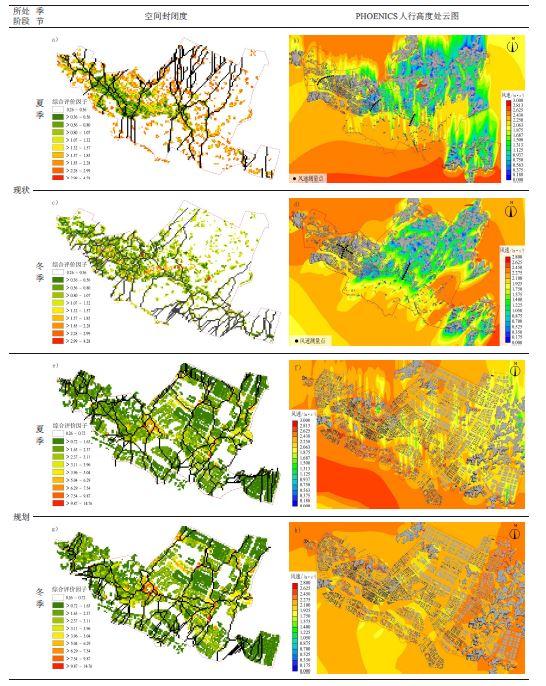
南方季风气候夏热冬冷的特殊性,让人们意识到城市在夏季应加强自然通风,冬季则需抵御寒冷的冬季风,而构建城市通风廊道不仅有利于缓解城市夏季的热岛效应、减轻大气污染,还能减少冬季风的侵袭。当前城市风环境研究一般选用数值模拟的方法,其可实现不同情境下的城市风环境模拟研究;但也存在短板,特别是在城市总体规划等大尺度的设计方案初期,受计算机性能限制需要花费大量的时间和精力。文章以湖南省衡阳县城为研究对象,提出通过规则建模的方法建立城市3D模型,并利用ArcGIS空间叠加构建城市空间封闭度综合评价模型。通过该方法计算出城市的潜在通风廊道,并与PHOENICS模拟的风速云图进行验证,结果基本吻合,验证了模型的可行性。研究发现:在设计初期阶段应考虑城市风环境变化,选择规则建模不仅有利于方案的快速建模,还能快捷构建规划方案的通风廊道;城市通风廊道的构建需要考虑多项城市要素,根据风道的不同作用空间在规划方案中构建了8条一级通风廊道和14条二级通风廊道,并比较PHOENICS的风速云图和综合评价结果,证明了由建筑、路网、水体、绿化系统所构建的廊道系统能较好地与通风廊道相重叠,并证明了风口、开敞空间、水域、道路和建筑的优化措施能有效改善规划方案的通风能力;对比单因子与多因子的评价结果,进一步论证了单一标准评价的局限性,而多因子评价更适合复杂的城市风环境;空间封闭度模型不仅考虑了地形高差,还考虑了建筑环境因子(天空开阔度、绝对粗糙度、迎风面积密度、平均高度、建筑密度),为城市通风廊道构建提供了一种更加便捷有效的新方法,有利于城市的绿色低碳建设。
向艳芬 , 郑伯红 , 郭睿 , 江燚晗 . 基于空间封闭度的城市通风廊道构建——以衡阳县城为例[J]. 热带地理, 2023 , 43(8) : 1523 -1535 . DOI: 10.13284/j.cnki.rddl.003570
The monsoon climate in southern China is characterized by hot summers and cold winters. These extreme conditions have caught the attention of researchers because of the importance of designing cities so as to strengthen natural ventilation in summer and reduce exposure to cold winds during winter. Not only do the design and construction of urban ventilation corridors lead to the mitigation of the urban heat island effect in summer, the corridors also contribute to reducing atmospheric pollution and the invasion of winter monsoons. This study is specifically concerned with an analytical method that can be used, especially during the planning and design of cities, to improve the urban wind environment. Currently, most urban wind environment studies generally adopt numerical simulations as the investigation method. To some extent, this approach can be helpful with urban wind environment analyses under different planning and design scenarios. Many existing studies indicate that this technique has the advantage of rendering urban wind environment predictions with reliable accuracy. Numerical wind environmental simulations—especially, Computational Fluid Dynamics (CFD) simulation models—have been used for urban planning and design optimization. However, these models have certain limitations about the planning and workflow that the numerical simulation techniques require. For instance, in the early stages of urban design schemes, such as the master planning stage, the workload and amount of time required to perform the necessary repetitive simulations become enormous (not only in terms of time and energy but also with regard to expertise). The thorough and exhaustive numerical simulation task sometimes becomes impossible because of the limitations of computer performance, particularly for large city-scale areas. In this study, Hengyang County, Hunan Province, was selected as the study area. A new method was proposed to reduce the workload, time, and computational equipment requirements for analyzing the wind environment of a large city-scale area during the early stages of urban planning and design. The proposed method starts with the construction of a 3D model of the city using rule-based modeling, followed by a comprehensive evaluation model implemented in ArcGIS to assess the urban spatial enclosure and its influence on urban ventilation corridors. We used the least-cost path to generate ventilation corridors under different wind directions. The measurement points in the ventilation corridors of the city were selected to validate the wind speed cloud map simulated by PHOENICS. The simulation results were basically consistent with the site-measurements, thus demonstrating the validity of the evaluation model proposed in this study. Several findings are derived from this study. First, changes in the urban wind environment should be considered at the early stage of urban design. Second, the choice of rule-based modeling is not only beneficial to the quick modeling of the design scheme but is also efficient for a quick modeling of ventilation corridors. Third, the construction of urban ventilation corridors needs to consider several urban elements. The 8 primary ventilation corridors and 14 secondary ventilation corridors are constructed in the planning scheme according to the different action spaces of the wind corridors. Comparing the wind speed map of PHOENICS and the comprehensive evaluation results, it is proved that the urban ventilation corridor system constructed by buildings, road networks, water, and greenery systems can be quite overlapped with the ventilation corridors, and it also proved that the optimization measures based on wind openings, open space, water, roads, and buildings can effectively improve the ventilation capacity of the planning scheme. The study further demonstrates the limitation of single-criteria evaluation compared to multi-criteria evaluation which is more suitable for the complex urban wind environment. In addition to terrain height differences, the urban spatial enclosure model reflects consideration for building environment factors, such as the sky view factor, absolute roughness, frontal area density, average height, and building density. Thus, we propose a more convenient and effective method for the design of urban ventilation corridors that can be beneficial for achieving green and low-carbon urban planning.
表1 夏、冬季潜在风道数值对比Table1 Comparison of measured values of urban ventilation corridor in summer and winter |
| 测量点 | 风速/(m·s-1) | |
|---|---|---|
| 实测 | 模拟 | |
| 沿清江路 | 1.6 | 0.8 |
| 海英大道 | 1.8 | 1.6 |
| 蒸水河西段 | 2.0 | 1.7 |
| 保安路 | 1.0 | 0.7 |
| 新正路 | 1.7 | 1.5 |
| 洪山路 | 1.4 | 1.0 |
表2 衡阳县城一、二级城市通风廊道汇总Table 2 The summary table of primary and secondary urban ventilation corridors in Hengyang county |
| 编号 | 名称 | 分级 | 走向 | 分类 | 备注 |
|---|---|---|---|---|---|
| 1 | 蒸水河西段通风廊道 | 一级 | 南北 | 河流型 | 蒸水河西段结合虎形山郊野公园和西渡公园布置,联系翻冲风口 |
| 2 | 解放西路通风廊道 | 一级 | 东西 | 道路型 | 解放西路两侧贯彻三区,联系岭湾风口 |
| 3 | 清江路通风廊道 | 一级 | 南北 | 道路型 | 清江路两侧结合清水垄公园,联系柿子塘风口和岳塘风口 |
| 4 | 洪山路通风廊道 | 一级 | 南北 | 道路型 | 洪山路两侧结合清水垄公园和米子水库,联系船山发展核中心,联系柿子塘风口 |
| 5 | 蒸水河中段通风廊道 | 一级 | 东西 | 河流型 | 结合中洲公园、船山广场布置 |
| 6 | 海英大道—农业园通风廊道 | 一级 | 南北 | 绿地型 | 结合海英大道和英睦塘公园布置 |
| 7 | 两里塘通风廊道 | 一级 | 南北 | 复合型 | 两里塘路与两里塘郊野生态公园结合布置,联系挂榜山风口 |
| 8 | 城东大道通风廊道 | 一级 | 南北 | 道路型 | 联系江山郊野公园,联系兰水塘风口和发家塘风口 |
| 9 | 燕西大道北段通风廊道 | 二级 | 南北 | 道路型 | 联系虎形山郊野公园与翻冲风口 |
| 10 | 学前路—中心路通风廊道 | 二级 | 东西 | 复合型 | 联系蒸水河风道和明翰公园,引风入中心 |
| 11 | 新正路通风廊道 | 二级 | 东西 | 道路型 | 新正路两侧绿带结合明翰广场布置 |
| 12 | 蒸水河西南段通风廊道 | 二级 | 东西 | 复合型 | 通过蒸水河联系中洲公园,虎形山郊野公园 |
| 13 | 城南大道通风廊道 | 二级 | 东西 | 道路型 | 城南大道两侧,结合南山广场布置,联系合家桥风口和发家塘风口 |
| 14 | 西渡公园—明翰广场—中洲公园通风廊道 | 二级 | 南北 | 复合型 | 保安路两侧结合中洲公园和明翰公园以及西渡公园布置 |
| 15 | 衡邵公路通风廊道 | 二级 | 南北 | 绿地型 | 结合衡邵公路两侧绿带布置 |
| 16 | 公园北路通风廊道 | 二级 | 东西 | 道路型 | 结合清水垄公园、英睦塘公园布置 |
| 17 | 人和路通风廊道 | 二级 | 东西 | 道路型 | 人和路两侧,联系两里塘郊野公园 |
| 18 | 联胜路东段通风廊道 | 二级 | 东西 | 道路型 | 结合米子公园和农业生态园布置 |
| 19 | 开福路通风廊道 | 二级 | 南北 | 道路型 | 开福路两侧,结合南山广场布置 |
| 20 | 两里塘公园—农业生态园通风廊道 | 二级 | 南北 | 绿地型 | 两个公园绿带形成联系兰水塘风口的风道 |
| 21 | 市场路通风廓道 | 二级 | 东西 | 道路型 | 市场路两端,联系江山郊野生态公园 |
| 22 | 江山公园通风廊道 | 二级 | 南北 | 绿地型 | 从江山郊野生态公园引风入城,联系挂榜山风口 |

向艳芬:论文选题,论文设计,调查研究,提出论文研究方法,可视化呈现,论文撰写与修改;
郑伯红:指导研究过程,提出修改意见,提升论文质量等;
郭 睿:调查研究;
江燚晗:前期分析,制图。
|
Ashie Y, Hirano K, and Kono T. 2009. Effects of Sea Breeze on Thermal Environment as a Measure Against Tokyo's Urban Heat Island. Yokohama: The Seventh International Conference on Urban Climate.
|
|
Chang S, Jiang Q, and Zhao Y. 2018. Integrating CFD and GIS into the Development of Urban Ventilation Corridors: A Case Study in Changchun City, China. Sustainability, 10(6): 1814.
|
|
Chen L, and Ng E. 2011. Quantitative Urban Climate Mapping Based on a Geographical Database: A Simulation Approach Using Hong Kong as a Case Study. International Journal of Applied Earth Observation and Geoinformation, 13(4): 586-594.
|
|
Gal T, Lindberg F, and Unger J. 2009. Computing Continues Sky View Factor Using 3D Urban Raster and Vector Databases: Comparison and Application to Urban Climate. Theoretical and Applied Climatology, (1/2): 111-123.
|
|
Germano M. 2007. Assessing the Natural Ventilation Potential of the Basel Region. Energy and Buildings, 39(11): 1159-1166.
|
|
Grimmond C S B, and Oke T R. 1999. Aerodynamic Properties of Urban Areas Derived from Analysis of Surface Form. Journal of Applied Meteorology, 38: 1262-1292.
|
|
Hsieh C, and Huang H. 2016. Mitigating Urban Heat Islands: A Method to Identify Potential Wind Corridor for Cooling and Ventilation. Computers, Environment and Urban Systems, 57: 130-143.
|
|
Kanda M, Inagaki A, Miyamoto T, Gryschka M, and Raasch S. 2013. A New Aerodynamic Parametrization for Real Urban Surfaces. Boundary-Layer Meteorology, 148(2): 357-377.
|
|
Kondo J, and Yamazawa H. 1986. Aerodynamic Roughness over an Inhomogeneous Ground Surface. Boundary-Layer Meteorology, 35(4): 331-348.
|
|
李廷廷. 2017. 基于城市形态和地表粗糙度的城市风道构建及规划方法研究. 深圳:深圳大学.
Li Tingting. 2017. Research on the Construction and Planning of Urban Ventilation Based on Urban Morphology and Surface Roughness: A Case Study of Shenzhen, China. Shenzhen: Shenzhen University.
|
|
刘勇洪,张硕,程鹏飞,陈鹏,魏来,房小怡. 2017. 面向城市规划的热环境与风环境评估研究与应用——以济南中心城为例. 生态环境学报,26(11):1892-1903.
Liu Yonghong, Zhang Shuo, Cheng Pengfei, Chen Peng, Wei Lai, and Fang Xiaoyi. 2017. Research and Application of Heat and Ventilation Environment Assessment for City Planning: A Case Study of Jinan Central Urban Area. Ecology and Environmental Sciences, 26(11): 1892-1903.
|
|
刘勇洪,徐永明,张方敏,程宸. 2019. 城市地表通风潜力研究技术方法与应用——以北京和广州中心城为例. 规划师,35(10):32-40.
Liu Yonghong, Xu Yongming, Zhang Fangmin, and Cheng Chen. 2019. Research and Application of Urban Surface Ventilation Potential: Cases of Beijing and Guangzhou. Planners, 35(10): 32-40.
|
|
卢飞红. 2016. 基于GIS和地表粗糙度评价的南京市主城区通风廊道识别研究. 南京:南京大学.
Lu Feihong.2016. Identification of Ventilation Corridor in Urban Ares Based on GIS and Roughness Evaluation: A Case Study of Nanjing. Nanjing: Nanjing University.
|
|
骆燕文,何江. 2017. “城市引擎”规则建模在城市规划中的作用与特点. 国际城市规划,32(3):106-112.
Luo Yanwen, and He Jiang. 2017. Functions and Characteristics of City Engine and Its Rule-Based Modeling in Urban Planning. Urban Planning International, 32(3): 106-112.
|
|
Man S W, Niched J E, To P H, and Wong J. 2010. A Simple Method for Designation of Urban Ventilation Corridors and Its Application to Urban Heat Island Analysis. Building & Environment, 45(8): 1880-1889.
|
|
Ng E, Yuan C, Chen L, Ren C, and Fung J C H. 2011. Improving the Wind Environment in High-Density Cities by Understanding Urban Morphology and Surface Roughness: A Study in Hong Kong. Landscape and Urban Planning, 101(1): 59-74.
|
|
Peng F, Wong M S, Wang Y, and Nichol J E. 2017. Modeling of Urban Wind Ventilation Using High Resolution Airborne Lidar Data. Computers, Environment and Urban Systems, 64: 81-90.
|
|
Plate E J. 1999. Methods of Investigating Urban Wind Fields—Physical Models. Atmospheric Environment, 33(24/25): 3981-3989.
|
|
Ren C, Yang R, Cheng C, Xing P, Fang X Y, Zhang S, Wang H F, Shi Y, Zhang X Y, Kwok Y T, and Ng E. 2018. Creating Breathing Cities by Adopting Urban Ventilation Assessment and Wind Corridor Plan - The Implementation in Chinese Cities. Journal of Wind Engineering and Industrial Aerodynamics, 182: 170-188.
|
|
任超,吴恩融,卢茨·卡施纳. 2013. 城市环境气候信息在德国城市规划中的应用及其启示. 国际城市规划,28(4):91-99.
Ren Chao, Ng Edward, and Lutz Katzschner. 2013.The Application of Urban Environmental and Climatic Information in German Urban Planning and the Inspirations for China. Urban Planning International, 28(4): 91-99.
|
|
日本建築学会. 2007. 市街地风环境予测のための流体数値解析ガイドブック―ガイドラインと検证用データベース―. 东京:日本建築学会.
Architectural Institute of Japan. 2007. Guidebook of Numerical Fluid Analysis for Prediction of Urban Wind Environment -Guideline and Database for Verification. Tokyo: Architectural Institute of Japan.
|
|
申鑫杰,赵芮,何瑞珍,王琦,郭煜琛. 2020. 郑州市市区风环境模拟研究. 地球信息科学学报,22(6):1349-1357.
Shen Xinjie, Zhao Rui, He Ruizhen, Wang Qi, and Guo Yuchen. 2020. Research on Urban Wind Environment Simulation: A Case Study of Zhengzhou Central Area. Journal of Geo-Information Science, 22(6): 1349-1357.
|
|
史兵,汪新,赵冬. 2017. 天空开阔度对城市住宅小区热环境影响的数值模拟. 应用力学学报,34(6):1181-1186.
Shi Bing, Wang Xin, and Zhao Dong. 2017. Numerical Simulation of the Influence of Sky Openness on the Thermal Environment of Urban Residential District. Chinese Journal of Applied Mechanics, 34(6): 1181-1186.
|
|
唐玉琪,麻炳欣,王晓峰,岳彩军,谈建国. 2020. 形态学方法在上海城市下垫面空气动力学参数估算中的适用性分析. 暴雨灾害,39(4):382-391.
Tang Yuqi, Ma Bingxin, Wang Xiaofeng, Yue Caijun, and Tan Jianguo. 2020. Analysis on Applicability of Morphology Methods in the Estimation of Aerodynamic Parameter of Urban Areas in Shanghai. Torrential Rain and Disasters, 39(4): 382-391.
|
|
Trubka R, Glackin S, Lade O, and Pettit C. 2016. A Web-Based 3D Visualization and Assessment System for Urban Precinct Scenario Modeling. ISPRS Journal of Photogrammetry and Remote Sensing, 117: 175-186.
|
|
万艳华. 2010. 长江中游传统村镇建筑文化研究. 武汉:武汉理工大学.
Wan Yanhua. 2010. A Study on the Architectural Culture of Traditional Villages and Towns in Mid-Changjiang River. Wuhan: Wuhan University of Technology.
|
|
王伟武,黎菲楠,王頔,汪琴. 2019. 基于通风潜力及风特征量化分析的城市风道构建. 浙江大学学报(工学版),53(3):470-481.
Wang Weiwu, Li Feinan, Wang Di, and Wang Qin. 2019. Urban Ventilation Corridor Construction Based on Ventilation Potential and Quantitative Analysis of Wind Characteristics. Journal of Zhejiang University (Engineering Science), 53(3): 470-481.
|
|
王学军,郭亚军. 2006. 基于G1法的判断矩阵的一致性分析. 中国管理科学,(3):65-70.
Wang Xuejun, and Guo Yajun. 2006. Analyzing the Consistency of Comparison Matrix Based on G1 Method. Chinese Journal of Management Science, (3): 65-70.
|
|
Wicht M, Wicht A, and Osińska-Skotak K. 2017. Detection of Ventilation Corridors Using a Spatio-Temporal Approach Aided by Remote Sensing Data. European Journal of Remote Sensing, 50(1): 254-267.
|
|
Williams C D, and Wardlaw R L. 1992. Determination of the Pedestrian Wind Environment in the City of Ottawa Using Wind Tunnel and Field Measurements. Journal of Wind Engineering and Industrial Aerodynamics, 41(1/3): 255-266.
|
|
Wong M S, Nichol J E, To P H, and Wang J. 2010. A Simple Method for Designation of Urban Ventilation Corridors and Its Application to Urban Heat Island Analysis. Building and Environment, 45(8): 1880–1889.
|
|
Yuan C, Ren C, and Ng E. 2014. GIS-Based Surface Roughness Evaluation in the Urban Planning System to Improve the Wind Environment- A Study in Wuhan, China. Urban Climate, 10: 585-593.
|
|
张弘驰. 2020. 基于迎风面积的滨海山地城市风廊发掘及设计策略. 大连:大连理工大学.
Zhang Hongchi. 2020. Ventilation Path Excavation and Design Strategy of Coastal Mountainous City Based on Frontal Area. Dalian: Dalian University of Technology.
|
|
张蒙. 2017. 山地传统民居及聚落选址的风水研究. 重庆:重庆师范大学.
Zhang Meng. 2017. A Feng Shui Study of Traditional Folk House & Settlement Site Selection in Mountainous Region. Chongqing: Chongqing Normal University.
|
|
张海龙. 2015. 基于遥感和城市空间形态学方法的城市热环境研究. 南京:南京信息工程大学.
Zhang Hailong. 2015. Study of Urban Thermal Environment Based on Remote Sensing and Urban Spatial Morphology. Nanjing: Nanjing University of Information Science and Technology.
|
|
赵敬源,宋晓明,刘加平. 2010. 城市气候环境图集的内容与应用. 城市问题,(7):19-22.
Zhao Jingyuan, Song Xiaoming, and Liu Jiaping. Content and Application of Urban Climate Environment Atlas. Urban Problems, (7): 19-22.
|
|
中华人民共和国国家技术监督局,中华人民共和国建设部. 1994. GB 50178-93 建筑气候区划标准. 北京:中国计划出版社.
The State Bureau of Quality and Technical Supervision, and Ministry of Construction of the People's Republic of China. 1994. Standard of Climate Regionalization for Architecture: GB 50178-93. Beijing: China Planning Press.
|
|
中华人民共和国国家发展和改革委员会,中华人民共和国住房和城乡建设部. 2016. 国家发展改革委 住房城乡建设部关于印发城市适应气候变化行动方案的通知. (2016-02-04)[2021-11-16]. https://www.ndrc.gov.cn/xxgk/zcfb/tz/201602/t20160216_963584.html?code=&state=123.
National Development and Reform Commission and Ministry of Housing and Urban-Rural Development of the People's Republic of China. 2016. Notice of the National Development and Reform Commission and Ministry of Housing and Urban-Rural Development on the Issuance of the Action Plan for Urban Adaptation to Climate Change. (2016-02-04) [2021-11-16]. https://www.ndrc.gov.cn/xxgk/zcfb/tz/201602/t20160216_963584.html?code=&state=123.
|
|
中共中央政治局. 2015. 中央城市工作会议. 北京:中华人民共和国住房和城乡建设部. (2015-12-23)[2021-11-16]. https://www.mohurd.gov.cn/xinwen/gzdt/201512/20151223_226063.html.
Political Bureau of the Central Committee of the Communist Party of China. 2015. Central City Work Conference. Beijing: Ministry of Housing and Urban-Rural Development of the People's Republic of China. (2015-12-23) [2021-11-16]. https://www.mohurd.gov.cn/xinwen/gzdt/201512/20151223_226063.html.
|
/
| 〈 |
|
〉 |