老龄人口与养老设施匹配关系时空演化研究——以广州市为例
|
周柳青(1986—),女,广东梅州人,高级工程师,硕士,主要研究方向为国土空间规划、城市更新及城乡专项规划研究,(E-mail)45134405@qq.com; |
收稿日期: 2022-10-31
修回日期: 2023-01-05
网络出版日期: 2023-09-11
基金资助
国家自然科学基金项目“智慧社会下的远程办公:时空模式、影响机理及空间效应”(42271210)
广东省自然科学基金面上项目“基于多源地理大数据的城市活力与建成环境关系研究:时空异质性、非线性与阈值效应”(2022A1515011572)
中央高校基本科研业务费项目“粤港澳大湾区空间集聚与扩散的过程与机制研究”(22qntd2001)
Spatiotemporal Evolution of the Matching Relationship between the Elderly Population and Facilities for the Elderly: A Case Study of Guangzhou
Received date: 2022-10-31
Revised date: 2023-01-05
Online published: 2023-09-11
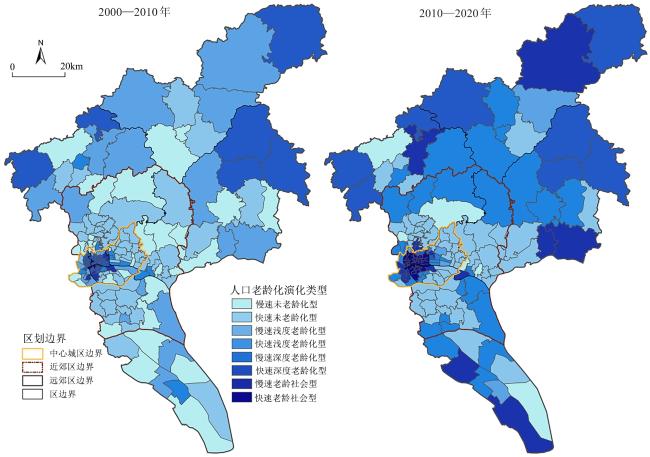
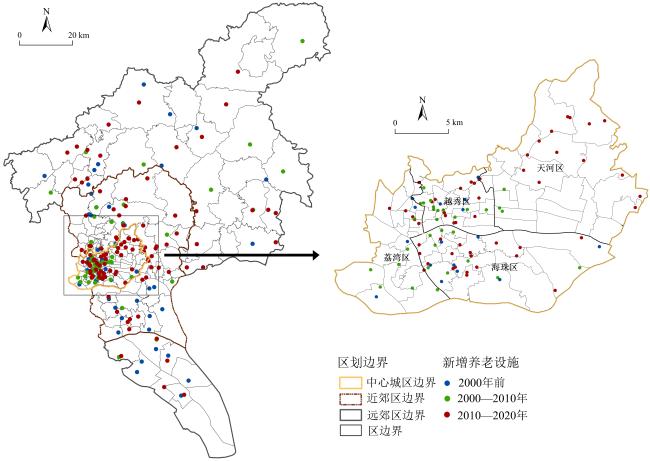
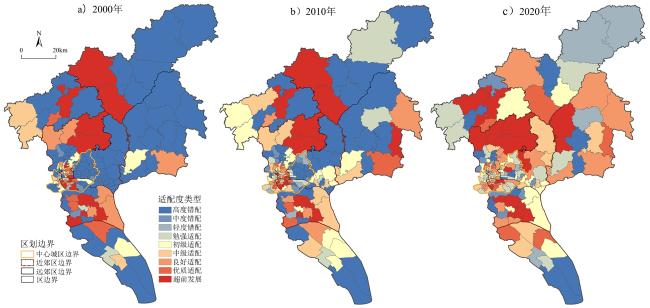
以广州市为例,利用人口普查和养老设施数据,以街道/镇为空间单元,分析2000—2020年老龄人口与养老设施空间的时空演化特征,并探究二者的匹配关系及其时空演化特征。结果表明:1)广州市老龄人口与养老设施空间不均衡特征愈加显著,相较于老龄人口持续的“高-低-中”圈层结构,养老设施经历从相对均衡转变为由内向外逐级递减的演化过程;2)广州市老龄人口与养老设施匹配关系虽然得到一定改善,但不匹配现象仍然突出;3)广州市老龄人口与养老设施匹配关系在中心城区、近郊区和远郊区的空间差异逐渐缩小,且匹配关系改善的空间单元存在明显的空间分异。
周柳青 , 周婷婷 , 王莉 , 王波 . 老龄人口与养老设施匹配关系时空演化研究——以广州市为例[J]. 热带地理, 2023 , 43(9) : 1777 -1786 . DOI: 10.13284/j.cnki.rddl.003739
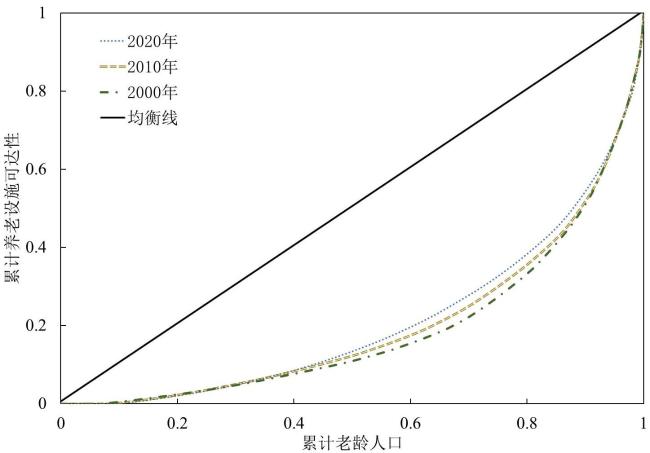
As places providing professional living care, facilities for the elderly (hereafter abbreviated as "facilities") are playing an increasingly important role in China's old-age service system. Evidence suggests that older adults who receive living care from nearby facilities enjoy better health outcomes than those who move to facilities over long distances. Therefore, a higher level of matching between the elderly population and facilities is crucial for improving service efficiency and facility support. Taking Guangzhou as a case study, this study collected data on the population census and facilities from 2000 to 2020. The data were used to analyze the spatiotemporal evolution of the elderly population, facilities, and their matching relationships, focusing on microscale units (i.e., sub-districts and towns). The results show that the uneven spatial distribution of both the elderly population and facilities is becoming more evident. Specifically, there is a stable "high-low-middle" sphere structure of the elderly population distribution. While the central areas are already home to an aged society, suburban areas have a relatively low level of population aging owing to the concentration of the modern service industry and strategic emerging industries that attract the working-age population. Accordingly, the level of population aging in outskirts is between those of the central and suburban areas. Compared to the consistent sphere structure of the elderly population distribution, the number of facilities has evolved from an even distribution to a polarized distribution that decreases stepwise from the inside to the outside. Although populations in both areas have aged rapidly, the number of facilities have increased considerably in the central areas, whereas limited growth has occurred in the outskirts. Second, from a global perspective, although the matching relationship between the elderly population and facilities has improved, the level remains low. Specifically, the Gini coefficient of the elderly population and facilities decreased from 0.62 in 2000 to 0.54 in 2020. However, even by 2020, 30% of the elderly population was able to enjoy living care from nearly 60% of facilities; instead, approximately 10% of the elderly population was not well covered by facilities. Third, from a local perspective, improvement in the matching relationship between the elderly population and facilities did not occur equally across Guangzhou. Specifically, although most sub-districts and towns have witnessed an improvement from a low level of "mismatch" to a medium level of "match," these sub-districts and towns are mainly distributed in Tianhe and Huangpu. Generally, even by 2020, few sub-districts and towns reached a high level of "match" relationship between the elderly population and facilities. The percentage of these subdistricts and towns, which are mainly concentrated in the central areas and are located near Baiyun and Panyu, has slowly increased from 25.4% in 2000 to 32.4% in 2020. Finally, some policy measures regarding the spatial planning of facilities have been independently proposed for the central areas, suburban areas, and outskirts based on the specific spatiotemporal evolution characteristics of the matching relationship between the elderly population and facilities during the last two decades.
表1 2000—2020年广州市老龄人口(≥65岁)与养老设施统计Table 1 Statistics of populationand facilities for the elderly(above 65 years old) in Guangzhou during 2000-2020 |
| 圈层结构 | 分区 | 2000年 | 2010年 | 2020年 | ||||||||
|---|---|---|---|---|---|---|---|---|---|---|---|---|
| 人口/人 | 人口占比/% | 养老设施/个 | 人口/人 | 人口占比/% | 养老设施/个 | 人口/人 | 人口占比/% | 养老设施/个 | ||||
| 中心城区 | 荔湾区 | 79 855 | 9.69 | 5 | 94 179 | 10.49 | 19 | 169 184 | 13.66 | 31 | ||
| 越秀区 | 110 231 | 11.33 | 4 | 132 848 | 11.48 | 13 | 164 984 | 15.88 | 22 | |||
| 海珠区 | 88 556 | 7.22 | 6 | 136 418 | 8.75 | 14 | 213 733 | 11.75 | 31 | |||
| 天河区 | 40 437 | 3.62 | 0 | 70 019 | 4.89 | 2 | 132 007 | 5.89 | 16 | |||
| 近郊区 | 白云区 | 67 693 | 3.82 | 11 | 101 803 | 4.63 | 17 | 207 876 | 5.55 | 32 | ||
| 黄埔区 | 19 182 | 4.33 | 0 | 33 801 | 4.40 | 2 | 70 258 | 5.56 | 16 | |||
| 番禺区 | 43 657 | 4.01 | 10 | 71 060 | 5.14 | 11 | 153 324 | 5.77 | 17 | |||
| 远郊区 | 花都区 | 43 473 | 6.40 | 4 | 58 158 | 4.20 | 7 | 109 297 | 6.65 | 15 | ||
| 南沙区 | 26 451 | 5.05 | 6 | 33 593 | 5.82 | 8 | 63 111 | 7.45 | 13 | |||
| 从化区 | 35 397 | 6.88 | 3 | 41 907 | 7.14 | 4 | 63 849 | 8.90 | 9 | |||
| 增城区 | 51 227 | 6.13 | 2 | 67 084 | 6.53 | 6 | 112 710 | 7.69 | 14 | |||
| 总计 | 606 159 | 6.10 | 51 | 840 870 | 6.62 | 103 | 1 460 333 | 7.82 | 216 | |||
表2 广州市区域人口老龄化演化类型Table 2 Types of regional population aging in Guangzhou |
| 类型 | ≥65岁人口占比/% | ≥65岁年均增长率/% | 特征 |
|---|---|---|---|
| 慢速未老龄化型 | PA≤7 | V PA≤4 | 该街道/镇人口老龄化程度较低,且长时期停滞于现人口老龄化阶段 |
| 快速未老龄化型 | PA≤7 | 4<V PA | 该街道/镇人口老龄化程度较低,且很快进入下一个人口老龄化阶段 |
| 慢速浅度老龄化型 | 7<PA≤10 | V PA≤4 | 该街道/镇人口老龄化程度不高,且长时期停滞于现人口老龄化阶段 |
| 快速浅度老龄化型 | 7<PA≤10 | 4<V PA | 该街道/镇人口老龄化程度不高,且很快进入下一个人口老龄化阶段 |
| 慢速深度老龄化型 | 10<PA≤14 | V PA≤4 | 该街道/镇人口老龄化程度较高,且长时期停滞于现人口老龄化阶段 |
| 快速深度老龄化型 | 10<PA≤14 | 4<V PA | 该街道/镇人口老龄化程度较高,且很快进入下一个人口老龄化阶段 |
| 慢速老龄社会型 | 14<PA | V PA≤4 | 该街道/镇人口老龄化程度极高,且长时期停滞于现人口老龄化阶段 |
| 快速老龄社会型 | 14<PA | 4<V PA | 该街道/镇人口老龄化程度极高,且很快进入下一个人口老龄化阶段 |
|
表3 2000—2020年广州市养老设施机构性质和规模等级Table 3 Statistics of institution nature, scale and grade of facility for the elderly in Guangzhou during 2000-2020 |
| 机构属性 | 年份 | 指标 | 中心城区 | 近郊区 | 远郊区 |
|---|---|---|---|---|---|
| 机构性质 | 2000 | 民办占比/% | 75 | 31.8 | 6.7 |
| 相对份额/% | 60 | 35 | 5 | ||
| 2010 | 民办占比/% | 91.7 | 46.7 | 8 | |
| 相对份额/% | 73.3 | 23.3 | 3.3 | ||
| 2020 | 民办占比/% | 95 | 70.3 | 31.4 | |
| 相对份额/% | 60.8 | 29.1 | 10.1 | ||
| 规模等级 | 2000 | 小型/个 | 7 | 9 | 14 |
| 中型/个 | 5 | 8 | 1 | ||
| 大型/个 | 3 | 4 | 0 | ||
| 2010 | 小型/个 | 26 | 13 | 20 | |
| 中型/个 | 16 | 9 | 2 | ||
| 大型/个 | 6 | 10 | 1 | ||
| 2020 | 小型/个 | 56 | 25 | 40 | |
| 中型/个 | 28 | 18 | 7 | ||
| 大型/个 | 17 | 21 | 4 |

1 全国人口普查数据来源于国家统计局网站,网址:http://www.stats.gov.cn/sj/pcsj/。
2 采用≥65岁人口占比作为老龄化指标。当占比达到7%,表明进入老龄化社会;当占比达到7%~14%、14%~20%、20%~40%时,则分别处于轻度老龄化、中度老龄化和重度老龄化阶段。
3 “四二一”家庭指家庭中包括4位老人,1对为独生子女的夫妻,1个孩子。
4 鉴于数据有限,本研究养老设施特指机构养老。下文同。
5 广州市人口普查数据来源于广州市统计局网站,网址:http://tjj.gz.gov.cn/stats_newtjyw/tjsj/pcsj/4jpsjhb/。
6 为保持空间单元的一致性,以2020年行政区划为基准(共计176个街道/镇),依据行政区划调整记录,相应地归并2000、2010年的空间单元。
7 广州市养老设施数据来源于广州市民政局网站,网址:http://mzj.gz.gov.cn/gk/fwjgylb/index.html。
周柳青:数据收集、论文撰写;
周婷婷:论文选题、研究框架与思路、论文修改;
王 莉:数据处理、图表制作、论文排版;
王 波:论文修改、获取基金资助。
|
程敏,崔晓. 2022. 兼顾公平和效率的养老机构空间配置优化研究——以上海市闵行区为例. 地域研究与开发,41(3):43-48.
Cheng Min, and Cui Xiao. 2022. Research on Spatial Configuration of Residential Care Homes Based on Principles of Fairness and Efficiency: A Case Study of Minhang District in Shanghai City. Areal Research and Development, 41(3): 43-48.
|
|
戴靓华,周典,王亮. 2018. 城市社区医养结合型养老设施空间策略研究. 现代城市研究,(8):7-12.
Dai Lianghua, Zhou Dian, and Wang Liang. 2018. Study on Spatial Strategies of Medical-Nursing Combined Facilites for the Aged in Urban Community. Modern Urban Research, (8): 7-12.
|
|
戴维,铃木博志,长谷川直树. 2012. 北京养老服务机构入住理由及位置选择的初探——关于合理布局建设养老服务机构. 城市规划,36(9):77-84.
Dai Wei, Suzuki Hiroshi, and Hasegawa Naoki. 2012. Residence Reasons and Location Selection of Welfare Facilities for the Elderly in Beijing: The Ideal Way to Allocate Welfare Facilities for the Elderly. City Planning Review, 36(9): 77-84.
|
|
丁秋贤,朱丽霞,罗静. 2016. 武汉市养老设施空间可达性分析. 人文地理,31(2):36-42.
Ding Qiuxian, Zhu Lixia, and Luo Jing. 2016. Analysing Spatial Accessibility to Residential Care Facilities in Wuhan. Human Geography, 31(2): 36-42.
|
|
杜鹏,孙鹃娟,张文娟,王雪辉. 2016. 中国老年人的养老需求及家庭和社会养老资源现状——基于2014年中国老年社会追踪调查的分析. 人口研究,40(6):49-61.
Du Peng, Sun Juanjuan, Zhang Wenjuan, and Wang Xuehui. 2016. The Demands of Old-Age Care and the Family and Social Resources for the Chinese Elderly: A Study Based on 2014 China Longitudinal Aging Social Survey. Population Research, 40(6):49-61.
|
|
方世敏,黄琰. 2020. 长江经济带旅游效率与规模的时空演化及耦合协调. 地理学报,75(8):1757-1772.
Fang Shimin, and Huang Yan. 2020. Spatio-Temporal Evolutions and Coordination of Tourism Efficiency and Scale in the Yangtze River Economic Belt. Acta Geographical Sinica, 75(8): 1757-1772.
|
|
高晓路,颜秉秋,季珏. 2012. 北京城市居民的养老模式选择及其合理性分析. 地理科学进展,31(10):1274-1281.
Gao Xiaolu, Yan Bingqiu, and Ji Jue. 2012. Urban Elders' Desirable Caring Patterns and Its Rationality: A Decision Tree Analysis. Progress in Geography, 31(10): 1274-1281.
|
|
广州市民政局. 2012. 广州市民办社会福利机构资助办法的通知. (2012-03-29)[2022-07-20]. http://mzj.gz.gov.cn/gkmlpt/content/5/5492/post_5492861. html#345.
Bureau of Civil Affairs of Guangzhou Municipalit. 2012. Notice on the Subsidy Measures for Private Social Welfare Institutions in Guangzhou City. (2012-03-29) [2022-07-20]. http://mzj.gz.gov.cn/gkmlpt/content/5/5492/post_5492861.html#345.
|
|
广州市人民政府. 2020. 广州市街镇综合养老服务中心(颐康中心)建设提升行动计划. (2020-09-10)[2020-10-15]. https://www.gz.gov.cn/xw/jrgz/content/post_6536284.html.
Guangzhou Municipal Government. 2020. Guangzhou Street Town Comprehensive Elderly Care Service Center (Yikang Center) Construction Improvement Action Plan. (2020-09-10) [2020-10-15]. https://www.gz.gov.cn/xw/jrgz/content/post_6536284.html.
|
|
国务院. 2021a. 国务院关于印发“十四五”国家老龄事业发展和养老服务体系规划的通知. (2021-12-30)[2022-02-12]. https://www.gov.cn/zhengce/content/2022-02/21/content_5674844. htm.
State Council. 2021a. Notice of the State Council on the Issuance of the "14th Five-Year Plan" for the Development of the National Old-Age Career and the Old-Age Service System. (2021-12-30) [2022-02-12]. https://www.gov.cn/zhengce/content/2022-02/21/content_5674844. htm.
|
|
国务院. 2021b. 中共中央国务院关于加强新时代老龄工作的意见. (2021-11-18)[2021-11-24]. https://www.gov.cn/zhengce/2021-11/24/content_5653181.htm.
State Council. 2021b. Opinions of the Central Committee of the Communist Party of China and the State Council on Strengthening the Work on Aging in the New Era. (2021-11-18) [2021-11-24]. https://www.gov.cn/zhengce/2021-11/24/content_5653181.htm.
|
|
韩非,罗仁朝. 2020. 基于可达性测度的城市社区居家养老服务供需匹配研究——以南京为例. 经济地理,40(9):91-101.
Han Fei, and Luo Renchao. 2020. Matching of Supply and Demand for Community Service-Oriented Home Care Facilities Based on Accessibility Measurement: A Case Study of Nanjing. Economic Geography, 40(9): 91-101.
|
|
吉宇琴,姜会明. 2022. 新时代老龄化与养老资源适配度时空差异及其影响因素分析. 地理科学,42(5):851-862.
Ji Yuqin, and Jiang Huimin. 2022. Spatial and Temporal Differences and Influencing Factors of the Adaptation Degree of Aging and Pension Resources in the New Era. Scientia Geographica Sinica, 42(5): 851-862.
|
|
李小云,田银生,陈锦棠. 2011. 老龄化社会背景下对我国城市规划的思考. 热带地理,31(6):575-579.
Li Xiaoyun, Tian yinsheng, and Chen Jintang. 2011. Reflections of Urban Planning on the Context of an Aging Society. Tropical Geography, 31(6): 575-579.
|
|
林琳,马飞. 2007. 广州市人口老龄化的空间分布及趋势. 地理研究,26(5):1043-1054.
Lin Lin, and Ma Fei. 2007. Spatial Distributionand Trends of the Aging of Population in Guangzhou. Geographical Research, 26(5): 1043-1054.
|
|
林琳,肖纬,顾敏煜,范艺馨,钟志平. 2022. 广州长者饭堂供需匹配的类型、差异及调整思路. 热带地理,42(8):1301-1313.
Lin Lin, Xiao Wei, Gu Minyu, Fan Yixin, and Zhong Zhiping. 2022. Types, Differences, and Optimization of the Spatial Match of Supply and Demand of Elderly Canteens in Guangzhou. Tropical Geography, 42(8): 1301-1313.
|
|
Loo B P Y, Lam W W, Mahendran R, and Katagiri K. 2017. How is the Neighborhood Environment Related to the Health of Seniors Living in Hong Kong, Singapore, and Tokyo? Some Insights for Promoting Aging in Place. Annals of the American Association of Geographers, 107(4): 812-828.
|
|
马慧强,廉倩文,韩增林,弓志刚,李哲. 2020. 基本公共服务-城镇化-区域经济耦合协调发展时空演化. 经济地理,40(5):19-28.
Ma Huiqiang, Lian Qianwen, Han Zenglin, Gong Zhigang, and Li Zhe. 2020. Spatial-Temporal Evolution of Coupling and Coordinated Development of Basic Public Services, Urbanization and Regional Economy. Economic Geography, 40(5): 19-28.
|
|
民政部. 2012. 民政部关于鼓励和引导民间资本进入养老服务领域的实施意见. (2012-07-24)[2021-07-25]. https://xxgk.mca.gov.cn:8445/gdnps/pc/content.jsp?mtype=1&id=116530.
Ministry of Civil Affairs of the People's Republic of China. 2012. Implementation Opinions on Encouraging and Guiding Private Capital to Enter the Field of Elderly Care Services. (2012-07-24) [2021-07-25]. https://xxgk.mca.gov.cn:8445/gdnps/pc/content.jsp?mtype=1&id=116530.
|
|
民政部. 1996. 中华人民共和国老年人权益保障法. (1996-08-29)[2022-08-30]. http://www. npc. gov. cn/zgrdw/wxzl/gongbao/1996-08/29/content_1479994. htm. [Ministry of Civil Affairs of the People's Republic of China. 1996. Law of the People's Republic of China on the Protection of the Rights and Interests of the Elderly. (1996-08-29) [2022-08-30]. http://www.npc.gov.cn/zgrdw/wxzl/gongbao/1996-08/29/content_1479994.htm. ]
|
|
彭建东,邢露,杨红. 2022. 基于供需匹配的养老服务设施规划布局研究. 地球信息科学学报,24(7):1349-1362.
Peng Jiandong, Xing Lu, and Yang Hong. 2022. Research on Planning and Layout of Elderly Care Service Facilities Based on Supply-Demand Matching. Journal of Geo-Information Science, 24(7): 1349-1362.
|
|
曲鹏慧,张培刚,李蔚然,陈宏胜. 2022. 深度老龄化背景下县域养老服务设施布局规划策略——以徐州市沛县为例. 规划师,38(3):117-124.
Qu Penghui, Zhang Peigang, Li Weiran, and Cheng Hongsheng. 2022. The Planning Method of Elderly Care Service Facilities Layout in Counties at the Advanced Stage of Aging: A Case Study of Pei County, Xuzhou. Planners, 38(3): 117-124.
|
|
Tao Z, Cheng Y, and Liu J. 2020. Hierarchical Two-Step Floating Catchment Area (2SFCA) Method: Measuring the Spatial Accessibility to Hierarchical Healthcare Facilities in Shenzhen, China. International Journal for Equity in Health, 19 (1): 164-179.
|
|
陶卓霖,程杨,戴特奇,李雪. 2015. 基于公平最大化目标的2020年北京市养老设施布局优化. 地理科学进展,34(12):1609-1616.
Tao Zhuolin, Cheng Yang, Dai Teqi, and Li Xue. 2015. Spatial Optimization of Residential Care Facility Locations in 2020 in Beijing: Maximum Equity in Accessibility. Progress in Geography, 34(12): 1609-1616.
|
|
王波,卢佩莹,曹彦芹,甄峰. 2019. 中国养老政策的演进及智慧社会下居家养老的发展. 科技导报,37(6):6-12.
Wang Bo, Loo Becky P Y, Cao Yanqin, and Zhen Feng. 2019. China's Policy on Older People and Towards a New Framework of Supporting Aging-in-Place in the E-Society. Science & Technology Review, 37(6): 6-12.
|
|
王兰,周楷宸,汪子涵. 2021. 健康公平理念下社区养老设施的空间分布研究——以上海市中心城区为例. 人文地理,36(1):48-55.
Wang Lan, Zhou Kaichen, and Wang Zihan. 2021. Spatial Distribution of Community Pension Facilities from The Perspective of Healthy Equity: A Case Study of the Central City of Shanghai. Human Geography, 36(1): 48-55.
|
|
王志宝,孙铁山,李国平. 2013. 近20年来中国人口老龄化的区域差异及其演化. 人口研究,37(1):66-77.
Wang Zhibao, Sun Tieshan, and Li Guoping. 2013. Regional Differences and Evolutions of Population Aging in China. Population Research, 37(1): 66-77.
|
|
席晶,程杨. 2015. 北京市养老机构布局的时空演变及政策影响. 地理科学进展,34(9):1187-1194.
Xi Jing, and Cheng Yang. 2015. Spatiotemporal Evolution of Residential Care Facilities in Beijing and Policy Impacts. Progress in Geography, 34(9): 1187-1194.
|
|
谢淼,周素红. 2014. 就地老化与居住迁移:广州市中心城区老龄化地域空间格局的变化及动因. 规划师,30(10):96-103.
Xie Miao, and Zhou Suhong. 2014. Aging in Place and Residential Relocation: Spatial Transition and Problems in Guangzhou. Planners, 30(10): 96-103.
|
|
夏永久,邓世玉,王越. 2021. 基于生活圈理论的合肥市城市养老服务设施空间配置合理性研究. 热带地理,41(4):769-777.
Xia Yongjiu, Deng Shiyu, and Wang Yue. 2021. The Rationality of Spatial Allocation of Pension Service Facilities in Hefei City Based on Life Cycle Theory. Tropical Geography, 41 (4): 769-777.
|
|
阎志强. 2011. 广州人口老龄化与养老机构发展分析. 南方人口,26(6):1-7.
Yan Zhiqiang. 2011. An Analysis of the Organizations Supporting the Old at the Aging of Population in Guangzhou. South China Population, 26(6): 1-7.
|
|
Zhang F, Loo B P Y, and Wang B. 2022. Aging in place: From the Neighborhood Environment, Sense of Community to Life Satisfaction. Annals of the American Association of Geographers, 112(5): 1484-1499.
|
|
周春山,童新梅,王珏晗,赖舒琳. 2018. 2000—2010年广州市人口老龄化空间分异及形成机制. 地理研究,37(1):103-118.
Zhou Chunshan, Tong Xinmei, Wang Juehan, and Lai Shulin. 2018. Spatial Differentiation and the Formation Mechanism of Population Aging in Guangzhou in 2000-2010. Geographical Research, 37(1): 103-118.
|
|
住房城乡建设部. 2017. 老年人照料设施建筑设计标准. (2017-11-30)[2018-07-20] . https://www.mohurd.gov.cn/gongkai/zhengce/zhengcefilelib/201807/20180702_236618.html.
Ministry of Housing and Urban-Rural Development. 2017. Architectural Design Standards for Elderly Care Facilities. (2017-11-30) [2018-07-20]. https://www.mohurd.gov.cn/gongkai/zhengce/zheng cefilelib/201807/20180702_236618.html.
|
/
| 〈 |
|
〉 |