“三生”协同视角下生态空间识别与优化研究进展与展望
高新蕊:可视化分析及分析结果总结、研究结论、论文修改;
李平星:论文选题、理论基础、修改指导、基金支持;
梁 鑫:论文修改、研究展望、文本校对;
王履华:论文修改。
|
高新蕊(2002—),女,河北唐山人,硕士研究生,主要研究方向为土地利用的生态环境效应,(E-mail)gaoxinruiii@163.com; |
收稿日期: 2025-05-16
修回日期: 2025-06-25
网络出版日期: 2025-11-04
基金资助
国家自然科学基金项目(42377488)
Research Progress and Prospects for Ecological Space Identification and Optimization from the Perspective of "Sansheng" Synergy
Received date: 2025-05-16
Revised date: 2025-06-25
Online published: 2025-11-04
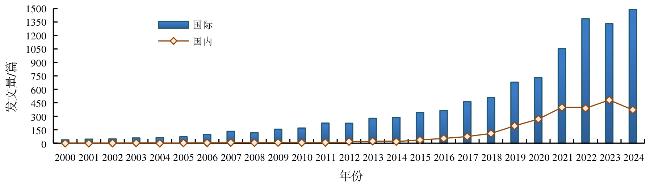
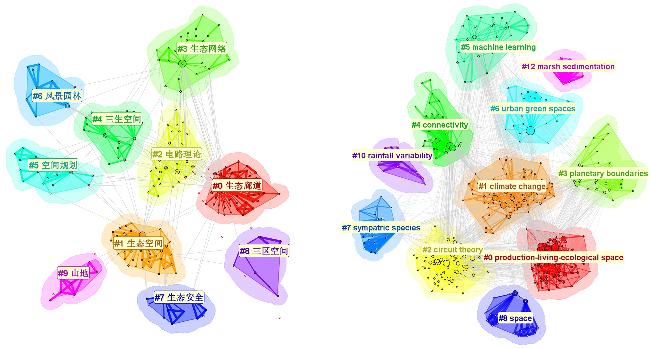
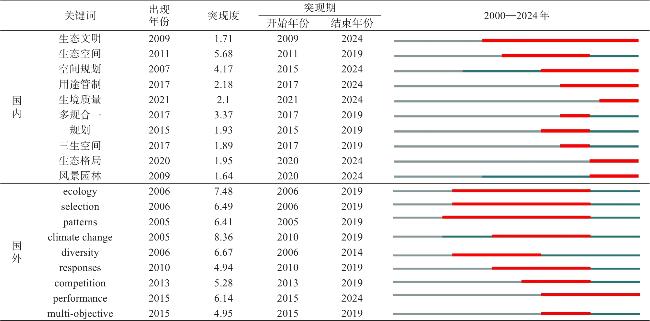
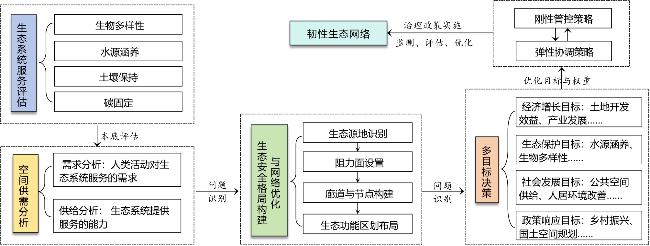
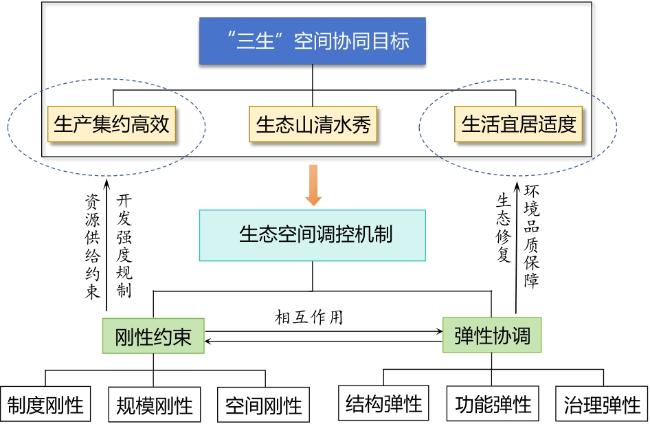
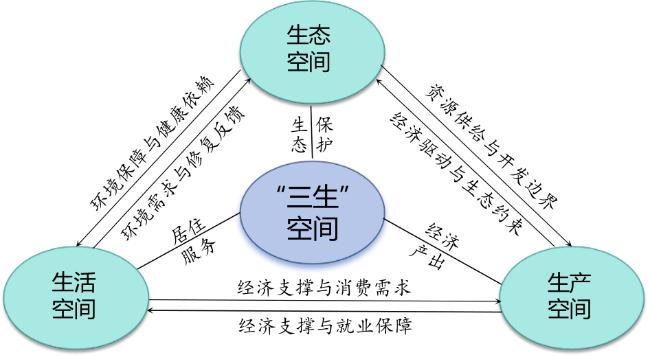
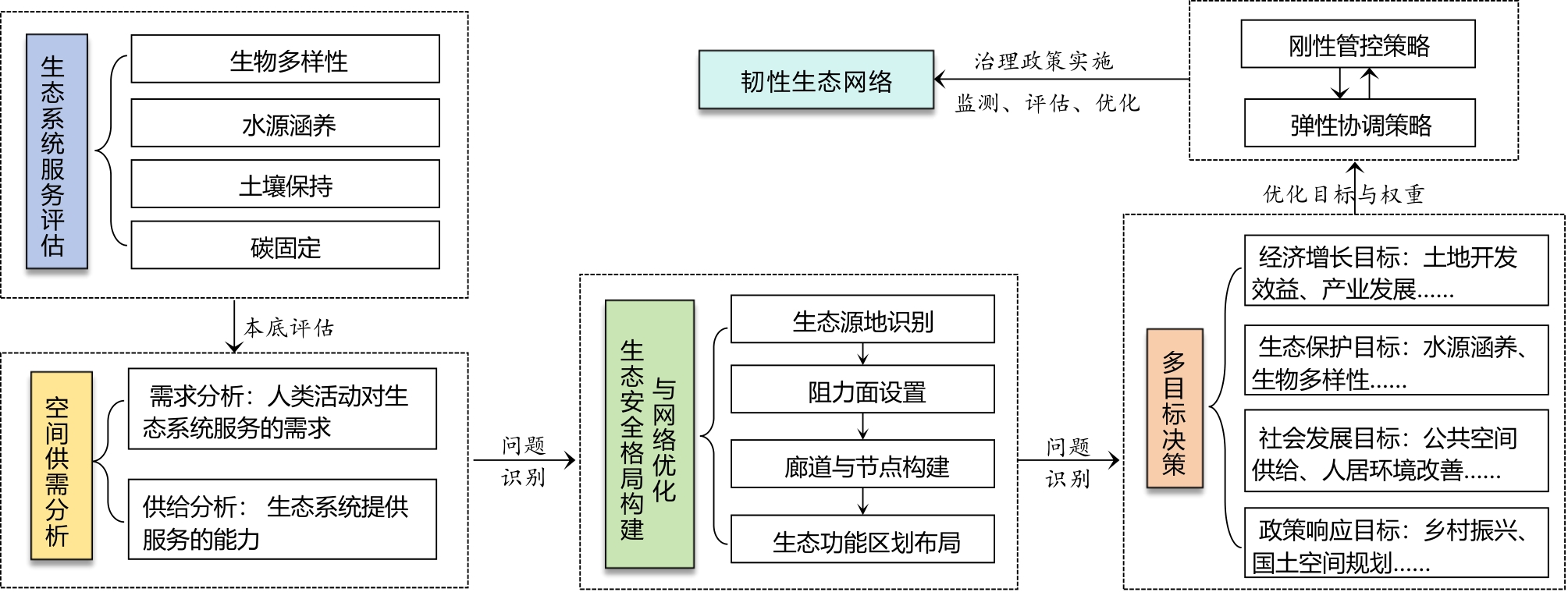
梳理生态空间识别与优化的研究进展,可深化生态空间研究的系统性认知,揭示生态空间研究如何从孤立保护走向系统治理,进而为国土空间综合治理和可持续发展提供参考。文章基于“三生”协同视角,运用文献计量方法,借助CiteSpace分析2000—2024年国内外相关研究热点,结合传统综述方法,梳理其研究进展,总结现有研究的不足,并展望未来发展方向。结果发现:1)研究期内,国内外发文量增幅相异但趋势相似,研究重心从单一的生态空间识别逐渐转向多功能生态空间的集成管理;2)生态空间内涵呈现从格局认知到功能统筹、人地协同的演变趋势,但关于协同机制缺少系统研究,未能有效缓解空间功能冲突;3)生态空间的研究方法持续优化,从要素、功能、过程和人地关系维度推动了生态空间研究体系的不断完善,然而多源数据异质性导致动态监测和多尺度分析存在一定均值误差;4)生态空间优化研究强调“三生”空间统筹,通过刚弹结合调控逻辑,守住生态安全底线的同时,推动生态功能向生产、生活价值转化,但在复杂人地系统的应用中,统筹生态过程与人类活动的动态建模仍需优化。未来应聚焦多源数据融合处理、人地系统互馈模拟及智能决策平台构建,强化生态空间保护修复与国土空间规划的深度衔接,为协同区域生态安全与高质量发展提供科学支撑。
高新蕊 , 李平星 , 梁鑫 , 王履华 . “三生”协同视角下生态空间识别与优化研究进展与展望[J]. 热带地理, 2025 , 45(10) : 1892 -1903 . DOI: 10.13284/j.cnki.rddl.20250320
Ecological space is a key component of national spatial planning initiatives, the scientific identification and optimization of which serve as a foundation for achieving sustainable spatial governance. In this study, we adopted a "production-living-ecological" collaborative perspective based on an integration of bibliometric analysis with traditional review methods. Utilizing CiteSpace, we examined relevant research hotspots, both domestically and internationally, from 2000 to 2024, and, herein, we outlined the progress in research, identified existing gaps in the literature, and anticipated the future directions of development. Our findings indicate that throughout the study period, although rates of increase in the numbers of papers published have differed between domestic and international contexts, they have shown broadly similar trends. The increase in published works was closely linked to the formulation of pertinent policies and driven by crisis agendas. Moreover, the focus of research has gradually transitioned from identifying individual ecological spaces to managing multifunctional ecological spaces in an integrated manner. In addition, we identified a trend in which the conceptualization of ecological space is evolving from mere pattern recognition toward functional coordination and human-land collaboration. A key factor associated with this evolution is the transcendence of the optimization of ecological space over traditional zonal thinking, emphasizing that it should instead be incorporated into a production-living-ecological collaborative framework to facilitate comprehensive territorial governance. Furthermore, we found that the index system for identifying ecological spaces has been continuously refined and that research methodologies have undergone constant optimization. This system primarily encompasses the following four categories: identification based on ecological elements and ecosystem composition; identification grounded in ecological functions and services; identification focused on ecological processes and spatial connectivity; and identification related to human-land relationships. These advances have contributed to a substatial enhancement of the research framework surrounding ecological space across the four dimensions elements, functions, processes, and relationships. Research on ecological space optimization highlights the importance of coordinated development among the production-living-ecological spaces. By integrating both rigid and flexible regulatory frameworks, this approach not only safeguards ecological security but also facilitates the transformation of ecological functions to productive and living values. This encompasses independent layout optimization studies, comprehensive enhancement of production-living-ecological spaces, and regional territorial space structure optimization. However, despite these advances, considerable deficiencies remain in the realm of ecological space identification and optimization research. These include a lack of systematic investigations into collaborative mechanisms, heterogeneity in multi-source data that results in certain mean errors during dynamic monitoring and multi-scale analysis, and a pressing need to optimize dynamic modeling that effectively integrates ecological processes with human activities within complex human-land systems. Looking ahead, it will be essential to strengthen the connection between ecological space protection and restoration efforts and territorial spatial planning. Such integration will provide scientific support for achieving a coordinated type of development that is conducive to facilitating both regional ecological security and high-quality growth.
表1 生态空间识别方法对比Table 1 Comparison of ecological space identification methods |
| 类型 | 技术方法 | 适用场景 | 优缺点 |
|---|---|---|---|
| 基于生态要素与 生态系统构成 | 遥感解析、GIS空间分析、 土地分类 | 划定生态保护区、 要素稳定区域 | 数据客观、成本低;但忽略动态过程, 无法充分反映生态服务功能 |
| 基于生态功能与服务 | 生态服务评价模型、 敏感性评价、指标体系 | 关键生态服务区识别、 服务价值评估 | 直观反映生态系统服务与功能,支持决策; 但数据需求高,主观性强 |
| 基于生态过程与 空间连通性 | 最小累积阻力模型、 生态网络分析 | 物种迁徙保护、 生境连通性维护 | 捕捉生态过程动态与空间联系; 计算复杂,阻力值主观 |
| 基于人地关系与 综合管理格局 | 多源数据融合、 跨尺度分析 | 国土空间规划、 城乡协调区域 | 综合自然-社会-经济因素,但数据异构整合难 |
表2 生态空间政策工具效能对比Table 2 Comparison of the effectiveness of ecological space policy tools |
| 类型 | 中国案例 | 国际案例 | 优缺点 |
|---|---|---|---|
| 空间协同 | “三区三线”;京津冀生态协同;长江经济带“多规合一”生态管控;粤港澳大湾区生态廊道与生态屏障建设等 | 日本数字田园都市国家构想;英国生态基础 设施规划治理等 | 多功能统筹; 但跨部门协调成本高 |
| 刚性管控 | 生态保护红线;自然保护地;长江十年禁渔计划;国家公园体制试点等 | 欧盟Natura 2000自然保护地网络;美国《濒危物种法》下的栖息地保护等 | 保护效果可量化; 但经济激励不足 |
| 经济激励 | 流域生态保护补偿;草原补奖政策;碳交易试点;退耕还林还草等 | 美国土地信托;哥斯达黎加生态系统服务付费计划;加拿大湿地生态补偿与交易机制等 | 提升主体积极性; 但市场流动性低 |
|
Amindin A, Siamian N, Kariminejad N, Clague J J, and Pourghasemi H R. 2024. An Integrated GEE and Machine Learning Framework for Detecting Ecological Stability under Land Use/Land Cover Changes. Global Ecology and Conservation, 53: e03010.
|
|
Bai Y, Tang X, Xue F, Long D, Li J, and Tang Y. 2025. Spatiotemporal Variation and Dynamic Simulation of Carbon Stock Based on PLUS and InVEST Models in the Li River Basin, China. Scientific Reports, 15(1): 6060.
|
|
Bu Z, Fu J, Jiang D, and Lin G. 2023. Production–Living–Ecological Spatial Function Identification and Pattern Analysis Based on Multi-Source Geographic Data and Machine Learning. Land, 12(11): 2029.
|
|
Chen C, Yuan X, and Gan S. 2024. A New Strategy Based on Multi-Source Remote Sensing Data for Improving the Accuracy of Land Use/Cover Change Classification. Scientific Reports, 14(1): 26855.
|
|
陈振,郭杰,张雪微,何鸿飞,欧名豪. 2024. 耦合景观生态安全格局的南京市“三生”空间多情景模拟. 水土保持研究,31(4):383-394.
Chen Zhen, Guo Jie, Zhang Xuewei, He Hongfei, and Ou Minghao. 2024. Multi-Scenario Simulation of Production-Life-Ecology Space in Nanjing Coupled with Landscape Ecological Security Pattern. Research of Soil and Water Conservation, 31(4): 383-394.
|
|
程佳琦,林伊琳,赵俊三,覃彬桂,2024. 昆明市“三生空间”功能耦合协调时空特征与影响因素. 水土保持研究,31(3):299-310,319.
Cheng Jiaqi, Lin Yilin, Zhao Junsan, and Qin Bingui. 2024. Spatiotemporal Characteristics and Influencing Factors of Functional Coupling and Coordination of 'Production-Living-Ecological' Spaces in Kunming City. Research of Soil and Water Conservation, 31(3): 299-310, 319.
|
|
迟妍妍,许开鹏,王晶晶,张丽苹. 2018. 京津冀地区生态空间识别研究. 生态学报,38(23):8555-8563.
Chi Yanyan, Xu Kaipeng, Wang Jingjing, and Zhang Liping. 2018. Identifying Regional Ecological Space in Beijing, Tianjin, and Hebei. Acta Ecologica Sinica, 38(23): 8555-8563.
|
|
Council of the European Communities. 1992. Council Directive 92/43/EEC on the Conservation of Natural Habitats and of Wild Fauna and Flora. (1992-05-21) [2025-10-22]. https://eur-lex.europa.eu/legal-content/EN/TXT/?uri=CELEX:31992L0043.
|
|
董雅文,周雯,周岚,周慧. 1999. 城市化地区生态防护研究——以江苏省南京市为例. 城市研究,(2):6-8,10.
Dong Yawen, Zhou Wen, Zhou Lan, and Zhou Hui. 1999. Research on Ecological Protection in Urbanized Areas: Taking Jiangsu Province and Nanjing City as Examples. Urban Research,(2): 6-8, 10.
|
|
窦银娣,叶玮怡,李伯华. 2022. 旅游驱动型传统村落“三生”空间功能更新的特征、模式与逻辑——以湖南省张谷英村为例. 热带地理,42(1):136-147.
Dou Yindi, Ye Weiyi, and Li Bohua. 2022. Features, Models and Logic of Function Renewal of "Living-Production-Ecological" Space in Tourism-Driven Traditional Villages: A Case Study of Zhang Guying Village, Hunan Province. Tropical Geography, 42(1): 136-147.
|
|
樊杰. 2024. “十五五”时期中国区域协调发展的理论探索、战略创新与路径选择. 中国科学院院刊,39(4):605-619.
Fan Jie. 2024. Theory, Strategy and Path of China's Regional Coordinated Development during 15th Five-Year Plan Period. Bulletin of Chinese Academy of Sciences, 39(4): 605-619.
|
|
费建波,夏建国,胡佳,舒向阳,吴玺,李军. 2019. 生态空间与生态用地国内研究进展. 中国生态农业学报,27(11):1626-1636.
Fei Jianbo, Xia Jianguo, Hu Jia, Shu Xiangyang, Wu Xi, and Li Jun. 2019. Research Progress of Ecological Space and Ecological Land in China. Chinese Journal of Eco-Agriculture, 27(11): 1626-1636.
|
|
Gong Z, Yuan Y, Qie L, Huang S, Xie X, Zhong R, and Pu L. 2023. Spatiotemporal Differentiation and Coupling Coordination Relationship of the Production-Living-Ecological Function at County Scale: A Case Study of Jiangsu Province. Land, 12(11): 2027.
|
|
黄安,许月卿,王燕,田莉,夏菁,朱玲,庄元,蒋好忱,雷宝佳. 2024. “三生”空间冲突风险研究的逻辑主线:机制、评估与优化路径. 经济地理,44(11):173-183.
Huang An, Xu Yueqing, Wang Yan, Tian Li, Xia Jing, Zhu Ling, Zhuang Yuan, Jiang Haochen, and Lei Baojia. 2024. The Paradigms of the Research on the Production-Living-Ecological Space Conflict Risk: Mechanism, Evaluation and Optimization Path. Economic Geography, 44(11): 173-183.
|
|
Huang G, Hu W, Du J, Jia Y, Zhou Z, Lei G, Saintilan N, Wen L, and Wang Y. 2025. Identification and Scenario-Based Optimization of Ecological Corridor Networks for Waterbirds in Typical Coastal Wetlands. Ecological Indicators, 171: 113147.
|
|
黄金川,林浩曦,漆潇潇. 2017. 面向国土空间优化的三生空间研究进展. 地理科学进展,36(3):378-391.
Huang Jinchuan, Lin Haoxi, and Qi Xiaoxiao. 2017. A Literature Review on Optimization of Spatial Development Pattern Based on Ecological-Production-Living Space. Progress in Geography, 36(3): 378-391. .
|
|
黄燕芬,张志开,张超. 2020. 交易费用理论视角的中国农村土地信托模式研究. 公共管理与政策评论,9(5):73-86.
Huang Yanfen, Zhang Zhikai, and Zhang Chao. 2020. Study of China's Rural Land Trust Model from the Perspective of Transaction Cost Theory. Public Administration and Policy Review, 9(5): 73-86.
|
|
孔冬艳,陈会广,吴孔森. 2021. 中国“三生空间”演变特征、生态环境效应及其影响因素. 自然资源学报,36(5):1116-1135.
Kong Dongyan, Chen Huiguang, and Wu Kongsen. 2021. The Evolution of "Production-Living-Ecological" Space, Eco-Environmental Effects and Its Influencing Factors in China. Journal of Natural Resources, 36(5): 1116-1135.
|
|
孔雪松,朱思阳,金志丰. 2020. 国土空间用途管制刚性与弹性的互动逻辑及优化路径. 规划师,36(11):11-15.
Kong Xuesong, Zhu Siyang, and Jin Zhifeng. 2020. The Interaction Logic and Optimization Path of Rigidity and Flexibility in Land Spatial Use Control. Planners, 36(11): 11-15.
|
|
Li K, Wang X, Zhao F, An B, and Li P. 2024. Land Use Modeling and Carbon Storage Projections of the Bosten Lake Basin in China from 1990 to 2050 Across Multiple Scenarios. Scientific Reports, 14(1): 27136.
|
|
李平星,梁鑫,朱春成. 2024. 青藏高原荒野地适宜性评价与空间分布特征. 地理科学进展,43(4):727-740.
Li Pingxing, Liang Xin, and Zhu Chuncheng. 2024. Suitability Evaluation and Spatial Distribution Characteristics of Wilderness Area on the Qinghai-Tibet Plateau. Progress in Geography, 43(4): 727-740.
|
|
Li W, Chen X, Zheng J, Zhang F, Yan Y, Hai W, Yang J, Han C, and Liu L. 2025. Effectiveness and Driving Mechanisms of Ecological Conservation and Restoration in Sichuan Province, China. Ecological Indicators, 172: 113238.
|
|
李效顺,李志鑫,谢晓彤,刘希朝,陈姜全,李奕菲. 2023. 河南省城镇化、碳排放与“三生”空间交互机制分析. 农业工程学报,39(11):256-265.
Li Xiaoshun, Li Zhixin, Xie Xiaotong, Liu Xizhao, Chen Jiangquan, and Li Yifei. 2023. Analysis of the Interaction Mechanism of Urbanization, Carbon Emissions, and Production-Living-Ecological Space in Henan Province of China. Transactions of the Chinese Society of Agricultural Engineering, 39(11): 256-265.
|
|
陆大道. 2002. 关于地理学的“人-地系统”理论研究. 地理研究,(2):135-145.
Lu Dadao. 2022. Theoretical Studies of Man-Land System as the Core of Geographical Science. Geographical Research, (2): 135-145.
|
|
马远,李锋,杨锐. 2021. 城市化对生物多样性的影响与调控对策. 中国园林,37(5):6-13.
Ma Yuan, Li Feng, and Yang Rui. 2021. The Impact of Urbanization on Biodiversity and Its Regulation Countermeasures. Chinese Landscape Architecture, 37(5): 6-13.
|
|
Mao C and Niu J. 2024. Quantitative Analysis of Ecological Compensation in the Yangtze River Delta Region Based on the Value of Ecosystem Services and Ecological Footprint. Frontiers in Ecology and Evolution, 12: 1335761.
|
|
孟德惠,孙适,吴远翔,李朦朦,潘宥承,李婷婷. 2025. 机器学习在生态安全领域中的应用综述. 生态学报,45(3):1503-1517.
Meng Dehui, Sun Shi, Wu Yuanxiang, Li Mengmeng, Pan Youcheng, and Li Tingting. 2025. A Review of the Application of Machine Learning in the Field of Ecological Safety. Acta Ecologica Sinica. 45(3): 1503-1517.
|
|
沈润,史正涛,何光熊,林燕华,徐瑞. 2022. 基于景观破碎化指数的西双版纳生态安全格局构建与优化. 热带地理,42(8):1363-1375.
Shen Run, Shi Zhengtao, He Guangxiong, Lin Yanhua, and Xu Rui. 2022. Construction and Optimization of the Ecological Security Pattern of Xishuangbanna Based on Fragmentation Index. Tropical Geography, 42(8): 1363-1375.
|
|
孙梓渊,王赛鸽,陈彬. 2024. 基于生态系统服务的生态安全格局构建与生态韧性评估——以长株潭城市群为例. 生态学报,44(11):4650-4661.
Sun Ziyuan, Wang Saige, and Chen Bin. 2024. Construction of Ecological Security Pattern and Assessment of Ecological Resilience Based on Ecosystem Services: A Case Study of Changsha-Zhuzhou-Xiangtan Urban Agglomeration. Acta Ecologica Sinica, 44(11): 4650-4661.
|
|
UNEA. 2019. Resolution 73/284: United Nations Decade on Ecosystem Restoration(2021-2030). (2019-03-06) [2025-05-01]. https://undocs.org/A/RES/73/284.
|
|
Wang K and Chen Q. 2025. Exploring the Spatiotemporal Effects of Urban Scale and Urban Vitality on S&D Balance in the Yangtze River Delta, China from 2015 to 2025. Scientific Reports, 15(1): 648.
|
|
王倩娜,谢梦晴,张文萍,庄子薛,魏琪力,罗言云. 2023. 成渝城市群区域生态与城镇发展双网络格局分析及时空演变. 生态学报,43(4):1380-1398.
Wang Qianna, Xie Mengqing, Zhang Wenping, Zhuang Zixue, Wei Qili, and Luo Yanyun. 2023. Regional Pattern Analysis and Spatio⁃Temporal Evolution of Ecological and Urban Dual Network in Chengdu⁃Chongqing Urban Agglomeration. Acta Ecologica Sinica, 43(4): 1380-1398.
|
|
韦芦桂. 2021. 贵港市低质量国土生态空间识别研究. 南宁:南宁师范大学.
Wei Lugui. 2021. Study on Ecological Space Identification of Low Quality Land in Guigang City. Nanning: Nanning Normal University.
|
|
魏伟,段云生,尹力,薄立明,夏俊楠. 2024. 珠江流域地域主体功能时空演化特征及驱动机制. 热带地理,44(11):1933-1948.
Wei Wei, Duan Yunsheng, Yin Li, Bo Liming, and Xia Junnan. 2024. Spatio-Temporal Evolution Characteristics and Driving Mechanism of Regional Main Functional Area in the Pearl River Basin. Tropical Geography, 44(11): 1933-1948.
|
|
翁奕城,王楠,陈梓聪. 2025. 供需视角下的城市公园绿地空间评价及优化. 华侨大学学报(自然科学版),(1):60-70.
Weng Yicheng, Wang Nan, and Chen Zicong. 2025. Space Evaluation and Optimization of Urban Park Green From Perspective of Supply and Demand. Journal of Huaqiao University(Natural Science), (1): 60-70.
|
|
谢花林,姚干,何亚芬,张道贝. 2018. 基于GIS的关键性生态空间辨识——以鄱阳湖生态经济区为例. 生态学报,38(16):5926-5937.
Xie Hualin, Yao Gan, He Yafen, and Zhang Daobei. 2018. Study on Spatial Identification of Critical Ecological Space Based on GIS: A Case Study of Poyang Lake Ecological Economic Zone. Acta Ecologica Sinica, 38(16): 5926-5937.
|
|
杨锐,曹越. 2019. “再野化”:山水林田湖草生态保护修复的新思路. 生态学报,39(23):8763-8770.
Yang Rui and Cao Yue. 2019. Rewilding: New Ideas for Ecological Protection and Restoration Projects of Mountains-Rivers-Forests-Farmlands-Lakes-Grasslands. Acta Ecologica Sinica, 39(23): 8763-8770.
|
|
Zhang Y, Yang R, Sun M, Lu Y, Zhang L, Yin Y, and Li X. 2024. Identification of Spatial Protection and Restoration Priorities for Ecological Security Pattern in a Rapidly Urbanized Region: A Case Study in the Chengdu–Chongqing Economic Circle, China. Journal of Environmental Management, 366: 121789.
|
|
中共中央办公厅 国务院办公厅. 2019. 中共中央办公厅 国务院办公厅印发《关于在国土空间规划中统筹划定落实三条控制线的指导意见》. 中华人民共和国国务院公报,(32):23-25.
General Office of the Central Committee of the Communist Party of China and General Office of the State Council. 2019. General Office of the Central Committee of the Communist Party of China and General Office of the State Council issued the "Guiding Opinions on Coordinating the Delineation and Implementation of Three Control Lines in National Land and Space Planning". Gazette of the State Council of the People's Republic of China, (32): 23-25.
|
|
中共中央办公厅 国务院办公厅. 2024. 中共中央办公厅 国务院办公厅关于加强生态环境分区管控的意见. (2024-03-17)[2025-05-01]. https://www.gov.cn/zhengce/202403/content_6939837.htm.
General Office of the Central Committee of the Communist Party of China and General Office of the State Council. 2024. Opinions on Strengthening Ecological Environment Regional Control by the General Office of the Central Committee of the Communist Party of China and the General Office of the State Council. (2024-03-17) [2025-05-01]. https://www.gov.cn/zhengce/202403/content_6939837.htm.
|
|
中华人民共和国农业农村部.2013 农业部办公厅 财政部办公厅关于做好2013年草原生态保护补助奖励机制政策实施工作的通知.(2013-06-06)[2025-10-22]. https://jcs.moa.gov.cn/trzgl/201306/t20130606_3485365.htm.
Ministry of Agriculture and Rural Affairs of the People's Republic of China. 2013. Notice of General Office of Ministry of Agriculture and Rural Affairs and General Office of the Ministry of Finance on Doing a Good Job in the Implementation of the 2013 Grassland Ecological Protection Subsidy and Reward Mechanism Policy. (2013-06-06) [2025-10-22]. https://jcs.moa.gov.cn/trzgl/201306/t20130606_3485365.htm.
|
|
仲俊涛,王蓓,米文宝,樊新刚,杨美玲,杨显明. 2020. 基于InVEST模型的宁夏盐池县禁牧草地生态补偿标准空间识别. 地理科学,40(6):1019-1028.
Zhong Juntao, Wang Bei, Mi Wenbao, Fan Xingang, Yang Meiling, and Yang Xianming. 2020. Spatial Recognition of Ecological Compensation Standard for Grazing Grassland in Yanchi County Based on InVEST Model. Scientia Geographica Sinica, 40(6): 1019-1028.
|
|
Zhou G, Gao J, Zhang R, Yang Z, Zhang S, Wang L, Su Y, Huan Y, and Liang T. 2025. A New Perspective for Enhancing Social and Ecological Systems Coordination in Ecological Restoration. Ecological Process, 14: 20.
|
|
周思杨,陈佳璇,程迁,李巍. 2022. 生态空间优化与管控在城市规划环境影响评价中的应用研究. 环境工程技术学报,12(6):1930-1937.
Zhou Siyang, Chen Jiaxuan, Cheng Qian, and Li Wei. 2022. Research on the Application of Ecological Space Optimization and Management in Urban Planning Environmental Impact Assessment. Journal of Environmental Engineering Technology, 12(6): 1930-1937.
|
/
| 〈 |
|
〉 |