磨憨—磨丁跨境经济合作区空间“管治魔方”研究
|
葛旭瑞(1997—),男,安徽铜陵人,博士研究生,研究方向为跨境经济研究,(E-mail)1274887151@qq.com; |
收稿日期: 2025-04-15
修回日期: 2025-09-01
网络出版日期: 2025-12-25
基金资助
云南省西南联合研究生院科技专项基础研究重大项目(202302AO370007)
云南省哲学社会科学创新团队(2023CX02)
国家自然科学基金项目(42101231)
Study on the Spatial "Governance Magic Cube" for the Mohan-Boten Cross-Border Economic Cooperation Zone
Received date: 2025-04-15
Revised date: 2025-09-01
Online published: 2025-12-25
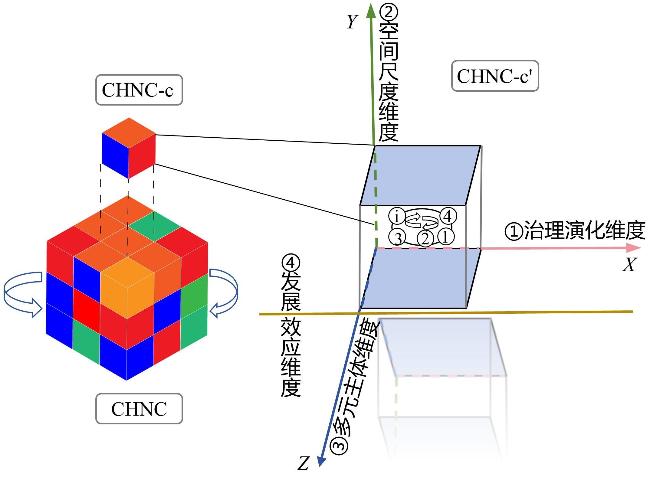
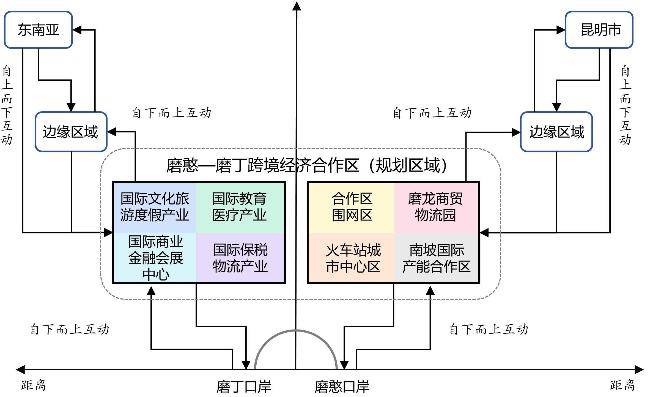
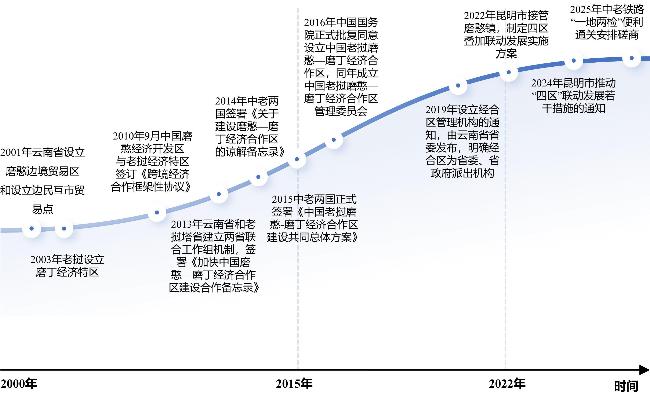
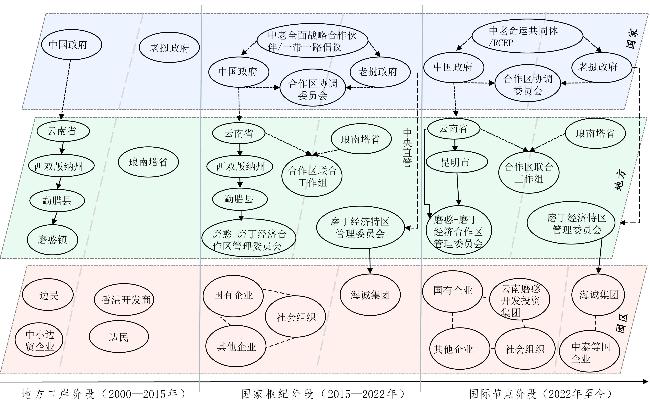
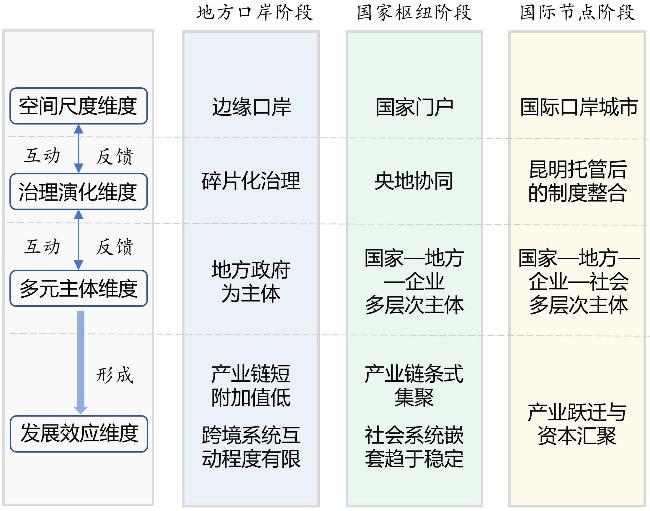
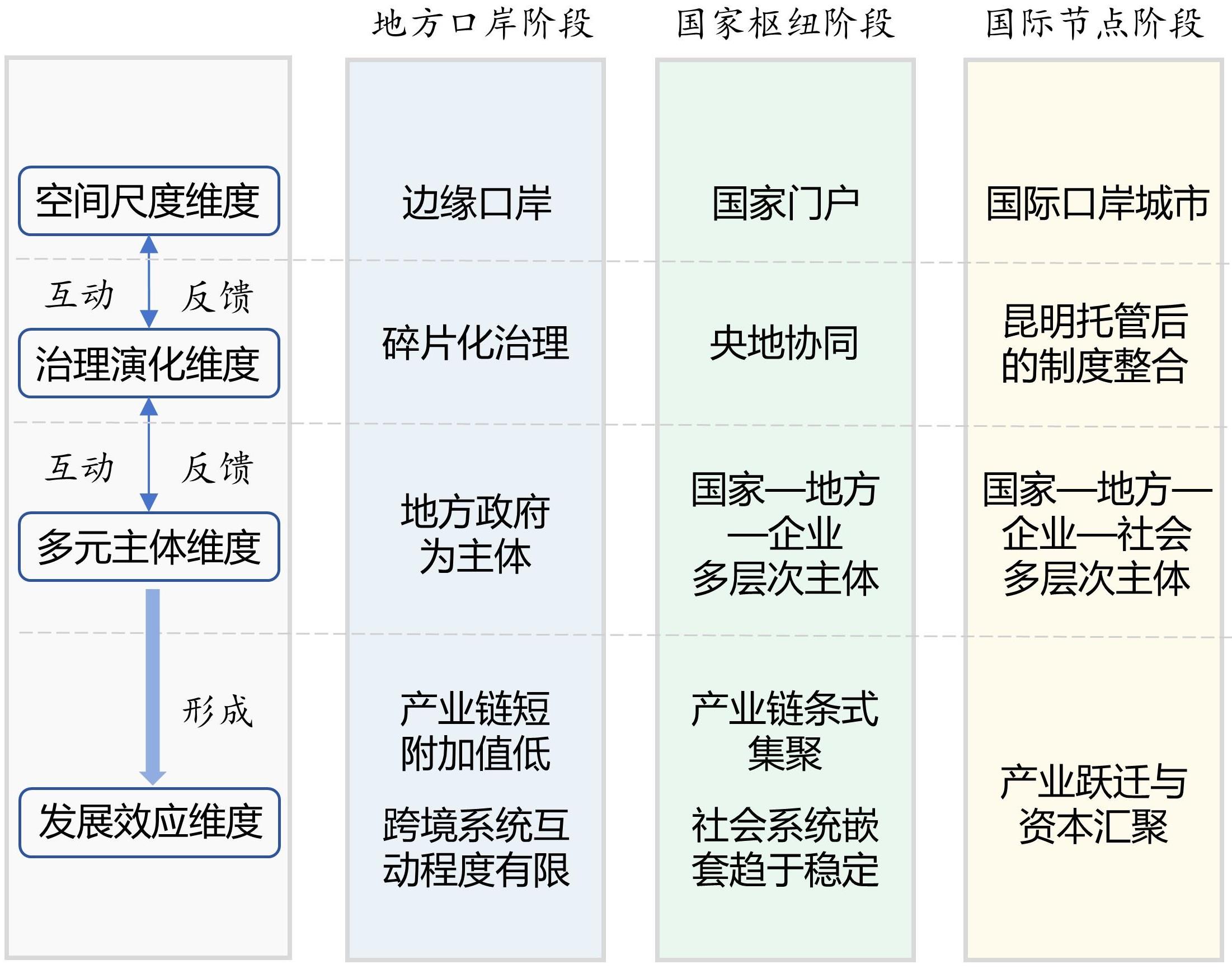
跨境经济合作区是中国与沿线国家经贸合作的重要载体,厘清其空间管治机制对区域高质量发展和国内国际双循环有效推进具有重要意义。文章基于新区域主义理论,以磨憨—磨丁跨境经济合作区为例,通过半结构访谈等方法,解构磨憨—磨丁跨境经济合作区空间管治机制,结果表明:1)空间尺度维度上,磨憨—磨丁跨境经济合作区实现了从“边缘口岸”向“国际节点”的跃迁,其空间结构呈现由邻近化向网络化和加速化发展的趋势;2)治理演化维度上,合作区经历了从“地方主导试验”到“国家战略统筹”再到“跨国嵌套协同”的递进式转型。通过政策试错、制度调适与规则固化,逐步形成了时序嵌套的治理机制,推动跨境治理实现由行政分割向制度整合的根本性转变;3)多元主体维度上,合作区的治理模式由单一政府主导转向多元主体互动,跨境治理体系日益多样化,组织间的合作与互动变得更加复杂且具有动态性;4)发展效应维度上,合作区通过推动产业链协同升级和资源的高效配置,进一步强化其在国家与国际网络中的枢纽地位,逐步发展成为连接区域发展与制度创新的重要平台。
关键词: 新区域主义; 边境; 管治机制; “管治魔方”; 磨憨—磨丁跨境经济合作区
葛旭瑞 , 钱镜帆 , 李灿松 , 潘莹 , 雷竣超 , 周绍聪 . 磨憨—磨丁跨境经济合作区空间“管治魔方”研究[J]. 热带地理, 2025 , 45(12) : 2209 -2223 . DOI: 10.13284/j.cnki.rddl.20250241
Cross-border economic cooperation zones are vital platforms for China's economic and trade engagement with neighboring countries. It is imperative to clarify their spatial governance mechanisms to promote high-quality regional development and foster dual domestic–international circulation. Grounded in the theoretical perspective of new regionalism, this article constructs an analytical framework called the "Governance Magic Cube" to examine the governance mechanisms of cross-border economic cooperation zones. The framework explores four interrelated dimensions: spatial scale, governance evolution, multi-actor participation, and development effects. Taking the Mohan-Boten Cross-border Economic Cooperation Zone as a case study, this study conducted an empirical analysis of its spatial transformation, institutional restructuring, and actor interactions. Based on the policy milestones represented by the 2015 Joint Master Plan and the 2022 administrative transfer to Kunming, this study divides the Cooperation Zone's development trajectory into three stages: local, national, and international. Through semi-structured interviews, land-use data analysis, and multi-source documentary materials, the study provides an integrated interpretation of the zone's spatial dynamics and governance logic. The findings indicate that: 1) Spatial scale: The Mohan–Boten Cooperation Zone has undergone a substantive leap from a "marginal border port" to an "international node." Its spatial structure, initially characterized by a linear "corridor-style" pattern extending along the Kunming–Bangkok Highway, with the twin ports of Mohan and Boten as core anchors, is now evolving toward a more networked, accelerated spatial configuration. 2) Governance evolution: The cooperation zone has experienced a progressive shift from "locally led experimentation" to "national strategic coordination," and eventually toward "transnational nested collaboration." Through policy trial and error, institutional adjustment, and the consolidation of regulatory rules, a temporally nested governance mechanism has gradually emerged, facilitating a fundamental transformation in cross-border governance from administrative segmentation to institutional integration. 3) Multi-actor participation: The governance model has shifted from a single government-led approach to a more interactive configuration involving multiple actors, including national authorities, local governments, enterprises, and social organizations. This shift has led to an increasingly diverse and dynamic cross-border governance system, where inter-organizational collaboration has become more complex, fluid, and multidirectional. 4) Development effects: The cooperation zone has strengthened its role as a strategic hub within national and international networks by promoting the coordinated upgrading of industrial chains and efficient allocation of resources. As a result, it is steadily evolving into a key platform linking regional development with institutional innovation. Overall, the study argues that cross-border economic cooperation zones operate as open systems shaped by spatial proximity, institutional forces, and social networks. Their governance mechanisms exhibit phased transitions, structural reconfiguration, and actor collaboration emerging from the synergistic interaction of spatial expansion, institutional restructuring, and multi-actor engagement. This study enriches research on cross-border regional governance and offers new insights into the evolutionary pathways of such zones under multi-scale, multi-actor conditions. In practice, it highlights the need to strengthen coordination among spatial planning, institutional alignment, industrial organization, and social governance, and to promote a shift from infrastructure-driven growth to institutional synergy and functional deepening, thereby enhancing the strategic role of cooperation zones within China's broader opening-up framework.
表1 2000—2015年磨憨—磨丁缓冲区土地利用变化趋势Table 1 Spatial change trend of land use in the Mohan-Boten buffer zone during 2000-2015 |
| 土地利用 类型 | 2000年 | 2005年 | 2010年 | 2015年 | ||||
|---|---|---|---|---|---|---|---|---|
| 中国 | 老挝 | 中国 | 老挝 | 中国 | 老挝 | 中国 | 老挝 | |
| 灌溉农田 | 0.18 | 0.04 | 0.18 | 0.04 | 0.19 | 0.04 | 0.19 | 0.04 |
| 沼泽地 | 0.01 | 0.02 | 0.01 | 0.02 | 0.01 | 0.02 | 0.01 | 0.02 |
| 森林 | 265.73 | 262.04 | 264.06 | 257.39 | 260.25 | 252.69 | 257.35 | 248.70 |
| 草地 | 0.97 | 2.76 | 0.89 | 2.75 | 0.9 | 2.67 | 0.82 | 2.63 |
| 灌木地 | 96.04 | 132.34 | 96.75 | 136.81 | 99.56 | 140.9 | 101.02 | 144.25 |
| 不透水表面 | 0.6 | 0.12 | 1.64 | 0.31 | 2.59 | 1.01 | 4.10 | 1.67 |
| 水体 | 0.04 | 0.46 | 0.04 | 0.46 | 0.07 | 0.47 | 0.08 | 0.47 |
表2 磨憨口岸人流、交通流、物流Table 2 Passenger flow, transport flow, and cargo flow at the Mohan port |
| 年份 | 人流/万人次 | 交通流/万次 | 物流/万t |
|---|---|---|---|
| 2008 | 64.01 | 9.88 | 32.81 |
| 2009 | 61.22 | 11.33 | 38.13 |
| 2010 | 67.09 | 16.66 | 61.97 |
| 2011 | 61.66 | 18.22 | 76.41 |
| 2012 | 64.31 | 19.65 | 91.18 |
| 2013 | 75.24 | 27.17 | 113.92 |
| 2014 | 96.00 | 35.35 | 153.15 |
| 2015 | 116.72 | 37.04 | 158.81 |
| 2016 | 119.63 | 37.19 | 150.16 |
| 2017 | 145.87 | 42.89 | 201.97 |
| 2018 | 153.71 | 41.98 | 248.16 |
| 2019 | 173.27 | 46.91 | 347.13 |
| 2020 | 46.86 | 23.86 | 322.00 |
| 2021 | 30.22 | 20.03 | 352.23 |
| 2022 | 26.86 | 17.39 | 308.23 |
| 2023 | 129.37 | 28.06 | 348.77 |
| 2024 | 73.00 | 34.25 | 478.00 |
|
1 https://www.km.gov.cn/c/2023-09-25/4779769.shtml
2 https://jclao.com/laos-could-lose-millions-with-closure-of-boten-border-crossing/
3 https://kmtb.mofcom.gov.cn/dyyzh/art/2025/art_5d119fbca692454e9a2647cb48ea0b52.html
4 http://yn.news.cn/20230809/2cfa37206d5e47748806fbc8ab5ee50a/c.html
5 http://yn.people.com.cn/BIG5/n2/2020/0713/c378439-34151802.html
6 http://www.yn.xinhuanet.com/20250318/84406ffe3f954ed494ac658dca1bb033/c.html
7 https://dianchi.km.gov.cn/c/2024-06-26/6896290.shtml
葛旭瑞:负责论文撰写及修改;
钱镜帆、李灿松:论文总体设计与指导、基金支持;
潘 莹、雷竣超、周绍聪:参与研究过程、插图制作以及文章修改。
|
Borzel T A and Risse T. 2016. The Oxford Handbook of Comparative Regionalism. Oxford: Oxford University Press.
|
|
Boschma R. 2005. Proximity and Innovation: A Critical Assessment. Regional Studies, 39(1): 61-74.
|
|
Brunet-Jailly E. 2022. Cross-Border Cooperation: A Global Overview. Alternatives, 47(1): 3-17.
|
|
Casula M. 2024. How Different Multilevel and Multi-Actor Arrangements Impact Policy Implementation: Evidence from EU Regional Policy. Territory, Politics, Governance, 12(7): 1048-1072.
|
|
陈艳华,张虹鸥,黄耿志,叶玉瑶,吴旗韬. 2019. 中国―老挝境外经贸合作区的发展模式与启示——以万象赛色塔综合开发区为例. 热带地理,39(6):844-854.
Chen Yanhua, Zhang Hong'ou, Huang Gengzhi, Ye Yuyao, and Wu Qitao. 2019. Development Mode and Enlightenment of theChinese Overseas Economic and Trade Cooperation Zone in Laos: A Case Study of the Vientiane Saysettha Development Zone. Tropical Geography, 39(6): 844-854.
|
|
崔日明,陈永胜. 2022. 沿边开放与区域经济增长——基于制度变迁的研究. 山西大学学报(哲学社会科学版),45(1):139-148.
Cui Riming, and Chen Yongsheng. 2022. Border Opening and Regional Economic Growth: A Study Based on Institutional Changes. Journal of Shanxi University(Philosophy & Social Science), 45(1): 139-148.
|
|
邓婷婷,马春雪. 2017. 新区域主义视角下“一带一路”的合作机制研究. 时代法学,15(4):59-69.
Deng Tingting and Ma Chunxue. 2017. A Study on the Cooperative Mechanisms of "the Belt and Road" from the Perspective of New Regionalism. Presentday Law Science, 15(4): 59-69.
|
|
董晓芳,李灿松,刘晓凤,饶允昌. 2024. 中缅非法跨境活牛贸易的时空过程与运作机制. 热带地理,44(7):1184-1195.
Dong Xiaofang, Li Cansong, Liu Xiaofeng, and Rao Yunchang. 2024. Spatiotemporal Process and Operational Mechanism of Illegal Cross-Border Cattle Trade between China and Myanmar. Tropical Geography, 44(7): 1184-1195.
|
|
Gómez-Mera L. 2008. How 'New' is the 'New Regionalism' in the Americas? The Case of Mercosur. Journal of International Relations and Development, 11: 279-308.
|
|
郭垠宏,宋涛,孙曼. 2023. 安全、发展与开放关联下的中国边境地域功能演化及时段划分. 地理研究,42(10):2574-2591.
Guo Yinhong, Song Tao, and Sun Man. 2023. The Territorial Function Evolution and Time Segmentation of Chinese Border in the Context of Security, Development and Opening up Nexus. Geography Research, 42(10): 2574-2591.
|
|
Hataley T and Leuprecht C. 2018. Determinants of Cross-Border Cooperation. Journal of Borderlands Studies, 33(3): 317-328.
|
|
贺璟寰,罗斌,戚冬瑾. 2023. 空间的“柔性”重构——欧盟的跨边界合作与规划实践. 国际城市规划,38(5):47-55.
He Jinghuan, Luo Bin, and Qi Dongjin. 2023. "Soft" Reconfiguration of Space: Practice of Cross-Border Cooperation and Planning in the EU. Urban Planning International, 38(5): 47-55.
|
|
Hettne B. 2005. Beyond the 'New' Regionalism. New Political Economy, 10(4): 543-571.
|
|
胡超. 2019. 全面开放新格局下中国边境经济合作区转型升级研究. 西部论坛,29(5):65-74.
Hu Chao. 2019. Research on Transformation and Upgrading of China's Border Economic Cooperation Zone under New Pattern of Overall Opening up. West Forum, 29(5): 65-74.
|
|
胡伟,于畅. 2020. 区域协调发展战略背景下中国边境经济合作区发展研究. 区域经济评论,(2):44-55.
Hu Wei and Yu Chang. 2020. Study on China's Border Economy Cooperate Districts under the Background of Regional Coordinative Development Strategy. Regional Economic Review, (2): 44-55.
|
|
黄朝阳. 2020. 中国—东盟跨境经济合作区发展成效与困境. 人民论坛,(25):78-79.
Huang Chaoyang. 2020. Development Effectiveness and Dilemma of China-ASEAN Cross-Border Economic Cooperation Area. People's Tribune, (25): 78-79.
|
|
Keuffer N and Horber-Papazian K. 2020. The Bottom-Up Approach: Essential to an Apprehension of Local Autonomy and Local Governance in the Case of Switzerland. Local Government Studies, 46(2): 306-325.
|
|
冷志明,雷亿辉. 2011. 基于新区域主义的我国连片贫困区开发研究. 经济地理,31(4):646-650.
Leng Zhiming and Lei Yihui. 2011. Development Research of Continuous Poor Areas of Our Country Based on New Regionalism. Economic Geography, 31(4): 646-650.
|
|
李晓玲,谭爽,魏冶,刘志高. 2024. 历史演化视角下跨境经济区域合作研究——以图们江次区域国际合作为例. 世界地理研究,33(4):1-12.
Li Xiaoling, Tan Shuang, Wei Ye, and Liu Zhigao. 2024. Research on Cross-Border Economic Regional Cooperation through the Lens of Historical Evolution: A Case of International Cooperation in Tumen River Sub-Region. World Regional Studies, 33(4): 1-12.
|
|
梁明. 2017. 支持边合区加快发展 提升沿边开发开放水平. 国际贸易,(8):8-13.
Liang Ming. 2017. Supporting the Accelerated Development of Border Cooperation Zones to Enhance the Level of Development and Opening up along the Border. International Trade, (8): 8-13.
|
|
刘海猛,方创琳,李咏红. 2019. 城镇化与生态环境“耦合魔方”的基本概念及框架. 地理学报,74(8):1489-1507.
Liu Haimeng, Fang Chuanglin, and Li Yonghong. 2019. The Coupled Human and Natural Cube: A Conceptual Framework for Analyzing Urbanization and Eco-Environment Interactions. Acta Geographica Sinica, 74(8): 1489-1507.
|
|
刘曙华,张鹏飞,周青,黄轲. 2021. “一带一路”背景下中越跨境经济合作区支持政策研究. 广西社会科学,(9):71-79.
Liu Shuhua, Zhang Pengfei, Zhou Qing, and Huang Ke. 2021. Research on Support Policies of China-Vietnamese Cross-Border Economic Cooperation Zone under the Background of "the Belt and Road". Social Sciences in Guangxi, (9): 71-79.
|
|
刘祺. 2017. 理解跨界治理:概念缘起、内容解析及理论谱系. 科学社会主义,(4):95-100.
Liu Qi. 2017. Understanding Cross-Border Governance: Conceptual Origins, Content Analysis and Theoretical Genealogy. Scientific Socialism, (4): 95-100.
|
|
卢小平. 2016. 跨境经济合作区建设的国际协同——以中国与东盟三国为例. 中国特色社会主义研究,(4):29-35.
Lu Xiaoping. 2016. International Synergy in the Construction of Cross-Border Economic Cooperation Zones—An Example of China and the Three ASEAN Countries. Studies on Socialism with Chinese Characteristics, (4): 29-35.
|
|
马博. 2010. 中国跨境经济合作区发展研究. 云南民族大学学报(哲学社会科学版),27(4):117-121.
Ma Bo. 2010. Research on the Development of Chinese Cross—Border Economic Cooperation Zone. Journal of Yunnan Nationalities University(Social Sciences), 27(4): 117-121.
|
|
苗长虹,樊杰,张文忠. 2002. 西方经济地理学区域研究的新视角——论"新区域主义"的兴起. 经济地理,(6):644-650.
Miao Changhong, Fan Jie, and Zhang Wenzhong. 2002. New Perspectives on Regional Development in Western Economic Geography:A Critical Assessment of "The New Regionalism". Economic Geography, (6): 644-650.
|
|
Perkmann M. 2007. Policy Entrepreneurship and Multilevel Governance: A Comparative Study of European Cross-Border Regions. Environment and Planning C: Government and Policy, 25(6): 861-879.
|
|
Prytula K, Maksymenko A, and Demedyuk O. 2019. The Institutional and Legal Framework for the Development of the Transport Infrastructure in the Cross-Border Area between EU and Ukraine. Zeszyty Naukowe Wyższej Szkoły Bankowej w Poznaniu, 86(3): 47-67.
|
|
全毅. 2015. 海峡两岸共建厦金跨境经济合作区的方案与建议. 亚太经济,(6):140-146.
Quan Yi. 2015. Solutions and Suggestions to Build the Xiamen-Kinmen Cross-Border Economic Cooperation Zone on Both Sides of the Taiwan Strait. Journal of the Asia Pacific Economy, (6): 140-146.
|
|
Renner T, Meijerink S, and Van der Zaag P. 2018. Progress Beyond Policy Making? Assessing the Performance of Dutch-German Cross-Border Cooperation in Deltarhine. Water International, 43(7): 996-1015.
|
|
宋涛,孙曼,刘志高. 2022. 改革开放以来中国西南边境地区制度与产业协同演化研究——以云南勐腊为例. 地理研究,41(3):633-646.
Song Tao, Sun Man, and Liu Zhigao. 2022. Institutional-Industrial Coevolution and Opening up Development in Border Towns:A case study of Mengla in Yunnan. Geography Research, 41(3): 633-646.
|
|
宋泽楠. 2017. 西南少数民族地区的开放型发展——基于中越跨境经济合作区的视角. 广西民族研究,(2):153-161.
Song Zenan. 2017. The Open-Oriented Development in the Southwestern Minority Area: Focusing on the Sino-Vietnamese Cross-Border Economic Cooperation Zone. Guangxi Ethnic Studies, (2): 153-161.
|
|
宋周莺,姚秋蕙,胡志丁,刘卫东. 2020. 跨境经济合作区建设的“尺度困境”——以中老磨憨-磨丁经济合作区为例. 地理研究,39(12):2705-2717.
Song Zhouying, Yao Qiuhui, Hu Zhiding, and Liu Weidong. 2020. 'Scale Paradox' of Cross-Border Economic Cooperation Zones: A Case Study of China-Laos Mohan-Boten Economic Cooperation Zone. Geography Research, 39(12): 2705-2717.
|
|
Song Z, Yao Q, and Liu W. 2024. The Growth of Cross-Border Regions Toward "Two Countries, One Park": A Case Study of the Mohan-Boten Cross-Border Cooperation Zone. Growth and Change, 55(4): e70005.
|
|
Sousa L D. 2013. Understanding European Cross-Border Cooperation: A Framework for Analysis. Journal of European Integration, 35(6): 669-687.
|
|
Trippl M. 2010. Developing Cross-Border Regional Innovation Systems: Key Factors and Challenge. Tijdschrift voor Economische en Sociale Geografie, 101(2): 150-160.
|
|
涂裕春,刘彤. 2016. 民族地区口岸经济发展预判——基于“一带一路”建设的分区域类型研究. 西南民族大学学报(人文社科版),37(1):162-166.
Tu Yuchun and Liu Tong. 2016. Forecasting the Economic Development of Ports in Ethnic Areas—A Study of Sub-Regional Types Based on the Construction of "the Belt and Road". Journal of Southwest Minzu University(Humanities and Social Sciences Edition), 37(1): 162-166.
|
|
王涛,李君,李立晓,陈长瑶. 2021. 多民族共生村落农户居住空间“耦合魔方”研究——以洱源县郑家庄为例. 世界地理研究,30(2):399-409.
Wang Tao, Li Jun, Li Lixiao, and Chen Changyao. 2021. Study on the "Coupling Rubik's Cube" in the Living Space of Farmers in Multi-Ethnic Symbiotic Villages—Taking Zhengjiazhuang in Eryuan County as a Sample. World Regional Studies, 30(2): 399-409.
|
|
王赞信,魏巍,吴鹏. 2018. 我国西南边境地区跨境贸易的阻力及其影响因素. 地域研究与开发,37(2):69-72.
Wang Zanshin, Wei Wei, and Wu Peng. 2018. Barriers to Cross-Border Trade and the Impact Factors in Southwest China. Areal Research and Development, 37(2): 69-72.
|
|
习近平. 2017. 决胜全面建成小康社会夺取新时代中国特色社会主义伟大胜利——在中国共产党第十九次全国代表大会上的报告. 党建,(11):15-34.
Xi Jinping. 2017. Securing a Decisive Victory in Building a Moderately Prosperous Society in All Respects and Striving for the Great Success of Socialism with Chinese Characteristics for a New Era—Report to the 19th National Congress of the Communist Party of China. Party Building, (11): 15-34.
|
|
习近平. 2022. 高举中国特色社会主义伟大旗帜 为全面建设社会主义现代化国家而团结奋斗:在中国共产党第二十次全国代表大会上的报告. (2022-10-25)[2025-03-01]. https://www.gov.cn/xinwen/2022-10/25/content_5721685.htm?jump=true&wd=&eqid=ee77784e0029e72a0000000364904ee1.
Xi Jinping. 2022. Holding High the Great Banner of Socialism with Chinese Characteristics and Striving in Unity for the Full Construction of a Modern Socialist Country: Report to the 20th National Congress of the Communist Party of China. (2022-10-25) [2025-03-01]. https://www.gov.cn/xinwen/2022-10/25/content_5721685.htm?jump=true&wd=&eqid=ee77784e0029e72a0000000364904ee1.
|
|
肖池伟,饶滴滴,刘怡媛,封志明,李鹏. 2019. 地缘经济合作背景下的中国磨憨―老挝磨丁口岸地区建设用地扩张. 地球信息科学学报,21(10):1576-1585.
Xiao Chiwei, Rao Didi, Liu Yiyuan, Feng Zhiming, and Li Peng. 2019. Construction Land Expansion in the Mohan-Boten Port Area between China and Laos in the Geoeconomic Cooperation Contex. Journal of Geo-information Science, 21(10): 1576-1585.
|
|
谢晓霞. 2021. 文化戍边视角下云南边疆地区农村公益电影放映探析. 思想战线,47(6):67-75. [Xie Xiaoxia. 2021. Village Movie Shows and Their Significance in Reinforcing Border Defence. Thinking, 47(6): 67-75. ]
|
|
徐哲俊,徐琳栋. 2016. 图们江跨境经济合作区的朝鲜人力资源开发与合作研究. 东疆学刊,33(4):100-105.
Xu Zhejun and Xu Lindong. 2016. Research on North Korean Human Resource Development and Cooperation in Tumen River Cross-Border Economic Cooperation Zone. Dongjiang Journal, 33(4): 100-105.
|
|
颜梅艳,余斌,郭新伟,卓蓉蓉. 2021. 基于主客观比较视角的乡村人居环境建设适配性评价——以江汉平原公安县为例. 地理科学进展,40(11):1876-1887.
Yan Meiyan, Yu Bin, Guo Xinwei, and Zhuo Rongrong. 2021. Adaptability of Rural Human Settlements Construction Based on Subjective and Objective Comparison:A Case Study of Gong'an County on the Jianghan Plain. Progress in Geography, 40(11): 1876-1887.
|
|
杨单璇,李灿松,胡伟,赖足兰,葛旭瑞. 2025. 基于文献计量的智慧边境研究进展与展望. 热带地理,45(1):155-167.
Yang Dangxuan, Li Cansong, Hu Wei, Lai Zulan, and Ge Xurui. 2025. Advances and Prospects in Smart Border Studies Based on a Bibliometric Analysis. Tropical Geography, 45(1): 155-167.
|
|
杨茜茜,王燕. 2018. 中越跨境经济合作区相关法律问题研究——以中国河口—越南老街经济合作区为例. 国际经济合作,(7):34-39.
Yang Qianqian and Wang Yan. 2018. Research on Legal Issues Related to Sino-Vietnamese Cross-Border Economic Cooperation Zone—Taking China's Hekou-Vietnam's Laojie Economic Cooperation Zone as an Example. Journal of International Economic Cooperation, (7): 34-39.
|
|
詹小颖. 2015. 沿边民族地区跨境经济合作区研究——以桂越边域凭祥—同登跨境经济合作区为例. 云南民族大学学报(哲学社会科学版),32(4):98-102.
Zhan Xiaoying. 2015. Research on the Cross-Border Economic Cooperation Zones:A Case Study of Pingxiang-Thi Tran Dong Dǎng Cross-Border Economic Cooperation Zone. Journal of Yunnan Minzu University(Social Sciences), 32(4): 98-102.
|
|
张紧跟. 2010. 新区域主义:美国大都市区治理的新思路. 中山大学学报(社会科学版),50(1):131-141.
Zhang Jingen. 2010. The New Regionalism: New Ideas for the Governance of U.S. Metropolitan Areas. Journal of Sun Yat-sen University(Social Science Edition), 50(1): 131-141.
|
|
张云. 2022. 新时代党中央治边稳藏的创新理论与伟大实践. 中国藏学,(3):1-13.
Zhang Yun. 2022. The Innovative Theory and Great Practice of the CPC Central Committee in Governing and Stabilizing Tibet in the New Era. China Tibetology, (3): 1-13
|
|
赵忠龙. 2021. 跨境经济合作区多层级治理探讨. 人民论坛·学术前沿,(10):132-135.
Zhao Zhonglong. 2021. Discussion on Multi-Level Governance of the Cross-Border Economic Cooperation Zone. Frontiers, (10): 132-135.
|
|
郑先武. 2006. 新区域主义理论:渊源、发展与综合化趋势. 欧洲研究,(1):39-58.
Zheng Xianwu. 2006. Origin, Contemporary, and Synthetic Development Trends of New Regionalism. China Journal of European Studies, (1): 39-58.
|
|
中国口岸协会. 2009. 中国口岸年鉴. 北京:中国海关出版社. [China Ports Association. 2009. China Ports Yearbook. Beijing: China Customs Press. ]
|
/
| 〈 |
|
〉 |