



地缘军事影响力:评价体系、空间演化与形成路径
|
郭卫东(1992—),男,江西井冈山人,博士,讲师,主要研究方向为地缘政治与国家安全,(E-mail)guowd28@126.com; |
收稿日期: 2025-05-18
修回日期: 2025-06-09
网络出版日期: 2025-12-25
基金资助
国家自然科学基金(42501202)
Geomilitary Powers: Evaluation Framework, Spatial Evolution, and Configuration Pathways
Received date: 2025-05-18
Revised date: 2025-06-09
Online published: 2025-12-25
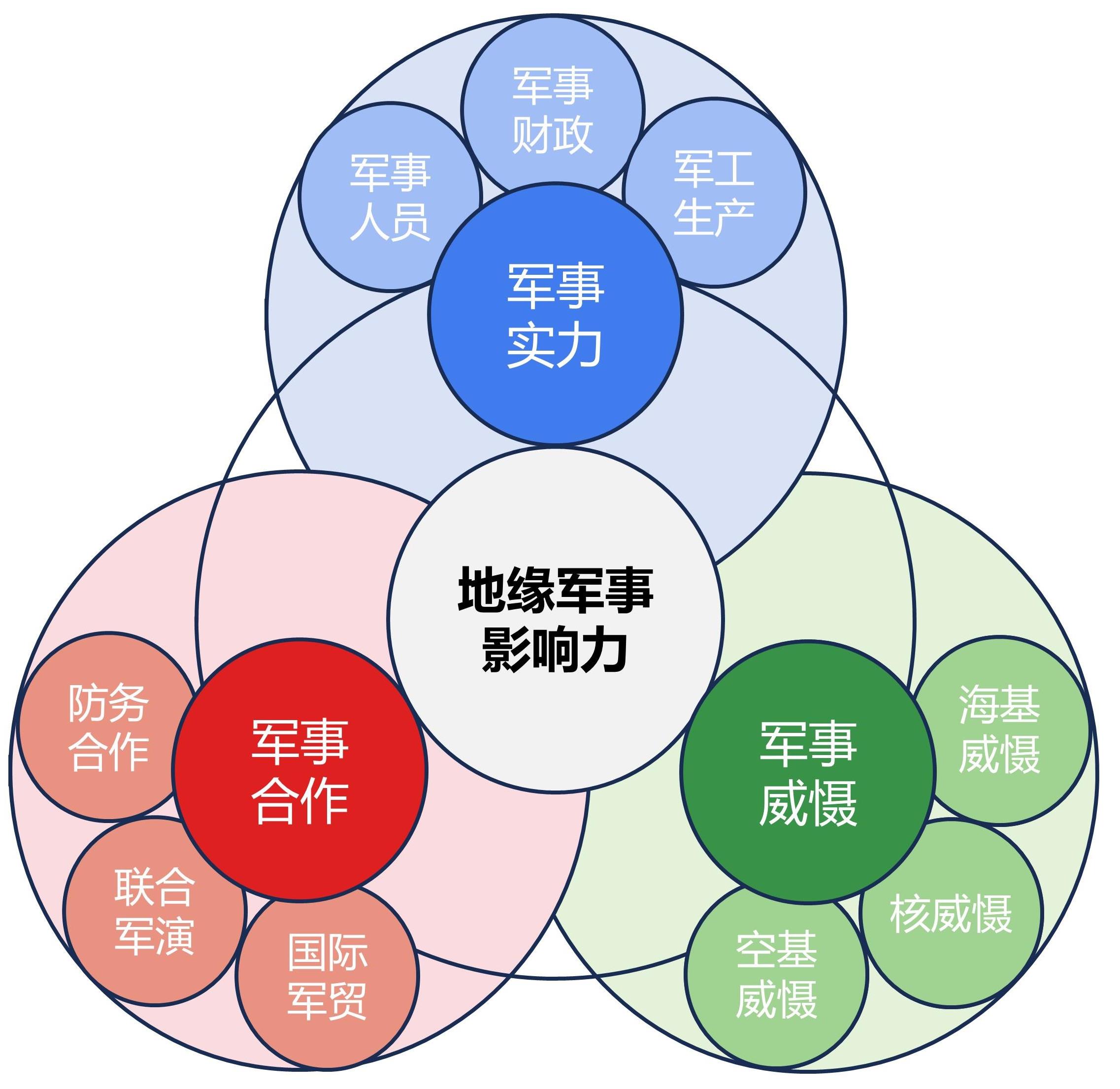
当前大国博弈和地区冲突的持续蔓延使得军事因素日益成为影响地缘关系和国际博弈的重要变量,深入探析地缘军事影响力的空间态势和形成路径对军事资源的合理配置具有重要意义。文章采用指标体系构建、标准差椭圆和定性比较分析等方法,对地缘军事影响力进行定量测度,结果表明:1)基于军事实力、军事合作和军事威慑这3个维度构建评价指标体系,将其作为世界各国地缘军事影响力的分析框架,具有较强的解释力。2)全球地缘军事影响力呈现以“一超多强”的稳定格局,美国始终是最具地缘军事影响力的国家,中国和印度呈现明显的上升态势,俄罗斯和英国呈现下降态势。各国地缘军事影响力的动态消长促使其重心呈现向东南方向移动的态势,中国成为地缘军事影响力重心移动最主要的动力。3)地缘军事影响力的形成路径可划分为军事实力与军事合作协同型路径、军事合作引领型路径和综合型路径,多条件综合组态效应构成强大的地缘军事影响力,在核心条件缺失和仅辅助条件存在的状态下均难以产生地缘军事影响力。
郭卫东 , 徐伟 , 杜德斌 , 李祺祥 . 地缘军事影响力:评价体系、空间演化与形成路径[J]. 热带地理, 2025 , 45(12) : 2197 -2208 . DOI: 10.13284/j.cnki.rddl.20250323
The persistent escalation of great power rivalries and regional conflicts has elevated military factors as increasingly critical variables that shape geopolitical relations and international power dynamics. Conducting an in-depth analysis of the spatial dynamics and formation pathways of geopolitical military influence is therefore of paramount importance for optimizing the allocation of military resources. Building upon the identified gaps in the existing literature on geopolitical military influence, this study employed an index system construction approach that integrated methodologies such as standard deviational ellipse analysis and fuzzy-set qualitative comparative analysis. A preliminary evaluation framework for assessing geopolitical military influence was developed, and its spatial evolution patterns and multidimensional formation mechanisms were examined. The findings revealed the following: (1) Military capability—represented by military financing, personnel strength, and defense industrial production—constitutes the foundational prerequisite for the generation of geopolitical military influence. Military cooperation—encompassing defense collaboration, joint military exercises, and international arms trade—enables the expansion and outward projection of such influence through diverse operational modalities. Military deterrence mechanisms—including nuclear, air-based, and sea-based deterrence—serve as critical manifestations of a nation's strategic acumen and technological prowess, collectively projecting coercive power to deter adversarial states. (2) The global geomilitary landscape demonstrates a stable pattern of "one superpower, many strong powers," with the United States consistently maintaining its position as the most geopolitically influential military power. Concurrently, China and India exhibit significant upward trajectories, whereas Russia and the United Kingdom display declining trends. The dynamic shifts in national geomilitary powers have prompted a southeastward shift in the global power center, with China emerging as the principal driver of this movement. (3) The pathways to geomilitary power can be categorized into three types: synergistic pathways of military strength and cooperation, military cooperation-led pathways, and comprehensive pathways. The multi-condition configurational effects form a robust geomilitary power that cannot be achieved in the absence of core conditions or the presence of only auxiliary conditions. The evolutionary trajectory of a nation's geopolitical military influence progresses through distinct developmental stages—beginning with a military cooperation-led formation pathway, transitioning to a synergistic pathway combining military capability and cooperation, and ultimately ascending toward an integrated pathway. This escalating evolution maps the developmental trajectory through which states enhance their comprehensive national power and geopolitical military influence. This article's in-depth exploration of geopolitical and geomilitary power research not only enhances our understanding of the dynamic evolution of geomilitary power dynamics among different countries but also significantly enriches and expands the research scope of geopolitics and geopolitical military studies. This provides a crucial perspective for comprehending the transformation of the global geopolitical landscape.
表1 地缘军事影响力的评价指标体系Table 1 System of evaluation indicators of geomilitary power |
| 一级指标 | 二级指标 | 三级指标 |
|---|---|---|
| 军事实力 | 军事财政 | 军费规模 |
| 军事人员 | 军队规模 | |
| 军工生产 | 全球军工百强企业数量 | |
| 军事合作 | 防务合作 | 防务合作条约签订数量 |
| 国际军贸 | 国际武器贸易规模 | |
| 联合军演 | 国际联合军事演习次数 | |
| 军事威慑 | 核威慑 | 核武器数量 |
| 海基威慑 | 航空母舰数量 | |
| 空基威慑 | 第五代战斗机数量 |
表2 2000—2022年地缘军事影响力前10强Table 2 Top 10 countries in terms of geomilitary power during 2000-2022 |
| 序号 | 2000年 | 2007年 | 2014年 | 2022年 | ||||
|---|---|---|---|---|---|---|---|---|
| 国家 | 得分 | 国家 | 得分 | 国家 | 得分 | 国家 | 得分 | |
| 1 | 美国 | 0.912 | 美国 | 0.914 | 美国 | 0.939 | 美国 | 0.939 |
| 2 | 俄罗斯 | 0.373 | 俄罗斯 | 0.388 | 俄罗斯 | 0.375 | 中国 | 0.379 |
| 3 | 英国 | 0.323 | 中国 | 0.332 | 中国 | 0.332 | 俄罗斯 | 0.323 |
| 4 | 中国 | 0.284 | 印度 | 0.330 | 印度 | 0.291 | 印度 | 0.291 |
| 5 | 印度 | 0.259 | 英国 | 0.292 | 法国 | 0.234 | 英国 | 0.281 |
| 6 | 法国 | 0.243 | 法国 | 0.261 | 英国 | 0.233 | 法国 | 0.234 |
| 7 | 意大利 | 0.170 | 巴基斯坦 | 0.192 | 巴基斯坦 | 0.143 | 巴基斯坦 | 0.148 |
| 8 | 土耳其 | 0.161 | 德国 | 0.161 | 朝鲜 | 0.109 | 德国 | 0.140 |
| 9 | 德国 | 0.148 | 西班牙 | 0.158 | 德国 | 0.099 | 意大利 | 0.134 |
| 10 | 巴基斯坦 | 0.138 | 乌克兰 | 0.146 | 意大利 | 0.096 | 以色列 | 0.131 |
表3 2000—2022年地缘军事影响力重心分布空间演化Table 3 Gravity center of spatial distribution for geomilitary power during 2000-2022 |
| 参数 | 2000年 | 2007年 | 2014年 | 2022年 |
|---|---|---|---|---|
| 中心经度 | 10°47′5″W | 6°30'35"W | 8°28'18"W | 6°19'21″W |
| 中心纬度 | 20°36′33″N | 19°36'11″N | 18°11'27″N | 18°1'16″N |
| 方向角度 | 86.11° | 86.74° | 87.57° | 87.78° |
表4 条件和结果的校准锚点Table 4 Calibration points of conditions and results |
| 条件和结果 | 完全隶属 | 交叉点 | 完全不隶属 |
|---|---|---|---|
| 地缘军事影响力 | 0.024 | 0.010 | 0.004 |
| 军事财政 | 46.029 | 5.265 | 0.798 |
| 军事人员 | 11.550 | 2.250 | 0.525 |
| 军工生产 | 3.000 | 2.000 | 1.000 |
| 防务合作 | 13.750 | 6.000 | 3.000 |
| 国际军贸 | 127.000 | 7.000 | 0.000 |
| 联合军演 | 122.250 | 55.500 | 16.00 |
| 核威慑 | 0.750 | 0.500 | 0.000 |
| 海基威慑 | 2.000 | 1.000 | 0.000 |
| 空基威慑 | 2.000 | 1.000 | 0.000 |
表5 单个条件的必要性分析Table 5 Necessity test results of individual conditions |
| 变量 | 高地缘军事影响力 | 低地缘军事影响力 | ||
|---|---|---|---|---|
| 一致性 | 覆盖度 | 一致性 | 覆盖度 | |
| 军事财政 | 0.816 | 0.859 | 0.294 | 0.298 |
| 军事人员 | 0.771 | 0.823 | 0.318 | 0.328 |
| 军工生产 | 0.119 | 1.000 | 0.000 | 0.000 |
| 防务合作 | 0.797 | 0.843 | 0.278 | 0.284 |
| 国际军贸 | 0.774 | 0.847 | 0.282 | 0.298 |
| 联合军演 | 0.825 | 0.848 | 0.302 | 0.299 |
| 核威慑 | 0.161 | 0.916 | 0.079 | 0.433 |
| 海基威慑 | 0.146 | 0.908 | 0.079 | 0.472 |
| 空基威慑 | 0.165 | 0.918 | 0.079 | 0.422 |
| ~军事财政 | 0.333 | 0.328 | 0.861 | 0.818 |
| ~军事人员 | 0.370 | 0.360 | 0.828 | 0.777 |
| ~军工生产 | 0.881 | 0.477 | 1.000 | 0.523 |
| ~防务合作 | 0.323 | 0.317 | 0.846 | 0.800 |
| ~国际军贸 | 0.358 | 0.34 | 0.855 | 0.785 |
| ~联合军演 | 0.319 | 0.321 | 0.847 | 0.823 |
| ~核威慑 | 0.900 | 0.503 | 0.985 | 0.531 |
| ~海基威慑 | 0.915 | 0.507 | 0.985 | 0.527 |
| ~空基威慑 | 0.896 | 0.502 | 0.985 | 0.532 |
|
表6 地缘军事影响力的构成组态Table 6 Configuration results of geomilitary power |
| 条件 | 高影响力形成路径 | 低影响力形成路径 | |||||||
|---|---|---|---|---|---|---|---|---|---|
| 1 | 2 | 3 | 4 | 5 | 6 | 1 | 2 | 3 | |
| 军事财政 | ● | ● | ● | ● | ● | ● | |||
| 军事人员 | ● | ● | ● | ● | ● | ● | |||
| 军工生产 | ● | ||||||||
| 防务合作 | ● | ● | ● | ● | |||||
| 国际军贸 | ● | ● | ● | ● | ● | ||||
| 联合军演 | ● | ● | ● | ● | ● | ||||
| 核威慑 | ● | ||||||||
| 海基威慑 | ● | ||||||||
| 空基威慑 | ● | ||||||||
| 一致性 | 0.995 | 0.974 | 0.987 | 0.983 | 0.993 | 0.999 | 0.997 | 0.908 | 0.941 |
| 原始覆盖度 | 0.396 | 0.428 | 0.422 | 0.446 | 0.102 | 0.058 | 0.629 | 0.192 | 0.138 |
| 唯一覆盖度 | 0.029 | 0.089 | 0.021 | 0.072 | 0.014 | 0.049 | 0.479 | 0.053 | 0.021 |
| 总体一致性 | 0.969 | 0.966 | |||||||
| 总体覆盖度 | 0.679 | 0.725 | |||||||
|
郭卫东:论文选题、研究方案设计、数据整理、论文撰写、图件制作;
徐 伟:论文选题、研究方案设计、修改指导;
杜德斌:论文选题、修改指导、基金支持;
李祺祥:图件制作、论文修改、文本校对。
|
Angus B. 2017. Could Night Hawks be Used for Red Air. Air Force Magazine, 16(2): 18.
|
|
Bernhardt J and Sukin L. 2021. Joint Military Exercises and Crisis Dynamics on the Korean Peninsula. Journal of Conflict Resolution, 65(5): 855-888.
|
|
曹宛鹏. 2022. 美国在南海及周边地区的军事权力增长及军事存在演变. 世界地理研究,31(4):726-736.
Cao Wanpeng. 2022. The Growth of Military Power and Evolution of Military Presence of the U.S. in the South China Sea and Surrounding Areas. World Regional Studies, 31(4): 726-736.
|
|
Cheung T M. 2021. A Conceptual Framework of Defence Innovation. Journal of Strategic Studies, 44(6): 775-801.
|
|
Douch M and Solomon B. 2013. Middle Powers and the Demand for Military Expenditures. Defence and Peace Economics, 25(6): 605-618.
|
|
Douhet G. 2009. The Command of the Air. Chicago: University of Alabama Press.
|
|
杜德斌,段德忠,夏启繁,曹宛鹏,马亚华,刘承良. 2021. 世界地理结构与美国的全球战略及军力设计. 世界地理研究,30(4):667-684.
Du Debin, Duan Dezhong, Xia Qifan, Cao Wanpeng, Ma Yahua, and Liu Chengliang. 2021. World Geographic Structure and U.S. Global Strategy and Military Force Design. World Regional Studies, 30(4): 667-684.
|
|
杜运周,贾良定. 2017. 组态视角与定性比较分析(QCA):管理学研究的一条新道路. 管理世界,(6):155-167.
Du Yunzhou, and Jia Liangding. 2017. Configurational Perspective and Qualitative Comparative Analysis(QCA): A New Path for Management Research. Journal of Management World, (6): 155-167.
|
|
Fearon J D. 1995. Rationalist Explanations for war. International Organization, 49(3): 379-414.
|
|
冯伟,骆建成,谢宗仁,廖晋平. 2019. 军事战略能力评估指标及评估模型研究. 军事运筹与系统工程,33(3):13-17.
Feng Wei, Luo Jiancheng, Xie Zongren, and Liao Jinping. 2019. Research on Military Strategic Capability Evaluation Indicators and Evaluation Models. Military Operations Research and Systems Engineering, 33(3): 13-17.
|
|
郭卫东,杜德斌. 2023. 全球军事科技贸易网络空间格局演化及影响因素. 地理学报,78(2):403-422.
Guo Weidong and Du Debin. 2023. The Evolution and Influencing Factors of the Global Arm Trade Cyberspace Pattern. Acta Geographica Sinica, 78(2): 403-422.
|
|
郭卫东,杜德斌,易鑫磊,高勤. 2024a. 军事科技发展趋势下全球军工生产特征、发展动力与政策启示. 世界科技研究与发展,46(5):605-615.
Guo Weidong, Du Debin, Yi Xinlei, and Gao Qin. 2024a. Characteristics of Global Military Production, Development Dynamics and Policy Implications under Military Science and Technology Development Trends. World Sci-tech R&D: 46(5): 605-615.
|
|
郭卫东,杜德斌. 2024b. 基于模糊集定性比较分析的中国研发密集型企业格局特征与集聚路径. 地理科学,44(4):598-609.
Guo Weidong and Du Debin. 2024b. Characteristics of R&D-Intensive Enterprise Pattern and Clustering Path Based on fsQCA in China. Scientia Geographica Sinica, 44(4): 598-609.
|
|
Horowitz M C and Pindyck S. 2023. What is a Military Innovation and Why It Matters. Journal of Strategic Studies, 46(1): 85-114.
|
|
Hossain M A, Quaddus M, Warren M, Akter S, and Pappas I. 2022. Are You a Cyberbully on Social Media? Exploring the Personality Traits Using a Fuzzy-Set Configurational Approach. International Journal of Information Management, 66: 102537.
|
|
胡建梅,于嘉林,张超. 2024. 基于标准差椭圆的中国对非洲援助空间分配问题研究. 世界地理研究,33(3):79-88.
Hu Jianmei, Yu Jialin, and Zhang Chao. 2024. Spatial Distribution of China's Aid to Africa: A Study Based on Standard Deviational Ellipse. World Regional Studies, 33(3): 79-88.
|
|
胡志丁,林瑶. 2023. 地缘位势与双边关系的互动规律探讨——以中美在东盟十国地缘博弈为例. 经济地理,43(7):27-41.
Hu Zhiding and Lin Yao. 2023. Exploring the Interaction Between Geo-Potential And Bilateral Relations: A Case Study of the Geopolitical Game between China and the United States in ASEAN. Economic Geography, 43(7): 27-41.
|
|
胡志丁,赵玉洁,赵路平. 2024. 地缘政治学诞生的时代背景与创建的学理基础. 地理研究,43(2):505-518.
Hu Zhiding, Zhao Yujie, and Zhao Luping. 2024. The Historical Context and Theoretical Foundations for the Emergence of Geopolitics. Geographical Research, 43(2): 505-518.
|
|
焦美琪,杜德斌,桂钦昌,杨文龙,侯纯光. 2019. 全球城市技术合作网络的拓扑结构特征与空间格局. 地理科学,39(10):1546-1552.
Jiao Meiqi, Du Debin, Gui Qinchang, Yang Wenlong, and Hou Chunguang. 2019. The Topology Structure and Spatial Pattern of Global City Technical Cooperation Network. Scientia Geographic Sinica, 39(10): 1546-1552.
|
|
Kinne B J. 2018. Defense Cooperation Agreements and the Emergence of a Global Security Network. International Organization, 72(4): 799-837.
|
|
Kuo R and Blankenship B D. 2022. Deterrence and Restraint: Do Joint Military Exercises Escalate Conflict? Journal of Conflict Resolution, 66(1): 3-31.
|
|
Leeds B A. 2003. Do Alliances Deter Aggression? The Influence of Military Alliances on the Initiation of Militarized Interstate Disputes. American Journal of Political Science, 47(3): 427-439.
|
|
李海. 2025. 德国武器出口再创新高. 中国国防报,2025-09-19.
Li Hai. 2025. German Arms Exports Reach Another Record High. Zhong Guo Guo Fang Bao, 2025-09-19.
|
|
李希雅,杜德斌,陈俊华,夏启繁. 2021. 地缘位势视角下中美俄与伊朗的地缘关系解析. 热带地理,41(6):1153-1165.
Li Xiya, Du Debin, Chen Junhua, and Xia Qifan. 2021. Analysis of the Geopolitical Relations between China, the USA, Russia, and Iran: From a Geo-Potential Perspective. Tropical Geography, 41(6): 1153-1165.
|
|
马汉. 2013. 海权与1812年战争的关系. 李少彦,董绍峰,姜代超,译. 北京:海洋出版社.
Mahan. 2013. The Relationship between Sea Power and the War of 1812. Li Shaoyan, Dong Shaofeng, and Jiang Daichao, Trans. Beijing: Maritime Press.
|
|
Michaels J H. 2024. Deterrence Studies: A field Still in Progress. Journal of Strategic Studies, 47(6/7): 1058-1079.
|
|
Morgan P M. 2017. The Concept of Deterrence and Deterrence Theory. Oxford: Oxford Research Encyclopedia of Politics.
|
|
Ragin C. 2000. Fuzzy-Set Social Science. Chicago: University of Chicago Press.
|
|
Schneider C Q and Wagemann C. 2012. Set-theoretic Methods for the Social Sciences: A Guide to Qualitative Comparative Analysis. New York: Cambridge University Press.
|
|
Souva M. 2023. Material Military Power: A Country-Year Measure of Military Power, 1865-2019. Journal of Peace Research, 60(6): 1002-1009.
|
|
唐代红,张晶,韩志军,常耀伟,杜树坤. 2024. 多领域视角下中美在东南亚的地缘影响力比较研究. 地理与地理信息科学,40(1):89-98.
Tang Daihong, Zhang Jing, Han Zhijun, Chang Yaowei, and Du Shukun. 2024. A Comparative Study on the Geo-Influence of China and the U.S. on Southeast Asia from the Perspective of Multiple Fields. Geography and Geo-Information Science, 40(1): 89-98.
|
|
万筠,王佃利. 2019. 中国邻避冲突结果的影响因素研究——基于40个案例的模糊集定性比较分析. 公共管理学报,16(1):66-76,172.
Wan Yun and Wang Dianli. 2019. Research on the Affecting Factors of NIMBY Conflict Outcomes in China: Based on 40 NIMBY Conflicts Cases through fsQCA. Journal of Public Management, 16(1): 66-76, 172.
|
|
王强,高云翔,杭爽,张笔峰. 2023. 基于综合集成法的军事战略能力评估方法. 系统工程与电子技术,45(8):2312-2317.
Wang Qiang, Gao Yunxiang, Hang Shuang, and Zhang Bifeng. 2023. Military Strategic Capability Assessment Method Based on Meta-Synthetic Approach. Systems Engineering and Electronics, 45(8): 2312-2317.
|
|
王淑芳,葛岳静,曹原,胡浩. 2014. 中国周边地缘影响力的建模与测算——以南亚为例. 地理科学进展,33(6):738-747.
Wang Shufang, Ge Yuejing, Cao Yuan, and Hu Hao. 2014. Modeling China's Geopolitical Influence in Surrounding Areas: A Case Study of South Asia. Progress in Geography, 33(6): 738-747.
|
|
王淑芳,葛岳静,刘玉立. 2015. 中美在南亚地缘影响力的时空演变及机制. 地理学报,70(6):864-878.
Wang Shufang, Ge Yuejing, and Liu Yuli. 2015. The Spatio-Temporal Evolution and Driving Mechanism of Geopolitical Influence of China and the US in South Asia. Acta Geographica Sinica, 70(6): 846-878.
|
|
Wendt A. 1999. Social Theory of International Politics. Cambridge: Cambridge University Press.
|
|
许瑞明. 2020. 基于军事力量层级划分的军力对比评估. 军事运筹与系统工程,34(1):24-28.
Xu Ruiming. 2020. Comparative Evaluation of Military Forces Based on Hierarchical Division of Military Forces. Military Operations Research and Systems Engineering, 34(1): 24-28.
|
|
许晓春. 2003. 国际政治中的影响力概念探析. 国际关系学院学报,(4):3-7.
Xu Xiaochun. 2003. The Conception of Influence in International Politics. Journal of University of International Relations, (4): 3-7.
|
|
薛亮. 2023. 美国“一体化威慑”的战略逻辑:以AUKUS的演进为范例. 国际安全研究,41(5):54-80,158-159.
Xue Liang. 2023. Strategic Logic of the US Integrated Deterrence: Taking the Evolution of AUKUS as an Example. Journal of International Security Studies, 41(5): 54-80, 158-159.
|
|
杨文龙, 游小珺, 杜德斌. 2021. 商品贸易网络视角下地缘经济系统的属性与功能演进. 地理研究, 40(2): 356-372. [Yang Wenlong, You Xiaojun, and Du Debin. 2021. The Evolutionary Properties and Functions of the Geo-Economic System From the Perspective of Global Commodity Trade Network. Geographical Research, 40(2): 356-372.
|
|
张明华,冯伟. 2018. 关于军力评估若干问题的思考. 军事运筹与系统工程,32(4):5-8.
Zhang Minghua and Feng Wei. 2018. Reflections on Several Issues Concerning Military Force Evaluation. Military Operations Research and Systems Engineering, 32(4): 5-8.
|
|
张兴伦,王光霞. 2020. 基于武器贸易数据的地缘军事态势分析. 地域研究与开发,39(3):1-5,12.
Zhang Xinglun and Wang Guangxia. 2020. Geo-Military Situation Analysis Based on Arms Trade Data. Areal Research and Development, 39(3): 1-5, 12.
|
|
中国社会科学院世界经济与政治研究所课题组. 2022. 世界百年未有之大变局与世界政治格局演进. 世界社会主义研究,7(4):27-36,98.
Research Group of Institute of World Economics and Politics, Chinese Academy of Social Sciences. 2022. Profound World Changes Unseen in a Century and Evolution of World Politica Pattern. World Socialism Studies, 7(4): 27-36, 98.
|
|
Zilincik S. 2022. Technology is Awesome, But So What?! Exploring the Relevance of Technologically Inspired Awe to the Construction of Military Theories. Journal of Strategic Studies, 45(1): 5-32.
|
/
| 〈 |
|
〉 |


