乡村旅游地“潮汐现象”的声景观疏解——感官资本的激活与时空重构
数据收集与分析,图表制作
|
刘笑明(1974—),男,陕西宝鸡人,博士,副教授,研究方向为乡村旅游经济与管理,E-mail:liuxiaoming1974@126.com |
收稿日期: 2025-11-28
修回日期: 2026-01-17
网络出版日期: 2026-05-06
基金资助
国家自然科学基金项目(42471248);陕西省哲学社会科学研究项目(2026YB0239)
版权
Soundscape-Based Mitigation of the Tidal Phenomenon in Rural Destinations: Sensory Capital Activation and Spatio-Temporal Fixation
Received date: 2025-11-28
Revised date: 2026-01-17
Online published: 2026-05-06
Copyright
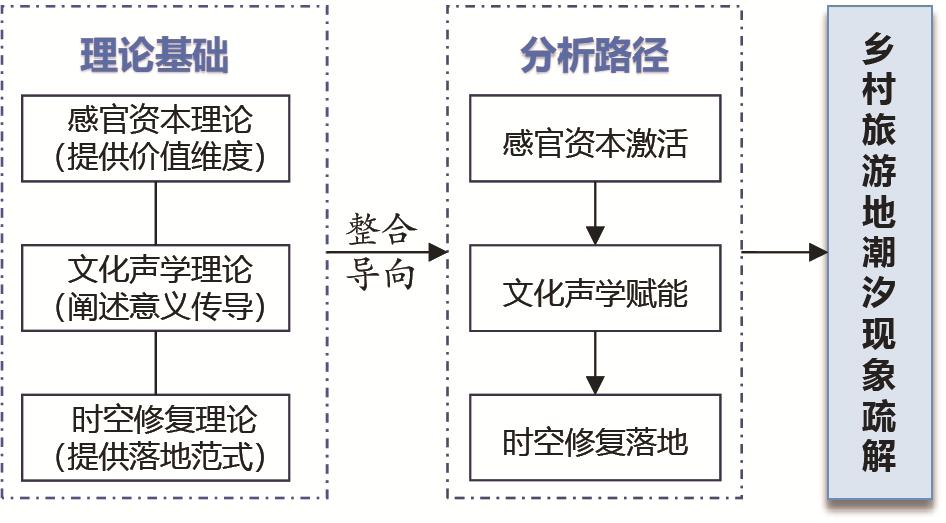
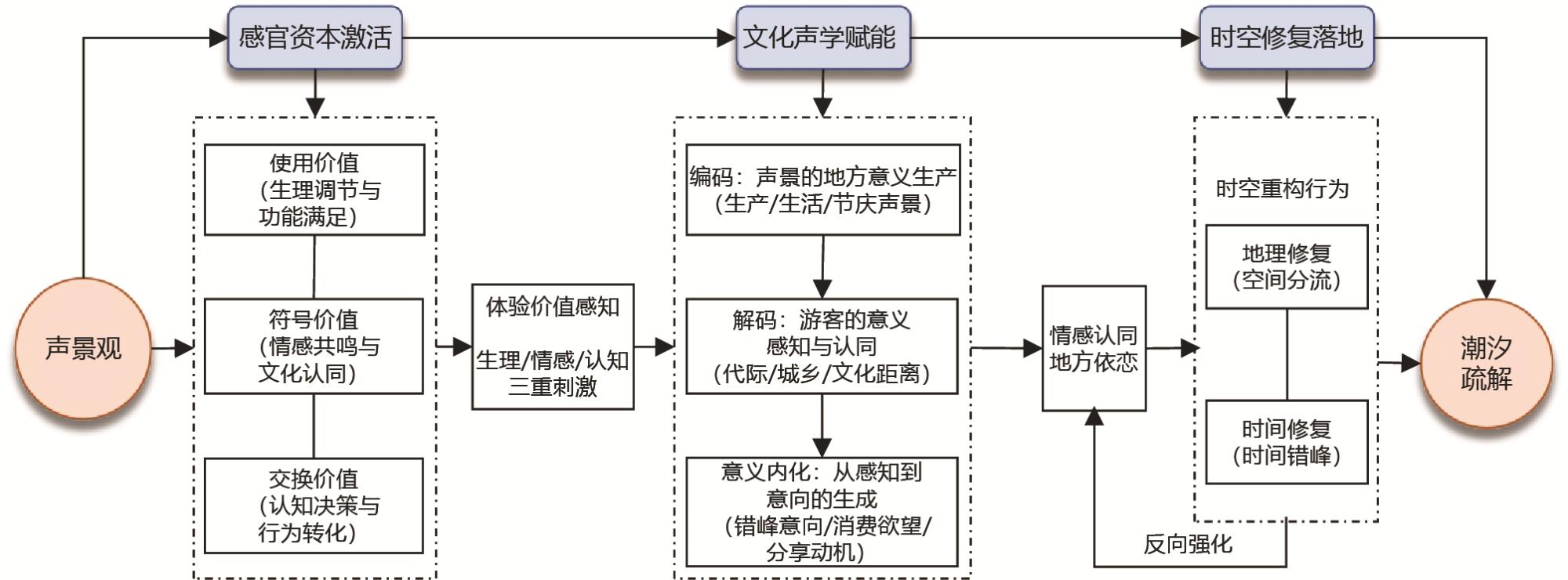
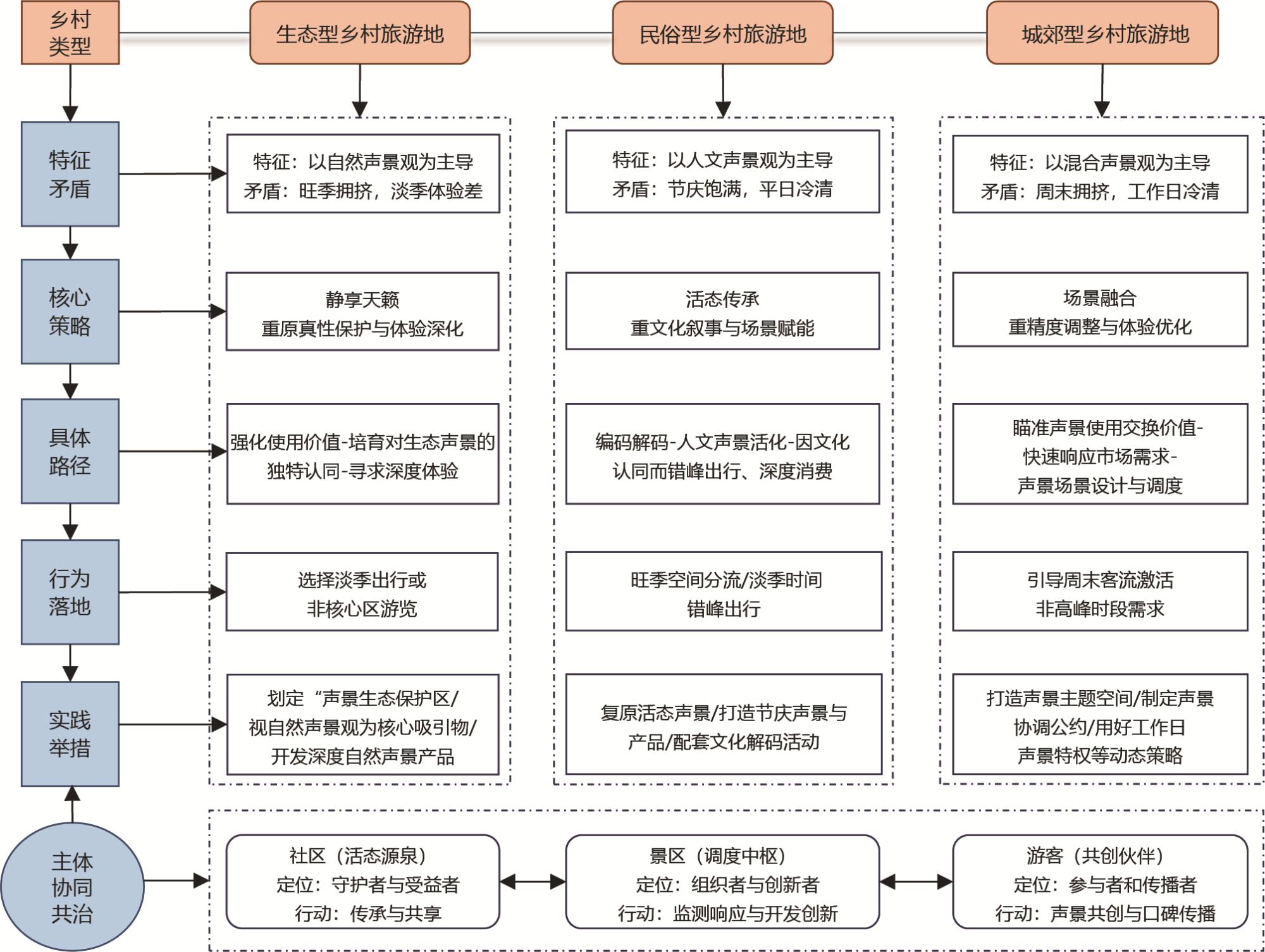
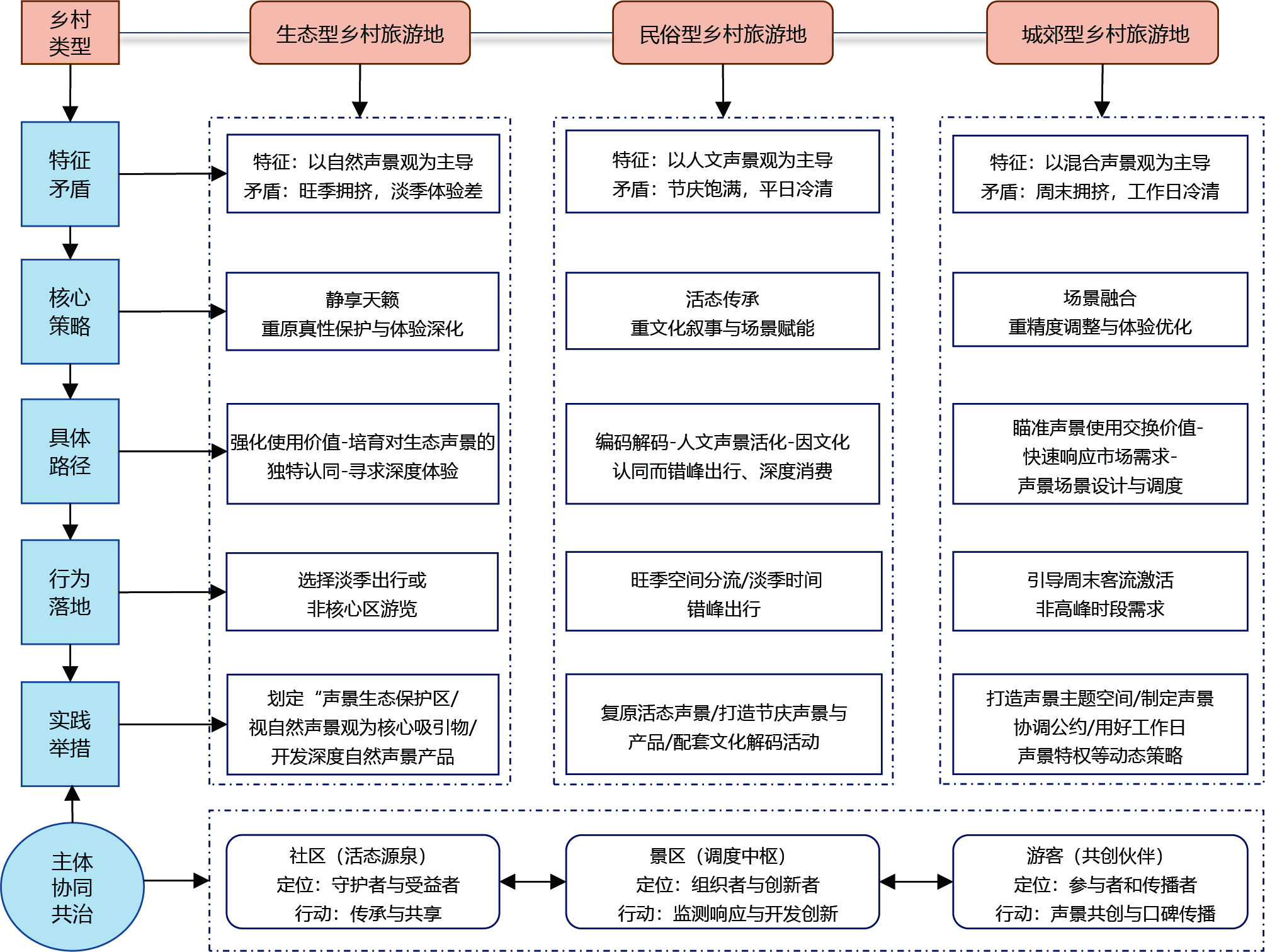
游客时空非均衡分布的“潮汐现象”是乡村旅游地实现可持续发展的核心瓶颈。声景观作为一类长期被忽视的“感官资本”,具有破解这一困境的独特潜力。文章整合感官资本、文化声学和时空修复理论,构建“价值—意义—实践”贯通的分析框架,通过对典型案例地的深访、观察与文本分析,系统阐释声景观疏解潮汐现象的内在机制。研究发现:声景观通过“感官激活—文化认同—时空重构”的递进路径发挥作用,并内嵌“深度体验—认同强化—主动错峰”的反馈回路,形成具有自我增强效应的疏解机制。具体而言,感官资本(使用价值、符号价值与交换价值)构成行为改变的底层动力,文化声学完成地方意义的编码—解码—内化传导,时空修复则通过空间分流与时间错峰实现客流重塑。基于此,文章提出针对生态型、民俗型与城郊型乡村的差异化声景实践路径。文章重新审视了将声景观视为“辅助要素”的传统认知,将感官资本与时空修复理论延伸至非视觉维度,为破解乡村旅游潮汐困境提供了新的理论视角与实践思路。
刘笑明 , 徐婷 . 乡村旅游地“潮汐现象”的声景观疏解——感官资本的激活与时空重构[J]. 热带地理, 2026 , 46(5) : 954 -966 . DOI: 10.13284/j.cnki.rddl.20250846
The "tidal phenomenon" of tourist flows in rural destinations—characterized by peak-season overcrowding and off-season stagnation—poses a critical barrier to sustainable development. Conventional hard strategies, such as capacity expansion and price regulation, are often inefficient and may undermine local authenticity. The soundscape, as a largely overlooked form of sensory capital, offers potential to flexibly guide tourists’ spatio-temporal behavior; however, its underlying mechanisms remain unclear. This study integrates sensory capital, cultural acoustics, and spatio-temporal fix theories to construct a "value-meaning-practice" framework, aiming to elucidate the core pathways and differentiated strategies for soundscape-based mitigation. A multi-case qualitative design encompassed six rural destinations in China: Yuantang Terraces and Libo Zhangjiang (ecological), Yongding Tulou and Dangjia Village (cultural-heritage), and Moganshan and Zhanqi Village (suburban). Data were collected through participant observation (7-15 days per site), in-depth interviews (80 respondents; approximately 120,000 words), and textual analyses (327 User-Generated Content (UGC) items and official documents). The analysis followed a three-stage coding process using NVivo 12 until theoretical saturation was achieved. The results revealed a three-stage progressive pathway—sensory capital activation, cultural acoustics empowerment, and spatio-temporal fixation—embedded within a self-reinforcing feedback loop. At the sensory capital activation level, natural soundscapes generate use value through stress reduction and attention restoration, extending tourists’ average dwell time at Yuantang Terraces by 20 min. Humanistic soundscapes generate symbolic value through nostalgia and participatory engagement. Elderly tourists in Dangjia Village planned winter return visits triggered by traditional peddlers’ calls, while younger tourists developed a sense of belonging through interactive drum performances. Soundscapes also carry exchange value as information carriers: the "rice paddy frog calls" short video in Zhanqi Village directly prompted off-season bookings, while off-season mountain singing in Yongding Tulou encouraged off-peak recommendations. At the cultural acoustics empowerment level, local communities encode productive and everyday soundscapes (e.g., rammed earth chanting symbolizing solidarity and morning pestle sounds reflecting a grain-cherishing philosophy). Tourists decode these sounds through generational, urban-rural, and cultural distance lenses, thereby fostering deep place attachment. Drum sounds initially perceived as "noisy" were reinterpreted as “powerfully beautiful” after tourists learned about their historical military and harvest functions. This internalization translates into three behavioral outcomes: off-season intention (e.g., Moganshan winter bamboo-listening participants expressed a willingness to revisit during the off-season), consumption desire (e.g., purchasing soundscape-themed teaware as memory vessels), and enhanced sharing motivation (e.g., UGC related to weaving sounds achieved significantly higher interaction rates than conventional landscape photographs). At the spatio-temporal fixation level, spatial diversion during peak seasons achieves a geographical fix: zoning of Yuantang Terraces into quiet listening and interactive areas reduced core-area crowding by an estimated 28%, while drum sounds in Dangjia Village acted as an "acoustic lighthouse," guiding tourists toward peripheral alleys. Temporal staggering during the off-season achieves a temporal fix: Libo Zhangjiang’s "summer night firefly stream soundscape" narrative increased off-season visitation by 35%, while Moganshan’s soundscape membership system (off-season points redeemable for peak-season privileges) cultivated stable off-season visitation habits. This process forms a self-reinforcing loop—"deep experience → identity reinforcement → active off-peak behavior"—providing endogenous momentum for long-term visitor balance. The mechanism exhibits differentiated emphases across rural types: ecological villages prioritize use value and restorative experiences; cultural heritage villages emphasize symbolic value and cultural authenticity; and suburban villages prioritize exchange value and flexible scene construction. The essence of soundscape mitigation lies in a systematic socio-cultural process of "sensory activation → cultural identification → spatio-temporal restructuring," with its feedback loop ensuring sustainability. The theoretical contributions are twofold: first, the study introduces an auditory dimension into sensory capital theory by operationalizing a three-dimensional value system and demonstrating how soundscapes guide spatio-temporal decisions through physiological, emotional, and cognitive pathways, thereby challenging the visual-centric bias in tourism geography; second, it establishes a cultural interpretative pathway for spatio-temporal fixation theory by demonstrating that soundscape-based cultural narratives constitute a non-economic fix, thereby extending the theory’s application from capital logic to sensory-cultural governance.
表1 案例地声景观及其潮汐现象疏解概况Table 1 Profile of case study sites and soundscape-based mitigation of tourist tide |
| 案例地 类型 | 代表案例 | 核心声景资源 | 潮汐现象 主要表现 | 声景观疏解潮汐现象的核心体现 |
| 生态型 | 云南元阳 梯田 | 梯田灌水声、 鸟鸣、风声 | 旺季观景台拥挤, 淡季体验单一 | 以自然声景的“静谧疗愈”价值舒缓旺季拥堵处的游客焦虑,引导停留与 分流;以季节性水声塑造淡季的独特生态听觉标识,吸引专项体验客流。 |
| 生态型 | 贵州荔波 樟江 | 溪流声、 森林声景 | 旺季核心区超载, 淡季资源闲置 | 通过“森林静听步道”等设计,利用溪流、鸟鸣等声景的恢复性效应, 在旺季疏导客流至非核心区;打造“夏夜萤火虫声景”等淡季专属叙事,激活生态游憩需求。 |
| 民俗型 | 福建永定 土楼 | 夯土号子、客家山 歌、节庆仪式声 | 节庆期间人满 为患,平日冷清 | 将高强度、瞬时的节庆仪式声景,活态转化为日常可体验的“夯土号子” 展示与山歌传习,以深度文化体验吸引游客错峰来访,化解“节庆性拥堵”。 |
| 民俗型 | 陕西韩城 党家村 | 行鼓表演、方言、 手工艺声 | 文化体验集中, 时空分布不均 | 利用行鼓表演声的穿透性与号召力,作为动态的“听觉灯塔”,在旺季引导 客流从核心建筑向周边巷弄扩散;开发方言、手工艺声的互动体验,丰富 平日文化内涵。 |
| 城郊型 | 浙江德清 莫干山 | 自然声景、咖啡馆 民宿等混合声景 | 周末拥挤, 工作日冷清 | 通过打造“竹林静听会”等主题声景空间与事件,塑造工作日/淡季独有的 “宁静奢华”体验;运用“声景会员体系”激励错峰消费,实现客流的时间均衡。 |
| 城郊型 | 成都郫都区 战旗村 | 田园声景、 亲子活动声 | 短途客流潮汐 效应显著 | 设计“听雨廊”等声景打卡点与“稻田蛙鸣”亲子活动,将声体验转化为 可预约、可引导的消费节点,有效分散周末客流,提升非高峰时段吸引力。 |
表2 编码过程示例Table 2 Examples of the coding process |
| 数据来源 | 原始语句示例(开放式编码) | 范畴化 (主轴编码) | 核心范畴 (选择性编码) |
| 访谈T-荔波-11 | “水声好像能把心里的烦躁都冲走,不知不觉就在这坐了半小时, 本来只想歇个脚。” | 生理调节与 停留延长 | 感官资本激活 |
| UGC-莫干山-128 | “深夜的虫鸣和偶尔的狗吠,反而让失眠的我感到一种安心的陪伴, 这是城市酒店给不了的。” | 情感共鸣与 地方依恋 | 感官资本激活 |
| 访谈T-战旗-05 | “APP上推荐说这个时间点去‘听雨廊’能听到最清脆的雨打芭蕉声, 我们就是冲着这个来的。” | 声景信息 驱动决策 | 感官资本激活 |
| 访谈R-永定-05 (居民) | “从小听惯了夯墙的号子,那节奏就是团结和力量,现在唱给游客听 也是想让他们明白我们客家人的精神。” | 社区的声音 文化编码 | 文化声学赋能 |
| 访谈T-10 (外国游客) | “导游解释说这鼓声曾经用来传递消息,我再看这古老的村落,感觉 仿佛能‘听’到它的历史在回响。” | 游客的文化解码与 意义感知 | 文化声学赋能 |
| UGC-韩城-089 | “买了能发出风声的陶笛,每次吹响像又回到党家村那个高高的看家楼。 为了这感觉,淡季人少时再去一次也挺好。” | 声景消费与 错峰重游意愿 | 文化声学赋能 |
| 观察O-莫干山- | 工作日上午,约三分之一游客手持“声景地图”,在不同主题声景打卡点 (如“竹语亭” “溪畔石”)间穿梭。 | 声景引导的 空间分流 | 时空修复落地 |
| 访谈T-郫都-08 | “公众号推文说冬天的战旗村能听到‘霜冻落叶声’,觉得很特别, 就特意挑了个周三过来体验,果然很清净。” | 季节性声景驱动的 时间错峰 | 时空修复落地 |
|
Anderson R. Sound and the City: Acoustic Environments and Cultural Identity. Journal of Urban Cultural Studies, 2013, 20 (2): 123- 140.
|
|
Bai W, Wang J, Wong J W C, Han X Y, and Guo Y Q. The Soundscape and Tourism Experience in Rural Destinations: An Empirical Investigation from Shawan Ancient Town. Humanities and Social Sciences Communications, 2024, 11 (1): 1- 13.
|
|
Bourdieu P. 1986. The Forms of Capital. New York: Greenwood Press.
|
|
Butler R W. The Concept of a Tourist Area Cycle of Evolution: Implications for Management of Resources. The Canadian Geographer, 1980, 24 (1): 5- 12.
|
|
池方爱, 李高梅, 管斌君. 浙江传统村落之聆赏艺术初探——以斯宅村为例探析其“传统村落声景观”及村落保护策略. 城市规划, 2019, 43 (2): 84- 90.
Chi Fang'ai, Li Gaomei, and Guan Binjun. A Preliminary Study on the Listening and Appreciation Art of Traditional Villages in Zhejiang: Exploring the "Traditional Village Soundscape" and Village Protection Strategies with Sizhai Village as an Example. City Planning Review, 2019, 43 (2): 84- 90.
|
|
邓志勇. 2015. 族群 聚落 声音: 声景学视野下的文化生态. 北京: 北京旅游教育出版社.
Deng Zhiyong. 2015. Ethnic Group, Settlement, Sound: Cultural Ecology from the Perspective of Soundscape. Beijing: Beijing Tourism Education Press.
|
|
Geertz C. 1973. The Interpretation of Cultures. New York: Basic Books.
|
|
Guo X, Jiang S Y, Liu J, Chen Z, and Hong X C. Understanding the Role of Visitor Behavior in Soundscape Restorative Experiences in Urban Parks. Forests, 2024, 15 (10): 1751.
|
|
Harvey D. 2003. Spaces of Capital: Towards a Critical Geography. New York: Routledge.
|
|
黄翠婷, 晋秀龙, 沈冰清. 基于声景感知的传统村落景区旅游体验质量研究——以安徽宏村为例. 四川旅游学院学报, 2021 (2): 16- 21.
Huang Cuiting, Jin Xiulong, and Shen Bingqing. Study on the Quality of Tourism Experience in Traditional Village Scenic Spots Based on Soundscape Perception: A Case Study of Hongcun, Anhui. Journal of Sichuan Tourism University, 2021 (2): 16- 21.
|
|
Kou L, Xiao X, Xu H, and Cheng J. Understanding Tourist Experiences of Sounds at Nature-Based Destinations: From a Relational Perspective. Current Issues in Tourism, 2024, 27 (4): 600- 618.
|
|
李伯华, 邓蕴, 窦银娣. 旅游型传统村落声景观的特征解析、问题呈现与提升策略——以湖南省皇都村为例. 中国生态旅游, 2025, 15 (1): 173- 186.
Li Bohua, Deng Yun, and Dou Yindi. Characteristic Analysis, Problem Presentation and Improvement Strategies of Soundscape in Tourism-Oriented Traditional Villages: A Case Study of Huangdu Village, Hunan Province. Chinese Ecotourism, 2025, 15 (1): 173- 186.
|
|
李志飞, 李佳蔚. 听得见的乡愁: 乡村旅游中的声音景观. 四川师范大学学报(社会科学版), 2023, 50 (1): 98- 106.
Li Zhifei and Li Jiawei. Audible Nostalgia: Soundscape in Rural Tourism. Journal of Sichuan Normal University (Social Sciences Edition), 2023, 50 (1): 98- 106.
|
|
刘爱利, 胡中州, 刘敏, 邓志勇, 姚长宏. 声景学及其在旅游地理研究中的应用. 人文地理, 2013, 28 (6): 1132- 1142.
Liu Aili, Hu Zhongzhou, Liu Min, Deng Zhiyong, and Yao Changhong. Soundscape and Its Application in Tourism Geography Research. Human Geography, 2013, 28 (6): 1132- 1142.
|
|
刘福承, 刘爱利, 刘敏, 韩雪, 姚长宏. 基于居民感知的古村落声景变迁及影响研究——以安徽宏村为例. 旅游科学, 2017, 31 (4): 78- 90.
Liu Fucheng, Liu Aili, Liu Min, Han Xue, and Yao Changhon. Study on the Changes and Impacts of Ancient Village Soundscape Based on Residents' Perception: A Case Study of Hongcun, Anhui. Tourism Science, 2017, 31 (4): 78- 90.
|
|
刘岩. 声音文化研究: 界说、类型与范式. 外国文学, 2021 (6): 123- 133.
Liu Yan. Sound Culture Studies: Definition, Types and Paradigms. Foreign Literature, 2021 (6): 123- 133.
|
|
刘玉堂, 姜雨薇. 钟声里的城市: 江汉关声音景观的角色变迁及地方依恋. 理论月刊, 2022 (1): 79- 87.
Liu Yutang and Jiang Yuwei. The City in the Bell: Role Change and Place Attachment of Jianghanguan Soundscape. Theory Monthly, 2022 (1): 79- 87.
|
|
Liu Y, Wang C, and Wei M. Soundscape in Rural Tourism: The Interplay between Authenticity, Visitor Experience, and Behavioral Intention. Tourism Management, 2024, 98, 104789.
|
|
毛琳箐, 康健. 传统声景观的非物质文化遗产特征研究——以贵州侗族传统村落为例. 广西民族研究, 2020 (1): 108- 116.
Mao Linqing and Kang Jian. Study on the Intangible Cultural Heritage Characteristics of Traditional Soundscape: A Case Study of Traditional Dong Villages in Guizhou. Guangxi Ethnic Studies, 2020 (1): 108- 116.
|
|
Oberman T, Latini A, Aletta F, Gozzi G, Kang J, and Torresin S. Human Sounds and Associated Tonality Disrupting Perceived Soundscapes in Protected Natural Areas. Scientific Reports, 2025, 15, 12345.
|
|
仇梦嫄, 杨加猛, 张捷. 视听及其交互效应对旅游者总体生活质量的影响研究——恢复性环境体验的中介作用. 旅游科学, 2021, 35 (4): 5- 20.
Qiu Mengyuan, Yang Jiameng, and Zhang Jie. Study on the Impact of Audio-Visual and Their Interaction Effects on Tourists' Overall Quality of Life: The Mediating Role of Restorative Environmental Experience. Tourism Science, 2021, 35 (4): 5- 20.
|
|
任雅枝, 余志远, 刘玥. 离乡群体的乡村声景符号感知与乡愁表意机制. 热带地理, 2025, 45 (9): 1565- 1577.
Ren Yazhi, Yu Zhiyuan, and Liu Yue. Rural Soundscape Symbol Perception and Nostalgia Representation Mechanism of the Diaspora Groups. Tropical Geography, 2025, 45 (9): 1565- 1577.
|
|
Schafer R M. 1993. The Soundscape: Our Sonic Environment and the Tuning of the World. Rochester: Destiny Books.
|
|
Stake R E. 2006. Multiple Case Study Analysis. New York: The Guilford Press.
|
|
生态环境部, 国家质量监督检验检疫总局. 2008. 声环境质量标准(GB 3096-2008). 北京: 中国环境科学出版社.
Ministry of Ecology and Environment of the People's Republic of China, General Administration of Quality Supervision, Inspection and Quarantine of the People's Republic of China. 2008. Environmental Quality Standard for Noise(GB 3096-2008). Beijing: China Environmental Science Press.
|
|
孙维国. 2024. 加强引导精准施策 缓解假日旅游“冷热不均”. 中国旅游报, 2024-04-25(03).
Sun Weiguo. 2024. Strengthen Guidance and Precise Measures to Alleviate the 'Uneven Development' of Holiday Tourism. China Tourism News, 2024-04-25(03).
|
|
王铭杰, 孟凯, 张世泽, 李雯婕, 唐佳欣, 王辰露. 乡村性和乡村旅游吸引力: 基于游客感知视角的要素结构辨识和认知机制解析. 热带地理, 2021, 41 (6): 1325- 1337.
Wang Mingjie, Meng Kai, Zhang Shize, Li Wenjie, Tang Jiaxin, and Wang Chenlu. Rurality and Rural Tourism Attraction: Element Structure Identification and Cognitive Mechanism Analysis Based on Tourists' Perception. Tropical Geography, 2021, 41 (6): 1325- 1337.
|
|
翁时秀, 保继刚. 中国旅游地理学学术实践的代际差异与学科转型. 地理研究, 2017, 36 (5): 824- 836.
Weng Shixiu and Bao Jigang. Generational Differences and Disciplinary Transformation in Academic Practice of Chinese Tourism Geography. Geographical Research, 2017, 36 (5): 824- 836.
|
|
Xie B. 2023. Spatial Sound—Principles and Applications. Boca Raton: CRC Press.
|
|
张捷. Schafer声景观理论经典著作的评析. 旅游学刊, 2015, 30 (12): 121- 124.
Zhang Jie. A Review of Schafer's Classic Works on Soundscape Theory. Tourism Tribune, 2015, 30 (12): 121- 124.
|
|
张玲玲, 郭英之, 申军波. 多维感官视阈下乡村旅游体验: 价值重构与情境创设. 农业现代化研究, 2022, 43 (4): 660- 667.
Zhang Lingling, Guo Yingzhi, and Shen Junbo. Rural Tourism Experience from the Perspective of Multi-Dimensional Senses: Value Reconstruction and Context Creation. Research of Agricultural Modernization, 2022, 43 (4): 660- 667.
|
/
| 〈 |
|
〉 |