中国实际光伏部署区域未来发电潜力的气候风险评估
研究思路与方法设计,论文修改与校对
|
张德帅(1998—),男,四川绵阳人,硕士研究生,研究方向为全球变化与碳循环,E-mail:zhangdsh9@mail2.sysu.edu.cn |
收稿日期: 2025-10-28
修回日期: 2026-04-17
网络出版日期: 2026-05-16
基金资助
国家自然科学基金青年科学基金项目(42301020);广东省基础与应用基础研究基金项目(2024A1515010929)
版权
Climate-Risk Assessment for Future Power-Generation Potential of China's Deployed Solar Photovoltaic Systems
Received date: 2025-10-28
Revised date: 2026-04-17
Online published: 2026-05-16
Copyright
在全球能源结构加速向可再生能源转型的背景中,中国已成为光伏领域的引领者,其装机容量与发电量均位居世界前列。然而,以往研究多集中于评估覆盖全部陆地表面的光伏发电潜力(PsolarPV),忽视了对已实际部署、正在运行的光伏设施所面临的气候风险,导致对现有光伏系统发电潜力在未来气候变化下的评估仍不够充分。为此,文章基于耦合模型比对项目第六阶段的多模型数据,模拟并分析了2015—2060年3种温室气体排放情景下中国现有光伏部署区域PsolarPV的时空变化趋势。结果显示,在3种不同温室气体排放情景下,未来全国年均PsolarPV预计均保持增加的趋势(从0.6%±0.4%到3.4%±0.4%)。不过,随着温室气体排放情景的加剧,PsolarPV的相对增加量将减少约2.8%,同时亏电天数的相对变化将增加约3.4%。该下降趋势主要由气温升高所驱动,其负面影响的贡献率从低温室气体排放情景下的31.0%增长到高温室气体排放情景下的46.2%。此外,中国光伏系统的运行稳定性对未来气候变化呈现显著的空间异质性,其中西北、华北和华东地区对气候变化最为敏感。在高温室气体排放情景下,这3个地区的亏电天数平均增加0.8 d/10 a,且PsolarPV的年内短期波动和季节性波动幅度均明显高于其他地区。
张德帅 , 欧阳卓林 , 李雁君 , 杜建会 , 张海成 . 中国实际光伏部署区域未来发电潜力的气候风险评估[J]. 热带地理, 2026 , 46(5) : 796 -808 . DOI: 10.13284/j.cnki.rddl.20250745
Amidst the global transition toward renewable energy, China has emerged as the world leader in solar photovoltaic (PV) capacity and generation. However, the climatic risks and operational stability of this extensively deployed PV infrastructure under future climate change remain insufficiently assessed. Previous studies have primarily focused on the theoretical PV power-generation potential (PsolarPV) across terrestrial areas, overlooking the specific climatic risks of existing operational PV facilities. This study addresses this critical gap through a comprehensive, multi-dimensional risk assessment for China's deployed PV systems. We developed a high-resolution hourly PsolarPV model driven by a multi-model ensemble from the NASA Earth Exchange Global Daily Downscaled Projections (NEX-GDDP-CMIP6) under three greenhouse gas (GHG) emission scenarios from 2015 to 2060. Focusing on China’s existing deployed PV infrastructure and seven representative regions, we quantified future changes in annual PsolarPV and their driving factors, the frequency of extreme PV power events (energy "surplus" and energy “deficit” days), and intra-annual variability (short-term fluctuations and seasonal variations). Our results reveal that future trends in PsolarPV across China’s PV deployments are shaped by the opposing effects of increasing solar radiation (positive effect) and rising surface temperatures (negative effect). Under the low-emission scenario (SSP1-2.6), enhanced solar radiation dominates, leading to a nationwide increase in annual PsolarPV of 3.4%±0.4% (multi-model mean ± standard error). In contrast, under the high-emission scenario (SSP5-8.5), thermal-induced efficiency losses offset these gains, resulting in a slight increase of 0.6%±0.4% in PsolarPV and a rise in the frequency of poor-power days by 0.1 d per decade. Moreover, climate-induced impacts exhibited pronounced spatial heterogeneity. With increasing GHG emissions, deployed PV systems in northwestern, northern, and eastern China are projected to be the most climate-sensitive, experiencing greater changes in power-generation potential and more frequent extreme power-generation events. Northwest China, where PV deployments are concentrated, is projected to experience a decline of -0.5%±0.2% in PsolarPV and an increase of 1.0 d per decade in extreme poor-power days under the high-emission scenario. Conversely, the deployed PV systems in South and Southwest China exhibited stronger climate resilience. Furthermore, higher GHG-emission scenarios are expected to intensify seasonal and short-term PsolarPV fluctuations, especially in northern regions (e.g., Northeast, North, and Northwest China), posing greater challenges to grid stability and power dispatch management. In conclusion, this study provides the first location-specific, forward-looking climate risk assessment of China's existing PV infrastructure. These findings highlight that stringent GHG mitigation is critical for safeguarding solar energy assets and ensuring the long-term sustainability of PV power generation. They also emphasize the need for spatially differentiated climate adaptation strategies, including optimizing future deployment in climate-resilient regions, strengthening grid capacity with advanced energy storage, and enacting policies that enhance the climate resilience of China’s solar power system.
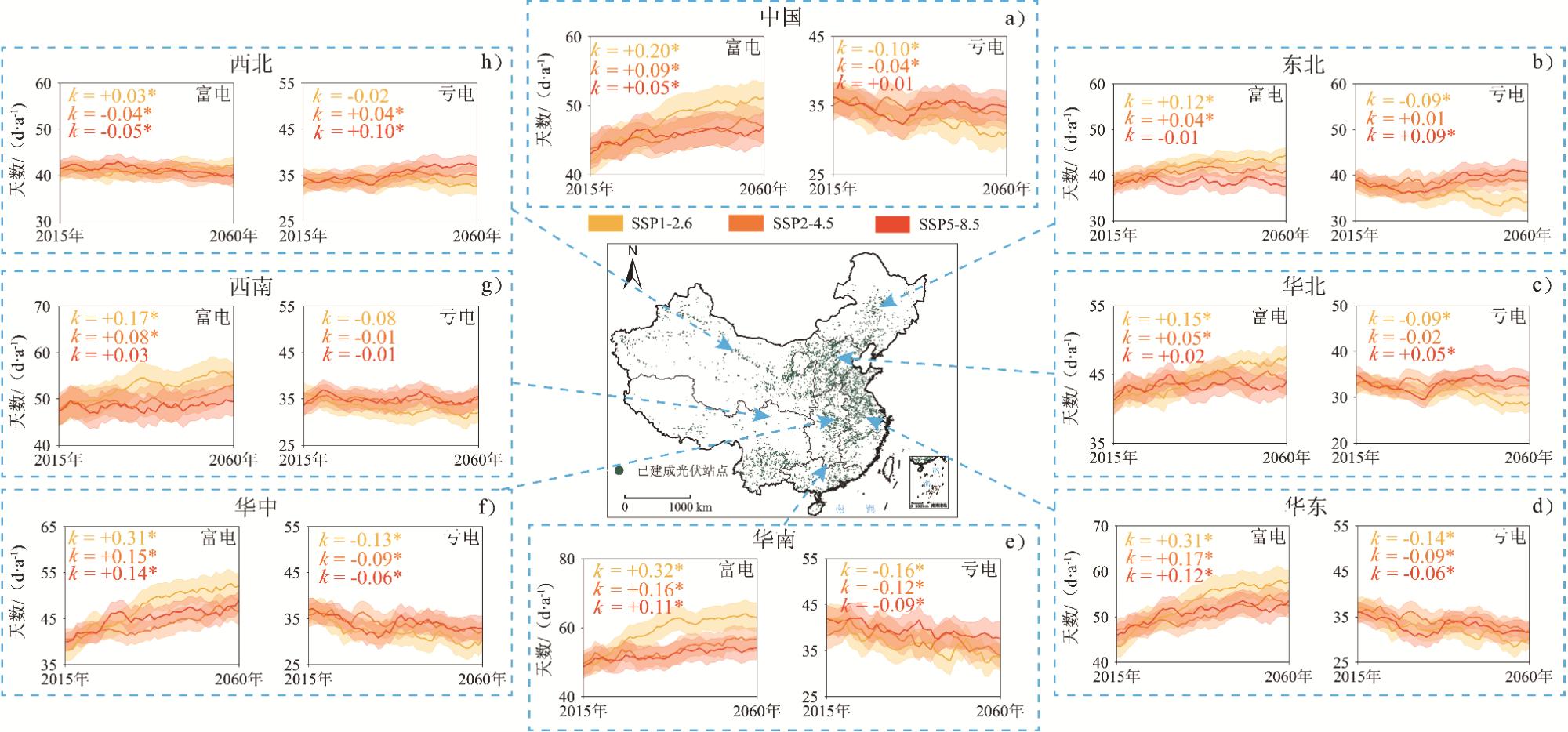
图3 未来不同温室气体排放情景下2015—2060年中国已部署光伏设施区域极端光伏发电事件频次的演变趋势注:实线表示多模型集合(NEX-GDDP-CMIP6)估计值的均值,阴影区域表示多模型集合估计值的标准误差。 Fig.3 Evolving trends in the frequency of extreme PV power-generation events in regions with deployed PV facilities in China during 2015-2060 under different GHG emission scenarios |
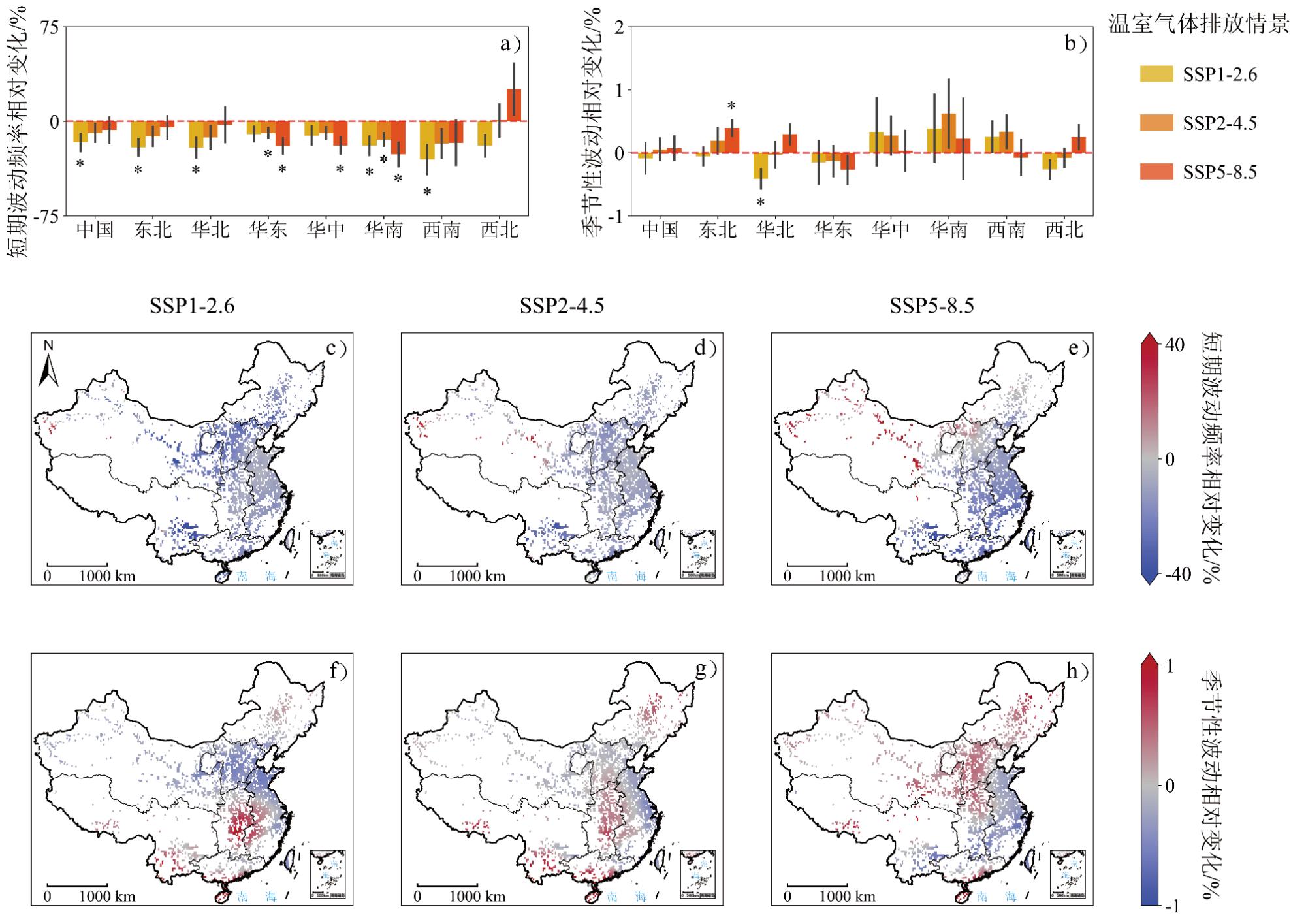
图4 不同温室气体排放情景下当前(2015—2024)至未来(2051—2060)PsolarPV年内短期波动频率和季节性波动的相对变化注:条形图中的误差棒表示多模型集合(NEX-GDDP-CMIP6)估计值的标准误差。 Fig.4 Relative changes in the frequency of intra-annual short-term fluctuation and seasonal variability of PsolarPV from the present-day(2015-2024) to the future(2051-2060) under different GHG emission scenarios. |
|
Barkanov E, Penalba M, Martinez A, Martinez-Perurena A, Zarketa-Astigarraga A, and Iglesias G. Evolution of the European Offshore Renewable Energy Resource Under Multiple Climate Change Scenarios and Forecasting Horizons via CMIP6. Energy Conversion and Management, 2024, 301, 118058.
|
|
Barron-Gafford G A, Pavao-Zuckerman M A, Minor R L, Sutter L F, Barnett-Moreno I, Blackett D T, Thompson M, Dimond K, Gerlak A K, Nabhan G P, and Macknick J E. Agrivoltaics Provide Mutual Benefits across the Food-Energy-Water Nexus in Drylands. Nature Sustainability, 2019, 2 (9): 848- 855.
|
|
Breyer C. Low-Cost Solar Power Enables a Sustainable Energy Industry System. Proceedings of the National Academy of Sciences, 2021, 118 (49): e2116940118.
|
|
Chen S, Lu X, Miao Y, Deng Y, Nielsen C P, Elbot N, Wang Y, Logan K G, McElroy M B, and Hao J. The Potential of Photovoltaics to Power the Belt and Road Initiative. Joule, 2019, 3 (8): 1895- 1912.
|
|
Chen X, Mao H, Cheng N, Ma L, Tian Z, Luo Y, Zhou C, Li H, Wang Q, Kong W, and Fan J. Climate Change Impacts on Global Photovoltaic Variability. Applied Energy, 2024, 374, 124087.
|
|
Chunduri S. 2025. Market Survey on Solar Cell Production Equipment 2025. (2026-01-16) [2026-04-25]. https://images.assettype.com/taiyangnews/2025-10-10/yduyuwjn/TYN_Market_Survey_Cell_Production_Equipment_2025_V01.pdf.
|
|
Deng Y, Van Brackle C H, Dai X, Zhao J, Chen B, and Huang J. Tailoring Solvent Coordination for High-Speed, Room-Temperature Blading of Perovskite Photovoltaic Films. Science Advances, 2019, 5 (12): eaax7537.
|
|
Friedl M and Damien S M. 2022. MODIS/Terra+Aqua Land Cover Type Yearly L3 Global 500m SIN Grid V061. (2022-08-05) [2026-04-25]. https://www.earthdata.nasa.gov/data/catalog/lpcloud-mcd12q1-061.
|
|
Gernaat D E H J, de Boer H S, Daioglou V, Yalew S G, Müller C, and van Vuuren D P. Climate Change Impacts on Renewable Energy Supply. Nature Climate Change, 2021, 11 (2): 119- 125.
|
|
Gil V, Gaertner M A, Gutierrez C, and Losada T. Impact of Climate Change on Solar Irradiation and Variability over the Iberian Peninsula Using Regional Climate Models. International Journal of Climatology, 2019, 39 (3): 1733- 1747.
|
|
国家能源局. 2024. 从输“煤电”到送“绿电”——我国“西电东送”加速绿色转型. (2024-08-23)[2026-04-25]. https://www.nea.gov.cn/2024-08/23/c_1212390763.htm.
National Energy Administration. 2024. From transmitting "Coal Power" to Delivering "Green Power": China's "West to East Power Transmission" Accelerates Green Transition. (2024-08-23) [2026-04-25]. https://www.nea.gov.cn/2024-08/23/c_1212390763.htm.
|
|
国家能源局. 2025.2025年一季度光伏发电建设情况. (2025-04-29)[2026-04-25]. https://www.nea.gov.cn/20250429/b78504d2e8a14b97bdcffb2c501b7393/c.html.
National Energy Administration. 2025. Construction Status of Photovoltaic Power Generation in the First Quarter of 2025. (2025-04-29) [2026-04-25]. https://www.nea.gov.cn/20250429/b78504d2e8a14b97bdcffb2c501b7393/c.html.
|
|
Haegel N M, Margolis R, Buonassisi T, Feldman D, Froitzheim A, Garabedian R, Green M, Glunz S, Henning H M, Holder B, Kaizuka I, Kroposki B, Matsubara K, Niki S, Sakurai K, Schindler R A, Tumas W, Weber E R, Wilson G, Woodhouse M, and Kurtz S. Terawatt-Scale Photovoltaics: Trajectories and Challenges. Science, 2017, 356 (6334): 141- 143.
|
|
He G, Lin J, Sifuentes F, Liu X, Abhyankar N, and Phadke A. Rapid Cost Decrease of Renewables and Storage Accelerates the Decarbonization of China's Power System. Nature Communications, 2020, 11 (1): 2486.
|
|
Helveston J and Nahm J. China's Key Role in Scaling Low-Carbon Energy Technologies. Science, 2019, 366 (6467): 794- 796.
|
|
Hernandez R R, Hoffacker M K, and Field C B. Efficient Use of Land to Meet Sustainable Energy Needs. Nature Climate Change, 2015, 5 (4): 353- 358.
|
|
Höltinger S, Mikovits C, Schmidt J, Baumgartner J, Arheimer B, Lindström G, and Wetterlund E. The Impact of Climatic Extreme Events on the Feasibility of Fully Renewable Power Systems: A Case Study for Sweden. Energy, 2019, 178, 695- 713.
|
|
Hua S. 2025. January 2. All About HJT-The Secret of Heterojunction Solar Cell Technology. (2025-01-02) [2026-04-25]. https://www.pv-magazine.com/press-releases/all-about-hjt-the-secret-of-heterojunction-solar-cell-technology.
|
|
IEA. 2024. Renewables 2024. Paris: International Energy Agency.
|
|
IPCC. 2023. Climate Change 2023: Synthesis Report. Contribution of Working Groups I, II and III to the Sixth Assessment Report of the Intergovernmental Panel on Climate Change. Geneva: Intergovernmental Panel on Climate Change (IPCC).
|
|
Jerez S, Tobin I, Vautard R, Montávez J P, López-Romero J M, Thais F, Bartok B, Christensen O B, Colette A, Déqué M, Nikulin G, Kotlarski S, van Meijgaard E, Teichmann C, and Wild M. The Impact of Climate Change on Photovoltaic Power Generation in Europe. Nature Communications, 2015, 6 (1): 10014.
|
|
Jiang H, Lu N, Yao L, Qin J, and Liu T. Impact of Climate Changes on the Stability of Solar Energy: Evidence from Observations and Reanalysis. Renewable Energy, 2023, 208, 726- 736.
|
|
Kawajiri K, Oozeki T, and Genchi Y. Effect of Temperature on PV Potential in the World. Environmental Science & Technology, 2011, 45 (20): 9030- 9035.
|
|
Lei Y, Wang Z, Wang D, Zhang X, Che H, Yue X, Tian C, Zhong J, Guo L, Li L, Zhou H, Liu L, and Xu Y. Co-Benefits of Carbon Neutrality in Enhancing and Stabilizing Solar and Wind Energy. Nature Climate Change, 2023, 13 (7): 693- 700.
|
|
Levin K, Rich D, Ross K, Fransen T, and Elliott C. 2020. Designing and Communicating Net-Zero Targets. (2020-07-29) [2026-04-25]. https://www.wri.org/research/designing-and-communicating-net-zero-targets.
|
|
Li A, Liu L, Li S, Cui X, Chen X, and Cao X. Global Photovoltaic Solar Panel Dataset from 2019 to 2022. Scientific Data, 2025, 12 (1): 637.
|
|
Li J and Huang J. The Expansion of China's Solar Energy: Challenges and Policy Options. Renewable and Sustainable Energy Reviews, 2020, 132, 110002.
|
|
Li X, Mauzerall D L, and Bergin M H. Global Reduction of Solar Power Generation Efficiency due to Aerosols and Panel Soiling. Nature Sustainability, 2020, 3 (9): 720- 727.
|
|
梁双, 王涉, 徐辉. 中国西电东送40年发展成效与政策建议. 中国电力, 2024, 57 (11): 88- 93.
Liang Shuang, Wang She, and Xu Hui. Development Achievements and Policy Suggestions of China's West to East Power Transmission for 40 Years. Electric Power, 2024, 57 (11): 88- 93.
|
|
Liu Z, Guo J, Wang X, Wang Y, Li W, Wang X, Fan Y, and Wang W. Prediction of Long-Term Photovoltaic Power Generation in the Context of Climate Change. Renewable Energy, 2024, 235, 121263.
|
|
Luo L, Zhuang Y, Liu H, Zhao W, Chen J, Du W, and Gao X. Environmental Impacts of Photovoltaic Power Plants in Northwest China. Sustainable Energy Technologies and Assessments, 2023, 56, 103120.
|
|
Mallapaty S. How China could be Carbon Neutral by Mid-Century. Nature, 2020, 586 (7830): 482- 483.
|
|
Meng R, Meng Z, Ren X, Cai J, and Tong X. Positive Impacts of Typical Desert Photovoltaic Scenarios in China on the Growth and Physiology of Sand-Adapted Plants. Frontiers in Plant Science, 2025, 15, 1515896.
|
|
Nature Synthesis. The Synthesis of Perovskites. Nature Synthesis, 2025, 4, 1019.
|
|
Rand J, Strauss R, Gorman W, Seel J, Kemp J, Jeong S, Robson D, and Wiser R H. 2023. Queued up: Characteristics of Power Plants Seeking Transmission Interconnection as of the End of 2022. (2023-04-14) [2026-04-25]. https://escholarship.org/uc/item/7w87m1pr.
|
|
Rodríguez-Gallegos C D, Liu H, Gandhi O, Singh J P, Krishnamurthy V, Kumar A, Stein J S, Wang S, Li L, Reindl T, and Peters I M. Global Techno-Economic Performance of Bifacial and Tracking Photovoltaic Systems. Joule, 2020, 4 (7): 1514- 1541.
|
|
Saxena A, Brown C, Arneth A, and Rounsevell M. Advanced Photovoltaic Technology can Reduce Land Requirements and Climate Impact on Energy Generation. Communications Earth & Environment, 2024, 5 (1): 586.
|
|
Sepulveda N A, Jenkins J D, Edington A, Mallapragada D S, and Lester R K. The Design Space for Long-Duration Energy Storage in Decarbonized Power Systems. Nature Energy, 2021, 6 (5): 506- 516.
|
|
Schwanitz, V. J. Evaluating integrated assessment models of global climate change. Environmental Modelling & Software, 2013, 50, 120- 131.
|
|
Shravanth Vasisht M, Srinivasan J, and Ramasesha S K. Performance of Solar Photovoltaic Installations: Effect of Seasonal Variations. Solar Energy, 2016, 131, 39- 46.
|
|
Thrasher B, Maurer E P, McKellar C, and Duffy P B. Technical Note: Bias Correcting Climate Model Simulated Daily Temperature Extremes with Quantile Mapping. Hydrology and Earth System Sciences, 2012, 16 (9): 3309- 3314.
|
|
Tuan Le A H, Basnet R, Yan D, Chen W, Nandakumar N, Duttagupta S, Seif J P, and Hameiri Z. Temperature-Dependent Performance of Silicon Solar Cells with Polysilicon Passivating Contacts. Solar Energy Materials and Solar Cells, 2021, 225, 111020.
|
|
Victoria M, Haegel N, Peters I M, Sinton R, Jäger-Waldau A, del Cañizo C, Breyer C, Stocks M, Blakers A, Kaizuka I, Komoto K, and Smets A. Solar Photovoltaics is Ready to Power a Sustainable Future. Joule, 2021, 5 (5): 1041- 1056.
|
|
Xia Z, Li Y, Zhang W, Chen R, Guo S, Zhang P, and Du P. Solar Photovoltaic Program Helps Turn Deserts Green in China: Evidence from Satellite Monitoring. Journal of Environmental Management, 2022, 324, 116338.
|
|
Yang Y, Lin S, Lu R, and Liu X. CPVPD-2024: A Chinese Photovoltaic Plant Dataset Derived via a Topography-Enhanced Deep Learning Framework. Scientific Data, 2025, 12 (1): 1601.
|
|
于佳, 王勇. 中国光伏产业发展与“一带一路”新机遇——基于新结构经济学视角的解析. 西安交通大学学报(社会科学版), 2020, 40 (5): 87- 98.
Yu Jia and Wang Yong. Development of the Photovoltaic Industry in China and New Opportunities from the Belt and Road Initiative: Analysis from the Perspective of New Structural Economics. Journal of Xi'an Jiaotong University (Social Sciences), 2020, 40 (5): 87- 98.
|
|
Zeng X, Sun W, Jia M, Xue Z, Zhou C, and Sun L. Global High-Resolution Mapping of Photovoltaic Power Plants from 2019 to 2025 Using Unsupervised Index-Based Multi-Source Data Fusion Method. International Journal of Applied Earth Observation and Geoinformation, 2025, 145, 105005.
|
|
Zhou J, Ding Q, Zou Z, Deng J, Xu C, and Yang W. 2023. Land Suitability Evaluation of Large-Scale Photovoltaic Plants Using Structural Equation Models. Resources, Conservation and Recycling, 198: 107179.
|
|
Zou H, Du H, Ren J, Sovacool B K, Zhang Y, and Mao G. Market Dynamics, Innovation, and Transition in China's Solar Photovoltaic (Pv) Industry: A Critical Review. Renewable and Sustainable Energy Reviews, 2017, 69, 197- 206.
|
|
Zuluaga C F, Avila-Diaz A, Justino F B, Martins F R, and Ceron W L. The Climate Change Perspective of Photovoltaic Power Potential in Brazil. Renewable Energy, 2022, 193, 1019- 1031.
|
|
中国气象局. 2025.2024年中国风能太阳能资源年景公报. (2025-02-11)[2026-04-25]. https://www.cma.gov.cn/zfxxgk/gknr/qxbg/202502/t20250211_6847016.html.
China Meteorological Administration. 2025.2024 China Wind and Solar Energy Resources Bulletin. (2025-02-11) [2026-04-25]. https://www.cma.gov.cn/zfxxgk/gknr/qxbg/202502/t20250211_6847016.html.
|
/
| 〈 |
|
〉 |