Drug Economy and Fragmented Sovereignty: A Geopolitical Analysis of Northern Myanmar
Received date: 2019-09-13
Request revised date: 2019-10-21
Online published: 2019-12-26
Copyright
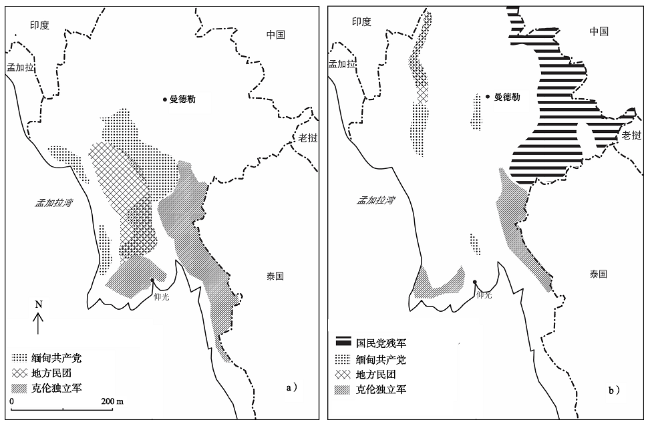
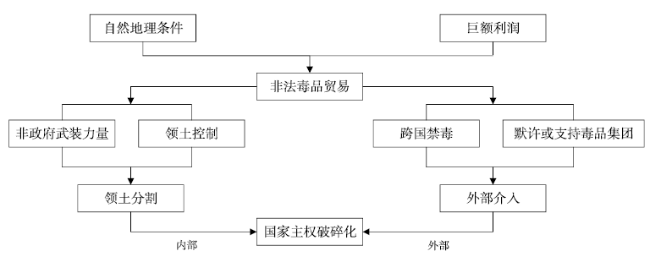
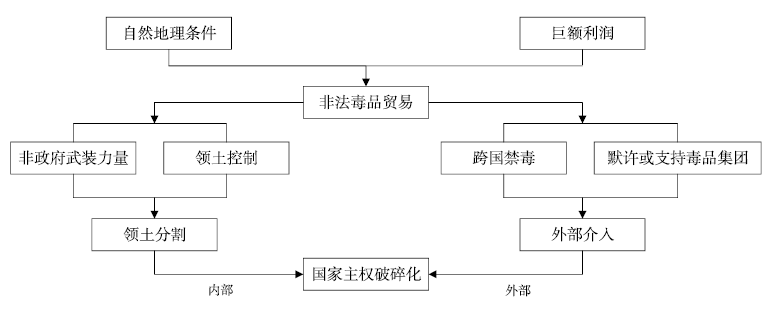
Ethnic states in northern Myanmar, including the Shan and Kachin states, are adjacent to the Chinese province of Yunnan. These states constitute today’s notorious Golden Triangle. As the world’s second largest drug production area, the Golden Triangle has accommodated the production and trafficking of illicit drugs for more than 100 years. The drug economy has turned northern Myanmar into a zone of military conflicts and economic plight, raising various issues regarding how illicit drugs shape national sovereignty. Building upon archives and scholarly references, this study focuses on northern Myanmar and the origin and evolution of the drug economy in this mountainous area. Using the latest theoretical tenets in political geography, this study specifically explores how the drug economy has generated political and economic crisis since Myanmar became independent in 1948 and examines the accompanying geopolitical conflicts and external intervention. The research questions in this study are as follows: Why have illicit drugs taken root in northern Myanmar? How does the drug economy influence the Burmese state’s national sovereignty and territorial control in northern Myanmar? The study argues that illicit drugs result in and are attributed to domestic fragmented sovereignty and external intervention. Furthermore, the drug economy and drug-related crimes have already penetrated into northern Myanmar to such an extent that national sovereignty is seriously jeopardized. On the one hand, drug-related organizations fight against the Burmese Military forces to impose territorial control upon villages and towns so that they can safeguard drug plantations and trafficking. Drug money in turn consolidates these organizations’ military capacity, resulting in drug militaries in both the Shan and Kachin states. On the other hand, the Burmese military forces deployed the drug economy to entice local militias to partner in fighting against the well-organized Burmese Communist Party during the 1970s and 1980s and ethnic armed groups during the 2000s. Drugs, violent conflicts, and territorial fragmentation have combined to shape sovereignty in northern Myanmar and generate endless political crisis. In addition, the drug economy provides an opportunity for external forces to intervene in domestic affairs in Myanmar. During the last six decades, various forces from China and the United States have either relied on drugs to enfeeble the Burmese state’s efforts at territorial control in the northern highland or exercised drug control to influence social and economic development in the source areas. Because of the low degree of trust between the central state controlled by the Burman majority and military forces controlled by ethnic minority groups in the northern region, there is a lack of ethnic reconciliation and thus a benign political condition for nationwide drug control. Hence, the drug economy in northern Myanmar is intertwined with nation building, which triggers fragmented national sovereignty and external intervention. As a result, northern Myanmar has become among the poorest areas in Asia. An analysis of illicit drugs as an open-sourced architecture of power can enrich Agnew’s theory of territory and sovereignty. Practically, a historical understanding of the drug economy in northern Myanmar can contribute to China-Myanmar relations and show the challenges and opportunities of regionalization between Yunnan and Myanmar.
Xiaobo Su , Xiaomei Cai , Can Zhou . Drug Economy and Fragmented Sovereignty: A Geopolitical Analysis of Northern Myanmar[J]. Tropical Geography, 2019 , 39(6) : 799 -811 . DOI: 10.13284/j.cnki.rddl.003193

表1 1998—2015年缅甸罂粟种植和鸦片产量估计Tab.1 Estimates of poppy cultivation and opium production in Laos and Burma during 1998-2015 |
| 年份 | 罂粟种植面积/hm² | 干鸦片的估计产量/kg |
|---|---|---|
| 1998 | 130 300 | 1 303 000 |
| 1999 | 89 500 | 895 000 |
| 2000 | 108 700 | 1 087 000 |
| 2001 | 105 000 | 1 097 000 |
| 2002 | 81 400 | 828 000 |
| 2003 | 62 200 | 810 000 |
| 2004 | 44 200 | 370 000 |
| 2005 | 32 800 | 312 000 |
| 2006 | 21 500 | 315 000 |
| 2007 | 27 700 | 460 000 |
| 2008 | 28 500 | 410 000 |
| 2009 | 31 700 | 330 000 |
| 2010 | 38 100 | 580 000 |
| 2011 | 43 600 | 610 000 |
| 2012 | 51 000 | 690 000 |
| 2013 | 57 800 | 870 000 |
| 2014 | 57 600 | 670 000 |
| 2015 | 55 500 | 647 000 |
数据来源:UNODC,2016。 |
| [1] |
|
| [2] |
|
| [3] |
|
| [4] |
|
| [5] |
|
| [6] |
|
| [7] |
|
| [8] |
|
| [9] |
|
| [10] |
|
| [11] |
|
| [12] |
|
| [13] |
杜德斌, 马亚华 . 2015. “一带一路”:中华民族复兴的地缘大战略. 地理研究, 34(6):1005-1014.
[
|
| [14] |
|
| [15] |
|
| [16] |
国家禁毒委员会. 2018. 2018年中国禁毒报告. 北京:国家禁毒委员会.
[ China National Narcotic Control Committee. 2018. Drug Report in China in 2018. Beijing: China National Narcotic Control Committee. ]
|
| [17] |
|
| [18] |
|
| [19] |
贺圣达 . 1992. 缅甸史. 北京: 人民出版社.
[
|
| [20] |
胡志丁, 陆大道, 杜德斌, 葛岳静, 骆华松 . 2017. 未来十年中国地缘政治学重点研究方向. 地理研究, 36(2):205-214.
[
|
| [21] |
|
| [22] |
|
| [23] |
|
| [24] |
李灿松, 骆华松, 胡志丁, 付磊, 熊理然 . 2015. 2015年缅北局势的未来走向及中国应对策略. 热带地理, 35(4):569-576.
[
|
| [25] |
李飞, 成升魁, 于会录, 秦奇, 刘晓洁, 徐增让, 吴良, 张丹, 李欣, 初冬梅 . 2016. 国家地缘脆弱性探索:缅甸案例及对中国地缘战略启示. 地理科学进展, 35(6):737-746.
[
|
| [26] |
林廖君 . 2016. 鲜为人知的“金三角”中缅联合作战. 档案记忆,( 8):45-48.
[
|
| [27] |
|
| [28] |
|
| [29] |
|
| [30] |
|
| [31] |
|
| [32] |
石磊 . 2012. 守望金三角. 香港: 旗林文化出版社有限公司.
[
|
| [33] |
|
| [34] |
|
| [35] |
|
| [36] |
苏晓波, 蔡晓梅 . 2017. 领域陷阱与中国在缅甸北部的跨国禁毒实践. 地理科学进展, 36(12):1552-1561.
[
|
| [37] |
|
| [38] |
田雪雪, 胡志丁, 王学文 . 2019. 当前缅北冲突与中缅边界管控研究. 世界地理研究, 28(2):114-123.
[
|
| [39] |
UNODC. 2014. Southeast Asia Opium Survey 2014. Bangkok: UNODC.
|
| [40] |
UNODC. 2016. World Drug Report 2016. Vienna: UNODC.
|
| [41] |
USAID. 2015. Fact Sheet: Highlights of US Assistance to Burma. Washington D C: USAID.
|
| [42] |
United States General Accounting Office. 1989. Drug Control in Burma. Washington D C: United States General Accounting Office.
|
| [43] |
|
| [44] |
|
| [45] |
|
| [46] |
|
| [47] |
徐银矶 . 2010. 滞缅“国军”与台湾和缅甸的关系. 南洋问题研究,( 1):38-43.
[
|
| [48] |
曾艺 . 1964. 滇缅边区游击战史(上). 台北:国防部史政编译局.
[
|
| [49] |
张勇安 . 2012. 冷战中的合作:美国与联合国《1961年麻醉品单一公约》的修正(1969-1975). 求是学刊,( 1):148-154.
[
|
| [50] |
张勇安 . 2013. 中美禁毒合作:过程、限度及战略选择. 现代国际关系,( 12):48-52.
[
|
/
| 〈 |
|
〉 |