Spatial Pattern and Industrial Development Characteristics of the Industrial Zone in Vietnam
Received date: 2019-06-08
Request revised date: 2019-10-10
Online published: 2019-12-26
Copyright
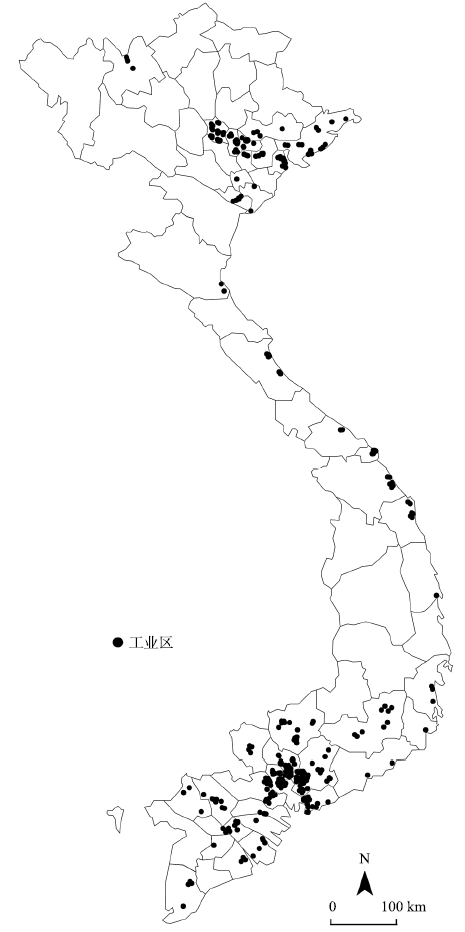
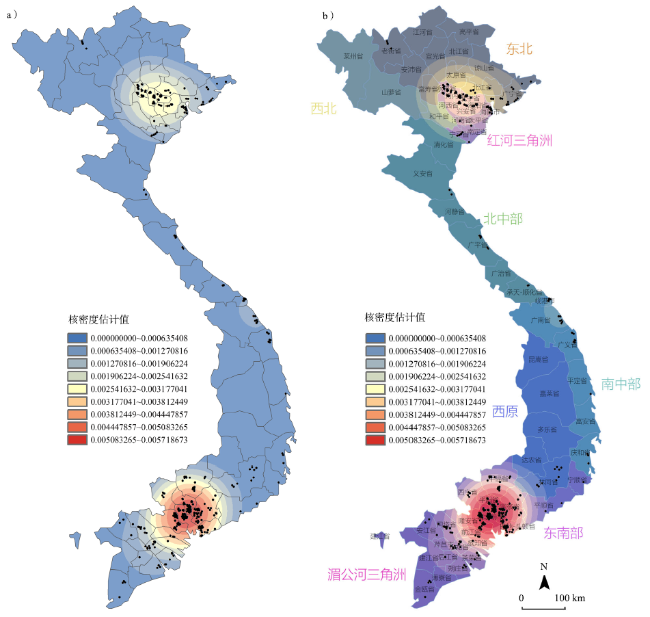
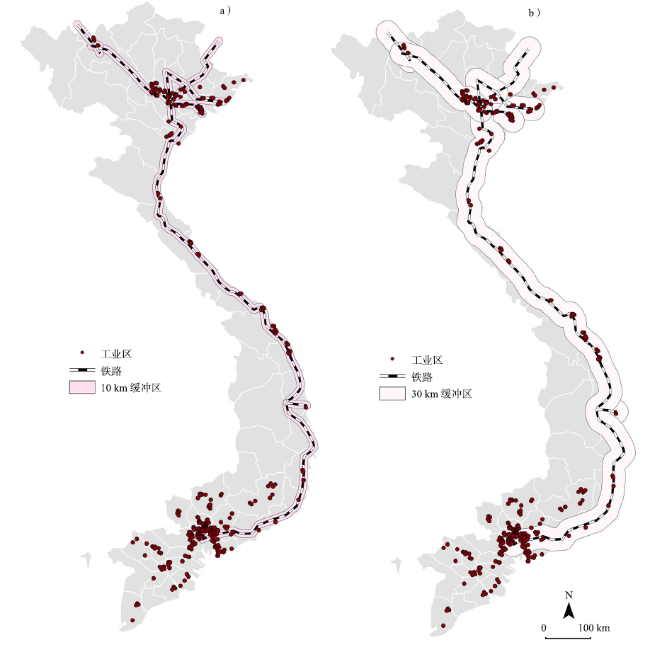
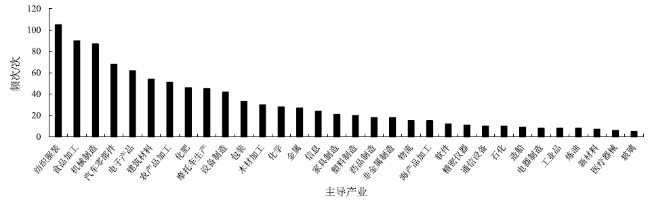
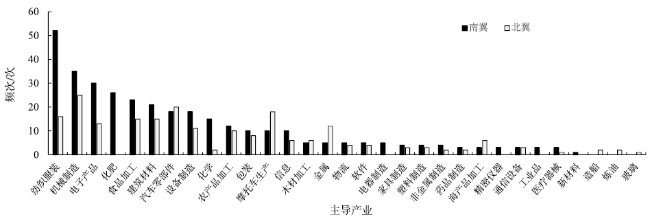
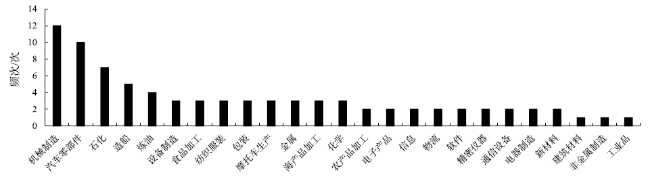
In the new era of globalization, China’s high-level openness and high-quality development led to a new round of industrial upgrading and spatial restructuring in the world under “the Belt and Road” initiative. Vietnam has become a new area of international capacity cooperation and industrial transfer and re-agglomeration. The industrial zone is the principal unit of Vietnam’s economic growth. It is also the key carrier of Sino-Vietnamese joint construction of “the Belt and Road” and deep implementation of productivity cooperation. The research on Vietnam’s industrial zones has attracted the attention of international and domestic scholars and shown rich achievements. However, insufficient attention has been paid to the spatial pattern, industrial differentiation, spatial production, and agglomeration mechanism of Vietnam’s industrial zones. By collecting and collating the basic data on Vietnam’s industrial zones using GIS, SPSS analysis technology, nuclear density analysis, exploratory spatial data analysis, correlation analysis, and other analysis methods, this paper analyzes the spatial distribution characteristics of Vietnam’s industrial areas and the characteristics of industrial agglomeration types and explores its formation mechanism. The results indicate that: 1) Vietnam’s industrial zone shows a significant spatial polarization distribution, with distribution of wings and depressions. 2) The characteristics of regional transportation orientation and socio-economic development orientation distribution in Vietnam’s industrial zones, historical reasons, natural topography, regional transportation facilities, planning guidance, and socio-economic conditions are the main factors affecting the spatial distribution of Vietnam’s industrial zones. 3) The industrial characteristics of Vietnam’s industrial zones show that the south wing is dominated by light industry, the north wing is dominated by processing heavy industry, and the central region is dominated by mining-type and raw material processing heavy industries. 4) The industrialization of Vietnam is late and low, which is the main reason for the formation of labor-intensive industries. The division of the north and south and the macro guidance of the government are the main reasons for the differences in the industrial structure of the south wing, north wing, and central region.
Key words: industrial zone; spatial pattern; manufacturing industry; Vietnam
Xuefeng Hu , Xingping Wang , Sidong Zhao . Spatial Pattern and Industrial Development Characteristics of the Industrial Zone in Vietnam[J]. Tropical Geography, 2019 , 39(6) : 889 -900 . DOI: 10.13284/j.cnki.rddl.003197

表1 中越共建工业区汇总Tab.1 Summary table of the Vietnam Construction Industrial Zone |
| 园区名称 | 建设时间 | 建设地点 | 所处区域位置 | 规划面积/hm2 |
|---|---|---|---|---|
| 铃中出口加工区 | 1992年 | 胡志明市 | 南部主核心 | 326.37 |
| 龙江工业园区 | 2007年 | 前江省美荻市 | 南部主核心 | 600 |
| 深圳-海防经济贸易合作区 | 2008年 | 海防市安阳县 | 北部次核心 | 200 |
| 越南天虹海河工业区 | 2014年 | 广宁省海河县 | 北部次核心 | 3 100 |
表2 越南工业区数量与社会经济发展相关性分析Tab.2 Correlation between the number of industrial zones in Vietnam and socio-economic development |
| 项目 | 社会发展水平 | 经济发展水平 | 基础设施建设 | |||||||||
|---|---|---|---|---|---|---|---|---|---|---|---|---|
| 城镇化率 | 人口 | 人口密度 | 劳动力 | 工业总产值 | 项目数量 | 注册资本总额 | 道路网长度 | 铁路网长 | ||||
| 皮尔森(Pearson)相关 | 0.389* | 0.411* | 0.303 | 0.426** | 0.725** | 0.167 | 0.269 | 0.400* | -0.103 | |||
| 显著性(双尾) | 0.016 | 0.01 | 0.064 | 0.008 | 0 | 0.315 | 0.102 | 0.013 | 0.538 | |||
| 样本数/个 | 38 | 38 | 38 | 38 | 38 | 38 | 38 | 38 | 38 | |||
注:1)*在0.05的显著性水平下相关性显著(双边检验);**在0.01的显著性水平下相关性显著(双边检验);2)资料来源:根据越南2017年统计年鉴计算。 |
表3 越南工业区主导产业Tab.3 Leading industry of industrial zone in Vietnam |
| 产业类型 | 主导产业门类 |
|---|---|
| 第二产业 | 食品加工、机械制造、纺织服装、汽车零部件制造、建筑材料、农产业加工、设备制造、电子产品、包装、摩托车生产、木材加工、金属、信息、家具制造、塑料制造、药品制造、非金属制造、物流、化学、软件、精密仪器、通信设备、电器制造、工业品、新材料、造船、医疗器械、玻璃、航空设备、半导体 |
| 第三产业 | 物流仓储、旅游服务业、房地产、软件服务、人力资源培训 |
| [1] |
|
| [2] |
|
| [3] |
|
| [4] |
曹原, 王佳, 葛岳静 . 2011. 越南政治地理的脆弱性. 世界地理研究, 20(4):26-32.
[
|
| [5] |
陈宏胜, 王兴平, 陈剑锋 . 2015. 中非经贸联系暨中国开发区经验的非洲实践. 上海城市规划, 6(6):97-103.
[
|
| [6] |
|
| [7] |
范公职 . 2013. 越南河内工业区吸引投资研究. 南宁:广西大学: 64-66, 68-71.
[
|
| [8] |
高超, 金凤君 . 2015. 沿海地区经济技术开发区空间格局演化及产业特征. 地理学报, 70(2):202-213.
[
|
| [9] |
|
| [10] |
钱纳里 H . 1989. 工业化和经济增长的比较研究. 上海:上海三联书店.
[
|
| [11] |
金辉 . 2018. 我国境外经贸合作区产业集聚影响因素研究——以越南龙江工业园区为例. 现代经济信息,( 15):159-161.
[
|
| [12] |
[
|
| [13] |
吕亚军 . 2013. 越南产业集聚发展战略探析. 东南亚纵横,( 2):37-41.
[
|
| [14] |
|
| [15] |
Ministry of Land, Infrastructure, Transport and Tourism, JAPAN (MLT). 2019. An Overview of Spatial Policy in Asian and European countries. Vietnam. (2015-02-16)[ 2019-11-26]. http://www.mlit.go.jp/kokudokeikaku/international/spw/general/vietnam/index_e.html .
|
| [16] |
马晓冬, 马荣华, 徐建刚 . 2004. 基于ESDA-GIS的城镇群体空间结构. 地理学报, 59(6):1048-1057.
[
|
| [17] |
孟广文, 杜明明, 赵钏, 王继光, 于淙阳, 马祥雪, 张宁月 . 2019. 中国海外园区越南龙江工业园投资效益与启示. 地理学报, 39(6):16-25.
[
|
| [18] |
|
| [19] |
|
| [20] |
|
| [21] |
|
| [22] |
沈正平, 简晓彬, 赵洁 . 2018. “一带一路”沿线中国境外合作产业园区建设模式研究. 国际城市规划, 164(2):37-44.
[
|
| [23] |
|
| [24] |
王兴平 . 2015. 中国开发区在非洲. 南京: 东南大学出版社.
[
|
| [25] |
王兴平, 崔功豪, 高舒欣 . 2018. 全球化与中国开发区发展的互动特征及内在机制研究. 国际城市规划, 33(2):16-22.
[
|
| [26] |
翁羽 . 2007. 大规模建设中的越南港口. 集装箱化, 18(7):8-11.
[
|
| [27] |
|
| [28] |
禹文豪, 艾廷华 . 2015. 核密度估计法支持下的网络空间POI点可视化与分析. 测绘学报, 44(1):82-90.
[
|
| [29] |
越投网. 2017. 越南调研宏观篇崛起的越南. (2017-08-09)[2019-11-26]. http://mini.eastday.com/a/170809085713952-2.html .
[ Vietnam Investment Website. 2017. Vietnam Research on the Rise of Vietnam. (2017-08-09).[ 2019-11-26]. http://mini.eastday.com/a/170809085713952-2.html ]
|
| [30] |
张奥博 . 2014. 越南工业化发展研究. 厦门:厦门大学.
[
|
| [31] |
赵胜波, 王兴平, 胡雪峰 . 2018. “一带一路”沿线中国国际合作园区发展研究——现状、影响与趋势. 城市规划, 42(9):9-20.
[
|
| [32] |
驻越南经商参处. 2003. 越南纺织服装业市场和政策情况. (2003-05-12).[ 2019-11-26]. http://vn.mofcom.gov.cn/aarticle/ztdy/200305/20030500089617.html .
[ Economic and Commercial Counsellor’s Office of the Embassy of the People’s Republic of China in the Socialist Republic of Vietnam. 2003. Market and Policy of Vietnamese Textile and Clothing Industry. (2003-05-12).[ 2019-11-26]. http://vn.mofcom.gov.cn/aarticle/ztdy/200305/20030500089617.html ]
|
| [33] |
驻越南经商参处. 2017. 2017年前7个月越南工业区建设情况.(2017-08-22).[ 2019-11-26]. http://vn.mofcom.gov.cn/article/jmxw/201708/20170802631211.shtml .
[ Economic and Commercial Counsellor’s Office of the Embassy of the People’s Republic of China in the Socialist Republic of Vietnam. 2017. Construction of Vietnam Industrial Zone in the First 7 Months of 2017. (2017-08-22).[ 2019-11-26]. http://vn.mofcom.gov.cn/article/jmxw/201708/20170802631211.shtml ]
|
| [34] |
越南国家计划委员会. 1996. 2010年越南工业区发展规划. 世界机电经贸信息,( Z1):65.
[ Vietnam National Planning Commission. 1996. 2010 Vietnam Industrial Development Plan. World Electromechanical Trade Information, ( Z1):65. ]
|
/
| 〈 |
|
〉 |