Environmental Restorative Effects of Destination for Tourists from the Perspective of Tourist-Environment Interaction
Received date: 2019-10-14
Revised date: 2020-03-24
Online published: 2020-08-11
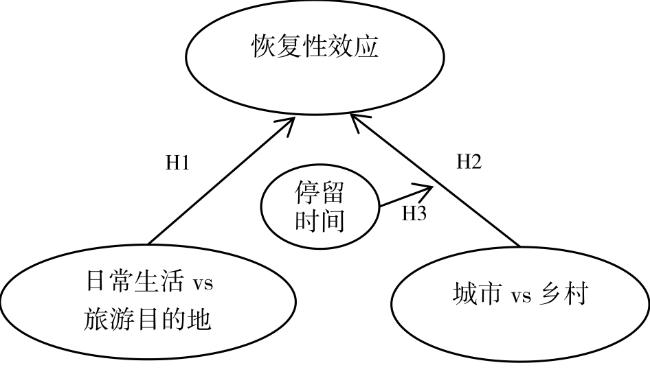
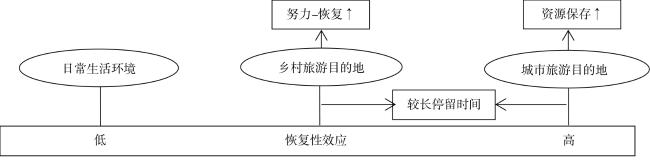
With the fast pace of life in modern society, people are under pressure from work and life, so we should pay attention to the mental health problems of individuals. However, both daily living environments and tourist destinations can provide an opportunity for individuals to recover, and the attributes of different environments lead to different degrees of recovery. Are individual restorative effects in the tourism destination higher than those in the daily life environment? Further, are there significant differences in the restorative effects between urban and rural tourism destinations? Does the length of stay regulate the relationship between the environment and the restorative effects? All these questions are worth thinking about and discussing further. For these reasons, this study adopts a questionnaire survey method, using the paired sample t-test and mixed design analysis of variance, to explore the restorative effects of tourists in different environments and to provide a psychological explanation for this phenomenon. Firstly, the four dimensions of recovery experience, that is, relaxation experience, psychological disengagement, mastery experience, and control experience, scored higher in the tourism destination category than in the daily life environment category. On the basis of Goffman’s dramatic framework and organizational behavior theory, the macro-restorative effects brought about by the liminal experience function of tourism destinations are stronger than the meta-restorative effects of non-working leisure experience in daily life. Secondly, under the influence of traditional Chinese cultural values and Confucianism, the restorative effects of the urban environment as perceived by Chinese tourists are higher than those of the natural environment. This study differentiated between urban and rural tourism destinations from the perspective of tourists’ perception, and beginning with the two aspects of restoration experience, that is, effort-restoration and resource conservation, and taking into account the role of the environment, then found that the attributes of tourism destinations and the separation between daily life are perceived by tourists as a social situation with backstage functions,so the tourism destinations could promote individual recovery better than daily living environment. Additionally, the study found that the threshold function of the destination has a time limit, and tourists’ psychological response to the environment will change at different stages. The difference in threshold experience between urban and rural tourism destinations has an impact in the first few days. When the length of stay is extended, tourists are more familiar with rural tourism destinations, and the restorative effects brought about by destination attributes that are more inclined to natural environment characteristics are highlighted. Moreover, the intersection between urban tourism destinations and daily living environment is becoming more and more obvious. Under certain circumstances, the effects of effort-restoration of urban tourism destinations may be lower than those of rural tourism destinations. Therefore, the type of destination does not independently affect the restorative effects of tourists; it is regulated by the length of stay and related to the degree of tourists’ adaptation to the environment. This study enriches the research on environmental restorative effects from the perspective of experience and also helps to deepen the understanding of the strategies to improve restorative effects for academia and industry. At the same time, it provides a comprehensive research perspective for understanding the relationship between restorative effects, type of environment, and length of stay.
Fang Zhu , Qin Su , Yun Tao , Jinghong Shen . Environmental Restorative Effects of Destination for Tourists from the Perspective of Tourist-Environment Interaction[J]. Tropical Geography, 2020 , 40(4) : 636 -648 . DOI: 10.13284/j.cnki.rddl.003262
表1 受访者样本信息Table 1 Sample information of the survey respondents |
| 变量 | 分类 | 人数/人 | 比例/% |
|---|---|---|---|
| 性别 | 男 | 242 | 44.8 |
| 女 | 298 | 55.2 | |
| 年龄/岁 | ≤20 | 36 | 6.7 |
| 21~35 | 388 | 71.9 | |
| 36~50 | 64 | 11.9 | |
| 51~65 | 32 | 5.9 | |
| >65 | 20 | 3.7 | |
| 文化程度 | 初中及以下 | 22 | 4.1 |
| 高中或中专 | 30 | 5.6 | |
| 大专 | 88 | 16.3 | |
| 本科 | 362 | 67.0 | |
| 硕士及以上 | 38 | 7.0 | |
| 职业 | 企业职工 | 156 | 28.9 |
| 个体工商户 | 128 | 23.7 | |
| 学生 | 78 | 14.4 | |
| 政府、事业单位职工 | 114 | 21.1 | |
| 其他 | 64 | 11.9 | |
| 人均月收入/元 | ≤3 000 | 60 | 11.1 |
| 3 001~4 500 | 88 | 16.3 | |
| 4 501~6 000 | 110 | 20.4 | |
| 6 001~7 500 | 78 | 14.4 | |
| 7 501~10 000 | 94 | 17.4 | |
| 10 001~15 000 | 72 | 13.3 | |
| ≥15 001 | 38 | 7.0 | |
| 旅行方式 | 独自出行 | 54 | 10.0 |
| 与家人或亲戚出行 | 214 | 39.6 | |
| 与朋友出行 | 254 | 47.0 | |
| 单位组团 | 6 | 1.1 | |
| 旅行社组团 | 12 | 2.2 |
表2 问卷信度和效度检验Table 2 Reliability and validity test of questionnaire |
| 变量 | 题项 | 克朗巴哈系数 | 均值 | 标准差 | 偏度 | 峰度 | |
|---|---|---|---|---|---|---|---|
| 问卷整体 | 30 | 0.932 | — | — | — | — | |
| 旅游 目的地 环境 | 恢复性效应 | 15 | 0.912 | 3.95 | 0.72 | -0.025 | -0.203 |
| 努力—恢复 | 7 | 0.891 | 3.96 | 0.75 | 0.052 | -0.095 | |
| 资源保存 | 8 | 0.901 | 3.92 | 0.84 | -0.208 | -0.093 | |
| 日常 生活 环境 | 恢复性效应 | 15 | 0.896 | 3.70 | 0.73 | 0.229 | -0.521 |
| 努力—恢复 | 7 | 0.863 | 3.58 | 0.76 | 0.126 | -0.306 | |
| 资源保存 | 8 | 0.887 | 3.68 | 0.86 | 0.165 | -0.025 | |
表3 潜变量相关系数和平均提取方差值的平方根(判别效度表)Table 3 Correlation coefficients of latent variables and square root of average variance extracted |
| 环境类型 | 维度 | 旅游目的地环境 | 日常生活环境 | |||
|---|---|---|---|---|---|---|
| 努力—恢复 | 资源 保存 | 努力—恢复 | 资源 保存 | |||
| 旅游目的地环境 | 努力—恢复 | 0.739 | — | — | — | |
| 资源保存 | 0.696 | 0.773 | — | — | ||
| 日常生活环境 | 努力—恢复 | 0.527 | 0.426 | 0.726 | — | |
| 资源保存 | 0.712 | 0.612 | 0.602 | 0.758 | ||
|
表4 验证性因子分析Table 4 Results of CFA |
| 努力—恢复 | 资源保存 | |||
|---|---|---|---|---|
| 变量 | 因子载荷 | 变量 | 因子载荷 | |
| 我感觉得到了休息 | 0.712 | 我能按照我喜欢的方式处理事情 | 0.751 | |
| 我努力让自己远离工作 | 0.753 | 我可以自己决定如何度过我的时间 | 0.756 | |
| 我根本没想过工作 | 0.760 | 我可以自己决定日程 | 0.863 | |
| 我甚至忘了工作 | 0.728 | 我可以自己决定做什么 | 0.757 | |
| 我主动花费时间休闲 | 0.632 | 我做了一些开阔视野的事情 | 0.640 | |
| 我充分利用这段时间放松 | 0.895 | 我做了一些挑战自我的事情 | 0.760 | |
| 我做了一些放松的事情 | 0.661 | 我寻求智力上的挑战 | 0.873 | |
| 我学到了新的知识 | 0.757 | |||
| 整体拟合优度(GoF) | AVE | 0.546 | AVE | 0.597 |
| CR | 0.922 | CR | 0.963 | |
| X2/df | 2.67 | X 2 /df | 2.82 | |
| GFI | 0.966 | GFI | 0.955 | |
| CFI | 0.912 | CFI | 0.901 | |
| RMSEA | 0.078 | RMSEA | 0.079 | |
表5 配对样本t检验结果Table 5 Results of paired-sample t-teats |
| 变量 | 旅游目的地均值 | 日常生活环境均值 | t值 |
|---|---|---|---|
| 努力—恢复 | 3.96 | 3.58 | 9.074*** |
| 资源保存 | 3.92 | 3.68 | 6.299*** |
| 恢复性效应 | 3.95 | 3.70 | 10.384*** |
|
表6 环境、目的地类型与停留时间的交互效应Table 6 Interaction effects among environment, destination type, and length of stay |
| 变量 | 均值(S.D.) | Levene’s Test F值 | Box’s Test F值 | Wilk’s Lambda | F值 | |||||
|---|---|---|---|---|---|---|---|---|---|---|
| 城市旅游目的地 | 乡村旅游目的地 | |||||||||
| S(n=132) | L(n=124) | S(n=146) | L(n=138) | |||||||
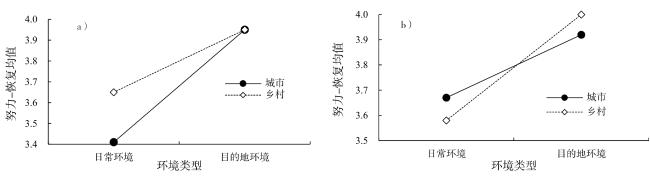
| 努力-恢复 | 旅游目的地 | 3.95(1.52) | 3.92(1.55) | 3.95(1.45) | 4.00(1.51) | 1.49 | 2.35 | 0.989 | 4.62* | |
| 日常环境 | 3.41(1.60) | 3.67(1.73) | 3.65(1.59) | 3.58(1.52) | 1.99 | — | — | — | ||
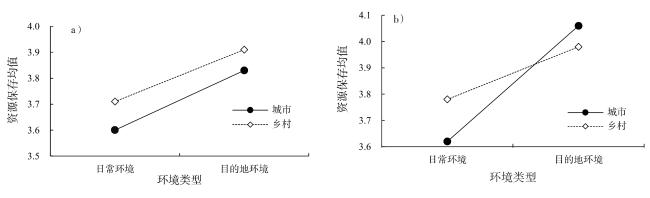
| 资源保存 | 旅游目的地 | 4.06(1.53) | 3.83(1.48) | 3.98(1.49) | 3.91(1.42) | 1.52 | 2.42 | 0.997 | 6.78* | |
| 日常环境 | 3.62(1.50) | 3.60(1.59) | 3.78(1.48) | 3.74(1.44) | 1.69 | — | — | — | ||
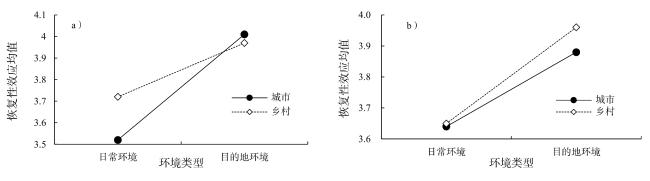
| 恢复性效应 | 旅游目的地 | 4.01(1.38) | 3.88(1.43) | 3.97(1.35) | 3.96(1.41) | 1.62 | 2.52 | 0.998 | 6.12* | |
| 日常环境 | 3.52(1.51) | 3.64(1.52) | 3.72(1.43) | 3.65(1.42) | 1.47 | — | — | — | ||
|
图2 努力—恢复的环境、目的地类型交互效应(a. 停留时间≤4 d;b. 停留时间>4 d)Fig.2 The interaction effect between environment and destination type on effort-recovery |
图3 资源保存的环境、目的地类型交互效应(a. 停留时间≤4 d;b. 停留时间>4 d)Fig.3 The interaction effect between environment and destination type on conservation of resources |

|
Berto R. 2005. Exposure to Restorative Environments Helps Restore Attentional Capacity. Journal of Environmental Psychology, 25(3): 249-259.
|
|
Brown L. 2013. Tourism: A Catalyst for Existential Authenticity. Annals of Tourism Research, 40: 176-190.
|
|
Caldwell L L. 2005. Leisure and Health: Why is Leisure Therapeutic?. British Journal of Guidance & Counselling, 33(1): 7-26.
|
|
Carr N. 2002. The Tourism-Leisure Behavioural Continuum. Annals of Tourism Research, 29(4): 972-986.
|
|
Chen C C and Petrick J F. 2013. Health and Wellness Benefits of Travel Experiences: A Literature Review. Journal of Travel Research, 52(6): 709-719.
|
|
Chen G and Bao J. 2014. Path Dependence in the Evolution of Resort Governance Models in China. Tourism Geographies, 16(5): 812-825.
|
|
Chen C C, Petrick J F and Shahvali M. 2016a. Tourism Experiences as a Stress Reliever: Examining the Effects of Tourism Recovery Experiences on Life Satisfaction. Journal of Travel Research, 55(2): 150-160.
|
|
Chen C C, Huang W J and Petrick J F. 2016b. Holiday Recovery Experiences, Tourism Satisfaction and Life Satisfaction—Is There a Relationship?. Tourism Management, 53: 140-147.
|
|
Chen G, Huang S and Bao J. 2016c. The Multiple Logics of Tourism Development in China. Journal of Sustainable Tourism, 24(12): 1655-1673.
|
|
Chen G, Huang S and Zhang D. 2017. Understanding Chinese Vacationers’ Perceived Destination Restorative Qualities: Cross-Cultural Validation of the Perceived Destination Restorative Qualities Scale. Journal of Travel & Tourism Marketing, 34(8): 1115-1127.
|
|
陈钢华,奚望.2018.旅游度假区游客环境恢复性感知对满意度与游后行为意向的影响:以广东南昆山为例.旅游科学,32(4):17-30.[Chen Ganghua and Xi Wang. The Impact of Vistors,Perceived Destination Restorative Qualities on Satisfaction and Post-Tour Behavioral Intentions: A Case Study of Nankunshan. Tourism Science, 32(4): 17-30. ]
|
|
陈钢华,奚望,黄松山,胡宪洋.2019.海滨旅游度假区游客环境和气候满意度对环境恢复性感知的影响.资源科学,41(3):430-440.[Chen Ganghua, Xi Wang, Huang Songshan and Hu Xianyang. 2019. Influences of Coastal Resort Vacationers,Environmental and Climate Satisfactions on Their Perceived Destination Restorative Qualities. Resources Science, 41(3): 430-440. ]
|
|
Chiang Y C, Li D and Jane H A. 2017. Wild or Tended Nature? The Effects of Landscape Location and Vegetation Density on Physiological and Psychological Responses. Landscape and Urban Planning, 167: 72-83.
|
|
Cho K S, Um S H and Lee T J. 2016. Perceived Restorativeness of Visits to Cultural Heritage Sites. Asia Pacific Journal of Tourism Research, 21(9): 1046-1069.
|
|
Davis L Y. 2013. Let Us Go Shopping: Exploring Northwest Chinese Consumers' Shopping Experiences. International Journal of Consumer Studies, 37(4): 353-359.
|
|
De Bloom J, Ritter S, Kühnel J, Reinders J and Geurts S. 2014. Vacation from Work: A ‘Ticket to Creativity’?: The Effects of Recreational Travel on Cognitive Flexibility and Originality. Tourism Management, 44: 164-171.
|
|
De Bloom J, Kompier M, Geurts S, De Weerth C, Taris T W and Sonnentag S. 2008. Do We Recover from Vacation? Meta-Analysis of Vacation Effects on Health and Well-Being. Journal of Occupational Health, 51: 13-25.
|
|
Demerouti E, Bakker A B and Bulters A J. 2004. The Loss Spiral of Work Pressure, Work-Home Interference and Exhaustion: Reciprocal Relations in a Three-Wave Study. Journal of Vocational Behavior, 64(1): 131-149.
|
|
Fritz C and Sonnentag S. 2006. Recovery, Well-Being, and Performance-Related Outcomes: The Role of Workload and Vacation Experiences. Journal of Applied Psychology, 91(4): 936.
|
|
Garst H, Frese M and Molenaar P. 2000. The Temporal Factor of Change in Stressor-Strain Relationships: A Growth Curve Model on a Longitudinal Study in East Germany. Journal of Applied Psychology, 85(3): 417.
|
|
Gilbert D and Abdullah J. 2004. Holiday-Taking and the Sense of Well-Being. Annals of Tourism Research, 31(1): 103-121.
|
|
Gofman E. 1959. The Presentation of Self in Everyday Life. New York: Anchor, 31.
|
|
Gump B B and Matthews K A. 2000. Are Vacations Good for Your Health? The 9-Year Mortality Experience After the Multiple Risk Factor Intervention Trial. Psychosomatic Medicine, 62(5): 608-612.
|
|
郭永锐,张捷,卢韶婧,张玉玲,年四锋,颜丙金.2014.旅游者恢复性环境感知的结构模型和感知差异.旅游学刊,29(2):93-102.[Guo Yongrui, Zhang Jie, Lu Shaojing, Zhang Yuling, Nian Sifeng and Yan Bingjin. 2014. The Difference and Structural Model of Tourists’ Perceived Restorative Environment. Tourism Tribune, 29(2): 93-102. ]
|
|
Hartig T. 1993. Nature Experience in Transactional Perspective. Landscape and Urban Planning, 25(1): 17-36.
|
|
Hartig T, Kaiser F G and Bowler P A. 1997. Further Development of a Measure of Perceived Environmental Restorativeness. Gavel, Sweden: Uppsala University, Institute for Housing Research.
|
|
Henseler J, Ringle C M and Sarstedt M. 2015. A New Criterion for Assessing Discriminant Validity in Variance-Based Structural Equation Modeling. Journal of the Academy of Marketing Science, 43(1): 115-135.
|
|
Herzog T R, Chen H C and Primeau J S. 2002. Perception of the Restorative Potential of Natural and Other Settings. Journal of Environmental Psychology, 22(3): 295-306.
|
|
Hipp J A and Ogunseitan O A. 2011. Effect of Environmental Conditions on Perceived Psychological Restorativeness of Coastal Parks. Journal of Environmental Psychology, 31(4): 421-429.
|
|
Hobfoll S E. 1998. Stress, Culture, and Community: The Psychology and Philosophy of Stress. New York: Plenum.
|
|
Hofstede G. 1984. Culture's Consequences: International Differences in Work-Related Values. CA: Sage, 63.
|
|
Iwasaki Y. 2001. Contributions of Leisure to Coping with Daily Hassles in University Students' Lives. Canadian Journal of Behavioural Science, 33(2): 128.
|
|
Iwasaki Y and Schneider I E. 2003. Leisure, Stress, and Coping: An Evolving Area of Inquiry. Leisure Sciences, 25(2): 107-113.
|
|
Jafari J. 1987. Tourism Models: The Sociocultural Aspects. Tourism Management, 8(2): 151-159.
|
|
Jepson D and Sharpley R. 2015. More Than Sense of Place? Exploring the Emotional Dimension of Rural Tourism Experiences. Journal of Sustainable Tourism, 23(8): 1157-1178.
|
|
Jex S M. 1998. Stress and Job Performance: Theory, Research, and Implications for Managerial Practice. CA: Sage Publications Ltd., 63.
|
|
Kaplan R and Kaplan S. 1989. The Experience of Nature: A Psychological Perspective. New York: Cambridge University Press.
|
|
Kaplan S. 1995. The Restorative Benefits of Nature: Toward an Integrative Framework. Journal of Environmental Psychology, 15(3): 169-182.
|
|
Kirillova K, Fu X, Lehto X and Cai L. 2014. What Makes a Destination Beautiful? Dimensions of Tourist Aesthetic Judgment. Tourism Management, 42: 282-293.
|
|
Kirillova K and Lehto X. 2016a. Aesthetic and Restorative Qualities of Vacation Destinations: How are they Related?. Tourism Analysis, 21(5): 513-527.
|
|
Kirillova K and Wang D. 2016b. Smartphone (dis) Connectedness and Vacation Recovery. Annals of Tourism Research, 61: 157-169.
|
|
Kjellgren A and Buhrkall H. 2010. A Comparison of the Restorative Effect of a Natural Environment with that of a Simulated Natural Environment. Journal of Environmental Psychology, 30(4): 464-472.
|
|
Korpela K and Kinnunen U. 2010. How is Leisure Time Interacting with Nature Related to the Need for Recovery from Work Demands? Testing Multiple Mediators. Leisure Sciences, 33(1): 1-14.
|
|
Lane B. 1994. What is Rural Tourism?. Journal of Sustainable Tourism, 2(1): 7-21.
|
|
Laumann K, Gärling T and Stormark K M. 2001. Rating Scale Measures of Restorative Components of Environments. Journal of Environmental Psychology, 21(1): 31-44.
|
|
Lee H A, Guillet B D, Law R and Leung R. 2012. Robustness of Distance Decay for International Pleasure Travelers: A Longitudinal Approach. International Journal of Tourism Research, 14(5): 409-420.
|
|
Lehto X Y. 2013. Assessing the Perceived Restorative Qualities of Vacation Destinations. Journal of Travel Research, 52(3): 325-339.
|
|
Lehto X, Kirillova K, Li H and Wu W. 2017. A Cross-Cultural Validation of the Perceived Destination Restorative Qualities Scale: the Chinese Perspective. Asia Pacific Journal of Tourism Research, 22(3): 329-343.
|
|
Li M. 2014. Cross-Cultural Tourist Research: A Meta-Analysis. Journal of Hospitality & Tourism Research, 38(1): 40-77.
|
|
刘群阅,尤达,潘明慧,池梦薇,黄启堂,兰思仁.2017.游憩者场所感知与恢复性知觉关系研究——以福州温泉公园为例.旅游学刊,32(7):77-88.[Liu Qunyue, You Da, Pan Minghui, Chi Mengwei, Huang Qitang and Lan Siren. 2017. Tourist Place Perception and Restorative Perception: A Case Study of Fuzhou Hot Spring Park. Tourism Tribune, 32(7):77-88. ]
|
|
刘群阅,陈烨,张薇,张逸君,黄启堂,兰思仁.2018.游憩者环境偏好,恢复性评价与健康效益评估关系研究——以福州国家森林公园为例.资源科学,40(2):381-391.[Liu Qunyue, Chen Ye, Zhang Wei, Zhang Yijun, Huang Qitang and Lan Siren. 2018. Tourists’ Environmental Preferences, Perceived Restoration and Perceived Health at Fuzhou National Park. Resources Science, 40(2): 381-391. ]
|
|
Lounsbury J W and Hoopes L L. 1986. A Vacation from Work: Changes in Work and Nonwork Outcomes. Journal of Applied psychology,71(3): 392-401.
|
|
Mannell R C and Iso-Ahola S E. 1987. Psychological Nature of Leisure and Tourism Experience. Annals of Tourism Research, 14(3): 314-331.
|
|
McCabe S. 2009. Who Needs a Holiday? Evaluating Social Tourism. Annals of Tourism Research, 36(4): 667-688.
|
|
McKercher B and Lui S L. 2014. Becoming a Tourist. International Journal of Tourism Research, 16(4): 399-406.
|
|
Meijman T F and Mulder G. 1998. Psychological Aspects of Workload. In: Drenth P J D, Thierry H and de Wolff C J. Handbook of work and organizational: Work Psychology. 2nd Edition. UK: Psychology Press/Erlbaum Taylor & Francis, 5-33.
|
|
Mok C and DeFranco A L. 2000. Chinese Cultural Values: Their Implications for Travel and Tourism Marketing. Journal of Travel & Tourism Marketing, 8(2): 99-114.
|
|
Nawijn J. 2011. Determinants of Daily Happiness on Vacation. Journal of Travel Research, 50(5): 559-566.
|
|
Nordh H, Alalouch C and Hartig T. 2011. Assessing Restorative Components of Small Urban Parks Using Conjoint Methodology. Urban Forestry & Urban Greening, 10(2): 95-103.
|
|
Pals R, Steg L, Dontje J, Siero F W and Der Zee K I. 2014. Physical Features, Coherence and Positive Outcomes of Person-Environment Interactions: A Virtual Reality Study. Journal of Environmental Psychology, 40: 108-116.
|
|
Pals R, Steg L, Siero F W and Der Zee V K. 2009. Development of the PRCQ: A Measure of Perceived Restorative Characteristics of Zoo Attractions. Journal of Environmental Psychology, 29(4): 441-449.
|
|
Payne S R. 2013. The Production of a Perceived Restorativeness Soundscape Scale. Applied Acoustics, 74(2): 255-263.
|
|
Pearce P L. 2011. Travel Motivation, Benefits and Constraints to Destinations. In: Wang Y and Pizam A. Destination Marketing and Management: Theories and Applications. New York: CAB International, 39-52.
|
|
Rosenbaum M S, Otalora M L and Ramírez G C. 2016. The Restorative Potential of Shopping Malls. Journal of Retailing and Consumer Services, 31: 157-165.
|
|
Sharpley R. 2002. The Consumption of Tourism. In: Richard Sharpley and David Telfer J. Tourism and Development: Concepts and Issues. Bristol: Channel View Publications, 300-318.
|
|
Shields R. 2013. Places on the Margin: Alternative Geographies of Modernity. New York: Routledge.
|
|
Sirgy M J, Kruger P S, Lee D J and Yu G B. 2011. How Does a Travel Trip Affect Tourists’ Life Satisfaction?. Journal of Travel research, 50(3): 261-275.
|
|
Sluiter J K, Frings-Dresen M H W, Meijman T F and Der Beek A J. 2000. Reactivity and Recovery from Different Types of Work Measured by Catecholamines and Cortisol: A Systematic Literature Overview. Occupational and Environmental Medicine, 57(5): 298-315.
|
|
Sonnentag S and Fritz C. 2007. The Recovery Experience Questionnaire: Development and Validation of a Measure for Assessing Recuperation and Unwinding from Work. Journal of Occupational Health psychology, 12(3): 204.
|
|
Sonnentag S and Geurts S A E. 2009. Methodological Issues in Recovery Research. UK: Emerald Group Publishing Limited, 1-36.
|
|
Staats H, Kieviet A and Hartig T. 2003. Where to Recover from Attentional Fatigue: An Expectancy-Value Analysis of Environmental Preference. Journal of Environmental Psychology, 23(2): 147-157.
|
|
Steiner C J and Reisinger Y. 2006. Understanding Existential Authenticity. Annals of Tourism Research, 33(2): 299-318.
|
|
Stokols D. 1978. Environmental Psychology. Annual Review of Psychology, 29(1): 253-295.
|
|
Strauss-Blasche G, Reithofer B, Schobersberger W, Ekmekcioglu C and Wolfgang M. 2005. Effect of Vacation on Health: Moderating Factors of Vacation Outcome. Journal of Travel Medicine, 12(2): 94-101.
|
|
Todd C. 2009. Nature, Beauty and Tourism. In: Tribe J. Philosophical Issues in Tourism. Bristol: Channel View Publishing, 154-170.
|
|
Wang N. 1999. Rethinking Authenticity in Tourism Experience. Annals of Tourism Research, 26(2): 349-370.
|
|
Westman M and Etzion D. 2001. The Impact of Vacation and Job Stress on Burnout and Absenteeism. Psychology & Health, 16(5): 595-606.
|
|
Winkelman M. 1994. Cultural Shock and Adaptation. Journal of Counseling & Development, 73(2): 121-126.
|
|
Xu W, Zhao J and Ye L. 2018. Culture is New Nature: Comparing the Restorative Capacity of Cultural and Natural Landscapes. International Journal of Environmental Studies, 75(5): 847-865.
|
|
张圆.2016.城市公共开放空间声景的恢复性效应研究.哈尔滨:哈尔滨工业大学,123.[Zhang Yuan. 2016. Research on the Restorative Effects of Soundscape in Urban Public Open Space. Harbin: Harbin Institute of Technology, 123. ]
|
/
| 〈 |
|
〉 |