The influence of Subways on Service Industry Agglomeration: Taking Guangzhou as an Example
Received date: 2020-08-24
Revised date: 2020-11-03
Online published: 2021-02-19
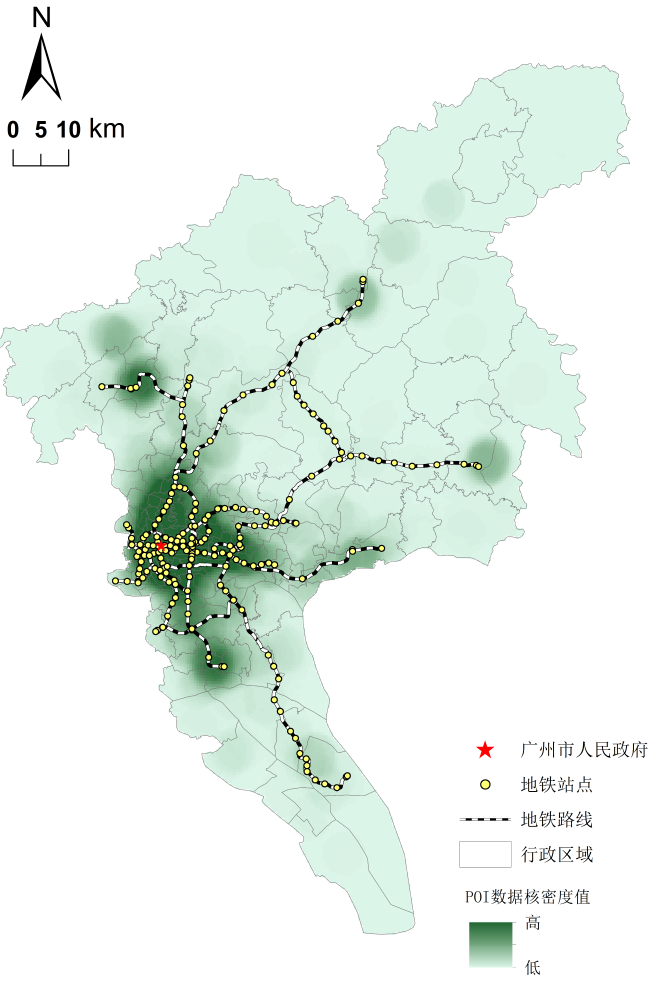
Agglomeration is an important feature of the spatial distribution of an urban internal service industry. Most of the previous studies on the influencing factors of urban internal service industry agglomeration have ignored traffic factors, especially the influence of subways. The improvement of traffic convenience can often affect the location of a service industry by gathering a flow of people. With the rapid growth in the number of China's metro cities, it is necessary to evaluate the impact of subways on the service industry activities within the city. In addition, most of the previous literature has not considered the spatial dependence of service activities, and there is little discussion on the heterogeneity of the service industry. In view of this, based on POI(Point of Information) data in Guangzhou as an example, this study uses a spatial autoregressive (SAR) model to identify the impact of subways on service industry agglomeration and analyzes the heterogeneity of different types of service industry. The results are summarized as follows. 1) Using Moran's I to measure the spatial correlation of Guangzhou's service industry agglomeration, the results indicate strong spatial correlation characteristics. In addition, according to the regression results of the SAR model, the spatial lag coefficient is significantly positive, which indicates that the service industry agglomeration has a considerable spatial dependence. Specifically, the degree of local service industry agglomeration will increase with an improvement in the surrounding areas. 2) The opening of subways has a significant positive impact on the spatial agglomeration of Guangzhou's service industry, which could increase the agglomeration levels in urban areas. One possible reason for this is that subways bring a floating population and reduce transaction costs. 3) There are different industries within the service industry, each of which has varying characteristics; thus, the impact of subways is heterogeneous, specifically as follows: the impact of a subway opening is higher on the wholesale and retail industry, accommodation and catering industry, and other life services than on other service industries but not significant on scientific research and technical services. 4) The impact of the metro on service industry agglomeration is also affected by the level of regional economic development. In areas with a higher level of economic development, the promotion effect of the metro on service industry agglomeration is more obvious. 5) Finally, a metro transfer station has a higher impact than a non-transfer station. One possible reason for this is that a metro transfer station is the intersection of multiple metro lines, which can often attract a greater flow of people and promote the flow of production factors, making service industry agglomeration more likely. The main contributions of this paper are as follows: first, taking Guangzhou, which has a well-developed metro network, as an example, this study evaluates the impact of the metro on service industry agglomeration and analyzes industry heterogeneity. Second, on the basis of constructing a spatial distance matrix of each economic unit, when considering the spatial dependence of service activities, the method of spatial economics was used to investigate the impact of subways on service industry agglomeration; third, taking big data represented by POIs as the source data, and taking streets and towns as the units of analysis, it more objectively and accurately reflects the spatial distribution characteristics of service industry agglomeration in cities.
Hongping Zhu , Wentao Zhu , Rongbao Zheng . The influence of Subways on Service Industry Agglomeration: Taking Guangzhou as an Example[J]. Tropical Geography, 2021 , 41(1) : 114 -123 . DOI: 10.13284/j.cnki.rddl.003307
表1 POI数据的服务业行业分类Table 1 Service industry’s classification of POI data |
| 行业分类 | POI数据内容 |
|---|---|
| 批发与零售 | 便利店、超市、商场、服装鞋帽皮具店、个人用品店、花鸟鱼虫市场、家电电子卖场、家居建材市场、特色商业街、体育用品店、文化用品店、专卖店、综合市场、充电站、充气站、加油站、摩托车销售、二手车销售、汽车配件销售、汽车装饰 |
| 交通运输、仓储邮政 | 汽车站、火车站、机场、公交车站、交通票销售网点、邮局、邮局速递、物流速递、物流仓储场地 |
| 住宿与餐饮 | 中餐厅、西餐厅、快餐厅、咖啡厅、茶艺馆、冷饮店、糕饼店、甜品店、宾馆、酒店、招待所 |
| 信息传输、软件和信息技术服务 | 中国移动营业厅、中国电信营业厅、中国联通营业厅 |
| 金融保险 | 银行、证券公司、保险公司、财务公司、期货公司、自动提款机 |
| 房地产 | 商务写字楼、住宅小区、售楼中心、房地产中介、物业公司 |
| 租赁和商务服务 | 汽车租赁公司、机械租赁公司、日用品租赁公司、旅行社、广告公司、事务所 |
| 科学研究和技术服务 | 科教文化机构 |
| 水利环境和公共设施管理 | 公园、广场、动物园、植物园、水族馆、纪念馆、环卫中转站、公共厕所 |
| 居民服务修理和其他服务 | 美容美发、洗浴、汽车摩托车维修、日用品和家电维修、洗衣店、婚庆、殡葬、保洁 |
| 教育 | 幼儿园、小学、中学、大学院校、培训机构、成人教育、职业技术教育 |
| 卫生和社会工作 | 医院、诊所、急救中心、疾病预防机构、动物医疗场所 |
| 文化体育和娱乐 | 科技馆、博物馆、档案馆、期刊杂志社、运动场馆、娱乐休闲场所、度假疗养场 |
| 公共管理社会保障和社会组织 | 政府机关、社会团体、民主党派、公检法机构、交通车辆管理、工商税务机构 |
表2 广州地铁线不同缓冲区内的服务业数量Table 2 Number of service industries in different buffer zones of subway lines in Guangzhou |
| 缓冲区半径/m | POI数量/个 | 百分比/% |
|---|---|---|
| 0~250 | 52 886 | 22.21 |
| 250~500 | 42 748 | 17.95 |
| 500~750 | 30 360 | 12.75 |
| 750~1 000 | 20 809 | 8.74 |
| >1 000 | 91 333 | 38.35 |
表3 各变量描述统计Table 3 Descriptive statistics of each variable |
| 变量 | 样本数 | 平均值 | 标准差 | 最小值 | 最大值 |
|---|---|---|---|---|---|
| lnSer | 170 | 5.080 | 1.878 | -0.310 | 7.724 |
| Metro | 170 | 0.297 | 0.556 | 0 | 3.101 |
| lnBas | 170 | 1.980 | 0.940 | -0.750 | 3.588 |
| lnRes | 170 | -0.221 | 1.840 | -4.644 | 3.686 |
| lnPop | 167 | 8.568 | 3.252 | 3.711 | 11.305 |
| lnEdu | 167 | 2.707 | 0.773 | 0.503 | 4.489 |
表4 OLS检验结果Table 4 OLS inspection results |
| 检验方式 | 自由度 | 统计量 | P值 |
|---|---|---|---|
| Lagrange Multiplier(lag) | 1 | 40.170 | 0.000 |
| Robust LM(lag) | 1 | 24.963 | 0.000 |
| Lagrange Multiplier(error) | 1 | 15.645 | 0.000 |
| Robust LM(error) | 1 | 0.438 | 0.508 |
| Lagrange Multiplier(SARMA) | 2 | 40.608 | 0.000 |
表5 SAR回归结果Table 5 SAR regression results |
| 变量 | 模型(1) | 模型(2) | 模型(3) | 模型(4) | 模型(5) |
|---|---|---|---|---|---|
| W_lnSER | 0.906***(0.029) | 0.582***(0.050) | 0.506***(0.054) | 0.410***(0.053) | 0.404***(0.053) |
| Metro | 0.230***(0.058) | 0.222***(0.052) | 0.225***(0.050) | 0.221***(0.046) | 0.199***(0.047) |
| lnBas | 0.409***(0.047) | 0.346***(0.049) | 0.190***(0.052) | 0.194***(0.052) | |
| lnRes | 0.161***(0.041) | 0.137***(0.038) | 0.130***(0.038) | ||
| lnPop | 0.308***(0.051) | 0.136***(0.051) | |||
| lnEdu | 0.187***(0.097) | ||||
| 常数项 | -0.128***(0.044) | -0.125***(0.039) | -0.128***(0.038) | -0.126***(0.035) | -0.113***(0.035) |
| R² | 0.862 | 0.896 | 0.903 | 0.918 | 0.920 |
| Loglikelihood | -95.931 | -55.310 | -47.849 | -31.490 | -29.637 |
| AIC | 197.861 | 118.620 | 105.697 | 74.979 | 73.273 |
| SC | 207.286 | 131.187 | 121.406 | 93.829 | 95.265 |
|
表6 分行业回归结果Table 6 Regression results by industry |
| 服务业细分行业 | 控制变量 | 地铁变量系数 | z值统计量 | R² |
|---|---|---|---|---|
| 批发与零售 | YES | 0.260***(0.067) | 3.879 | 0.837 |
| 交通运输、仓储邮政 | YES | 0.231***(0.057) | 4.067 | 0.882 |
| 住宿与餐饮 | YES | 0.239***(0.056) | 4.265 | 0.886 |
| 信息传输、软件和信息技术服务 | YES | 0.227***(0.071) | 3.209 | 0.811 |
| 金融保险 | YES | 0.202***(0.058) | 3.477 | 0.878 |
| 房地产 | YES | 0.184***(0.051) | 3.580 | 0.905 |
| 租赁和商务服务 | YES | 0.152***(0.055) | 2.757 | 0.889 |
| 科学研究和技术服务 | YES | 0.086(0.091) | 0.943 | 0.644 |
| 水利环境和公共设施管理 | YES | 0.072**(0.039) | 1.843 | 0.945 |
| 居民服务修理和其他服务 | YES | 0.226***(0.055) | 4.091 | 0.889 |
| 教育 | YES | 0.203***(0.052) | 3.917 | 0.903 |
| 卫生和社会工作 | YES | 0.224***(0.055) | 4.063 | 0.890 |
| 文化体育和娱乐 | YES | 0.159***(0.049) | 3.261 | 0.913 |
| 公共管理社会保障和社会组织 | YES | 0.170***(0.052) | 3.256 | 0.902 |
|
表7 区域异质性回归结果Table 7 Regression results of regional heterogeneity |
| 变量 | 经济水平>中位数 | 经济水平<中位数 |
|---|---|---|
| W_lnSER | 0.268***(0.075) | 0.269***(0.113) |
| Metro | 0.201***(0.071) | 0.159***(0.069) |
| lnBas | 0.161***(0.072) | 0.314***(0.079) |
| lnRes | 0.193**(0.057) | 0.128***(0.049) |
| lnPop | 0.230**(0.054) | 0.155***(0.053) |
| lnEdu | 0.244*(0.147) | 0.037(0.148) |
| 常数项 | -0.121***(0.057) | -0.007***(0.054) |
| R² | 0.886 | 0.730 |
| Loglikelihood | -22.307 | -7.307 |
| AIC | 58.614 | 28.614 |
| SC | 75.713 | 45.795 |
|
表8 换乘站与非换乘站回归结果Table 8 Regression results of transfer stations and non-transfer stations |
| 变量 | 换乘站集聚效应 | 非换乘站集聚效应 | |||
|---|---|---|---|---|---|
| 模型(1) | 模型(2) | 模型(3) | 模型(4) | ||
| W_lnSer | 0.818***(0.060) | 0.233***(0.078) | 0.790***(0.097) | 0.279***(0.115) | |
| Metro | 0.313**(0.182) | 0.213**(0.061) | 0.246***(0.053) | 0.188***(0.044) | |
| 常数项 | -0.208**(0.084) | -0.014***(0.050) | -0.026**(0.067) | 0.049**(0.065) | |
| 控制变量 | 否 | 是 | 否 | 是 | |
| R² | 0.669 | 0.875 | 0.605 | 0.763 | |
| Log likelihood | -74.355 | -26.361 | -26.232 | -1.636 | |
| AIC | 154.710 | 64.721 | 58.465 | 17.272 | |
| SC | 162.038 | 79.377 | 65.828 | 34.453 | |
|
表9 稳健性检验回归结果Table 9 Regression results of robustness test |
| 变量 | 模型(1) | 模型(2) |
|---|---|---|
| W_lnSer | 0.806***(0.050) | 0.245***(0.059) |
| Metro_dens | 0.308***(0.041) | 0.094***(0.033) |
| 常数项 | -0.078***(0.039) | -0.024***(0.027) |
| 控制变量 | 否 | 是 |
| R² | 0.743 | 0.881 |
| Log likelihood | -132.094 | -60.749 |
| AIC | 270.189 | 135.498 |
| SC | 279.614 | 157.489 |
|

1 数据来源:广州地铁集团有限公司. 广州地铁2009—2019年报. http://www.gzmtr.com/ygwm/gsgk/qynb/
2 https://gz.lianjia.com
|
Anselin L. 1988. Spatial Econometrics: Methods and Models. Netherlands: Springer.
|
|
曹允春,王尹君.2020.科技服务业集聚对科技创新的非线性影响研究——基于门槛特征和空间溢出视角.华东经济管理,34(10):31-39.[Cao Yunchun and Wang Yinjun. 2020. Research on the Non-Linear Influence of Science and Technology Service IndustryAgglomeration on Technological Innovation: Based on the Perspective of Threshold Characteristics and Spatial Spillover. East China Economic Management, 34(10): 31-39. ]
|
|
Chatman D G, Noland R B and Klein N J. 2016. Firm Births, Access to Transit, and Agglomeration in Portland, Oregon, and Dallas, Texas. Transportation Research Record, 2598(1): 1-10.
|
|
陈蔚珊,柳林,梁育填.2016.基于POI数据的广州零售商业中心热点识别与业态集聚特征分析.地理研究,35(4):703-716.[Chen Weishan, Liu Lin and Liang Yutian. 2016. Retail Center Recognition and Spatial Aggregating Feature Analysis of Retail Formats in Guangzhou Based on POI Data. Geographical Research, 35(4): 703-716. ]
|
|
Coll-Martínez Eva. 2019. Creativity and the City: Testing the Attenuation of Agglomeration Economies in Barcelona. Journal of Cultural Economics, 43 (3): 365-395.
|
|
Eunsol Bae and Kap-Sik Yun. 2020. An Analysis of Spatial Distribution Characteristics for Knowledge Services Startups in Busan. The Korean Journal of Local Government Studies, 23(4): 247-263.
|
|
广州市统计局.2012.广州市人口普查办公室.2012.广州市2010年人口普查资料(上、下).北京:中国统计出版社.[Guangzhou Municipal Bureau of Statistics. 2012. Guangzhou City Census Office. 2012. Guangzhou 2010 Population Census. Beijing: China Statistics Press. ]
|
|
广州市统计局. 2020. 2019年广州市国民经济和社会发展统计公报.(2020-03-27)[2020-07-15]. http://tjj.gz.gov.cn/tjgb/qstjgb/content/post_5746648.html.[Guangzhou Municipal Bureau of Statistics. 2020. The 2019 Guangzhou National Economic and Social Development Statistical Bulletin. (2020-03-27) [2020-07-15]. http://tjj.gz.gov.cn/tjgb/qstjgb/content/post_5746648. html. ]
|
|
国家统计局.2017.2017年国民经济行业分类(GB/T 4754—2017).(2017-09-27) [2018-06-15]. http://www.stats.gov.cn/tjsj/tjbz/hyflbz/201710/t20171012_1541679.html.[National Bureau of Statistics. 2017. The 2017 National Economic Industry Classification (GB/T 4754-2017). (2017-09-27)[2018-06-15]. http://www.stats.gov.cn/tjsj/tjbz/hyflbz/201710/t20171012_1541679. html. ]
|
|
胡林瑶,俞立平,段云龙.2020.交通便利度、信息化对高端服务业集聚的影响研究.科研管理,41(3):101-109.[Hu Linyao, Yu Liping and Duan Yunlong. 2020. A Research on the Impact of Traffic Convenience Level and Informatization on Gathering of High-Level Service Industry. Scientific Research Management, 41(3): 101-109. ]
|
|
Keeble D and Nachum L. 2002. Why do Business Service Firms Cluster? Small Consultancies, Clustering and Decentralization in London and Southern England. Transactions of the Institute of British Geographers, 27(1): 67-90.
|
|
Kekezi Orsa and Johan Klaesson. 2020. Agglomeration and Innovation of Knowledge Intensive Business Services. Industry and Innovation, 27(5): 538-561.
|
|
李莉,侯国林,夏四友,黄震方.2020.成都市休闲旅游资源空间分布特征及影响因素.自然资源学报,35(3):683-697.[Li Li, Hou Guolin, Xia Siyou and Huang Zhenfang. 2020. Spatial Distribution Characteristics and Influencing Factors of Leisure Tourism Resources in Chengdu. Journal of Natural Resources, 35(3): 683-697. ]
|
|
LeSage J and Pace R K. 2009. Introduction to Spatial Econometrics. Boca Raton: CRC Press.
|
|
李婧,谭清美,白俊红.2010.中国区域创新生产的空间计量分析——基于静态与动态空间面板模型的实证研究.管理世界,(7):43-55,65.[Li Jing, Tan Qingmei and Bai Junhong. 2010. The Impact of High-Speed Railway Construction on the Service Industries of Intermediate Station Cities: From the Perspective of Regional and Industrial Heterogeneity. Management World, (7): 43-55, 65. ]
|
|
李佳洺,孙威,张文忠.2018.北京典型行业微区位选址比较研究——以北京企业管理服务业和汽车制造业为例. 地理研究,37(12):2541-2553. [Li Jiaming, Sun Wei and Zhang Wenzhong. 2018. Comparative Study on Micro-Scale Location Choice of Typicalindustries: The Case Study of Management Service and Automobile Manufacturing in Beijing. Geographical Research, 37(12): 2541-2553. ]
|
|
黎日荣.2019. 生产性服务业集聚与城市生产率——差异化学习效应、选择效应与分类效应.产经评论,10(1):20-35.[Li Rirong. 2019. Producer Services Agglomeration and City Productivity—Differentiation Learning Effect, Selection Effect and Sorting Effect. Industrial Economic Review, 10(1): 20-35. ]
|
|
林秀梅,曹张龙.2019.生产性服务业空间集聚对产业结构升级影响的非线性特征——基于中国省级面板数据的实证研究.经济问题探索,(6):128-134.[Lin Xiumei and Cao Zhanglong. 2019. The Non-Linear Characteristics of the Impact of the Spatial Agglomeration of the Producer Service Industry on the Upgrading of the Industrial Structure: An Empirical Study Based on China's Provincial Panel Data. Inquiry into Economic Issues, (6): 128-134. ]
|
|
梁珍,王录仓,史凯文.2018. 兰州市生产性服务业空间集聚特征研究.资源开发与市场,34(5):660-664.[Liang Zhen, Wang Lucang and Shi Kaiwen. 2018. Study on Spatial Agglomeration Characteristics of Producer Services in Lanzhou City. Resource Development & Market, 34(5): 660-664. ]
|
|
Morshidi S. 2000. Globalising Kuala Lumpur and the Strategic Role of the Producer Services Sector. Urban Studies, 37(12): 2217-2240.
|
|
邵晖.2008.北京市生产者服务业聚集特征.地理学报,63(12):1289-1298.[Shao Hui. 2008. Agglomeration of Producer Services in Beijing. Acta Geographica Sinica, 63(12): 1289-1298. ]
|
|
宋伟轩,刘春卉.2018.长三角一体化区域城市商品住宅价格分异机理研究.地理研究,37(1):92-102.[Song Weixuan and Liu Chunhui. 2018. The Price Differentiation Mechanism of Commercial Housing in the Yangtze River Delta. Geographical Research, 37(1): 92-102. ]
|
|
王丹,方斌,张军,陈正富.2020.基于社区特征分析的扬州市居住-服务业空间关联及机理.地理科学,40(7):1134-1141.[Wang Dan, Fang Bin, Zhang Jun and Chen Zhengfu. 2020. Residential-Service Industry Space Association and Mechanism in Yangzhou City Based on Community Characteristics. Scientia Geographica Sinica, 40(7): 1134-1141. ]
|
|
王洪卫,韩正龙.2015.地铁影响住房价格的空间异质性测度——以上海市地铁11号线为例.城市问题,(10):36-42,48.[Wang Hongwei and Han Zhenglong. 2015. The Spatial Heterogeneity Measurement of the Influence of Subway on Housing Prices: Taking Shanghai Metro Line 11 as an Example. Urban Problems, (10): 36-42, 48. ]
|
|
温婷.2020.生产性服务业集聚、空间溢出与区域异质性——基于经济增长和产业结构升级的双视角.中国流通经济,34(9):119-127.[Wen Ting. 2020. Productive Services Industry Agglomeration, Space Spillover Effects and Regional Comparison. China Business and Market, 34(9): 119-127. ]
|
|
Wu Y, Fan P and You H. 2018. Spatial Evolution of Producer Service Sectors and Its Influencing Factors in Cities: A Case Study of Hangzhou, China. Sustainability, 10(4): 975.
|
|
Zenka J, Slach O and Ivan I. 2020. Spatial Patterns of Knowledge-Intensive Business Services in Cities of Various Sizes, Morphologies and Economies. Sustainability, 12(5): 1845.
|
|
张明志,孙婷,姚鹏.2019.高铁开通对城市服务业集聚效率的影响.软科学,33(8):44-48.[Zhang Mingzhi, Sun Ting and Yao Peng. 2019. Influence of High-Speed Rail Opening on Agglomeration Efficiency of Urban Service Industry. Soft Science, 33(8): 44-48. ]
|
|
张明志,余东华.2018.服务业集聚对城市生产率的贡献存在拐点吗?——来自中国275个地级及以上城市的证据.经济评论,(6):15-27.[Zhang Mingzhi and Yu Donghua. 2018. Is There a Turning Point in the Contribution of Service Agglomeration to UrbanProductivity: Evidence from 275 Cities at Prefecture Level or above in China. Economic Review, (6): 15-27. ]
|
|
张庆,彭震伟.2016.基于空间聚类分析的杭州市生产性服务业集聚区分布特征研究.城市规划学刊,(4):46-53.[Zhang Qing and Peng Zhenwei. 2016. Spatial Distribution of Producer Services in Hangzhou Central City Based on Spatial Clustering Analysis. Urban Planning Forum, (4): 46-53. ]
|
|
朱文涛,顾乃华,谭周令.2018.高铁建设对中间站点城市服务业就业的影响——基于地区和行业异质性视角.当代财经,(7):3-13.[Zhu Wentao, Gu Naihua and Tan Zhouling. 2018. The Impact of High-Speed Railway Construction on the Service Industries of IntermediateStation Cities: From the Perspective of Regional and Industrial Heterogeneity. Contemporary Finance & Economics, (7): 3-13. ]
|
|
中国城市轨道交通协会. 2020.城市轨道交通2019年度统计和分析报告.(2020-05-18)[2020-07-15]. https://www.camet.org.cn/tjxx/5133. [China Urban Rail Transit Association. 2020. Urban Rail Transit Statistics and Analysis Report for 2019. (2020-05-18) [2020-07-15]. https://www.camet.org.cn/tjxx/5133. ]
|
|
钟韵.2009.广州市生产性服务业规模体系与空间布局研究——总部经济浪潮中的思考.热带地理,29(6):544-549.[Zhong Yun. 2009. Scale System and Spatial Distribution of Producer Services in Guangzhou: Thinking in the Development of Headquarters Economy. Tropical Geography, 29(6): 544-549. ]
|
/
| 〈 |
|
〉 |