Basic Characteristics and Genesis of Cavernous Weathering Features on the Steep Slopes of Danxia Landscape in Danxiashan UNESCO Global Geopark
Received date: 2022-09-10
Revised date: 2022-10-21
Online published: 2023-02-03
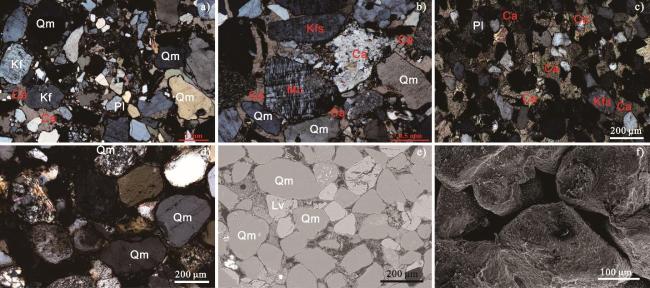
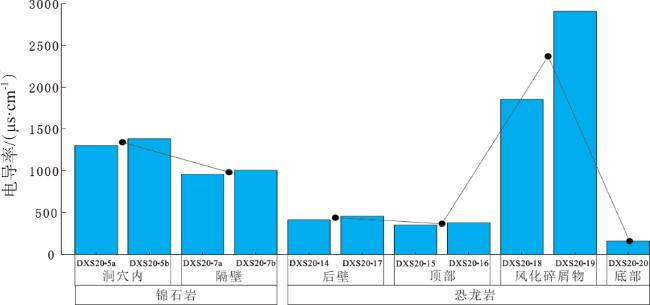
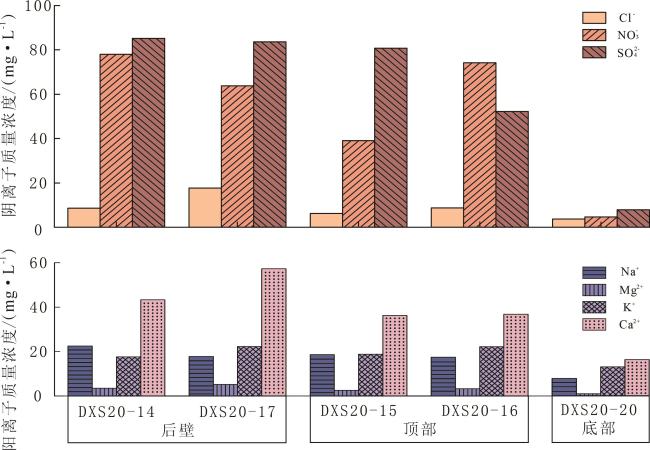
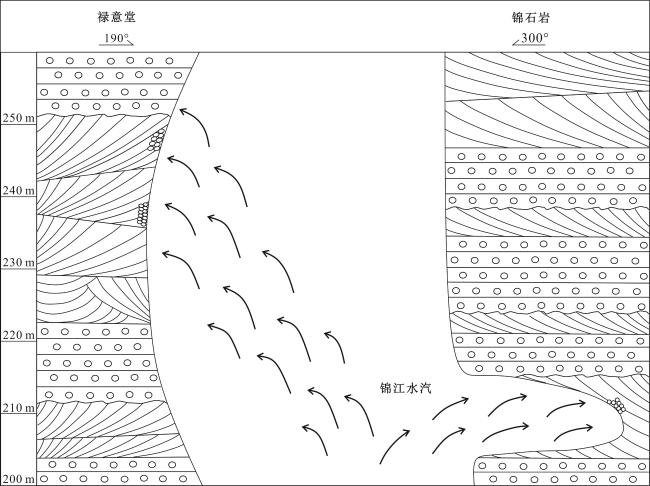
Cavernous weathering is widely distributed in different climate zones worldwide. The dominant controlling factors and their formation processes have long been discussed in the geomorphological community; however, many controversies remain. In the danxia landscape, various forms of cavernous weathering develop on steep slopes. They are important elements of the landscape and provide shelter for the preservation of many precious historical cultures, yet there have been few studies investigating their origin. Danxiashan is representative of the Natural World Heritage site 'China Danxia', with widespread cavernous weathering features of various sizes and shapes, providing a good opportunity for investigating the origin of cavernous weathering in subtropical humid climates. Typical caverns on sandstone and conglomerate slopes at five sites in Danxiashan were selected and studied by field investigation, morphological measurement, meteorological monitoring, sample microscopic observation, and salt experiments. The results show the following. First, the diameters of the cavern openings vary from centimeters to meters, and the shape of the cavern openings is elliptical to elliptical. The tafoni on conglomerate slopes are generally large and tend to grow upward and inward, while the caverns on sandstone slopes are generally small and arranged in a honeycomb-like structure. Second, lithology is fundamental for the development of caverns. At the macroscopic scale, it determines their location and arrangement because the caverns generally align within the lamination of beddings or cross-beddings. Indeed, the morphological characteristics of caverns developed differently under varying lithologies. At the microscopic scale, the red beds consist of abundant soluble mineral components, such as feldspars and carbonate cements, which are chemically dissolved in the seepage of acid rainwater, the salt crystallization of which leads to the destruction of the rock texture. Collectively, they would have initiated the formation of caverns. Third, the favorable microclimate within the caverns is a key factor that is water and salt accumulation, and consequently, salt weathering and enlargement of the caverns over time. Notably, the microclimate within the Jinshiyan Cave has provided favorable conditions for algae colonization, which controlled the formation of the cell-and-wall structure of the regular honeycombs at the Longlingpian Rock. Finally, the dominant controlling factors were dissimilar between caverns and interplayed in different development stages of cavernous weathering, the entire progression of which was potentially regulated by a self-organized mechanism. However, the influencing factors and critical values of the positive and negative feedback mechanisms require further study.
Yuexin Shi , Liuqin Chen , Dingding Du , Le Chai , Zihan Wang . Basic Characteristics and Genesis of Cavernous Weathering Features on the Steep Slopes of Danxia Landscape in Danxiashan UNESCO Global Geopark[J]. Tropical Geography, 2023 , 43(1) : 103 -114 . DOI: 10.13284/j.cnki.rddl.003614
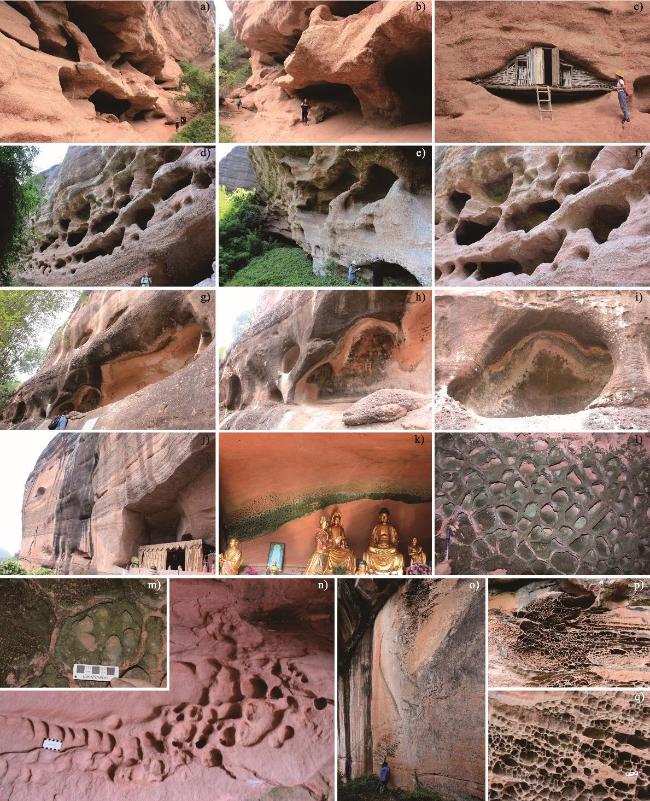
图2 丹霞山陡坡的砾岩和砂岩层上的风化洞穴 Fig.2 Cavernous weathering features on conglomerate and sandstone slopes of Danxiashan |
表1 丹霞山风化洞穴的基本特征总结Table1 Basic characteristics of cavernous weathering features in Danxiashan |
| 研究点 | 位置 | 岩性 | 形态 |
|---|---|---|---|
| 恐龙岩 | 玉屏峰,开口朝向232°,面向西南 | 厚层块状砾岩 | 大型 |
| 扬州寨 | 扬州寨北坡,洞穴的开口345°,其余开口朝向为15°至60°,大致为东北方向 | 厚层砾岩 | 大型 |
| 梦觉关 | 长老峰,开口方向290° | 中-细粒厚层砂岩 | 大型 |
| 锦石岩洞 | 长老峰北坡半山腰,位于大型层控洞穴内部,开口朝向300°,河流凹岸 | 中-细粒厚层砂岩 | 小型 |
| 禄意堂 | 睡美人(玉女拦江)南坡弧形崖壁上,朝向190° | 厚层砂岩 | 小型 |
表2 丹霞山恐龙岩和扬州寨洞穴尺寸和洞口朝向统计Table 2 Size and opening orientation of cavernous weathering features at Dinosaur Rock and Yangzhouzhai of Danxiashan |
| 洞穴统计 | 长度/m | 深度/m | 高度/m | 扁率 | 洞口朝向 |
|---|---|---|---|---|---|
| KLY1 | 13.35 | 9.00 | 1.75 | 0.87 | 205°SW |
| KLY2 | 2.03 | 1.43 | 1.26 | 0.38 | 205°SW |
| KLY3 | 3.35 | 7.90 | 2.91 | 0.13 | 205°SW |
| KLY4 | 9.21 | 8.35 | 3.16 | 0.66 | 205°SW |
| KLY5 | 2.92 | 3.65 | 1.32 | 0.55 | 193°SW |
| YZZ1 | 5.39 | 2.83 | 1.22 | 0.77 | 15°NE |
| YZZ2 | 7.50 | 2.27 | 2.20 | 0.71 | 60°NE |
| YZZ3 | 6.60 | 3.33 | 2.64 | 0.60 | 20°NE |
表3 丹霞山不同泉水和池水中水样的pHTable 3 PH values of water samples in different springs and pools of Danxiashan |
| 样品编号 | pH | 采样位置 |
|---|---|---|
| LWQ-1 | 5.78 | 龙王泉 |
| SRQ-1 | 5.86 | 雪岩石乳泉 |
| CTS-1 | 6.92 | 船头石向前约200 m的岩槽(小瀑布) |
| JBFJ-1 | 6.91 | 锦石岩寺浸碧浮金中间池水 |
| JBFJ-2 | 6.81 | 锦石岩寺浸碧浮金左边池水 |

史月欣:数据处理、论文撰写和修改;
陈留勤:实验分析、基金支持、论文设计和修改;
杜丁丁、柴乐、王子涵:实验分析和论文修改。
|
Angeli M, Hébert R, Menéndez B, David C and Bigas J P. 2010. Influence of Temperature and Salt Concentration on the Salt Weathering of a Sedimentary Stone with Sodium Sulfate. Engineering Geology, 115: 193-199.
|
|
Bak P. 1996. How Nature Works. The Science of Self-Organized Criticality. Copernicus Books: New York.
|
|
陈留勤,李馨敏,郭福生,李鹏程,李余亮,刘鑫. 2018. 丹霞山世界地质公园蜂窝状洞穴特征及成因分析. 地质论评,64(4):895-904.
Chen Liuqin, Li Xinmin, Guo Fusheng, Li Pengcheng, Li Yuliang and Liu Xin. 2018. Characteristics and Origin of Honeycombs in the Danxiashan Global Geopark in South China. Geological Review, 64(4): 895-904.
|
|
陈留勤,李鹏程,郭福生,刘鑫,李馨敏. 2019. 粤北丹霞盆地晚白垩世丹霞组沉积相及古气候意义. 沉积学报,37(1):17-29.
Chen Liuqin, Li Pengcheng, Guo Fusheng, Liu Xin and Li Xinmin. 2019. Facies Analysis and Paleoclimate Implications of the Late Cretaceous Danxia Formation in the Danxia Basin, Northern Guangdong Province, South China. Acta Sedimentologica Sinica, 37(1): 17-29.
|
|
Chen Liuqin, Guo Fusheng, Liu Fujun, Xu Huan, Ding Ting and Liu Xin. 2019. Origin of Tafoni in the Late Cretaceous Aeolian Sandstones, Danxiashan UNESCO Global Geopark, South China. Acta Geologica Sinica-English Edition, 93(2): 451-463.
|
|
Chen Liuqin, Migoń P, Guo Fusheng, Pan Zhixin and Wu Hao. 2022a. Cavernous Weathering in Aeolian Sandstones: An Example from the Yongningshan Hill of the Loess Plateau, Northwest China. Acta Geologica Sinica-English Edition, 96(5): 1764-1777.
|
|
Chen Liuqin, Guo Fusheng, Shao Chongjian, Du Dingding, Chen Fang and Luo Ming. 2022b. Geodiversity characterization of the Danxiashan UNESCO Global Geopark of China. International Journal of Geoheritage and Parks, 10: 459-476.
|
|
Chen Xin, Chen Liuqin, Zhang Yanhong, Du Dingding, Hu Haiping, Liu Dongxing and Li Wenzhuo. 2021. Lithological and Environmental Controls on Large Tafoni along Conglomerate Cliffs in Subtropic Humid Danxiashan UNESCO Global Geopark. Journal of Mountain Science, 18(5): 1131-1143.
|
|
Guo Fusheng, Chen Liuqin, Xu Huan and Liu Xin. 2018. Origin of Beaded Tafoni in Cliffs of Danxia Landscapes, Longhushan Global Geopark, South China. Journal of Mountain Science, 15(11): 2398-2408.
|
|
Huang Rihui and Wang Wei. 2017. Microclimatic, Chemical, and Mineralogical Evidence for Tafoni Weathering Processes on the Miaowan Island, South China. Journal of Asian Earth Sciences, 134: 281-292.
|
|
Huinink H P, Pel L and Kopinga K. 2004. Simulating the Growth of Tafoni. Earth Surface Processes and Landforms, 29(10): 1225-1233.
|
|
Inkpen R and Hall K. 2016. Using Morphospaces to Understand Tafoni Development. Geomorphology, 261: 193-199.
|
|
Kogure T, Sueyoshi R, Ohira H, Sampel Y, Shin K C and Abe Y. 2022. Formation Processes of Tafoni on Pyroclastic Rock Surfaces with Hydrothermal Alteration on the Isotake Coast, Shimane, Japan. Geomorphology, 398: 108050.
|
|
Lang-Yona N, Maier S, Macholdt D S, Mvller-Germann I E, Yordanova P, Rodriguez-Caballero E, Jochum K P, Ai-Amri A, Andreae M O, Fröhlich-Nowoisky J and Weber B. 2018. Insights into Microbial Involvement in Desert Varnish Formation Retrieved from Metagenomic Analysis. Environmental Microbiology Reports, 10(3): 264-271.
|
|
刘东兴,陈欣,陈留勤,郭福生,刘富军. 2022. 江西宁都翠微峰蜂窝状洞穴特征及成因. 山地学报,40(2):196-204.
Liu Dongxing, Chen Xin, Chen Liuqin, Guo Fusheng and Liu Fujun. 2022. Genesis of tafoni in the Cuiwei Peak, Jiangxi province, China. Mountain Research, 40(2): 196-204.
|
|
刘晓娇,徐娟,张斌,刘守江,覃发超,罗明良. 2013. 川中丘陵区河成壶穴的形态对比及成因. 山地学报,31(6):723-730.
Liu Xiaojiao, Xu Juan, Zhang Bin, Liu Shoujiang, Qin Fachao and Luo Mingliang. 2013. Morphological Comparison and Cause of River Potholes in Sichuan Hilly Area. Journal of Mountain Science, 31(6): 723-730.
|
|
吕洪波,苏德辰,章雨旭,冯雪东,李春旺. 2017. 中国不同气候带盐风化作用的地貌特征. 地质论评,63(4):911-926.
Lyu Hongbo, Su Dechen, Zhang Yuxu, Feng Xuedong and Li Chunwang. 2017. Landform Features of Salt Weathering in Different Climatic Zones in China. Geological Review, 63(4): 911-926.
|
|
马在平,黄继忠,张洪. 2005. 云冈石窟砂岩中碳酸盐胶结物化学风化及相关文物病害研究. 中国岩溶,24(1):73-78,84.
Ma Zaiping, Huang Jizhong and Zhang Hong. 2005. Chemical Weathering of Carbonate Cement in Sandstone and the Related Cultural Relic Diseases in Yungang Grottoes. Carsologica Sinica, 24(1): 73-78, 84.
|
|
Migoń P. 2021. Geomorphology of Conglomerate Terrains-Global Overview. Earth-Science Reviews, 208: 103302.
|
|
Mustoe G E. 2010. Biogenic Origin of Coastal Honeycomb Weathering. Earth Surface Processes and Landforms, 35(4): 424-434.
|
|
欧阳杰,朱诚,彭华,胡智农,俞锦标,王海昀,吕文,徐龙生. 2011. 湖南崀山丹霞地貌岩体抗酸侵蚀脆弱性的实验研究. 地球科学进展,26(9):965-970.
Ouyang Jie, Zhu Cheng, Peng Hua, Hu Zhinong, Yu Jinbiao, Wang Haiyun, Lyu Wen and Xu Longsheng. 2011. Experimental Research on Vulnerability of Danxia Rocks to Resistance against Acid Erosion in Langshan, Hunan Province. Advances in Earth Science, 26(9): 965-970.
|
|
Paradise T R. 2013. 4.7 Tafoni and Other Rock Basins. In: Shroder J F. Treatise on Geomorphology. San Diego: Academic Press, 111-126.
|
|
彭华,邱卓炜,潘志新. 2014. 丹霞山顺层洞穴风化特征的试验研究. 地理科学,34(4):454-463.
Peng Hua, Qiu Zhuowei and Pan Zhixin. 2014. Experimental Study on the Weathering Features of Bedding Caves at Mt. Danxiashan. Scientia Geographica Sinica, 34(4): 454-463.
|
|
Ponti S, Pezza M and Guglielmin M. 2021. The Development of Antarctic Tafoni: Relations between Differential Weathering Rates and Spatial Distribution of Thermal Events, Salts Concentration and Mineralogy. Geomorphology, 373: 1-12.
|
|
Rodriguez-Navarro C and Doehne E. 1999. Salt Weathering: Influence of Evaporation Rate, Supersaturation and Crystallization Pattern. Earth Surface Processes and Landforms, 24(3): 191-209.
|
|
Slavík M, Bruthans J, Fillippi M, Schweigstillová J, Falteisek L and Řihošek J. 2017. Biologically-Initiated Rock Crust on Sandstone: Mechanical and Hydraulic Properties and Resistance to Erosion. Geomorphology, 278: 298-313.
|
|
谭艳,朱诚,吴立,孙伟,王晓翠,贾天骄,彭华,侯荣丰. 2015. 广东丹霞山砂岩蜂窝状洞穴及白斑成因. 山地学报,33(3):279-287.
Tan Yan, Zhu Cheng, Wu Li, Sun Wei, Wang Xiaocui, Jia Tianjiao, Peng Hua and Hou Rongfeng. 2015. Geomophogensis on Sandstone Honeycombs and White Spot in the Mt. Danxiashan, Guangdong Province, South China. Mountain Research, 33(3): 279-287.
|
|
谭玉芳,李丽慧,杨志法,廖小辉. 2019. 红层砂岩与砾岩差异风化的湿度应力效应研究. 岩石力学与工程学报,38(S2):3481-3492.
Tan Yufang, Li Lihui, Yang Zhifa and Liao Xiaohui. 2019. Moisture Stress Effect and Its Control on Differential Weathering of Red-Bed Sandstone and Conglomerate. Chinese of Journal of Rock Mechanics and Engineering, 38(S2): 3481-3492.
|
|
Turkington A V and Phillips J D. 2004. Cavernous Weathering, Dynamical Instability and Self-Organization. Earth Surface Process and Landforms, 29: 665-675.
|
|
Viles H A and Goudie A S. 2011. Weathering in the Central Namib Desert, Namibia: Controls, Processes and Implications. Journal of Arid Environments, 93(3): 20-29.
|
|
Wieler N, Ginat H, Gillor O and Angel R. 2019. The Origin and Role of Biological Rock Crusts in Rocky Desert Weathering. Biogeosciences, 16(6): 1133-1145.
|
|
严绍军,陈嘉琦,窦彦,孙鹏. 2015. 云冈石窟砂岩特性与岩石风化试验. 现代地质,29(2):442-447.
Yan Shaojun, Chen Jiaqi, Dou Yan and Sun Peng. 2015. Characteristics of Yungang Grottoes Sandstone and Weathering Simulation Tests. Geoscience, 29(2): 442-447.
|
|
张娜. 2016. 福建泰宁、冠豸山丹霞洞穴成因研究. 南京:南京大学.
Zhang Na. 2016. Genesis on Danxia Caves of Taining and Guanzhaishan in Fujian Province. Nanjing: Nanjing University.
|
|
张显球. 1992. 丹霞盆地白垩系的划分与对比. 地层学杂志,16(2):81-95.
Zhang Xianqiu. 1992. Cretaceous Subdivision and Correlation in the Danxia Basin. Journal of Stratigraphy, 16(2): 81-95.
|
|
朱诚,彭华,李世成,黄林燕,郑朝贵,项伏生,孙毓飞,唐云松,胡济源,朱光辉,吕健君,程光华. 2005. 安徽齐云山丹霞地貌成因. 地理学报,60(3):445-455.
Zhu Cheng, Peng Hua, Li Shicheng, Huang Linyan, Zheng Chaogui, Xiang Fusheng, Sun Yufei, Tang Yunsong, Hu Jiyuan, Zhu Guanghui, Lyu Jianjun and Cheng Guanghua. 2005. Danxia Landform Genesis on Qiyun Mountain, Anhui Province. Acta Geographica Sinica, 60(3): 445-455.
|
|
朱诚,马春梅,张广胜. 2015. 中国典型丹霞地貌成因研究. 北京:科学出版社.
Zhu Cheng, Ma Chunmei and Zhang Guangsheng. 2015. Development Mechanisms of Typical Danxia Landforms in China. Beijing: Science Press.
|
/
| 〈 |
|
〉 |