Liminal Experience of Participants in Mass Sports Events: A Case Study of Marathon Participants
Received date: 2022-05-07
Revised date: 2022-09-25
Online published: 2023-08-14
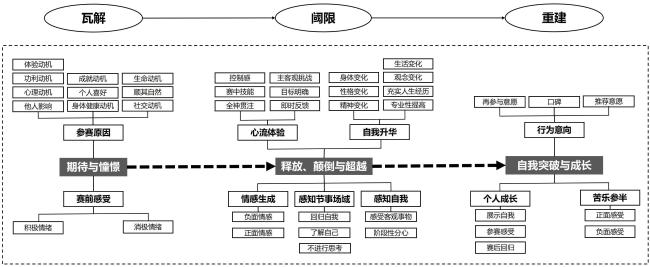
Event experience is an important topic in event research. Liminal experience, as the core experience of event participants, remains limited in research on mass sports events. Taking liminality theory as the logical starting point and marathon participants as subjects, this study collected data through interviews and analyzed it under the guidance of grounded theory. Forty secondary categories and ten main categories were extracted to construct a model of the liminal experience for marathon participants. The results show that the liminal experience of marathon participants can be regarded as a gradual process of "anticipation-release, inversion, and transcendence-self breakthrough and growth." The participants broke away from their daily structure with anticipation for the event and expectations of good self-performance. They immersed themselves in liminal experiences through perception, interaction, release, catharsis, transcendence, and inversion. Finally, the participants experienced a bittersweet experience, emotional sublimation, and personal growth. They were willing to promote and pass on their experiences. The research is innovatively based on marathon participants' event experience, interprets their experience from the perspective of embodied theory, explains the construction process of marathon participants' liminal experience, and enriches the research content of the liminal theory. This study observed that the marathon participants' experience is a liminal experience; however, it differs from other liminal experiences in that the participants have a flow experience and an individual self-breakthrough and growth in the liminal experience, which are difficult to produce in other events. Therefore, the theoretical value of this study is to supplement the research on the experiences of participants and liminal experiences in the field of events. The liminal experience conceptual model constructed in this study clearly shows the performance of participants at various stages, identifies key dimensions of their behavior, and lays the foundation for subsequent empirical research. The practical value of this research is that, through interviews with marathon participants, we learn about the views of amateur competitors on mass sports events. Most of them have service requirements, and organizers must continuously improve their ability and level of organization to provide participants with a good experience. Operators, sponsors, and other relevant organizers of mass sports events create a favorable atmosphere through policy support, financial support, and promotion, which helps participants enter the liminal state and immerse themselves in the event.
Fangqi Zhou , Xin Xu , Guangquan Dai . Liminal Experience of Participants in Mass Sports Events: A Case Study of Marathon Participants[J]. Tropical Geography, 2023 , 43(8) : 1625 -1636 . DOI: 10.13284/j.cnki.rddl.003716
表1 马拉松参赛者的样本人口统计特征Table 1 Sample demographics of marathon participants |
| 基本信息 | 类型 | 人数/人 | 百分比/% |
|---|---|---|---|
| 性别 | 男 | 37 | 62.71 |
| 女 | 22 | 37.29 | |
| 年龄/岁 | 20~29 | 12 | 20.34 |
| 30~39 | 19 | 32.20 | |
| 40~49 | 12 | 20.34 | |
| 50~59 | 12 | 20.34 | |
| ≥60 | 4 | 6.78 |
表2 访谈文本的开放性编码示例Table 2 The open coding example of interview text |
| 编号 | 原始语句 | 概念 | 次要范畴 |
|---|---|---|---|
| F-3 | “而且马拉松你看是一波接一波每个星期都有,其实很多人参加马拉松的目的并不是说更加快更强,而是为什么?——体验旅游吃喝玩乐。” | 体验旅游 | 体验动机 |
| M-27 | “就是没有去过的城市尽量想多走一走。” | 体验城市 | |
| M-5 | “中间很多时候是比较痛苦的,马拉松它毕竟是一个极限的,是体力消耗比较大的这样一个运动。” | 痛苦 | 负面情感 |
| M-9 | “然后尤其是最后10公里之后,真的是每一步都特别的挣扎。” | 挣扎 | |
| M-32 | “然后睡眠质量也好了,也能吃了,跑完就又能吃又能睡,也能跑。” | 身体健康 | 身体变化 |
| F-13 | “跑步3年,我的腿部线条紧致了,身形比例更好了。” | 身材变好 |
表3 访谈文本的主轴编码结果Table 3 The axial coding result of interview text |
| 主要范畴 | 次要范畴 | 概念 |
|---|---|---|
| 赛前感受 | 积极情绪 | 兴奋;激动 |
| 消极情绪 | 紧张;忐忑 | |
| 参赛原因 | 体验动机 | 体验城市;体验旅游;为了体验;出差顺便参赛 |
| 功利动机 | 为了减肥;为了多吃;为了拍照;为了薅羊毛;为了美丽 | |
| 心理动机 | 好玩;感兴趣;减压;自我鼓励 | |
| 他人影响 | 他人带动;感染力 | |
| 成就动机 | 追求挑战;追求成绩;自我追求;出于好胜;助力国内残障事业 | |
| 个人喜好 | 喜欢跑步;有运动习惯;性价比最优 | |
| 身体健康动机 | 为了健康;锻炼身体 | |
| 生命动机 | 空闲时间充足;有意义;丰富生活 | |
| 顺其自然 | 契机使然;水到渠成;日积月累;巧合 | |
| 社交动机 | 社交需求;好友聚会 | |
| 情感生成 | 负面情感 | 痛苦;坚持熬下去;过程虐;挣扎;脚痛;磨出血;辛苦;前期厌烦;没经验造成抽筋;撞墙期状态不好;迷茫;后悔 |
| 正面情感 | 享受过程;兴奋;打鸡血;参与感;集体感;幸福感;快感;舒服最重要;没有很累;体验好;体验难得;有趣;未达极限 | |
| 感知自我 | 回归自我 | 沉淀自己;放纵自我;释放自我;回到自我;逐渐进入状态;享受孤独;逐渐平静;严肃跑者 |
| 了解自己 | 监控自己身体;关注心率;了解自己身体;忠于自己身体 | |
| 不进行思考 | 放空自己;不过度思考 | |
| 感知节事 场域 | 感受客观事物 | 感受比赛;超越物理空间;感受魅力;感受城市 |
| 阶段性分心 | 同伴鼓励;领略城市风光;跳跃性关注周围;偶尔分心;急救跑者观察周围跑者 | |
| 心流体验 | 控制感 | 控制身体;改变受力点;保持力量;把握自己节奏 |
| 赛中技能 | 陪伴重要;不被干扰;投入全身;装备齐全;毅力坚持 | |
| 全神贯注 | 集中精力;坚持完赛;感受身体变化;成绩;目标;如何超越别人;计算路程 | |
| 主客观挑战 | 容易退步;意志力挑战;挑战自己;和自己比;进步困难;轮椅跑者付出更多;初跑难受;个人惰性;早起;“撞墙期”痛苦;不可控因素;极限运动;枯燥;受伤;身体不适;生命危险;参赛限制 | |
| 目标明确 | 针对赛事定目标;追求成绩;日积月累形成目标;有所提高;追求PB;追求参赛次数;根据能力定目标;达到目标;追求免抽签;不追求成绩;完赛;佛系参赛;不过度追求成绩 | |
| 即时反馈 | 自我心理建设;调整姿势;调整呼吸;保持清醒;认清自身能力;适时放弃;及时补给;及时降温;随时调整状态 | |
| 自我升华 | 身体变化 | 身体健康;身材变好;锻炼心肺;更灵敏;治疗疾病;保持年轻 |
| 性格变化 | 自律;自闭症患者改善;正能量;自信心增强;善于交往;有目标;自我肯定;失去“上进心”;看开生活;意志力增强;强大自己;性格开朗 | |
| 精神变化 | 减轻压力;精气神好;状态更好;积极;兴奋;心情舒畅;全家开心;不用午睡;体验到马拉松精神;日积月累的改变;了解自己;缓解焦虑 | |
| 生活变化 | 带动他人;结识丈夫;超越年龄;促进工作;生活质量提高;融入生活改变心智障碍患者及其家庭;锻炼处事能力;改变生活态度 | |
| 观念变化 | 发现生活无限可能;突破自我;发现生活美好;学会转换理念;逐渐看开;返璞归真;理性参与;生命在于运动 | |
| 充实人生经历 | 收藏价值;不同体验;获得尊重;回忆足够;收获感悟;融入身体;自我愉悦 | |
| 专业性提高 | 提高急救意识;成绩提高;了解运动科学理论 | |
| 个人成长 | 展示自我 | 展示参赛;奖励自己;表达共鸣;炫耀自我 |
| 参赛感受 | 冲到最后;舒适参赛;平静完赛;感受不同;丰富经历 | |
| 赛后回归 | 逐渐缓解;听取意见;注意休息 | |
| 苦乐参半 | 正面感受 | 上瘾;痛并快乐;阶段性畅爽;好玩;神圣的快感;愉悦感;满足感;惊喜;享受;成就感;爽;释放压力;舒服;比较轻松;兴奋;精力充沛;放松 |
| 负面感受 | 抽筋感;无法说话;折磨身体;厌跑;肌肉酸痛;累;后段煎熬;身体痛苦;磨出泡 | |
| 行为意向 | 再参与意愿 | 再参与;一直跑 |
| 口碑 | 持续关注;赛事进步 | |
| 推荐意愿 | 带动家人;影响他人 |

1 心流体验:心流体验是个体从事具有浓厚兴趣的活动时,因完全投入而产生的忘却周围环境、丧失自我意识和时间感,并乐在其中的一种心理过程。
2 共睦态:共睦态的概念源于社会学与人类学研究中的“Communitas”,Turner提出的“Communitas”现象是在仪式中的阈限阶段出现的。在阈限期内,受礼者彼此之间往往会形成一种同志关系和平等关系,世俗的级别和地位之分消失了,甚至呈现某种被同化的趋势,最终形成一种被其称为反结构的、彼此交融的共同体。Turner强调,共睦态是关系的一种形式,是有具体性、历史性、特异性的个体之间的关系。
周方祺:实施研究过程、采集整理数据、全文撰写以及修改等。
许 欣:指导研究过程、提出修改意见、提升论文质量等。
戴光全:指导研究过程、提出修改意见、提升论文质量、提供基金支持等。
|
阿诺尔德·范·热内普. 2012. 过渡礼仪. 黄剑波,柳博赟. 译. 北京:商务印书馆. [Gennep A V. 2012. The Rites of Passage. Huang Jianbo, and Liu Boyun, Trans. Beijing: Commercial Press.]
|
|
崔永衡,任振朋. 2016. 马拉松“晒客”自我呈现分析——基于戈夫曼拟剧理论. 体育研究与教育,31(4):22-27.
Cui Yongheng, and Ren Zhenpeng. 2016. Analysis of the Marathon Sharers Self-Presentation: Based on Goffman's Conception of Stage Performance. Sports Research and Education, 31(4): 22-27.
|
|
Currie R R. 1997. A Pleasure-Tourism Behaviors Framework. Annals of Tourism Research, 24(4): 884-897.
|
|
杜靖. 2007. 作为一种集体表象和过渡仪式的鲁南春节秧歌. 社会科学,324(8):141-147.
Du Jing. 2007. As a Kind of the Collective Representation and the Rites of Passage, the Yangge in the Spring Festival in the South of Shandong Province. Journal of Social Sciences, 324(8): 141-147.
|
|
Getz D, and Page S J. 2020. Event Studies: Theory, Research and Policy for Planned Events. 4th Edition. New York: Routledge.
|
|
Graburn N H H. 1980. The anthropology of tourism. International Social Science Journal, 10(1): 9-33.
|
|
Graburn N H H. 2001. Secular Ritual: A General Theory of Tourism. London: Cognizant Communication.
|
|
郭学松,阴腾龙. 2016. 仪式过程理论“阈限”范畴中的身体展演研究. 首都体育学院学报,28(3):226-230, 234.
Guo Xuesong, and Yin Tenglong. 2016. Study on Physical Performance in the "Threshold" Category of Ritual Process Theory. Journal of Capital University of Physical Education and Sports, 28(3): 226-230, 234.
|
|
郭学松,王伯余,杨海晨,陈萍,刘明云. 2017. 仪式、记忆与认同:“三公下水操”中的身体运动研究. 成都体育学院学报,43(6):52-57,72.
Guo Xuesong, Wang Boyu, Yang Haichen, Chen Ping, and Liu Mingyun. 2017. Ceremony, Memory and Identity: A Study on the Body Movement in San Gong Xia Shui Cao. Journal of Chengdu Sport University, 43(6): 52-57, 72.
|
|
Huang W J, Xiao H J, and Wang S. 2018. Airports as Liminal Space. Annals of Tourism Research, 70: 1-13.
|
|
Kim H, and Jamal T. 2007. Touristic Quest for Existential Authenticity. Annals of Tourism Research, 34(1): 181-201.
|
|
Lett J W. 1983. Ludic and Liminoid Aspects of Charter Yacht Tourism in the Caribbean. Annals of Tourism Research, 10(1): 35-56.
|
|
Li J, Wang J N, Qi J J, and Liu Y L. 2022. How Do Exhibitors Develop Exhibition Attachment? Evidence from China. Journal of Hospitality and Tourism Management, 50: 201-213.
|
|
梁子茵,殷红梅,李瑞,蔡茜,陆婷婷. 2021. 旅游影响下的传统饮食仪式地方性识别与建构——以贵州西江苗寨敬酒仪式为例. 美食研究,38(2):14-22.
Liang Ziyin, Yin Hongmei, Li Rui, Cai Xi, and Lu Tingting. 2021. Study on Recognition and Construction of Toast Ceremony Locality in Xijiang Miao Village, Guizhou: A Case Study of Gaoshanliushu. Journal of Researches on Dietetic Science and Culture, 38(2): 14-22.
|
|
廖俊,花莲莲,戴光全. 2013. 国内外阈限研究综述及其对节事阈限研究的启示. 旅游论坛,6(1):7-16.
Liao Jun, Hua Lianlian, and Dai Guangquan. 2013. Reviewing and Revealing Domestic and Foreign Liminality & Event Liminality Research. Tourism Forum, 6(1): 7-16.
|
|
卢芳芳. 2021. 社会记忆、身体操演与影视人类学方法及实践——基于白马藏人影像志创作的反思. 现代传播(中国传媒大学学报),43(5):91-95.
Lu Fangfang. 2021. Social Memory, Physical Performance, and Film and Television Anthropology Methods and Practices: Reflections Based on the Creation of Baima Tibetans' Photologs. Modern Communication (Journal of Communication University of China), 43(5): 91-95.
|
|
卢天凤,王玥. 2018. 文化身份认同视角:城市中产阶层热衷于马拉松的动因考究及问题规避. 武汉体育学院学报,52(2):11-16.
Lu Tianfeng, and Wang Yue. 2018. Motivation of Urban Middle Class People's Passion for Marathon Seen from Perspective of Culture Identity and Problems. Journal of Wuhan Institute of Physical Education, 52(2): 11-16.
|
|
罗秋菊,林潼. 2014. 亚运会开幕式对广州居民文化认同的影响研究——基于仪式理论的分析. 地理科学,34(5):587-593.
Luo Qiuju, and Lin Tong. 2014. Impact of 2010 Asia Games Opening Ceremony on Cultural Identity of Residents in Guangzhou: Perspective on Events and Ritual Theory. Scientia Geographica Sinica, 34(5): 587-593.
|
|
马凌. 2010. 节庆旅游中的阈限体验:日常世界与旅游世界——以西双版纳傣族泼水节为例. 学术研究,(11):94-99,126.
Ma Ling. 2010. Liminal Experience in Event Tourism: Daily World and Tourism World: A Case Study of the Water-Splashing Festival of Xishuangbanna Dai Nationality. Academic Research, (11): 94-99, 126.
|
|
马天,谢彦君. 2020. 梦想的远方:西藏具身旅游体验研究. 西藏民族大学学报(哲学社会科学版),41(3):120-127.
Ma Tian, and Xie Yanjun. 2020. The Distance of Dreams: A Study on the Embodied Tourist Experience of Tibet. Journal of Tibet Nationalities Institute (Philosophy and Social Sciences Edition), 41(3): 120-127.
|
|
Magrizos S, Kostopoulos I, and Powers L. 2020. Volunteer Tourism as a Transformative Experience: A Mixed Methods Empirical Study. Journal of Travel Research, 60(4): 878-895.
|
|
Neuhofer B, Celuch K, and To T L. 2020. Experience Design and the Dimensions of Transformative Festival Experiences. International Journal of Contemporary Hospitality Management, 32(9): 2881-2901.
|
|
Peachey J W, Borland J, Lobpries J, and Cohen A. 2015. Managing Impact: Leveraging Sacred Spaces and Community Celebration to Maximize Social Capital at a Sport-for-Development Event. Sport Management Review, 18(1): 86-98.
|
|
秦涛. 2012. 结构主义视域下民俗体育的文化意蕴探析. 成都体育学院学报,38(7):34-37.
Qin Tao. 2012. Cultural Implication of Folk Sports from the Perspective of Structuralism. Journal of Chengdu Sport University, 38(7): 34-37.
|
|
任大全,首洁. 2006. 大众体育赛事界定的历史渊源及赛事营销特点分析. 西安体育学院学报,23(2):18-20.
Ren Daquan, and Shou Jie. 2006. History of Mass Sports and Features of Mass Sports Competition Marketing. Journal of Xi'an Institute of Physical Education, 23(2): 18-20.
|
|
Sharpe E K. 2008. Festivals and Social Change: Intersections of Pleasure and Politics at a Community Music Festival. Leisure Sciences, 30(3): 217-234.
|
|
孙九霞,李毓. 2016. 西双版纳傣族园泼水演员的类阈限体验研究. 旅游学刊,31(5):72-80.
Sun Jiuxia, and Li Yu. 2016. A Study on Water-Splashing Actor's Liminoid Experience at Dai Nationality Garden in Xishuangbanna. Tourism Tribune, 31(5): 72-80.
|
|
孙卫华,刘亚楠. 2022. 仪式展演与象征抵抗:Cosplay的仪式实践与阈限空间. 当代传播,(3):75-79.
Sun Weihua, and Liu Yanan. 2022. Ritual Performance and Symbolic Resistance: Cosplay's Ritual Practice and Threshold Space. Contemporary Communication, (3): 75-79.
|
|
孙小龙,郜捷,林璧属,李磊. 2019. 旅游者在场情感体验建构:理论模型与实证检验. 热带地理,39(3):430-439.
Sun Xiaolong, Gao Jie, Lin Bishu, and Li Lei. 2019. Construction of Tourist' Emotional Experience in the On-Site Stage: Theoretical Model and Empirical Investigation. Tropical Geography, 39(3): 430-439.
|
|
谭红春. 2010. 体育竞赛的仪式过程分析. 体育学刊,17(10):32-36.
Tan Hongchun. 2010. Analysis of the Ritual Process of Sports Competitions. Journal of Physical Education, 17(10): 32-36.
|
|
陶慧,高喆,乔婧. 2020. 从阈限到融合:基于HIS视角的传统聚落重构路径研究. 西北民族研究,(4):140-151.
Tao hui, Gao Zhe, and Qiao Jing. 2020. From Threshold to Fusion: Research on Reconstruction Path of Traditional Settlements Based on HIS. Journal of Northwestern Ethnic Studies, (4): 140-151.
|
|
童国军. 2021. 凉山彝族原生态仪式舞蹈“朵洛荷”的体育人类学考释. 成都体育学院学报,47(5):100-105.
Tong Guojun. 2021. The Anthropological Interpretation of Original Ecological Ritual Dance "Doloho" of the Yi People in Liangshan. Journal of Chengdu Sport University, 47(5): 100-105.
|
|
Turner V. 1979. Frame, Flow and Reflection: Ritual and Drama as Public Liminality. Japanese Journal of Religious Studies, 6(4): 465-499.
|
|
Turner V. 1982. The Forest of Symbols: Aspects of Ndembu Ritual. Ithaca: Cornell University Press.
|
|
Vuuren C J V. 2014. A Ritual Perspective on the Comrades Marathon. South African Journal for Research in Sport Physical Education & Recreation, 36(2): 211-224.
|
|
王钢.2009. 仪式语境中的傣族泼水狂欢节.贵州民族研究,29(4):56-60.
Wang Gang. 2009. The Water Carnival of the Dai Nationality in the Ritual Theory. Guizhou Ethnic Studies, 29(4): 56-60.
|
|
王海,王大卫,李颖川,林致诚. 2012. 我国马拉松赛事研究. 体育文化导刊,(12):46-47,52. [Wang Hai, Wang Dawei, Li Yingchuan, and Lin Zhicheng. 2012. Research on Marathon in China. Sports Culture Guide, (12): 46-47, 52.]
|
|
王健. 2019. 休闲、身体与自我——城市马拉松流行的社会生成逻辑. 沈阳体育学院学报,38(3):39-44.
Wang Jian. 2019. Leisure, Body and Self: Sociological Generating Logic of Popular Urban Marathon. Journal of Shenyang Sport University, 38(3): 39-44.
|
|
王智慧. 2020. 解组与重构:“健康中国”背景下的社会心态适应——基于大众体育参与的分析. 体育与科学,41(2):20-30.
Wang Zhihui. 2020. Deconstruction and Reconstruction: Social Mentality Adaptation in the Context of "Healthy China": Based on the Analysis of Mass Sports Participation. Journal of Sports and Science, 41(2): 20-30.
|
|
维克多·特纳. 2006. 仪式过程:结构与反结构. 黄剑波,柳博赟. 译. 北京:中国人民大学出版社.
Turner V. 2006. The Ritual Process: Structure and Anti-Structure. Huang Jianbo, and Liu Boyun. Trans. Beijing: China Renmin University Press.
|
|
吴俊,唐代剑. 2018. 旅游体验研究的新视角:具身理论. 旅游学刊,33(1):118-125.
Wu Jun, and Tang Daijian. 2018. A New Tourism Experience Research Perspective: Embodied Theory. Tourism Tribune, 33(1): 118-125.
|
|
Wu S F, Li Y N, Wood E H, Senaux B, and Dai G Q. 2020. Liminality and Festivals: Insights from the East. Annals of Tourism Research, 80. DOI: 10.1016/j.annals.2019.102810.
|
|
吴少峰. 2019. 迷笛音乐节中文化表征过程的研究. 广州:华南理工大学.
Wu Shaofeng. 2019. The Work of Culture Representation in Midi Music Festival. Guangzhou: South China University of Technology.
|
|
郄双泽,关景媛. 2019. 结构功能主义视角下当前我国马拉松运动发展研究. 沈阳体育学院学报,38(6):50-54,96.
Xi Shuangze, and Guan Jingyuan. 2019. Development of Marathon in China from the Perspective of Structural Functionalism. Journal of Shenyang Sport University, 38(6):50-54, 96.
|
|
徐昶楠,郭志光,刘永峰,宫彬,张铭鑫. 2016. 篮球运动的人类学解读. 北京体育大学学报,39(8):20-25.
Xu Changnai, Guo Zhiguang, Liu Yongfeng, Gong Bin, and Zhang Mingxin. 2016. An Anthropological Analysis of Basketball Movement. Journal of Beijing Sport University, 39(8): 20-25.
|
|
闫晋芳. 2016. 自媒体时代小众新兴体育赛事的微博微信推送研究——以WTA天津公开赛为例. 天津:天津体育学院.
Yan Jinfang. 2016. Micro-Blog and Wechat Push Research on Emerging Niche Sporting Events in the We Media Era: Take WTA Tianjin Open for Example. Tianjin: Tianjin University of Sport.
|
|
于显洋,林超. 2018.“马拉松热”的社会学隐喻. 体育学研究,1(5):61-68.
Yu Xianyang, and Lin Chao. 2018. The Sociological Metaphor of Marathon Craze. Journal of Sports Research, 1(5): 61-68.
|
|
曾远力,闫红红. 2017. 青年参与马拉松运动的社会学分析. 中国青年研究,262(12):12-18.
Zeng Yuanli, and Yan Honghong. 2017. Sociological Analysis of Youth Participation in Marathon. China Youth Study, 262(12): 12-18.
|
|
张帆. 2007. 特纳与仪式理论. 西北民族研究,54(3):108-112.
Zhang Fan. 2007. Turner and Ritual Theory. Journal of Northwestern Ethnic Studies, 54(3): 108-112.
|
|
Zhang H, and Xu H G. 2019. A Structural Model of Liminal Experience in Tourism. Tourism Management, 71: 84-98.
|
|
张建军. 2009. 结构主义视阈下的仪式解读——读《仪式过程:结构与反结构》. 社会科学论坛(学术评论卷),191(6):151-160.
Zhang Jianjun. 2009. Interpretation of Ritual from the Perspective of Structuralism: ReadingRitual Process: Structure and Anti-Structure. Tribune of Social Sciences, 191(6): 151-160.
|
|
张燕中. 2008. 合肥市大众体育赛事服务体系构建的研究. 北京:北京体育大学.
Zhang Yanzhong. 2008. The Research of the Construction of Service System on Public Sports Matches in Hefei. Beijing: Beijing Sport University.
|
|
赵红梅. 2008. 也谈“communitas”人类学视野下的一种旅游体验. 思想战线,(4):44-48.
Zhao Hongmei. 2008. Talking about a Kind of Tourism Experience from the Anthropological Perspective of "Communitas". Thinking, (4): 44-48.
|
|
中国田径协会. 2020. 2019中国马拉松蓝皮书.(2020-05-21)[2022-02-12]. http://www.199it.com/archives/1045924.html.
Chinese Athletics Association. 2020. 2019 China Marathon Bluebook. (2020-05-21) [2022-02-12]. http://www.199it.com/archives/1045924.html.
|
|
周群英. 2023. 交融中的“结构”与结构中的“交融”——对阈限理论的诠释与反思. 西南民族大学学报(人文社会科学版),44(3):29-35.
Zhou Qunying. 2023. "Structure" in Communitas and "Communitas" in Structure: An Interpretation and Reflection on Liminal Theory. Journal of Southwest Minzu University (Humanities and Social Sciences Edition), 44(3): 29-35.
|
|
朱丽叶·M.科宾,安塞尔姆·L. 施特劳斯. 2008. 质性研究的基础:形成扎根理论的程序与方法. 3版. 朱光明. 译. 重庆:重庆大学出版社.
Corbin J M, and Strauss A L. 2008. Basic of Qualitative Research: Techniques and Procedures for Developing Grounded Theory. 3rd Edition. Zhu Guangming. Trans. Chongqing: Chongqing University Press.
|
/
| 〈 |
|
〉 |