Investigation on the Conservation Consciousness of an Important Pollination Insect: Stingless Bee in Hainan Tropical Rainforest National Park
Received date: 2023-02-07
Revised date: 2023-06-08
Online published: 2023-09-11
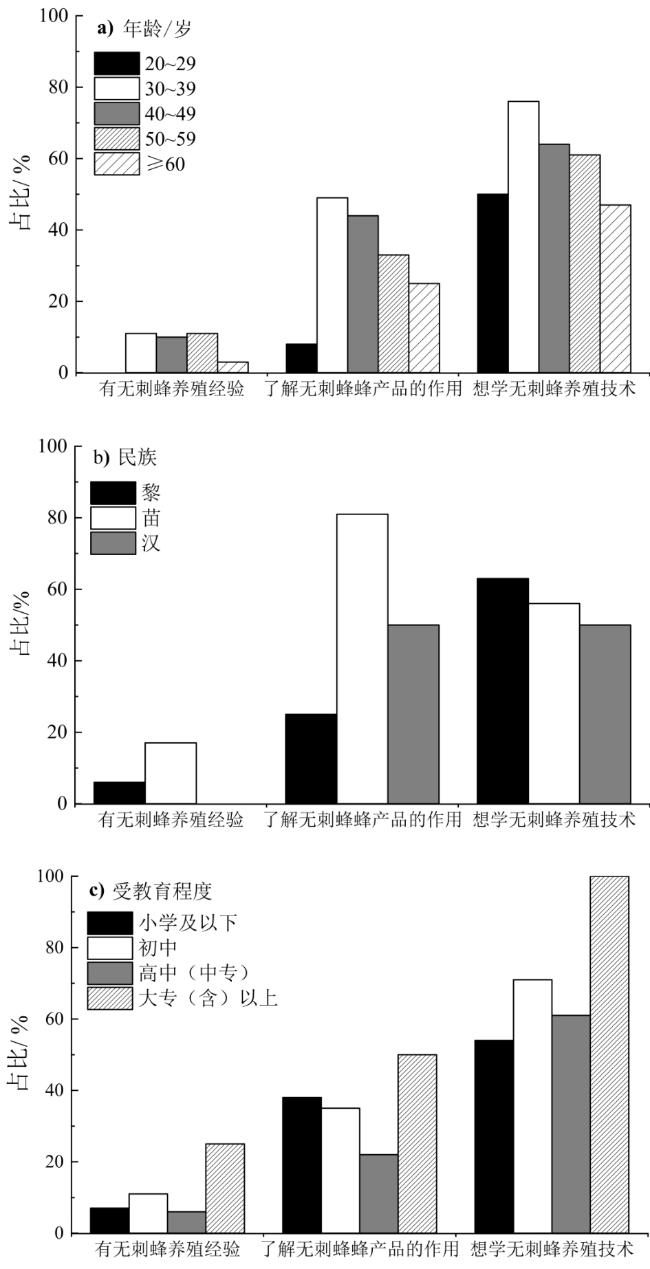
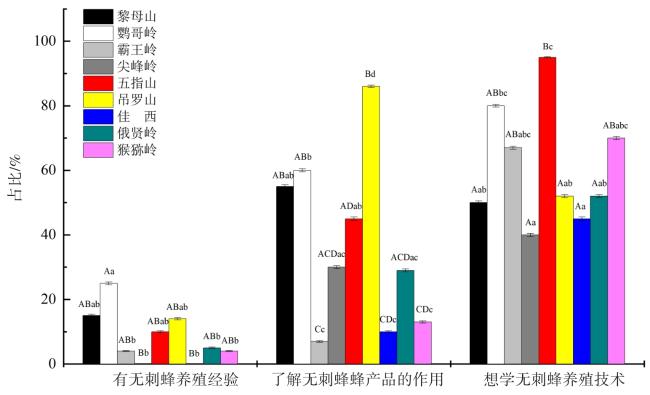
Stingless bees (Hymenoptera: Meloponini) play a significant ecological role in tropical and subtropical regions. They have good utilization value in pollination, medicinal applications, and industrial raw materials. However, the habitats of stingless bees have experienced fragmentation owing to anthropogenic interventions in the natural environment. Consequently, this disruption precipitated a substantial decline in both population abundance and species diversity, placing them at risk of endangerment. Recognizing this scenario, implementing measures to safeguard and judiciously exploit the stingless bee population has become imperative because it has a profound impact on the harmonized advancement of domains encompassing agriculture, medicine, and ecological diversity. From July 2020 to June 2021, comprehensive questionnaire surveys were methodically conducted. The methods employed included participatory interviews and random interception sampling techniques, culminating in a dataset of 291 validated questionnaires. These surveys indicated that the denizens of the communities surrounding the national park predominantly comprise ethnic groups such as Li and Miao. These groups continue to rely primarily on traditional natural resources for their sustenance and livelihood. However, their awareness of the importance of conserving the stingless bee population remains conspicuously deficient. Among the residents displaying the willingness and capacity to contribute to stingless bee conservation efforts, their inclinations appear to be influenced by factors such as prior experience in beekeeping, comprehension of stingless bee products, and demand for beekeeping techniques. Analysis of the survey results underscores a conspicuous gap in the fundamental understanding of the value of stingless bees and their products. Among the community residents, 64.04% lacked this essential comprehension. Furthermore, 91.67% of community residents did not engage in stingless bee breeding activities, and 39.06% were unwilling to learn beekeeping techniques. These findings underscore multifaceted issues within the community pertaining to legal and regulatory frameworks for stingless bee conservation, the popularization of science regarding stingless bees, stingless bee breeding techniques, and other aspects. These inadequacies pose substantial impediments to the sustainable development of stingless bee resources in Hainan Tropical Rainforest National Park. Given these challenges, conservation of stingless bees within the Hainan Tropical Rainforest National Park has emerged as an enduring and pivotal undertaking. In the promotion process, a strategy that encompasses enhanced science communication and public consciousness campaigns is essential. Fostering a positive public disposition towards conservation efforts, encouraging autonomous participation by residents in the conservation of stingless bees, and fostering a balanced coexistence between managed breeding and the protection of wild populations are vital approaches to ensuring the sustainability of stingless bee resources.
Xin Chen , Shan Zhao , Linming Li , Huazhou Wu , Zhe Zhang , Jinglin Gao , Shijie Wang . Investigation on the Conservation Consciousness of an Important Pollination Insect: Stingless Bee in Hainan Tropical Rainforest National Park[J]. Tropical Geography, 2023 , 43(9) : 1738 -1746 . DOI: 10.13284/j.cnki.rddl.003732
表1 受访者(分局工作人员)在各种人口学变量中的比例Table 1 Proportion of the interviewees (staff) in the different demo-graphic parameters |
| 人口学变量 | 霸王岭分局 | 尖峰岭分局 | 五指山分局 | 鹦哥岭分局 | 吊罗山分局 | 黎母山分局 | 猴猕岭分局 | 佳西分局 | 俄贤岭分局 | 合计/% | |
|---|---|---|---|---|---|---|---|---|---|---|---|
| 性别 | 男 | 14 | 10 | 11 | 10 | 12 | 9 | 11 | 9 | 11 | 97.98 |
| 女 | 0 | 0 | 0 | 0 | 0 | 2 | 0 | 0 | 0 | 2.02 | |
| 年龄/岁 | <30 | 0 | 0 | 0 | 0 | 1 | 0 | 0 | 0 | 0 | 1.01 |
| 30~39 | 0 | 0 | 8 | 1 | 1 | 1 | 1 | 3 | 5 | 20.20 | |
| 40~49 | 7 | 0 | 2 | 5 | 2 | 6 | 4 | 4 | 3 | 33.33 | |
| ≥50 | 7 | 10 | 1 | 4 | 8 | 4 | 6 | 2 | 3 | 45.45 | |
| 民族 | 汉 | 14 | 10 | 0 | 0 | 12 | 8 | 8 | 0 | 1 | 53.54 |
| 黎 | 0 | 0 | 11 | 8 | 0 | 2 | 2 | 9 | 10 | 42.42 | |
| 苗 | 0 | 0 | 0 | 2 | 0 | 0 | 0 | 0 | 0 | 2.02 | |
| 侗 | 0 | 0 | 0 | 0 | 0 | 1 | 0 | 0 | 0 | 1.01 | |
| 壮 | 0 | 0 | 0 | 0 | 0 | 0 | 1 | 0 | 0 | 1.01 | |
| 受教育 程度 | 小学 | 0 | 0 | 1 | 1 | 0 | 1 | 0 | 3 | 0 | 6.06 |
| 初中 | 7 | 2 | 3 | 3 | 3 | 6 | 3 | 3 | 7 | 37.37 | |
| 高中(中专) | 5 | 2 | 7 | 5 | 5 | 2 | 4 | 3 | 4 | 37.37 | |
| 大专(含)以上 | 2 | 6 | 0 | 1 | 4 | 2 | 4 | 0 | 0 | 19.19 | |
表2 受访者(社区群众)在各种人口学变量中的比例Table 2 Proportion of the interviewees (community public) in the different demo-graphic parameters |
| 人口学变量 | 霸王岭分局 周边 | 尖峰岭分局 周边 | 五指山分局 周边 | 鹦哥岭分局 周边 | 吊罗山分局 周边 | 黎母山分局 周边 | 猴猕岭分局 周边 | 佳西分局 周边 | 俄贤岭分局周边 | 合计/% | |
|---|---|---|---|---|---|---|---|---|---|---|---|
| 性别 | 男 | 27 | 19 | 20 | 19 | 17 | 20 | 23 | 20 | 21 | 96.87 |
| 女 | 0 | 1 | 0 | 1 | 4 | 0 | 0 | 0 | 0 | 3.13 | |
| 年龄/岁 | 20~29 | 1 | 5 | 1 | 1 | 1 | 0 | 0 | 2 | 1 | 6.25 |
| 30~39 | 8 | 4 | 6 | 9 | 6 | 3 | 0 | 0 | 1 | 19.27 | |
| 40~49 | 8 | 4 | 4 | 4 | 7 | 7 | 6 | 6 | 4 | 26.04 | |
| 50~59 | 7 | 5 | 6 | 4 | 5 | 8 | 9 | 7 | 5 | 29.17 | |
| ≥60 | 3 | 2 | 3 | 2 | 2 | 2 | 8 | 5 | 10 | 19.27 | |
| 民族 | 汉 | 0 | 1 | 0 | 0 | 0 | 0 | 0 | 0 | 1 | 1.04 |
| 黎 | 26 | 19 | 20 | 16 | 0 | 10 | 23 | 20 | 20 | 80.21 | |
| 苗 | 1 | 0 | 0 | 4 | 21 | 10 | 0 | 0 | 0 | 18.75 | |
| 受教育 程度 | 小学及以下 | 14 | 14 | 1 | 12 | 15 | 9 | 20 | 11 | 11 | 55.73 |
| 初中 | 9 | 5 | 15 | 3 | 6 | 7 | 2 | 7 | 8 | 32.29 | |
| 高中(中专) | 3 | 1 | 3 | 4 | 0 | 4 | 0 | 2 | 2 | 9.90 | |
| 大专(含)以上 | 1 | 0 | 1 | 1 | 0 | 0 | 1 | 0 | 0 | 2.08 | |

陈 歆:参与论文研究设计、整体撰写与图表制作;
赵 珊:全面参与论文研究设计、数据采集与处理分析;
李霖明、武华周、张 哲:参与问卷调查;
高景林:指导论文写作,提出修改意见;
王释婕:论文思路与研究设计、论文撰写、修改。
|
Amran F, and Zaini M A A. 2023. On the View of Stingless Bees' Non-Honey Foods. Journal of Apicultural Research, 62(1): 185-202.
|
|
Ávila S, Beux M R, Ribani R H, and Zambiazi R C. 2018. Stingless Bee Honey: Quality Parameters, Bioactive Compounds, Health-Promotion Properties and Modification Detection Strategies. Trends in Food Science & Technology, 81: 37-50.
|
|
陈宗铸,雷金睿,吴庭天,陈德祥,周璋,李苑菱,洪小江,杨众养,李意德. 2021. 国家公园生态系统生产总值核算——以海南热带雨林国家公园为例. 应用生态学报,32(11):3883-3892.
Chen Zongzhu, Lei Jingrui, Wu Tingtian, Chen Dexiang, Zhou Zhang, Li Yuanling, Hong Xiaojiang, Yang Zhongyang, and Li Yide. 2021. Gross Ecosystem Product Accounting of National Park: Taking Hainan Tropical Rainforest National Park as an Example. Chinese Journal of Applied Ecology, 32(11): 3883-3892.
|
|
戴漂漂,张旭珠,刘云慧. 2015. 传粉动物多样性的保护与农业景观传粉服务的提升. 生物多样性,23(3):408-418.
Dai Piaopiao, Zhang Xuzhu, and Liu Yunhui. 2015. Conserving Pollinator Diversity and Improving Pollination Services in Agricultural Landscapes. Biodiversity Science, 23(3): 408-418.
|
|
Giannini T C, Alves D A, Alves R, Cordeiro G D, Campbell A J, Awade M, Bento J M S, Saraiva A M, and Imperatriz-Fonseca V L. 2020. Unveiling the Contribution of Bee Pollinators to Brazilian Crops with Implications for Bee Management. Apidologie, 51: 406-421.
|
|
Grüter C. 2020. Stingless Bees: Their Behaviour, Ecology and Evolution. Cham, Switzerland: Springer.
|
|
Klein A M, Vaissière B E, Cane J H, Steffan-Dewenter I, Cunningham S A, Kremen C, and Tscharntke T. 2007. Importance of Pollinators in Changing Landscapes for World Crops. Proceedings of the Royal Society B: Biological Sciences, 274(1608): 303-313.
|
|
海南热带雨林国家公园. 2023. 海南热带雨林国家公园简介. (2019-12-13)[2023-04-10]. http://www.hntrnp.com/news/list-276.html.
Hainan Tropical Rainforest National Park. 2023. About Hainan Tropical Rainforest National Park. (2019-12-13) [2023-04-10]. http://www.hntrnp.com/news/list-276.html.
|
|
Ollerton J, Winfree R, and Tarrant S. 2011. How Many Flowering Plants are Pollinated by Animals?. Oikos, 120(3): 321-326.
|
|
潘岽生,王海京,李玉华,邹建平,周丽华,龚世平. 2010. 广东大峡谷自然保护区社区公众野生动物保护意识调查. 野生动物,31(4):218-220.
Pan Dongsheng, Wang Haijing, Li Yuhua, Zou Jianping, Zhou Lihua, and Gong Shiping. 2010. Survey of Public Awareness on Wildlife Conservation in Communities Around Daxiagu Nature Reserve, Guangdong. Chinese Journal of Wildlife, 31(4): 218-220.
|
|
Pan P, Wang S, Zhong Y, Xu H, and Wang Z. 2019. New Record of the Stingless Bee Tetragonula gressitti (Sakagami, 1978) in Southwest China (Hymenoptera: Apidae: Meliponini). Journal of Apicultural Research, 60(3): 503-505. https://doi.org/10.1080/00218839.2019.1688494.
|
|
Qu Y, Wang S, Wang K, and Wang Z. 2022. The Newly Rising Meliponiculture and Research on Stingless Bees in China-a Mini Review. Journal of Apicultural Research, 61(5): 9-12. https://doi.org/10.1080/00218839.2022.2104568.
|
|
Roubik D W. 2023. Stingless Bee (Apidae: Apinae: Meliponini) Ecology. Annual Review of Entomology, 68: 231-256.
|
|
Wang C Y, Zhao M, Xu H L, Zhang F L, Zhong Y H, Feng Y, and Wang S J. 2020. Complete Mitochondrial Genome of the Stingless Bee Lepidotrigona terminata (Hymenoptera: Meliponinae) and Phylogenetic Analysis. Mitochondrial DNA Part B, 5: 752-753.
|
|
Wang C, Zhao M, Wang S, Xu H, Yang Y, Liu L, and Feng Y. 2021. The Complete Mitochondrial Genome of Lepidotrigona flavibasis (Hymenoptera: Meliponini) and High Gene Rearrangement in Lepidotrigona Mitogenomes. Journal of Insect Science, 21(3): 10, 1-7.
|
|
Wang C, Yang P, Zhao M, Xu H, Liu L, Feng Y, and Wang S. 2022. Unusual Mitochondrial tRNA Rearrangements in Stingless Bee Tetragonula pagdeni and Phylogenetic Analysis. Entomological Science, 25: e12526.
|
|
Wang S, Wittwer B, Heard T A, Goodger J Q D, and Elgar M A. 2018. Nonvolatile Chemicals Provide a Nest Defence Mechanism for Stingless Bees Tetragonula carbonaria (Apidae, Meliponini). Ethology, 124: 633-640.
|
|
文家栋,王玉洁,高景林. 2013. 无刺蜂的研究概况与展望. 环境昆虫学报,35(1):102-108,121.
Wen Jiadong, Wang Yujie, and Gao Jinglin. 2013. Status and Prospects of Stingless Bees in the World. Journal of Environmental Entomology, 35(1): 102-108, 121.
|
|
Wu J, Duan Y, Gao Z, Yang X, Zhao D, Gao J, Han W, Li G, and Wang S. 2020. Quality Comparison of Multifloral Honeys Produced by Apis cerana cerana, Apis dorsata and Lepidotrigona flavibasis. LWT-Food Science and Technology, 134: 110225.
|
|
Wu J, Han B, Zhao S, Zhong Y, Han W, Gao J, and Wang S. 2022. Bioactive Characterization of Multifloral Honeys from Apis cerana cerana, Apis dorsata, and Lepidotrigona flavibasis. Food Research International, 161: 111808. https://doi.org/10.1016/j.foodres.2022.111808.
|
|
Wu J, Han B, Chen X, Gao J, Zhao S, Sun L, and Wang S. 2023. Quantification of Bioactive Components and Evaluation of Microbial Community and Antibacterial Activity from Heterotrigona itama and Tetrigona binghami Honeys. International Journal of Food Science & Technology, 58(5): 2247-2257. https://doi.org/10.1111/ijfs.16325.
|
|
吴娇,张世青,张凤龙,高景林,赵冬香,赵珊,韩文素,钟义海,王释婕. 2020. 两种无刺蜂蜂胶乙酸乙酯提取物中总酚含量及其抗氧化性比较. 江苏农业学报,36(4):1036-1040.
Wu Jiao, Zhang Shiqing, Zhang Fenglong, Gao Jinglin, Zhao Dongxiang, Zhao Shan, Han Wensu, Zhong Yihai, and Wang Shijie. 2020. Comparison on Total Phenols Content and Antioxidant Activity of Ethyl Acetate Extracts from Two Kinds of Stingless Bee Geopropolis. Jiangsu Journal of Agricultural Sciences, 36(4): 1036-1040.
|
|
王学婷,何可,张俊飚,童庆蒙,程文能. 2018. 农户对环境友好型技术的采纳意愿及异质性分析——以湖北省为例. 中国农业大学学报,23(6):197-209.
Wang Xueting, He Ke, Zhang Junbiao, Tong Qingmeng, and Cheng Wenneng. 2018. Farmers' Willingness to Adopt Environment Friendly Technologies and Their Heterogeneity: Taking Hubei Province as an Example. Journal of China Agricultural University, 23(6): 197-209.
|
|
张馨予,胡宇轩,张忠义,傅钰涵,谢屹. 2021. 中国公众的国际野生动物保护意愿调查:以非洲象为例. 生物多样性,29(10):1358-1368.
Zhang Xinyu, Hu Yuxuan, Zhang Zhongyi, Fu Yuhan, and Xie Yi. 2021. Chinese Public Willingness of International Wildlife Conservation: A Case Study of African Elephant. Biodiversity Science, 29(10): 1358-1368.
|
/
| 〈 |
|
〉 |