Research Progress on the Impact of Returned Overseas Talent on Regional Development
Received date: 2023-03-30
Revised date: 2023-08-30
Online published: 2024-02-08
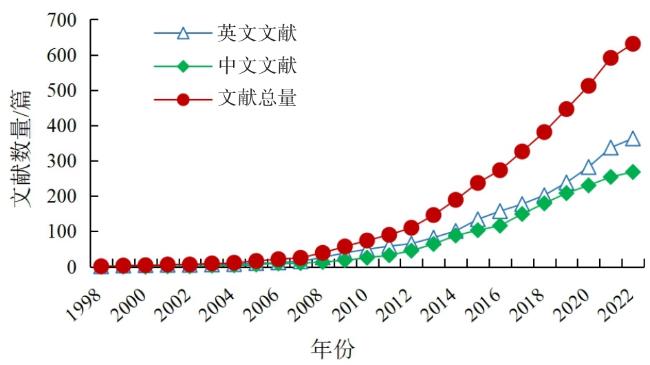
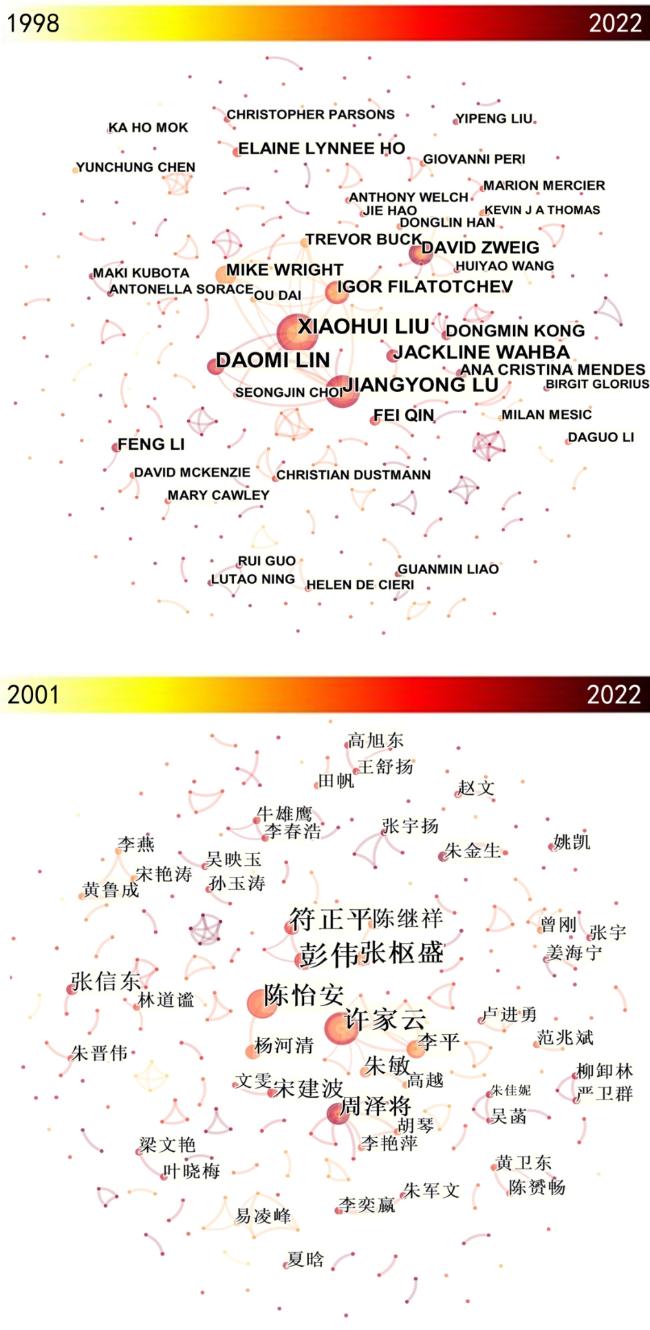
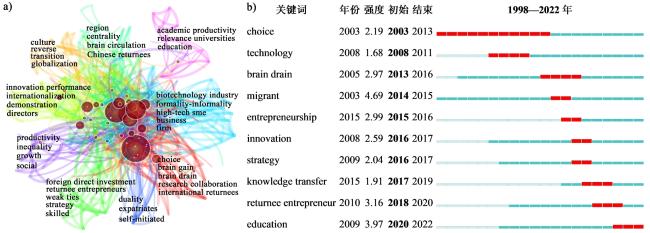
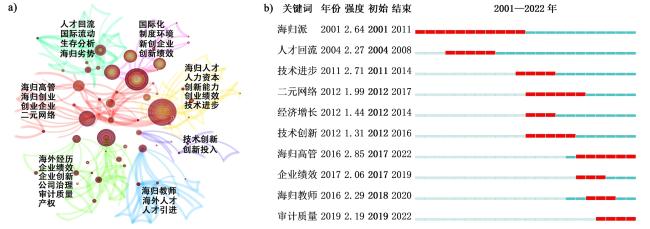
This study responds to the current rapid increase in research on the current focus and future direction of the impact of returned overseas talent on regional development at home and abroad, which still lacks a relatively systematic literature review. The study aims to provide a scientific basis for exploring the utility of talent returning from overseas. Using CiteSpace for the literature review, we retrieved 631 relevant papers in core journals from two databases, "Web of Science" and "China National Knowledge Infrastructure." With the help of quantitative statistics, collaborative networks, and keyword hotspot evolution, we analyzed and reviewed relevant studies and drew the following conclusions: First, based on the trend of increasing of literatures, the research shows a three-stage process from to 1998-2007, to 2008-2013, and 2014-present. The studies cover a wide range of topics, including regional innovation, economic development, and social differentiation, from multiple disciplines and perspectives, such as economics, management, sociology and geography. Second, the research is constantly expanding and deepening. The research subjects were refined from returned overseas talent as a whole to returnee entrepreneurs, executives, teachers, and other returned overseas talent in different fields. Research content has gradually shifted from technological progress and innovation to economic growth and enterprise efficiency and then to social structure and social cognition. The research results within each field were systematized. Lastly, The impact of returned overseas talent on regional development mainly stems from the advantages of human capital and international social capital contributed by the overseas experience of those returning. In the context of relatively underdeveloped regions, the impact of returnees on regional innovation, economic development, and social differentiation is widespread and multiscale, from the regional, organizational, and individual levels. To conclude, the research is based on regional realities; the theoretical contributions have gradually improved and diversified, and the research methods are both qualitative and quantitative. There is scope for future research on the following aspects: exploring the impact of returned overseas talent on regional development from a spatial perspective, looking at different spatial carriers in the region, the interaction mechanism between returned overseas talent and regional development, and the data sources, and methods used to study the impact of returned overseas talent on regional development.
Chenhui Hu , Haining Jiang . Research Progress on the Impact of Returned Overseas Talent on Regional Development[J]. Tropical Geography, 2024 , 44(2) : 365 -378 . DOI: 10.13284/j.cnki.rddl.temp.003796
表1 留学归国人才对区域发展影响相关文献发文量前5位期刊Table 1 Top five journals in terms of publications related to the impact of returned overseas talents on regional development |
| 文种 | 排序 | 期刊 | 发文量/篇 | 影响 因子 |
|---|---|---|---|---|
| 英文 | 1 | International Migration | 14 | 2.2 |
| 2 | Research Policy | 11 | 11.4 | |
| 3 | Journal of Ethnic and Migration Studies | 10 | 5.7 | |
| 4 | International Business Review | 9 | 8.9 | |
| 5 | Population Space and Place | 7 | 5.0 | |
| 中文 | 1 | 《科技进步与对策》 | 16 | 2.0 |
| 2 | 《科学学研究》 | 14 | 3.0 | |
| 3 | 《科技管理研究》 | 10 | 1.3 | |
| 4 | 《科学学与科学技术管理》 | 8 | 2.4 | |
| 5 | 《科研管理》 | 7 | 2.7 |
表2 留学归国人才对区域发展影响的英文期刊的高被引文献Table 2 The highest cited literatures related to the impact of returned overseas talents on regional development in English |
| 排序 | 作者 | 代表文献 | 被引频次/次 | 发表时间 |
|---|---|---|---|---|
| 1 | Saxenian A | From brain drain to brain circulation: Transnational communities and regional upgrading in India and China | 433 | 2005 |
| 2 | Waters J L | Geographies of cultural capital: Education, international migration and family strategies between Hong Kong and Canad | 309 | 2006 |
| 3 | Filatotchev I等 | The export orientation and export performance of high-technology SMEs in emerging markets: The effects of knowledge transfer by returnee entrepreneurs | 291 | 2009 |
| 4 | Israel D等 | Transnational entrepreneurship: An emergent field of study | 267 | 2009 |
| 5 | Eisfeldt A L等 | Organization capital and the cross-section of expected returns | 206 | 2013 |
| 6 | Giannetti M等 | The brain gain of corporate boards: Evidence from China | 201 | 2015 |
| 7 | Dustmann C | Return migration, wage differentials, and the optimal migration duration | 169 | 2003 |
| 8 | Liu X等 | Returnee entrepreneurs, knowledge spillovers and innovation in high-tech firms in emerging economies | 162 | 2010 |
| 9 | Mike W等 | Returnee entrepreneurs, science park location choice and performance: An analysis of high- technology SMEs in China | 139 | 2008 |
| 10 | Cappelli P等 | Talent management: Conceptual approaches and practical challenges | 137 | 2014 |
| 11 | Zweig D | Competing for talent: China's strategies to reverse the brain drain | 137 | 2006 |
| 12 | Armanios D E等 | How entrepreneurs leverage institutional intermediaries in emerging economies to acquire public resources | 122 | 2017 |
| 13 | Filatotchev I等 | Knowledge spillovers through human mobility across national borders: Evidence from Zhongguancun Science Park in China | 120 | 2011 |
| 14 | Dustmann C等 | Return migration, human capital accumulation and the brain drain | 113 | 2011 |
| 15 | Kenney M等 | Coming back home after the sun rises: Returnee entrepreneurs and growth of high tech industries | 112 | 2013 |
|
表3 留学归国人才对区域发展影响的中文期刊的高被引文献Table 3 The highest cited literatures related to the impact of returned overseas talents on regional development in Chinese |
| 排序 | 作者 | 代表文献 | 被引频次/次 | 发表时间 |
|---|---|---|---|---|
| 1 | 代昀昊等 | 高管海外经历是否能提升企业投资效率 | 564 | 2017 |
| 2 | 罗思平等 | 技术转移、“海归”与企业技术创新——基于中国光伏产业的实证研究 | 503 | 2012 |
| 3 | 刘凤朝等 | 高管团队海外背景对企业创新绩效的影响研究 | 455 | 2017 |
| 4 | 宋建波等 | 海归高管能促进企业风险承担吗——来自中国A股上市公司的经验证据 | 402 | 2017 |
| 5 | 宋建波等 | 董事的海外背景能促进企业创新吗? | 299 | 2016 |
| 6 | 李平等 | 国际智力回流的技术扩散效应研究——基于中国地区差异及门槛回归的实证分析 | 273 | 2011 |
| 7 | 黄海杰等 | 二代介入与企业创新——来自中国家族上市公司的证据 | 250 | 2018 |
| 8 | 柳光强 | 高管海外经历是否提升了薪酬差距 | 250 | 2018 |
| 9 | 张信东等 | 海归高管能促进企业技术创新吗? | 212 | 2016 |
| 10 | 刘青 | “海归”创业经营业绩是否更优:来自中国民营企业的证据 | 135 | 2013 |
| 11 | 刘柏等 | 董事会人力资本及其异质性与公司绩效 | 133 | 2017 |
| 12 | 郑明波等 | 高管海外经历、专业背景与企业技术创新 | 129 | 2019 |
| 13 | 赵珊珊等 | 高管学术经历、企业异质性与企业创新 | 115 | 2019 |
| 14 | 周泽将等 | 海归高管与企业创新投入:高管持股的调节作用——基于创业板企业的实证研究 | 109 | 2014 |
| 15 | 王德宏等 | 董事海外背景能否降低股价崩盘风险?——来自中国A股上市公司的经验证据 | 106 | 2018 |

胡晨晖:论文撰写与修改。
姜海宁:论文撰写,提出思路与构建框架,指导研究过程,提出修改意见。
|
Bai W, Johanson M, and Martín O M. 2016. Knowledge and Internationalization of Returnee Entrepreneurial Firms. International Business Review, 26(4): 652-665.
|
|
Bathelt H, Malmberg A, and Maskell P. 2004. Clusters and Knowledge: Local Buzz, Global Pipelines and the Process of Knowledge Creation. Progress in Human Geography, 28(1): 31-56.
|
|
Bilecen B and Faist T. 2015. International Doctoral Students as Knowledge Brokers: Reciprocity, Trust and Solidarity in Transnational Networks. Global Networks, 15(2): 217-235.
|
|
卞丽蓉,姜海宁,杨梦君. 2021. 长三角高校海外回流人才创新产出格局分析. 世界地理研究,30(6):1219-1229.
Bian Lirong, Jiang Haining, and Yang Mengjun. 2021. Analysis of Innovation Output Pattern of Returned Overseas Talents from Universities in the Yangtze River Delta. World Regional Studies, 30(6): 1219-1229.
|
|
Borjas G J and Bratsberg B. 1996. Who Leaves? The Outmigration of the Foreign-Born. Review of Economics and Statistic, 78(1): 165-176.
|
|
Cao C, Baas J, Wagner C S, and Jonkers K. 2020. Returning Scientists and the Emergence of China's Science System. Science and Public Policy, 47(2): 172-183.
|
|
Cappelli P and Keller J R. 2014. Talent Management: Conceptual Approaches and Practical Challenges. Social Science Electronic Publishing, 1(1): 305-331.
|
|
陈代还,段异兵,潘紫燕. 2015. 二元关系网络对海归科学家产出的影响——以中国“青年千人计划”为例. 中国科技论坛,233(9):143-147.
Chen Daihuan, Duan Yibin, and Pan Ziyan. 2015. The Impacts of Ambidextrous Network on Returnee Scientists Productivity: Evidence from the 1000-Youth Elite Program in China. Forum on Science and Technology in China, 233(9): 143-147.
|
|
陈健,柳卸林,邱姝敏,高雨辰. 2017. 海归创业的外来者劣势和知识资本的调节作用. 科学学研究,35(9):1348-1358.
Chen Jian, Liu Xielin, Qiu Shumin, amd Gao Yuchen. 2017. Liability of Foreignness and the Moderating Effect of Knowledge Capital. Studies in Science of Science, 35(9): 1348-1358.
|
|
陈雄兵,黄玉. 2020. 海归高管抑制了股价崩盘风险吗? 金融理论与实践,(1):73-82.
Chen Xiongbin and Huang Yu. 2020. Do Overseas Executives Curb the Risk of a Crash? Financial Theory & Practice, (1): 73-82.
|
|
陈燕. 2016. 契约印象:海归教师重塑高校课堂的跨文化分析. 华侨华人历史研究,(3):27-34.
Chen Yan. 2016. Spirit of Contract: A Transcultural Analysis of How Returned Talented Teachers Reconstruct Classroom Culture in Higher Education. Journal of Overseas Chinese History Studies, (3): 27-34.
|
|
Chen Y, Luo L, and Zhang Y. 2011. Development Trajectories in the Biotechnology Industry: China versus Leading Countries. China & World Economy, 19(3): 105-123.
|
|
Chou T L, Ching C H, Fan S M, and Chang J Y. 2011. Global Linkages, the Chinese High-Tech Community and Industrial Cluster Development: the Semiconductor Industry in Wuxi, Jiangsu. Urban Studies, 48(14): 3019-3042.
|
|
Cooley T and Marimon R. 2020. Commitment in Organizations and the Competition for Talent. Review of Economic Studies, 87(5): 2165-2204.
|
|
Dai O and Liu X H. 2009. Returnee Entrepreneurs and Firm Performance in Chinese High-Technology Industries. International Business Review, 18(4): 373-386.
|
|
代昀昊,孔东民. 2017. 高管海外经历是否能提升企业投资效率. 世界经济,40(1):168-192.
Dai Yunhao, and Kong Dongmin. 2017. Can Executives with Overseas Experience Improve Corporate investment Efficiency?. The Journal of World Economy, 40(1): 168-192.
|
|
Dai Y H, Kong D M, and Liu S S. 2018. Returnee Talent and Corporate Investment: Evidence from China. European Accounting Review, 27(2): 313-337.
|
|
董洁林. 2013. “天生全球化”创业模式探讨:基于“千人计划”海归高科技创业的多案例研究. 中国软科学,(4):26-38.
Dong J. 2013. The "Born Global" Entrepreneurship in China: Case Studies of the High-Tech Start-Ups Established by the "1000 Plan" Diaspora Entrepreneurs. China Soft Science, (4): 26-38.
|
|
Drori I, Honig B, and Wright M. 2010. Transnational Entrepreneurship: An Emergent Field of Study. Entrepreneurship Theory & Practice, 33(5): 1001-1022.
|
|
Dustman C. 2003. Return Migration, Wage Differentials, and the Optimal Migration Duration. European Economic Review, 47(2): 353-369.
|
|
杜兴强,侯菲. 2019. 审计师的海外经历与审计质量. 管理科学,32(6):133-148.
Du Xingqiang and Hou Fei. 2019. Individual Auditors' Foreign Experience and Audit Quality. Journal of Management Science, 32(6): 133-148.
|
|
段斌斌,许晓东,陈敏. 2021. 我国高校科技人才培育制度的特征、问题与改进——基于36位科技人才访谈的分析.高校教育管理,15(4):101-114.
Duan Binbin, Xu Xiaodong, and Chen Min. 2021. Features, Problems and Solutions of the Scientific and Technological Talent Cultivation System in Chinese Higher Education Institutions: Based on the Analysis of Interviews with 36 Scientific and Technological Talents. Journal of Higher Education Management, 15(4): 101-114.
|
|
Eisfeldt A L and Papanikolaou D. 2013. Organization Capital and the Cross-section of Expected Returns. The Journal of Finance, 68(4): 1365-1406.
|
|
范帅邦,郭琪,贺灿飞. 2015. 西方经济地理学的政策研究综述:基于CiteSpace的知识图谱分析. 经济地理,35(5):15-24. [Fan Shuaibang, Guo Qi, and He Canfei. 2015. A Review of Policy Analysis in Economic Geography Based on CiteSpace II. Economic Geography, 35(5): 15-24.]
|
|
Filatochev I, Liu X, Buck T, and Wright M. 2009. The Export Orientation and Export Performance of High-Technology SMEs in Emerging Markets: The Effects of Knowledge Transfer by Returnee Entrepreneurs. Journal of International Business Studies, 40(6):1005-1021.
|
|
Filatotchev I, Liu X H, Lu J Y, and Wright M. 2011. Knowledge Spillovers through Human Mobility across National Borders: Evidence from Zhongguancun Science Park in China. Research Policy, 40(3): 453-462.
|
|
国家统计局. 2021. 中国统计年鉴2021. 北京:中国统计出版社.
National Bureau of Statistics. 2021. China Statistical Yearbook 2021. Beijing: China Statistics Press.
|
|
Gao Y. 2009. Corporate Social Performance in China: Evidence from Large Companies. Journal of Business Ethics, 89(1): 23-35.
|
|
Henn S. 2012. Transnational Entrepreneurs, Global Pipelines and Shifting Production Patterns. The Example of the Palanpuris in the Diamond Sector. Geoforum, 43(3): 497-506.
|
|
Humpage L. 2021. How do Beliefs and Institutional Context Influence the Portability of Political and Civil Society Behaviours among New Zealand Return Migrants? Journal of Sociology, 57(2): 249-267.
|
|
姜海宁,丁海龙. 2018. 留创园建设与区域社会空间分异——对杭州余杭留创园及其周边的实证研究. 浙江师范大学学报(自然科学版),41(2):99-106.
Jiang Haining and Ding Hailong. 2018. Construction of Pioneering Park for Overseas Chinese Scholars and Regional Socio-Spatial Differentiations: A Case Study of Hangzhou Yuhang Pioneering Park for Overseas Chinese Scholars and Its Surrounding Areas. Journal of Zhejiang Normal University(Natural Sciences), 41(2): 99-106.
|
|
姜海宁,李鹏程,段怡冰,胡晨晖. 2022a. 业缘对环渤海地区海外高层次人才回流格局的影响. 世界地理研究,31(6):1142-1154.
Jiang Haining, Li Pengcheng, Duan Yibing, and Hu Chenhui. 2022a. Influence of Professional Tie on Location Choice of Overseas High Level Returned talents in the Bohai Rim Region. World Regional Studies, 31(6): 1142-1154.
|
|
姜海宁,张俊,李怡旻,王志刚. 2022b. 中国留学归国人才与经济规模的因果关联机制分析. 智库理论与实践,7(2):165-172.
Jiang Haining, Zhang Jun, Li Yiming, and Wang Zhigang. 2022b. Analysis of Causal Association Mechanism between Returned Overseas Talents and Economic Scale in China. Think Tank: Theory & Practice, 7(2): 165-172.
|
|
Jiang H, Zhang W, and Duan J. 2020a. Location Choice of Overseas High-Level Young Returned Talents in China. Sustainability, 12(21): 9210.
|
|
Jiang J, Mok K H, and Shen W. 2020b. Riding over the National and global Disequilibria: International Learning and Academic Career Development of Chinese Ph.D. Returnees. Higher Education Policy, 33(4): 531–554.
|
|
姜海宁,张文忠,许树辉,陈秋羽. 2018. 中国留学人员创业园分布及产业特征. 地理科学,38(12):4-12.
Jiang Haining, Zhang Wenzhong, Xu Shuhui, and Chen Qiuyu. 2018. The Spatial Distribution and Industrial Characteristics of Overseas Students Pioneer Parks in China. Scientia Geographica Sinica, 38(12): 1943-1951.
|
|
Jiang H. 2021. Spatial Character and Backflow Pattern of High-Level Returned Talents in China. Complexity, 2: 1-11.
|
|
蒋艳辉,曾倩芳,冯楚建,田迪. 2018. 非高管型海归、本土科技人才与企业突破性创新——来自中小型高新技术企业的经验证据. 中国软科学,(2):149-159.
Jiang Yanhui, Zeng Qianfang, Feng Chujian, and Tian Di. 2018. Non-Executive Returnees, Local Sci-Tech Talents and Radical Innovation: Empirical Evidence from China High-Technology SMEs. China Soft Science, (2): 149-159.
|
|
鞠斐,袁勇志. 2019. 将中美贸易摩擦转变为引进海外人才归国创业的战略机遇. 人民论坛·学术前沿,(22):154-157.
Ju Fei and Yuan Yongzhi. 2019. Turn the Sino-US Trade Friction into a Strategic Opportunity for Attracting the Overseas Chinese Talents Back to Start New businesses. Frontiers, (22): 154-157.
|
|
Koser K and Salt J. 1997. The Geography of Highly Skilled International Migration. International Journal of Population Geography, 3(4): 285-303.
|
|
Lee J H and Roberts M J D. 2015. International Returnees as Outside Directors: A Catalyst for Strategic Adaptation under Institutional Pressure. International Business Review, 24(4): 594-604.
|
|
Lee J J and Kim D. 2010. Brain Gain or Brain Circulation? U.S. Doctoral Recipients Returning to South Korea. Higher Education, 59(5): 627-643.
|
|
Li H Y. 2020. Role of Overseas Ethnic and Non-Ethnic Ties and Firm Activity in the Home Country in the Internationalization of Returnee Entrepreneurial Firms. Journal of International Management, 26(1): 100706.
|
|
Li H, Zhang Y, Li Y, and Zhang W Y. 2012. Returnees Versus Locals: Who Perform Better in China's Technology Entrepreneurship? Strategic Entrepreneurship Journal, 6(3): 257-272.
|
|
Liao G, Ma M S, and Yu X. 2016. Transporting Transparency: Director Foreign Experience and Corporate Information Environment. Social Science Electronic Publishing, 6: 1-51.
|
|
Lin D M, Lu J Y, Li P P, and Liu X H. 2015. Balancing Formality and Informality in Business Exchanges as a Duality: A Comparative Case Study of Returnee and Local Entrepreneurs in China. Management and Organization Review, 11(2): 315-342.
|
|
林晓峰,姜海宁. 2020. 基于论文合作的长三角“青年千人”知识合作网络特征分析. 世界地理研究,29(2):388-396.
Lin Xiaofeng and Jiang Haining. 2020. Analysis on the Characteristics of Knowledge Cooperation Network of "the 1000-Youth Elite" in the Yangtze River Delta Region on the Basis of Paper Cooperation. World Regional Studies, 29(2): 388-396.
|
|
李心斐,程宝栋,许恒,李芳芳. 2020. 高管“海归”背景有助于企业社会责任履行吗?——基于A股上市公司的经验数据. 经济管理,42(11):56-72.
Li Xinfei, Cheng Baodong, Xu Heng, and Li Fangfang. 2020. An Analysis of the Influence of “Returned” Executives on Social Responsibility Performance in Enterprises: Empirical Data Based on A-Share Listed Companies. Business and Management Journal, 42(11): 56-72.
|
|
刘凤朝,默佳鑫,马荣康. 2017. 高管团队海外背景对企业创新绩效的影响研究. 管理评论,29(7):135-147.
Liu Fengchao, Mo Jiaxin, and Ma Rongkang. 2017. The impact of TMT Overseas Background on Firm Innovation Performance. Management Review, 29(7): 135-147.
|
|
刘青,张超,吕若思,卢进勇. 2013. “海归”创业经营业绩是否更优:来自中国民营企业的证据. 世界经济,(12):70-89.
Liu Qing, Zhang Chao, Liu Ruosi, and Lu Jinyong. 2013. Whether "Overseas Returnees" have Better Entrepreneurial Performance: Evidence from Chinese Private Enterprises, (12): 70-89.
|
|
Liu X, Lu J, Filatotchev I, Buck T, and Wright M. 2010. Returnee Entrepreneurs, Knowledge Spillovers and Innovation in High-Tech Firms in Emerging Economies. Journal of International Business Studies, 41(7): 1183-1197.
|
|
Liu X H, Xia T J, Lu J Y, and Lin D M. 2019. Under What Institutional Conditions does Overseas Business Knowledge Contribute to Firm Performance? International Business Review, 28(3): 588-602.
|
|
刘霄. 2020. 海外学历对学术职业聘任与发展的影响——以我国28所公立高校的专任教师为例. 教师教育研究,32(5):115-128.
Liu Xiao. 2020. The Impact of Overseas Education on Academic Profession: Based on the Analysis of College Teachers in 28 Public Universities in China. Teacher Education Research, 32(5): 115-128.
|
|
刘晔,沈建法,刘于琪. 2013. 西方高端人才跨国流动研究述评. 人文地理,28(2):7-12.
Liu Ye, Shen Jianfa, and Liu Yuqi. 2013. Transnational Mobility of the Highly Skilled: A Review. Human Geography, 28(2): 7-12.
|
|
Liu Y. 2020. Contextualising Risk and Building Resilience: Returnees versus Local Entrepreneurs in China. Applied Psychology, 69(2): 415-443.
|
|
刘志高,张薇. 2018. 中国大都市区高新技术产业分叉过程及动力机制——以武汉生物产业为例. 地理研究,37(7):101-115.
Liu Zhigao and Zhang Wei. 2018. The Process and Dynamics of High-Tech Industrial Branching in China's Metropolitan Areas: A Case Study of Biotechnology Industry in Wuhan. Geographical Research, 37(7): 101-115.
|
|
罗思平,于永达. 2012. 技术转移、“海归”与企业技术创新——基于中国光伏产业的实证研究. 管理世界,(11):124-132.
Luo Siping and Yu Yongda. 2012. Technology Transfer, “Overseas Returnees" and Enterprise Technology Innovation: An Empirical Study Based on China's Photovoltaic Industry. Management World, (11): 124-132.
|
|
马海涛,张芳芳. 2019. 人才跨国流动的动力与影响研究评述. 经济地理,39(2):40-47.
Ma Haitao and Zhang Fangfang. 2019. Literature Review on the Impetus and Influence of Talents Mobility between Countries and Regions. Economic Geography, 39(2): 40-47.
|
|
马凌,谢圆圆,张博. 2022. 跨国主义视角下高校海归知识移民的回流与地方嵌入. 地理学报,77(6):1430-1445.
Ma Lin, Xie Yuanyuan, and Zhang Bo. 2022. Place Embeddedness of Chinese Academic Returnees from the Perspective of Transnationalism. Acta Geographica Sinica, 77(6): 1430-1445.
|
|
Mahroum S. 2001. Europe and the Immigration of Highly Skilled Labour. International Migration, 39(5): 27-43.
|
|
孟晋宇,刘超,陈向东. 2017. 海归学者跨国知识转移绩效的测度研究. 管理学报,(12):123-129.
Meng Jinyu, Liu Chao, and Chen Xiangdong. 2017. Performance Measurement for Transnational Knowledge Transfer by Chinese Returned Scholars. Chinese Journal of Management, (12): 123-129.
|
|
Morrison A, Rabellotti R, and Zirulia L. 2013. When do Global Pipelines Enhance the Diffusion of Knowledge in Clusters? Economic Geography, 89(1): 77-96.
|
|
Patel P C, Femhaber S A, Mcdoungallcovin P P, and Have R P. 2014. Beating Competitors to International Markets: The Value of Geographically Balanced Networks for Innovation. Strategic Management Journal, 35(5): 691-711.
|
|
Prevezer M. 2008. Technology Policies in Generating Biotechnology Clusters: A Comparison of China and the US. European Planning Studies, 16(3): 359-374.
|
|
Saxenian A. 2005. From Brain Drain to Brain Circulation: Transnational Communities and Regional Upgrading in India and China. Studies in Comparative International Development, 40(2): 35-61.
|
|
Song H. 1997. From Brain Drain to Reverse Brain Drain: Three Decades of the Korean Experience. Science, Technology and Society, 2(2): 317-345.
|
|
宋建波,文雯,王德宏. 2017. 海归高管能促进企业风险承担吗——来自中国A股上市公司的经验证据. 财贸经济,38(12):111-126.
Song Jianbo, Wang Wen, and Wang Dehong. 2017. Can Returnee Managers Promote Corporate Risk-Taking: Evidence from Chines a Share Companies. Finance & Trade Economics, 38(12): 111-126.
|
|
孙健,纪建悦,王丹. 2005. 海外科技人才回流的规律研究. 中国软科学,(8):6-10.
Sun Jian, Ji Jianyue, and Wang Dan. 2005. The Research on Regularity in the Returning of Overseas Technological Talents. China Soft Science, (8): 6-10.
|
|
Stark O and Bloom D E. 1985. The New Economics of Labor Migration. The American Economic Review, 75(2): 173-178.
|
|
Wang C C and Lin G. 2018. Geography of Knowledge Sourcing, Heterogeneity of Knowledge Carriers and Innovation of Clustering Firms: Evidence from China's Software Enterprises. Habitat International, 71: 60-69.
|
|
王浩然,王彪华,周泽将. 2021. 审计委员会海归背景与商誉减值计提. 审计与经济研究,36(1):58-67.
Wang Haoran, Wang Biaohua, and Hou Zejiang. 2021. Returnee Audit Committee and Goodwill Impairment Provision. Journal of Audit & Economics, 36(1): 58-67.
|
|
Wei Y Q, Liu X H, Lu J Y, and Yang J G. 2017. Chinese Migrants and Their Impact on Homeland Development. The World Economy, 40(11): 2354-2377.
|
|
Williams A M. 2007. International Labor Migration and Tacit Knowledge Transactions: A Multi-Level Perspective. Global Networks, 7(1): 29-50.
|
|
徐细雄,朱红艳,淦未宇,李万利. 2018. “海归”高管回流与企业社会责任绩效改善——基于文化趋同视角的实证研究. 外国经济与管理,40(5):99-112.
Xu Xixiong, Zhu Hongyan, Gan Weiyu, and Li Wanli. 2018. Returnees and Corporate Social Responsibility Performance: An Empirical Study from the Perspective of Cultural Convergence. Foreign Economics & Management, 40(5): 99-112.
|
|
许家云,刘廷华,李平. 2014. 海外留学经历是否提高了个人收入? 经济科学,(1):90-101.
Xu Jiayun, Liu Tinghua, and Li Ping. 2014. Whether Overseas Study Experience Improves Personal Income? Economic Science, (1): 90-101.
|
|
许家云,孙文娜. 2017. 海外留学经历促进了企业出口吗? 国际贸易问题,(10):39-50.
Xu Jiayun and Sun Wenna. 2017. Is Foreign Study Experience Helpful to Increase Firms' Export? Journal of International Trade, (10): 39-50.
|
|
严卫群,董彩婷,柳卸林. 2019. 国内创业网络对海归创业企业绩效的影响.科学学研究,37(5):878-887.
Yan Weiqun, Dong Caiting, and Liu Xielin. 2019. The Effects of Domestic Entrepreneurial Network on Performance of Returnee Entrepreneurial Firms. Studies in Science of Science, 37(5): 878-887.
|
|
杨立娜,许家云. 2018. 海归校领导与高校创新绩效——基于中国114所211高校的实证研究. 世界经济文汇,243(2):57-84.
Yang Lina and Xu Jiayun. 2018. Returnee School Leadership and University Innovation Performance: Based on an Empirical Study of 114 Universities in China. World Economic Papers, 243(2): 57-84.
|
|
Yin X and Zong X. 2022. International Student Mobility Spurs Scientific Research on Foreign Countries: Evidence from International Students Studying in China. Journal of Informetrics, 16(1): 101-227.
|
|
Yoon B L. 1992. Reverse Brain Drain in South Korea: State-Led model. Studies in Comparative International Development, 27(1): 4-26.
|
|
张枢盛,陈继祥. 2012. 基于文化视角的中国海归创业二元网络研究. 现代管理科学,(12):14-17.
Zhang Shusheng and Chen Jixiang. 2012. Study on the Binary Network of Chinese Returnees' Entrepreneurship from a Cultural Perspective. Modern Management Science, (12): 14-17.
|
|
张信东,吴静. 2016. 海归高管能促进企业技术创新吗? 科学学与科学技术管理,37(1):115-128.
Zhang Xindong and Wu Jing. 2016. Do returnee Executives Promote the Technology Innovation in Enterprises? Science of Science and Management of S.& T., 37(1): 115-128.
|
|
张宇扬,董丽萍,何瑛,傅四保. 2021. 校长海外经历能否提升高校创新水平. 中国科技论坛,298(2):121-131.
Zhang Yuyang, Dong Liping, He Ying, and Fu Sibao. 2021. Can President’s Oversea Experience Promote the Level of University Innovations. Forum on Science and Technology in China, 298(2): 121-131.
|
|
赵建吉,曾刚. 2010. 技术社区视角下新竹IC产业的发展及对张江的启示. 经济地理,30(3):438-442,430.
Zhao Jianji and Zeng Gang. 2010. The Development of IC Industry in Hsinchu and Enlightenment to Zhang Jiang from the Perspective of Technology Community. Economic Geography, 30(3): 438-442, 430.
|
|
赵文,王娜. 2017. 二元网络背景下中国海归企业绩效提升路径研究——基于模糊集的定性比较分析. 科学学与科学技术管理,38(5):128-139.
Zhao Wen and Wang Na. 2017. Research on Performance Improvement Path of Chinese Returnees Enterprises Considering Ambidextrous Network: The Fuzzy-Set Qualitative Comparative Analysis. Science of Science and Management of S.& T., 38(5): 128-139.
|
|
Zhou Y and Hsu J Y. 2011. Divergent Engagements: Roles and Strategies of Taiwanese and Mainland Chinese Returnee Entrepreneurs in the IT Industry. Global Networks-A Journal of Transnational Affairs, 11(3): 398-419.
|
|
周泽将,刘中燕,伞子瑶. 2017. 海归背景董事能否促进企业国际化? 经济管理,(7):106-121.
Zhou Zejiang, Liu Zhongyan, and San Ziyao. 2017. Can Overseas Returnees Directors Enhance Business Internationalization? Business and Management Journal, (7): 106-121.
|
|
朱敏,高越. 2012. 归国人才与中国企业国际化. 管理现代化,(4):82-84.
Zhu Min and Gao Yue. 2012. Returning Talents and Internationalization of Chinese Enterprises. Modernization of Management, (4): 82-84.
|
|
朱敏,许家云. 2013. 海外人才回流与FDI技术溢出——地区差异及影响因素的实证分析. 科学学研究,31(11):1663-1670.
Zhu Min and Xu Jiayun. 2013. Return of Overseas Talents and FDI Technology Spillover: An Empirical Analysis of the Regional Differences and Impact Factors. Studies in Science of Science, 31(11): 1663-1670.
|
|
Zweig D, Chen C, and Rosen S. 2004. Globalization and Transnational Human Capital: Overseas and Returnee Scholars to China. The China Quarterly, 179: 735-757.
|
|
Zweig D. 2006. Competing for Talent: China's Strategies to Reverse the Brain Drain. International Labour Review, 145(1): 65-90.
|
|
Zweig D, Tsai K S, and Singh A D. 2021. Reverse Entrepreneurial Migration in China and India: The Role of the State. World Development, 138: 105-192.
|
/
| 〈 |
|
〉 |