A Review on the Application Progress and Prospect of Mobile Phone Signaling Data in Jobs-Housing Relationship, Travel Behavior and Transportation Carbon Emissions Research
Received date: 2024-03-28
Revised date: 2024-04-21
Online published: 2024-05-08
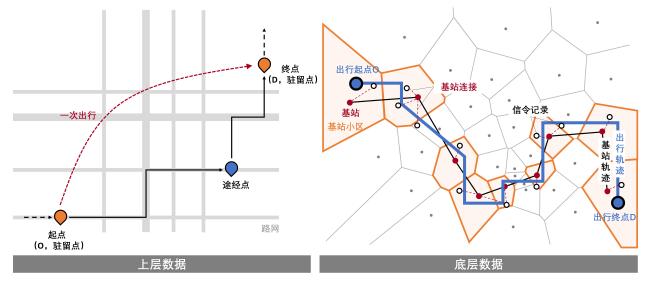
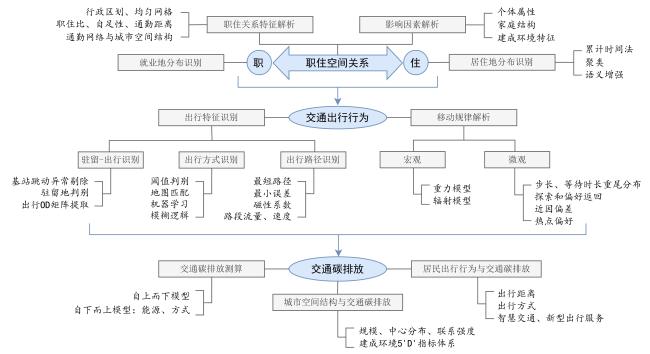
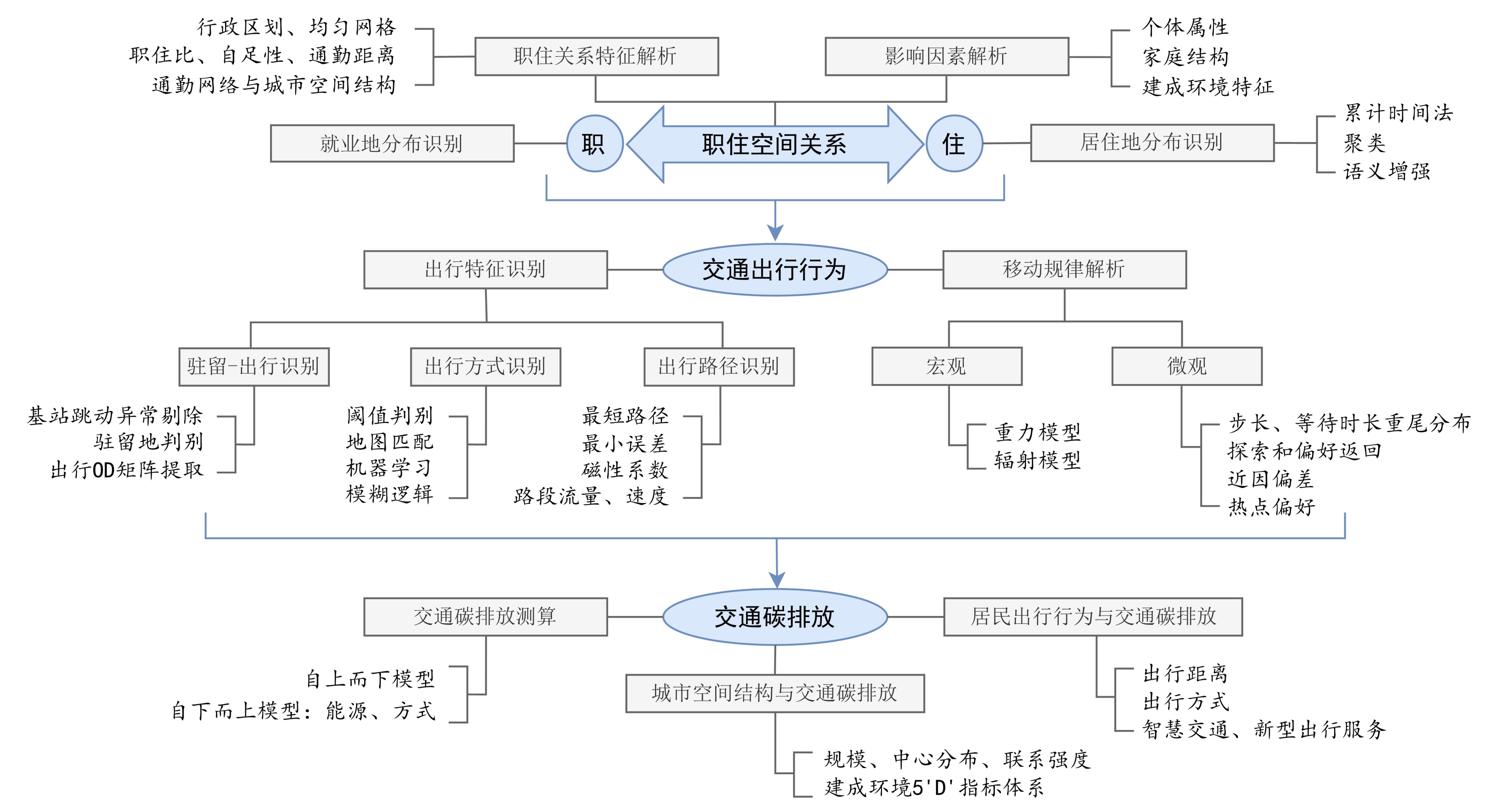
The rapid development of information technology has triggered an explosion of data, marking the era of big data. A wide range of transportation big data has been used in urban space and travel behavior studies since the beginning of this century. Mobile phone signaling data in particular have many advantages: they have prevalent spatial and temporal coverage, high tracking stability, satisfactory resolution, and low cost. The description of urban phenomena and the analysis of their forming mechanisms using mobile phone signaling data are thoroughly studied by previous research. The next course of action is to tackle specific urban problems. This study summarizes the application progress of mobile phone signaling data in job-housing relationships and travel behavior studies, discusses the application prospects of mobile phone signaling data in transportation carbon emissions research based on past applications and the existing literature on low-carbon transportation, and proposes a research framework and several future directions for studies using mobile phone big data to examine job-housing relationships, travel behavior, and transportation carbon emissions. We first provide a brief introduction to the features of mobile phone signaling data in comparison with other commonly used data types, including their type, content, and spatial-temporal resolution. We then review the existing applications in job housing and travel research. Regarding the jobs-housing relationship, prior studies employ mobile phone signaling data to detect the spatial distribution of workplaces and residences of urban dwellers, analyze jobs-housing relationship features and urban spatial structure characteristics, and examine the factors influencing jobs-housing relationships. Regarding travel behavior, studies employ mobile phone signaling data to identify stays and trips, infer trip modes, detect trip routes, and explore the universal laws of human mobility. Next, we also discuss how mobile phone signaling data can be applied to transportation carbon emissions research. Indeed, mobile phone signaling data can be used in the calculation of transportation carbon emissions and analysis of the relationships between urban spatial structure, individual travel behavior, and transportation carbon emissions, and its wide coverage and large sample size can be exploited to fill research gaps and problems that have yet to be resolved using traditional traffic datasets. Finally, we present a research framework underlining the indirect and direct effects of the jobs-housing relationship and travel behavior on transportation carbon emissions. We also propose future directions in study contents and methodological innovations by recommending long time-series longitudinal studies, large-scale comparative studies, and new population and transportation phenomena. We further recommend fusing multi-source big and small data, incorporating machine learning algorithms into traditional statistical analyses, and constructing digital twin models. Examining the jobs–housing relationship, travel behavior, and transport carbon emissions using mobile phone signaling data is essential for clarifying the interactions between urban and regional structures, travel behavior characteristics, and transport carbon emissions. It has important implications for emissions reduction and sustainable development in the context of proposing carbon peaking and carbon neutrality goals.
Yukun Gao , Pengjun Zhao . A Review on the Application Progress and Prospect of Mobile Phone Signaling Data in Jobs-Housing Relationship, Travel Behavior and Transportation Carbon Emissions Research[J]. Tropical Geography, 2024 , 44(5) : 877 -890 . DOI: 10.13284/j.cnki.rddl.003872
表1 手机信令数据与其他轨迹数据特征比较Table 1 Feature comparison of mobile phone signaling data and other trajectory data types |
| 数据特征 | 手机信令数据 | GPS定位数据 | 出行调查数据 |
|---|---|---|---|
| 获取方式 | 移动通信运营商获取 | 手机APP定位、车载定位等 | 问卷调查 |
| 获取成本 | 较低 | 居中 | 较高 |
| 空间范围 | 城市、区域、国家 | 城市、区域为主 | 城市为主 |
| 时间范围 | 月、年、甚至更长时段 | 周、月为主 | 周、月为主 |
| 空间精度 | 百米级 | 米级 | 具体POI位置 |
| 时间精度 | 分钟、小时级 | 秒级 | 具体时刻 |
| 样本量 | 百万、千万级 | 最高可达百万、千万级 | 最高可达千、万级 |
| 稳定性 | 稳定实时追踪 | 仅GPS开启时可追踪 | 存在报告错误 |

高瑜堃:负责论文撰写与图件制作;
赵鹏军:指导本文选题、框架设计,参与论文修改。
|
Barbosa H, De Lima-Neto F B, Evsukoff A, and Menezes R. 2015. The Effect of Recency to Human Mobility. EPJ Data Science, 4(1). DOI: 10.1140/epjds/s13688-015-0059-8.
|
|
Breyer N, Gundlegård D, and Rydergren C. 2018. Cellpath Routing and Route Traffic Flow Estimation Based on Cellular Network Data. Journal of Urban Technology, 25(2): 85-104.
|
|
Brown M A, Southworth F, and Sarzynski A. 2009. The Geography of Metropolitan Carbon Footprints. Policy and Society, 27(4): 285-304.
|
|
Calabrese F, Di Lorenzo G, Liu L, and Ratti C. 2011. Estimating Origin-Destination Flows Using Mobile Phone Location Data. IEEE Pervasive Computing, 10(4): 36-44.
|
|
Calabrese F, Diao M, Di Lorenzo G, Ferreira J, and Ratti C. 2013. Understanding Individual Mobility Patterns from Urban Sensing Data: A Mobile Phone Trace Example. Transportation Research Part C-Emerging Technologies, 26: 301-313.
|
|
Calabrese F, Ferrari L, and Blondel V D. 2015. Urban Sensing Using Mobile Phone Network Data: A Survey of Research. ACM Computing Surveys, 47(2): 25. DOI: 10.1145/2655691.
|
|
曹小曙,杨文越,黄晓燕. 2015. 基于智慧交通的可达性与交通出行碳排放——理论与实证. 地理科学进展,34(4):418-429.
Cao Xiaoshu, Yang Wenyue, and Huang Xiaoyan. 2015. Accessibility and CO2 Emissions from Travel of Smart Transportation: Theory and Empirical Studies. Progress in Geography, 34(4): 418-429.
|
|
Cao X (J), Mokhtarian P L, and Handy S L. 2009. Examining the Impacts of Residential Self-Selection on Travel Behaviour: A Focus on Empirical Findings. Transport Reviews, 29(3): 359-395.
|
|
陈飞,诸大建,许琨. 2009. 城市低碳交通发展模型、现状问题及目标策略——以上海市实证分析为例. 城市规划学刊,(6):39-46.
Chen Fei, Zhu Dajian, and Xu Kun. 2009. Research on Urban Low-carbon Traffic Model, Current Situation and Strategy: An Empirical Analysis of Shanghai. Urban Planning Forum, (6): 39-46.
|
|
Chen J T, Xiong C, and Cai M. 2022. A Travel Mode Identification Framework Based on Cellular Signaling Data. Mobile Information Systems, 2: 2113213. DOI: 10.1155/2022/2113213.
|
|
Chen X X, Xu X D, and Yang C. 2020. Trip Mode Inference From Mobile Phone Signaling Data Using Logarithm Gaussian Mixture Model. Journal of Transport and Land Use, 13(1): 429-445.
|
|
Chen, Y T, Zhao P J, Lin Y, Sun Y S, Chen R, Yu L, and Liu Y. 2024. Semantic-Enhanced Graph Convolutional Neural Networks for Multi-Scale Urban Functional-Feature Identification Based on Human Mobility. ISPRS International Journal of Geo-Information, 13(1): 27. DOI: 10.3390/ijgi13010027.
|
|
Chin K, Huang H, Horn C, Kasanicky I, and Weibel R. 2019. Inferring Fine-Grained Transport Modes from Mobile Phone Cellular Signaling Data. Computers Environment and Urban Systems, 77: 101348. DOI: 10.1016/j.compenvurbsys.2019.101348.
|
|
Cirilli A and Veneri P. 2014. Spatial Structure and Carbon Dioxide (CO2) Emissions Due to Commuting: An Analysis of Italian Urban Areas. Regional Studies, 48(12): 1993-2005.
|
|
Cornacchia G, Böhm M, Mauro G, Nanni M, Pedreschi D, and Pappalardo L. 2022. How Routing Strategies Impact Urban Emissions. (2022-07-04) [2023-10-10]. https://doi.org/10.48550/arXiv.2207.01456.
|
|
Cui X Z, Zhuang C G, Jiao Z Z, Tan Z Z, and Li S Y. 2023. How Can Urban Built Environment (BE) Influence On-Road (OR) Carbon Emissions? A Road Segment Scale Quantification Based on Massive Vehicle Trajectory Big Data. Journal of Transport Geography, 111: 103669. DOI: 10.1016/j.jtrangeo.2023.103669.
|
|
Cui Y, Zhao P, Li L, Li J, Gong M Y, Deng Y L, Si Z H, Yan S C, and Dang X W. 2024. A New Model for Residential Location Choice Using Residential Trajectory Data. Humanities and Social Sciences Communications, 11: 255. DOI: 10.1057/s41599-024-02678-2.
|
|
Debbage N and Shepherd J M. 2015. The Urban Heat Island Effect and City Contiguity. Computers Environment and Urban Systems, 54: 181-194.
|
|
Derrmann T, Frank R, Viti F, and Engel T. 2020. How Road and Mobile Networks Correlate: Estimating Urban Traffic Using Handovers. IEEE Transactions on Intelligent Transportation Systems, 21(2): 521-530.
|
|
Dong X X. 2020. Trade Uber for the Bus? An Investigation of Individual Willingness to Use Ride-Hail Versus Transit. Journal of the American Planning Association, 86(2): 222-235.
|
|
Ercan T, Onat N C, Keya N, Tatari O, Eluru N, and Kucukvar M. 2022. Autonomous Electric Vehicles Can Reduce Carbon Emissions and Air Pollution in Cities. Transportation Research Part D-Transport and Environment, 112: 103472. DOI: 10.1016/j.trd.2022.103472.
|
|
Ewing R and Cervero R. 2010. Travel and the Built Environment. Journal of the American Planning Association, 76(3): 265-294.
|
|
方丹,杨谨,陈绍晴. 2023. 城市群多中心发展的碳减排效应及其作用机制. 中国人口·资源与环境,33(9):45-58.
Fang Dan, Yang Jin, and Chen Shaoqing. 2023. Effects and Mechanisms of the Polycentric Development of Urban Agglomerations on Carbon Emission Reduction. China Population, Resources and Environment, 33(9): 45-58.
|
|
Fekih M, Bellemans T, Smoreda Z, Bonnel P, Furno A, and Galland S. 2021. A Data‑Driven Approach for Origin-Destination Matrix Construction From Cellular Network Signalling Data: A Case Study of Lyon Region (France). Transportation, 48(4): 1671-1702.
|
|
冯永恒,赵鹏军,伍毅敏,梁洁,张岩. 2020. 基于手机信令数据的大城市功能疏解的人口流动影响——以北京动物园批发市场为例. 城市发展研究,27(12):38-44.
Feng Yongheng, Zhao Pengjun, Wu Yimin, Liang Jie, and Zhang Yan. 2020. Assessing the Impact of Function Dispersion in Big Citys on Population Relocation Using Mobile Phone Data: A Case Study of the Zoo Wholesale Market in Beijing. Urban Development Studies, 27(12): 38-44.
|
|
Forghani M, Karimipour F, and Claramunt C. 2020. From Cellular Positioning Data to Trajectories: Steps Towards a More Accurate Mobility Exploration. Transportation Research Part C-Emerging Technologies, 117: 102666. DOI: 10.1016/j.trc.2020.102666.
|
|
Fukushige T, Fitch D T, and Handy S. 2023. Estimating Vehicle-Miles Traveled Reduced From Dock-less E-bike-share: Evidence From Sacramento, California. Transportation Research Part D-Transport and Environment, 117: 103671. DOI: 10.1016/j.trd.2023.103671.
|
|
García P, Herranz R, Ramasco J J, Andrienko G, Adler N, and Ciruelos C. 2016. Big Data Analytics For a Passenger-Centric Air Traffic Management System: A Case Study of Door-to-door Intermodal Passenger Journey Inferred From Mobile Phone Data. (2016-11-08) [2024-02-28]. https://www.sesarju.eu/sites/default/files/documents/sid/2016/SIDs_2016_paper_30.pdf.
|
|
龚华炜,靳文舟,郝小妮,罗强. 2017. 定制公交的博弈定价方法. 华南理工大学学报(自然科学版),45(8):70-76.
Gong Huawei, Jin Wenzhou, Hao Xiaoni, and Luo Qiang. 2017. Investigation into Pricing Game of Customized City Bus Service. Journal of South China University of Technology(Natural Science Edition), 45(8): 70-76.
|
|
González M C, Hidalgo C A, and Barabási A L. 2008. Understanding Individual Human Mobility Patterns. Nature, 453(7196): 779-782.
|
|
Graells-Garrido E, Caro D, and Parra D. 2018. Inferring Modes of Transportation Using Mobile Phone Data. EPJ Data Science, 7: 49. DOI: 10.1140/epjds/s13688-018-0177-1.
|
|
Gundlegård D, Rydergren C, Breyer N, and Rajna B. 2016. Travel Demand Estimation and Network Assignment Based on Cellular Network Data. Computer Communications, 95: 29-42.
|
|
海晓东,刘云舒,赵鹏军,张辉. 2020. 基于手机信令数据的特大城市人口时空分布及其社会经济属性估测——以北京市为例. 北京大学学报(自然科学版),56(3):518-530.
Hai Xiaodong, Liu Yunshu, Zhao Pengjun, and Zhang Hui. 2020. Using Mobile Phone Data to Estimate the Temporal-Spatial Distribution and Socioeconomic Attributes of Population in Megacities: A Case Study of Beijing. Acta Scientiarum Naturalium Universitatis Pekinensis, 56(3): 518-530.
|
|
何榕健,陈立峰,何建文,王楠,李尧,张紫琪,许志楠,邹亚娜,李乐溢,王祥荣. 2023. 城市居民出行碳排放模型构建及其应用. 复旦学报(自然科学版),62(6):796-806.
He Rongjian, Chen Lifeng, He Jianwen, Wang Nan, Li Yao, Zhang Ziqi, Xu Zhinan, Zou Yana, Li Leyi, and Wang Xiangrong. 2023. Construction and Application of Urban Residents' Travel Carbon Emission Model. Journal of Fudan University (Natural Science), 62(6): 796-806.
|
|
Horn C, Gursch H, Kern R, Cik M, Stanton N A, Landry S, DiBucchianico G, and Vallicelli A. 2017. QZTool-Automatically Generated Origin-Destination Matrices From Cell Phone Trajectories. Advances in Human Aspects of Transportation, 484: 823-833.
|
|
侯笑宇,司连法,王梅红,贺风. 2019. 结合手机信令数据和地理空间数据的居民职住信息识别. 测绘通报,(5):139-142.
Hou Xiaoyu, Si Lianfa, Wang Meihong, and He Feng. 2019. Work-Home Identification Based on Mobile Phone Signaling Data and Geospatial Data. Bulletin of Surveying and Mapping, (5): 139-142.
|
|
Huang H S, Cheng Y, and Weibel R. 2019. Transport Mode Detection Based on Mobile Phone Network Data: A Systematic Review. Transportation Research Part C-Emerging Technologies, 101: 297-312.
|
|
Jia W J, Chen T D, and Zhang W W. 2022. Willingness-to-Relocate: Examining Preferences for Parking Relocation of Privately-Owned Automated Vehicles. Transportation Research Part D-Transport and Environment, 108: 103318. DOI: 10.1016/j.trd.2022.103318.
|
|
Jiang S, Fiore G A, Yang Y, Ferreira J, Frazzoli E, and González M C. 2013. A Review of Urban Computing for Mobile Phone Traces: Current Methods, Challenges and Opportunities. In: Koonin S E, Wolfson O E, and Zheng Y. UrbComp '13: Proceedings of the 2nd ACM SIGKDD International Workshop on Urban Computing. New York: Association for Computing Machinery, 1-9.
|
|
隽志才,鲜于建川. 2008. 交通信息作用下的活动-出行决策行为研究. 中国公路学报,21(4):88-93.
Juan Zhicai, and Xianyu Jianchuan. 2008. Research on Activity-travel Decision Behavior with Effect of Traffic Information. China Journal of Highway and Transport, 21(4): 88-93.
|
|
柯友华,云美萍. 2007. 城市出行选择行为机理研究. 交通运输工程与信息学报,5(2):95-102.
Ke Youhua, and Yun Meiping. 2007. Analysis of Traveler's Choice Behavior Mechanism. Journal of Transportation Engineering and Information, 5(2): 95-102.
|
|
Leontiadis I, Lima A, Kwak H, Stanojevic R, Wetherall D, and Papagiannaki K. 2014. From Cells to Streets: Estimating Mobile Paths with Cellular-side Data. In: Proceedings of the 2014 Conference on Emerging Networking Experiments and Technologies (CoNEXT’14). New York: Association for Computing Machinery, 121-132.
|
|
Levinson D and Kumar A. 1997. Density and the Journey to Work. Growth and Change, 28(2): 147-172.
|
|
李巍,王宗相,王录仓,漆建武. 2023. 中国城市职住空间关系研究缘起、现状、困境与展望. 城市问题,(8):37-45.
Li Wei, Wang Zongxiang, Wang Lucang, and Qi Jianwu. 2023. The Origin, Current Status, Challenges and Prospects of Urban Jobs-Housing Relationship Research in China. Urban Problems, (8): 37-45.
|
|
李颖,陈婷婷,李郇,许伟攀,郎嵬. 2020. 基于手机信令的跨界地区职住中心识别及其模式——以广佛地区为例. 热带地理,40(2):206-216.
Li Ying, Chen Tingting, Li Xun, Xu Weipan, and Lang Wei. 2020. Identification and Patterns of Employment and Residential Centers in a Cross-Border Region Based on Mobile Phone Signaling Data: A Case Study of Guangzhou and Foshan. Tropical Geography, 40(2): 206-216.
|
|
Li Z J, Zhao P J, Yu L, Hai X D, and Feng Y H. 2023. The Changes in Job-Housing Balance During the Covid-19 Period in China. Cities, 137. DOI: 10.1016/j.cities.2023.104313.
|
|
Liu H Y, Skjetne E, and Kobernus M. 2013. Mobile Phone Tracking: In Support of Modelling Traffic-Related Air Pollution Contribution to Individual Exposure and Its Implications for Public Health Impact Assessment. Environmental Health, 12: 93. DOI: 10.1186/1476-069X-12-93.
|
|
Liu J H, Li M X, and Ding Y T. 2021. Econometric Analysis of the Impact of the Urban Population Size on Carbon Dioxide (CO2) Emissions in China. Environment Development and Sustainability, 23(12): 18186-18203.
|
|
刘望保,侯长营. 2013. 国内外城市居民职住空间关系研究进展和展望. 人文地理,28(4):7-12,40.
Liu Wangbao, and Hou Changying. 2013. Review and Prospect of Research on Spatial Relationship between Employment and Residential Location in Domestic and Abroad. Human Geography, 28(4): 7-12, 40.
|
|
刘云舒,赵鹏军,吕迪. 2021. 大数据城市通勤交通模型的构建与模拟应用. 地球信息科学学报,23(7):1185-1195.
Liu Yunshu, Zhao Pengjun, and Lyu Di. 2021. Big-Data Oriented Commuting Distribution Model and Application in Large Cities. Journal of Geo-information Science, 23(7): 1185-1195.
|
|
Liu Z Y, Zhao P J, Liu Q Y, Cui Y Z, Yang Y, Liu J, Li B H, and Li J W. 2023. Exploring the Spatial Characteristics of the Human Mobility Network in Rural Settings of China's Greater Bay Area. Journal of Transport Geography, 112: 103699. DOI: 10.1016/j.jtrangeo.2023.103699.
|
|
Lu Z B, Long Z, Xia J X, and An C C. 2019. A Random Forest Model for Travel Mode Identification Based on Mobile Phone Signaling Data. Sustainability, 11(21): 5950. DOI: 10.3390/su11215950.
|
|
马静,柴彦威,刘志林. 2011. 基于居民出行行为的北京市交通碳排放影响机理. 地理学报,66(8):1023-1032.
Ma Jing, Chai Yanwei, and Liu Zhilin. 2011. The Mechanism of CO2 Emissions from Urban Transport Based on Individuals' Travel Behavior in Beijing. Acta Geographica Sinica, 66(8): 1023-1032.
|
|
马书红,陈西芳,杨磊,赵玉哲,曾玉. 2024. 可达性对城市群多模式交通碳排放的空间异质性影响. 交通运输系统工程与信息[2024-04-21]. [Ma Shuhong, Chen Xifang, Yang Lei, Zhao Yuzhe, and Zeng Yu. 2024. Impacts of Accessibility on Spatial Heterogeneity of Multimodal Transportation Carbon Emissions in Urban Agglomeration. Journal of Transportation Systems Engineering and Information Technology[2024-04-21].] https://link.cnki.net/urlid/11.4520.U.20240403.1649.009.
|
|
Ngo N S, Gotschi T, and Clark B Y. 2021. The Effects of Ride-Hailing Services on Bus Ridership in a Medium-Sized Urban Area Using Micro-Level Data: Evidence From the Lane Transit District. Transport Policy, 105: 44-53.
|
|
钮心毅,丁亮. 2015. 利用手机数据分析上海市域的职住空间关系——若干结论和讨论. 上海城市规划,(2):39-43.
Niu Xinyi and Ding Liang. 2015. Analyzing Job-Housing Spatial Relationship in Shanghai Using Mobile Phone Data: Some Conclusions and Discussions. Shanghai Urban Planning Review, (2): 39-43.
|
|
钮心毅,林诗佳. 2022. 后工业化时代产业园区职住空间关系演变模式——基于大数据的实证研究. 同济大学学报(社会科学版),33(1):67-77.
Niu Xinyi and Lin Shijia. 2022. The Evolution Modes of Job-Housing Spatial Relationship in Industrial Parks in the Post-Industrial Era: An Empirical Study Based on Big Data. Journal of Tongji University (Social Science Edition), 33(1): 67-77.
|
|
Nyhan M, Sobolevsky S, Kang C G, Robinson P, Corti A, Szell M, Streets D, Lu Z F, Britter R, Barrett S R H, and Ratti C. 2016. Predicting Vehicular Emissions in High Spatial Resolution Using Pervasively Measured Transportation Data and Microscopic Emission’s Model. Atmospheric Environment, 140: 352-363.
|
|
潘海啸,王紫瞻. 2020. 空间单元选择及多维度要素对职住平衡成效的影响. 城市规划学刊,(2):25-31.
Pan Haixiao and Wang Zizhan. 2020. The Effects of Spatial Measurement Choice and Multidimensional Factors on Jobs-Housing Balance. Urban Planning Forum, (2): 25-31.
|
|
Phithakkitnukoon S, Sukhvibul T, Demissie M, Smoreda Z, Natwichai J, and Bento C. 2017. Inferring Social Influence in Transport Mode Choice Using Mobile Phone Data. EPJ Data Science, 6: 11. DOI: 10.1140/epjds/s13688-017-0108-6.
|
|
乔岩,焦利民. 2023. 全球视角下城市形态对交通碳排放的影响. 地理研究,42(12):3202-3218.
Qiao Yan and Jiao Limin. 2023. Impacts of Urban Form on Transportation Carbon Emissions from a Global Perspective. Geographical Research, 42(12): 3202-3218.
|
|
荣培君,张丽君,秦耀辰,李阳,郑智成. 2019. 建成环境对城市居民日常出行碳排放的影响——以开封市248个居住区为例. 地理研究,38(6):1464-1480.
Rong Peijun, Zhang Lijun, Qin Yaochen, Li Yang, and Zheng Zhicheng. 2019. Impact of Built Environment on Carbon Emissions from Daily Travel of Urban Residents: A Case Study of 248 Residential Areas in Kaifeng. Geographical Research, 38(6): 1464-1480.
|
|
Salon D, Boarnet M G, Handy S, Spears S, and Tal G. 2012. How do Local Actions Affect VMT? A Critical Review of the Empirical Evidence. Transportation Research Part D-Transport and Environment, 17: 495-508.
|
|
Schläpfer M, Dong L, O'Keeffe K, Santi P, Szell M, Salat H, Anklesaria S, Vazifeh M, Ratti C, and West G B. 2021. The Universal Visitation Law of Human Mobility. Nature, 593(7860): 522-527
|
|
Simini F, González M C, Maritan A, and Barabási A L. 2012. A Universal Model for Mobility and Migration Patterns. Nature, 484(7392): 96-100.
|
|
Song C M, Koren T, Wang P, and Barabási A L. 2010. Modelling the Scaling Properties of Human Mobility. Nature Physics, 6(10): 818-823.
|
|
Sultana S, Salon D, and Kuby M. 2019. Transportation Sustainability in the Urban Context: A Comprehensive Review. Urban Geography, 40(3): 279-308.
|
|
Sun B D, Han S D, and Li W. 2020. Effects of the Polycentric Spatial Structures of Chinese City Regions on CO2 Concentrations. Transportation Research Part D-Transport and Environment, 82: 102333. DOI: 10.1016/j.trd.2020.102333.
|
|
Tettamanti T, Demeter H, and Varga I. 2012. Route Choice Estimation Based on Cellular Signaling Data. ACTA Polytechnica Hungarica, 9(4): 207-220.
|
|
田佩宁,张皓翔,毛保华,张书婧. 2024. 城市客运方式碳排放强度比较研究. 中国环境科学[2024-04-21]. [Tian Peining, Zhang Haoxiang, Mao Baohua, and Zhang Shujing. 2024. Comparison of Carbon Emission Intensity of Different Urban Passenger Transport Modes. China Environmental Science[2024-04-21].] https://doi.org/10.19674/j.cnki.issn1000-6923.20240011.005.
|
|
王蓓,王良,刘艳华,杨波,黄晓春,杨明. 2020. 基于手机信令数据的北京市职住空间分布格局及匹配特征. 地理科学进展,39(12):2028-2042.
Wang Bei, Wang Liang, Liu Yanhua, Yang Bo, Huang Xiaochun, and Yang Ming. 2020. Characteristics of Jobs-Housing Spatial Distribution in Beijing Based on Mobile Phone Signaling Data. Progress in Geography, 39(12): 2028-2042.
|
|
Wang Z, He S Y, and Leung Y. 2018a. Applying Mobile Phone Data to Travel Behaviour Research: A Literature Review. Travel Behaviour and Society, 11: 141-155.
|
|
Wang Y H, Correia G H D, Van Arem B, and Timmermans H J P. 2018b. Understanding Travellers' Preferences for Different Types of Trip Destination Based on Mobile Internet Usage Data. Transportation Research Part C-Emerging Technologies, 90: 247-259.
|
|
Wang F L and Chen C. 2018c. On Data Processing Required to Derive Mobility Patterns From Passively-Generated Mobile Phone Data. Transportation Research Part C-Emerging Technologies, 87: 58-74.
|
|
Wang J, Zhou C J, Rong J, Liu S Y, and Wang Y. 2022. Community-Detection-Based Spatial Range Identification for Assessing Bilateral Jobs-Housing Balance: The Case of Beijing. Sustainable Cities and Society, 87: 104179. DOI: 10.1016/j.scs.2022.104179.
|
|
Wu C, Thai J, Yadlowsky S, Pozdnoukhov A, and Bayen A. 2015. Cellpath: Fusion of Cellular and Traffic Sensor Data for Route Flow Estimation Via Convex Optimization. Transportation Research Part C-Emerging Technologies, 59: 111-128.
|
|
Wu X, Tao T, Cao J, Fan Y, and Ramaswami A. 2019. Examining Threshold Effects of Built Environment Elements on Travel-Related Carbon-Dioxide Emissions. Transportation Research Part D-Transport and Environment, 75: 1-12.
|
|
Xia C Y, Li Y, Xu T B, Chen Q X, Ye Y M, Shi Z, Liu J M, Ding Q L, and Li X S. 2019. Analyzing Spatial Patterns of Urban Carbon Metabolism and Its Response to Change of Urban Size: A Case of the Yangtze River Delta, China. Ecological Indicators, 104: 615-625.
|
|
Xia D, Zheng L J, Cai X L, Liu W N, and Sun D H. 2022. Urban Customized Bus Design for Private Car Commuters. IEEE Internet of Things Journal, 9(21): 21723-21735.
|
|
Xiao C, Silva E A, and Zhang C. 2020. Nine-Nine-Six Work System and People's Movement Patterns: Using Big Data Sets to Analyse Overtime Working in Shanghai. Land Use Policy, 90: 104340. DOI: 10.1016/j.landusepol.2019.104340.
|
|
Yamada Y, Uchiyama A, Hiromori A, Yamaguchi H, and Higashino T. 2016. Travel Estimation Using Control Signal Records in Cellular Networks and Geographical Information. In: IEEE. Proceedings of the 9th IFIP Wireless and Mobile Networking Conference (WMNC). Colmar: IEEE, 138-144.
|
|
Yan L X, Wang D, Zhang S W, and Xie D C. 2019. Evaluating the Multi‑Scale Patterns of Jobs‑Residence Balance and Commuting Time-Cost Using Cellular Signaling Data: A Case Study in Shanghai. Transportation, 46(3): 777-792.
|
|
杨文越,曹小曙. 2019. 多尺度交通出行碳排放影响因素研究进展. 地理科学进展,38(11):1814-1828.
Yang Wenyue and Cao Xiaoshu. 2019. Progress of Research on Influencing Factors of CO2 Emissions from Multi-Scale Transport. Progress in Geography, 38(11): 1814-1828.
|
|
杨文越,梁斐雯,曹小曙. 2020. 多尺度建成环境对居民通勤出行碳排放的影响——来自广州的实证研究. 地理研究,39(7):1625-1639.
Yang Wenyue, Liang Feiwen, and Cao Xiaoshu. 2020. Examining the Effects of the Multi-Scale Built Environment on Residents' CO2 Emissions from Commuting: An Empirical Study of Guangzhou. Geographical Research, 39(7): 1625-1639.
|
|
Yang Z, Xie Z, Hou Z, Ji C H, Deng Z T, Li R, Wu X D, Zhao L, and Ni S. 2023. A Method of User Travel Mode Recognition Based on Convolutional Neural Network and Cell Phone Signaling Data. Electronics, 12(17): 3698. DOI: 10.3390/electronics12173698.
|
|
叶玉瑶,张虹鸥,许学强,吴旗韬. 2012. 面向低碳交通的城市空间结构:理论、模式与案例. 城市规划学刊,(5):37-43.
Ye Yuyao, Zhang Hong'ou, Xu Xueqiang, and Wu Qitao. 2012. The Urban Spatial Structure Towards Low-Carbon Transportation: Theory, Model and Case Study. Urban Planning Forum, (5): 37-43.
|
|
叶祖达. 2009. 碳排放量评估方法在低碳城市规划之应用. 现代城市研究,24(11):20-26.
Yip Stanley. 2009. Application of Carbon Dioxide Emission Audit to the Planning of Low Carbon Cities. Modern Urban Research, 24(11): 20-26.
|
|
于谦,刘海海,邱树荣,赵嘉雨. 2023. 基于手机信令数据的城市通勤碳排放分析. 武汉理工大学学报(交通科学与工程版)[2024-04-21]. [Yu Qian, Liu Haihai, Qiu Shurong, and Zhao Jiayu. 2023. Analysis of Urban Commuting Carbon Emission Based on Mobile Phone Signaling Data. Journal of Wuhan University of Technology (Transportation Science & Engineering)[2024-04-21].] https://kns.cnki.net/kcms2/detail/42.1824.U.20230704.1258.046.html.
|
|
Yu Q, Zhang H R, Li W F, Song X, Yang D Y, and Shibasaki R. 2020. Mobile Phone GPS Data in Urban Customized Bus: Dynamic Line Design and Emission Reduction Potentials Analysis. Journal of Cleaner Production, 272: 122471. DOI: 10.1016/j.jclepro.2020.122471.
|
|
Yue Y, Lan T, Yeh A G O, and Li Q Q. 2014. Zooming into Individuals to Understand the Collective: A Review of Trajectory-Based Travel Behaviour Studies. Travel Behaviour and Society, 1: 69-78.
|
|
Zhang P, Zhou J, and Zhang T. 2017. Quantifying and Visualizing Jobs-Housing Balance with Big Data: A Case Study of Shanghai. Cities, 66: 10-22.
|
|
张清,陶小马,杨鹏. 2012. 特大型城市客运交通碳排放与减排对策研究. 中国人口·资源与环境,22(1):35-42.
Zhang Qing, Tao Xiaoma, and Yang Peng. 2012. Research on Carbon Emissions from Metropolis Urban Passenger Transport and Countermeasures. China Population, Resources and Environment, 22(1): 35-42.
|
|
张顺. 2020. 基于多源数据的特大城市职住空间特征研究. 南京:东南大学.
Zhang Shun. 2020. Research on the Characteristics of Employment-Residential Space in Megacities Based on Multi-source Data. Nanjing: Southeast University. DOI: 10.27014/d.cnki.gdnau.2019.001752.
|
|
张陶新. 2012. 中国城市化进程中的城市道路交通碳排放研究. 中国人口·资源与环境,22(8):3-9.
Zhang Taoxin. 2012. Research on China’s Urban Road Transport Carbon Emissions Under Urbanization Process. China Population, Resources and Environment, 22(8): 3-9.
|
|
张艳,李春江,黄建毅,孟斌,孙蕊. 2019. 基于多源数据融合的北京市职住空间特征研究. 城市发展研究,26(12):37-45.
Zhang Yan, Li Chunjiang, Huang Jianyi, Meng Bin, and Sun Rui. 2019. Spatial Characteristics of Jobs-Housing Relationship of Beijing City Based on Multi-Source Data Integration. Urban Development Studies, 26(12): 37-45.
|
|
Zhao C Y, Wang K, Dong X C, and Dong K Y. 2022. Is Smart Transportation Associated with Reduced Carbon Emissions? The Case of China. Energy Economics, 105: 105715. DOI: 10.1016/j.eneco.2021.105715.
|
|
Zhao P and Gao Y. 2023a. Discovering the Long-term Effects of COVID-19 on Jobs-Housing Relocation. Humanities and Social Sciences Communications, 10: 633. DOI: 10.1057/s41599-023-02155-2.
|
|
Zhao P, Hu H, and Yu Z. 2023b. Investigating the Central Place Theory Using Trajectory Big Data. Fundamental Research, [2024-04-26]. https://www.sciencedirect.com/science/article/pii/S266732582300 2431.
|
|
Zhao P, Hu H, Zeng L, Chen J, and Ye X. 2023c. Revisiting the Gravity Laws of Inter-city Mobility in Megacity Regions. Science China-Earth Sciences, 66(2): 271-281.
|
|
Zhao P, Liu Q, Ma T, Kang T, Zhou Z, Liu Z, Zhang M, and Wan J. 2023d. Policy Instruments Facilitate China's COVID-19 Work Resumption. Proceedings of the National Academy of Sciences of the United States of America, 120(41): e2305692120. DOI: 10.1073/pnas.2305692120.
|
|
赵鹏军,罗佳,胡昊宇. 2021. 基于大数据的生活圈范围与服务设施空间匹配研究——以北京为例. 地理科学进展,40(4):541-553.
Zhao Pengjun, Luo Jia, and Hu Haoyu. 2021. Spatial Match Between Residents' Daily Life Circle and Public Service Facilities Using Big Data Analytics: A Case of Beijing. Progress in Geography, 40(4): 541-553.
|
|
钟炜菁,王德,谢栋灿,晏龙旭. 2017. 上海市人口分布与空间活动的动态特征研究——基于手机信令数据的探索. 地理研究,36(5):972-984.
Zhong Weijing, Wang De, Xie Dongcan, and Yan Longxu. 2017. Dynamic Characteristics of Shanghai's Population Distribution Using Cell Phone Signaling Data. Geographical Research, 36(5): 972-984.
|
|
Zhu J, Niu X Y, and Shi C. 2019. The Influencing Factors of a Polycentric Employment System on Jobs-Housing Matching-A Case Study of Hangzhou, China. Sustainability, 11(20): 5752. DOI: 10.3390/su11205752.
|
/
| 〈 |
|
〉 |