Passenger Flow Classification and Spatial Distribution Based on Transfer Time Cost: A Case Study of Xiamen City
Received date: 2023-08-16
Revised date: 2024-01-09
Online published: 2024-05-08
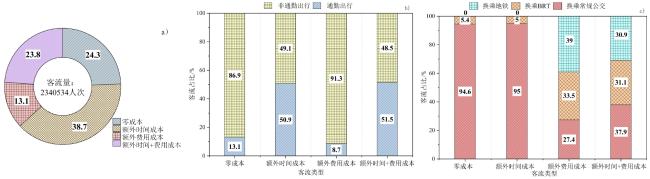
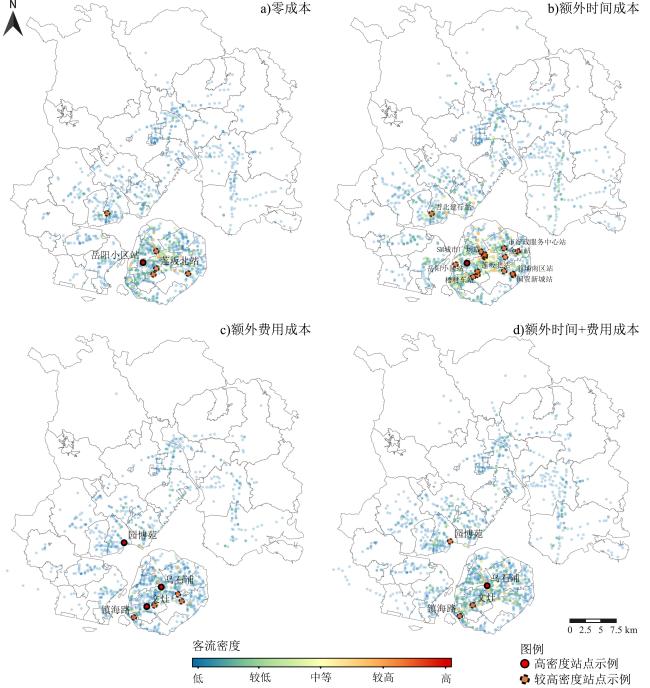
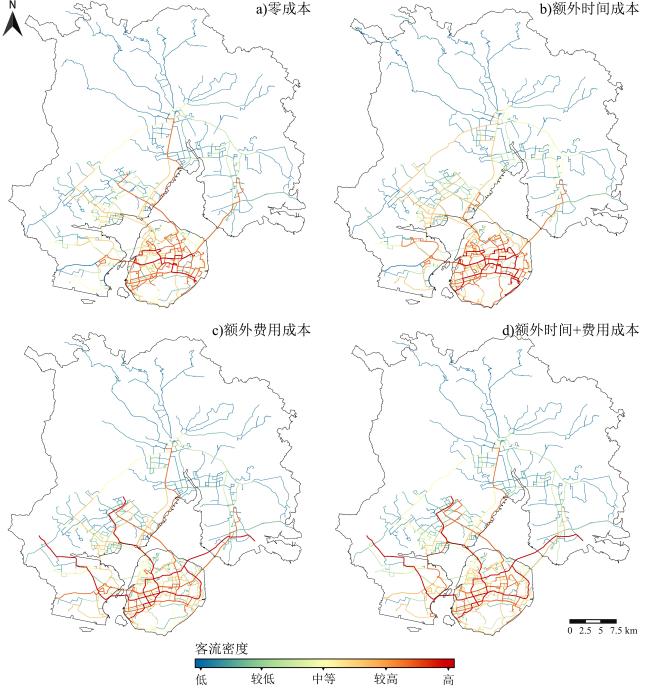
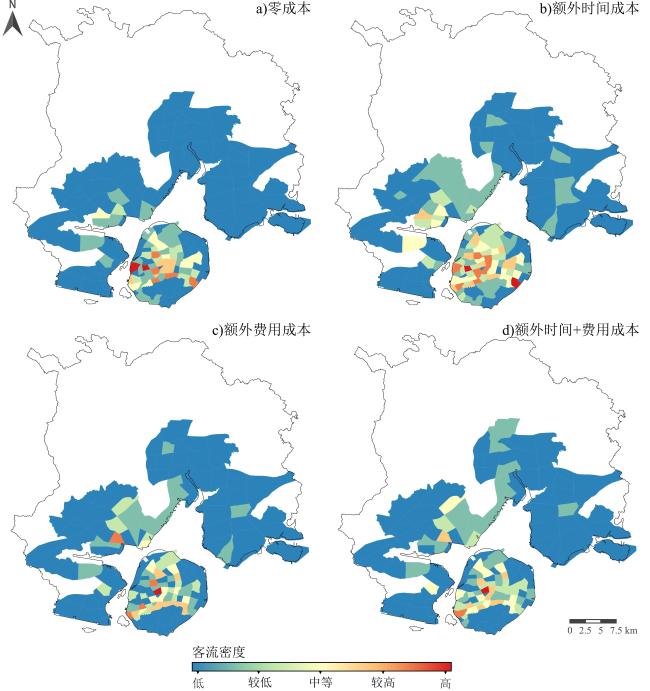
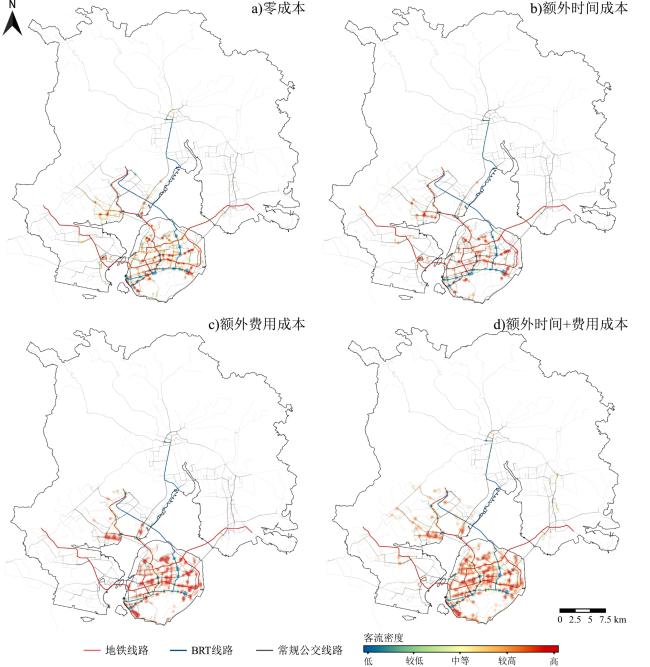
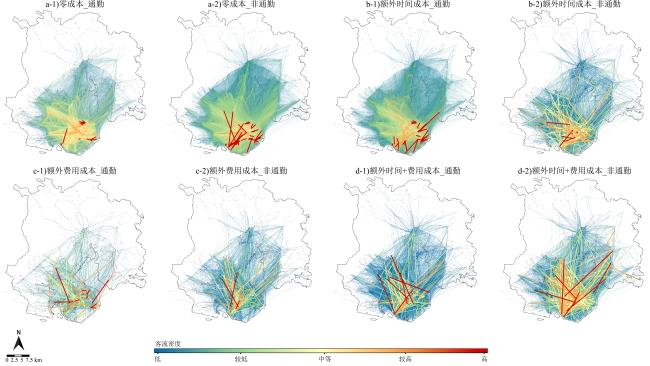
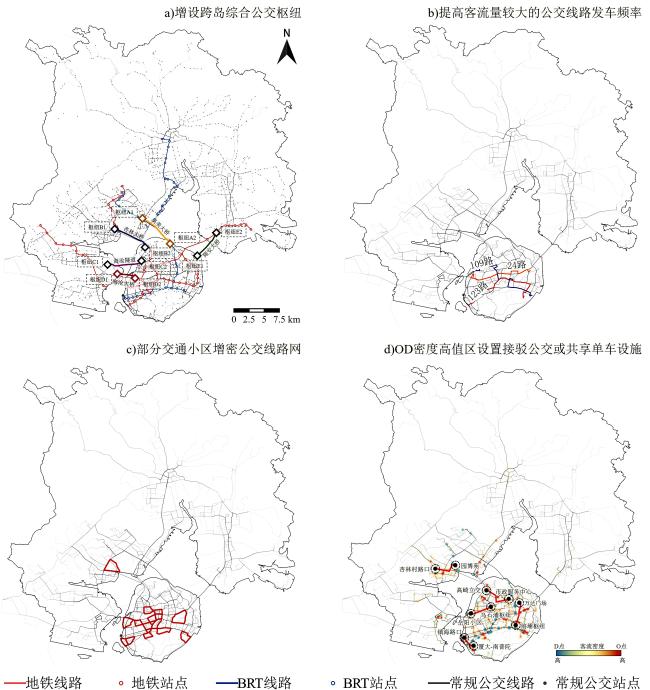
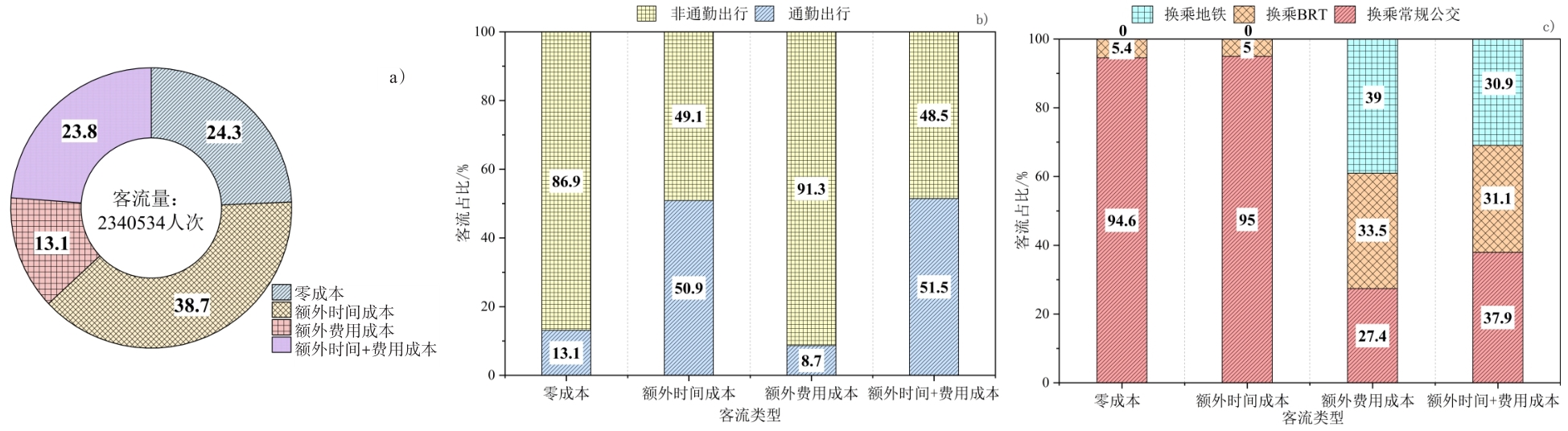
Implementing preferential policies for bus transfers is an important measure for promoting the development of public transportation. Although public transportation extends the travel time of passengers, the preferential policies reduce the travel costs to a certain extent. On the basis of IC card data of public transport, an income method model was constructed to evaluate the cost of passenger flow transfer time after the implementation of the preferential transfer policy in Xiamen and compare it with the reduced fees due to the policy regulations. To better assess the overall benefit of bus transfer travel, the transfer passenger flow was divided into four categories: transfer zero cost passenger flow, transfer additional cost passenger flow, transfer extra time cost passenger flow, and transfer extra time+cost passenger flow. The spatial distribution characteristics of various types of passenger flow are analyzed from five aspects: station, line, traffic area, density of travel starting and ending points, commuting and non-commuting of travel. With regard to stations, a large number of different types of passenger flowed into the area centered on Yueyang Community. As regards route, No. 24 mainly gathered a large number of different types of passenger flows. As regards transportation areas, numerous different types of passenger flows gathered in the transportation communities around the subway and the island's Bus Rapid Transit (BRT) lines. In terms of OD point density, each station of Rail Line 1 and the BRT stations had large numbers of passengers at the starting or ending points. In terms of commuting and non-commuting behaviors, the activity range of various passenger flows during commuting was smaller, the span was shorter, and the cross-island passenger flow was relatively small. In contrast, the passenger flow during non-commuting behavior showed a more evident cross-island trend, and the span was generally longer. This study devised a new passenger flow classification method to evaluate the effectiveness of a preferential policy for bus transfers. Further, it affords a reference for public transport operators to better comprehend the needs and behaviors of passengers and accordingly formulate more effective policies and measures.
Jialin Liu , Yue'er Gao , Ruizhen Qi . Passenger Flow Classification and Spatial Distribution Based on Transfer Time Cost: A Case Study of Xiamen City[J]. Tropical Geography, 2024 , 44(5) : 921 -937 . DOI: 10.13284/j.cnki.rddl.003877
表1 厦门市公共交通出行各换乘方式客流情况Table 1 Passenger flow of different transfer modes of public transport in Xiamen City |
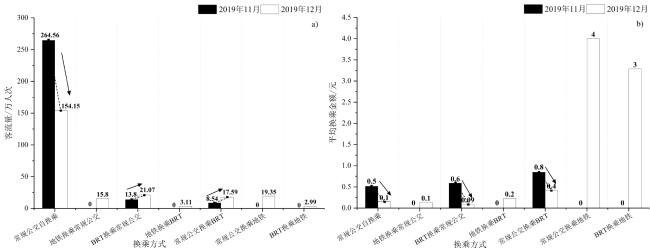
| 换乘方式 | 11月客流量/人次 | 12月客流量/人次 |
|---|---|---|
| 合计 | 2 868 975 | 2 340 534 |
| 常规公交自换乘 | 2 645 559 | 1 541 499 |
| 地铁换乘常规公交 | 0 | 158 027 |
| BRT换乘常规公交 | 137 999 | 210 650 |
| 地铁换乘BRT | 0 | 31 096 |
| 常规公交换乘BRT | 85 417 | 175 874 |
| 常规公交换乘地铁 | 0 | 193 468 |
| BRT换乘地铁 | 0 | 29 920 |
|
表2 客流通勤属性样例Table 2 Sample commuter attributes of passenger flow |
| IC卡编号 | 上车时间/s | 通勤属性 |
|---|---|---|
| 12437*** | 45 892 | 0 |
| 10995*** | 61 845 | 1 |
| 11444*** | 61 913 | 1 |
| 17279*** | 53 147 | 0 |
| 20964*** | 26 725 | 1 |
| 17262*** | 22 124 | 0 |
|
表3 换乘时间成本计算结果Table 3 Calculation results of transfer time value |
| 出行目的 | 换乘金额/元 | 换乘方式 | 客流量/人次 | 平均换乘时间成本/元 |
|---|---|---|---|---|
| 通勤 出行 | =0 | 常规公交 | 580 677 | 3.60 |
| BRT | 3 207 | 5.17 | ||
| 地铁 | 0 | — | ||
| >0 | 常规公交 | 119 020 | 4.96 | |
| BRT | 88 242 | 3.80 | ||
| 地铁 | 84 232 | 3.61 | ||
| 非通勤 出行 | =0 | 常规公交 | 996 018 | 0.99 |
| BRT | 8 249 | 1.13 | ||
| 地铁 | 0 | — | ||
| >0 | 常规公交 | 214 461 | 1.27 | |
| BRT | 107 272 | 1.12 | ||
| 地铁 | 139 156 | 0.97 |

1 K-means++算法是一种以K-means聚类算法为基础的改进算法,其主要在初始化簇中心的方式上做了改进,其他地方同K-means聚类算法一致(Abiodun et al., 2023)。
刘佳林:论文撰写与修改、数据处理、图件与表格绘制;
高悦尔:论文框架、研究思路及方法指导、论文审阅;
齐瑞臻:数据处理提供支持,提出修改意见。
|
Abiodun M Ikotun, Absalom E Ezugwu, Laith Abualigah, Belal Abuhaija, and Jia Heming. 2023. K-Means Clustering Algorithms: A Comprehensive Review, Variants Analysis, and Advances in the Era of Big Data. Information Sciences, 622(Apr): 178-210.
|
|
Andres Garcia-Martinez, Rocio Cascajo, Sergio R Jara-Diaz, Subeh Chowdhury, and Andres Monzon. 2018. Transfer Penalties in Multimodal Public Transport Networks. Transportation Research Part a-Policy and Practice, 114(A): 52-66.
|
|
Caio Pieroni, Mariana Giannotti, Bianca B Alves, and Renato Arbex. 2021. Big Data for Big Issues: Revealing Travel Patterns of Low-Income Population Based on Smart Card Data Mining in a Global South Unequal City. Journal of Transport Geography, 96(Oct): 03203.
|
|
Akhilesh Chepuri, Shriniwas Shrikant Arkatkar, Gaurang Joshi, and Srinivas S Pulugurtha. 2021. Assessing Value of Bus Transit Passenger's Travel Time and Savings. A Case Study of Mumbai, India. Rivista Internazionale di Economia dei Transporti / International Journal of Transport Economics, 47(3): 255-272.
|
|
Cohen William W.. 1995. Fast Effective Rule Induction. In: Armand Prieditis, and Stuart Russel. Proceedings of the Twelfth International Conference on Machine Learning. California: Morgan Kaufmann, 115-123.
|
|
Cui Chengliang, Zhao Yali, and Duan Zhengyu. 2014. Research on the Stability of Public Transit Passenger Travel Behavior Based on Smart Card Data. In: Ma Jianming, Yin Yafeng, Huang Helai, and Pan Difu. Cota International Conference of Transportation Professionals. Changsha: American Society of Civil Engineers, 1318-1326.
|
|
曹彦珍,何云斌,朱素霞,孙广路. 2017. 基于RIPPER的网络流量分类方法. 哈尔滨理工大学学报,22(5):85-90.
Cao Yanzhen, He Yunbin, Zhu Suxia, and Sun Guanglu. 2017. Network Flow Classification Methodrule-Based. Journal of Harbin University of Science and Technology, 22(5): 85-90.
|
|
陈坚,王曼,李和平,段力伟. 2017. 城市轨道交通网络乘客换乘路径选择行为模型. 交通运输系统工程与信息,17(6):235-241.
Chen Jian, Wang Man, Li Heping, and Duan Liwei. 2017. Choice Behavior of Passenger Transfer Route for Urban RailTransit Network. Journal of Transportation Systems Engineering and Information Technology, 17(6): 235-241.
|
|
Gwilliam K M. 1997. The Value of Time in Economic Evaluation of Transport Projects. (2013-10-08) [2023-10-15]. http://documents.worldbank.org/curated/en/759371468153286766/The-value-of-time-in-economic-evaluation-of-transport-projects.
|
|
He Li, Bruno Agard, and Martin Trépanier. 2018. A Classification of Public Transit Users with Smart Card Data Based on Time Series Distance Metrics and a Hierarchical Clustering Method. Transportmetrica A: Transport Science, 16(1): 56-75.
|
|
Hélène Bouscasse and Matthieu de Lapparent. 2019. Perceived Comfort and Values of Travel Time Savings in the Rhone-Alpes Region. Transportation Research Part a-Policy and Practice, 124(Jun): 370-387.
|
|
Hong Soung-Pyo. 2022. An Empirical Study on the Relationship between Headway of Inter-Region Public Transport and Waiting Time. Journal of Transport Research, 29(1): 1-10.
|
|
Jawaher Binsuwadan, Mark Wardman, Gerard de Jong, Richard Batley, and Phill Wheat. 2023. The Income Elasticity of the Value of Travel Time Savings: A Meta-Analysis. Transport Policy, 136(Jun): 126-136.
|
|
Liu Shasha, Yamamoto Toshiyuki, Yao Enjian, and Nakamura Toshiyuki. 2021. Examining Public Transport Usage by Older Adults with Smart Card Data: A Longitudinal Study in Japan. Journal of Transport Geography, 93(May): 103046.
|
|
Liu Yue, Chen Jun, Wu Weiguang, and Ye Jiao. 2019. Typical Combined Travel Mode Choice Utility Model in Multimodal Transportation Network. Sustainability, 11(2): 549.
|
|
李晓津,史晨钰,李烁烁. 2020. 我国航空与铁路联运定价策略研究——基于旅客时间价值的测算分析. 价格理论与实践,(8):128-131.
Li Xiaojin, Shi Chenyu, and Li Shuoshuo. 2020. Research on the Pricing Strategy of My Country's Air and Railway Combined Transport. Price: Theory & Prctice, (8): 128-131.
|
|
栾琨,隽志才. 2016. 基于RIPPER的有限理性下出行路径选择行为.中国高新技术企业,386(35):11-12.
Luan Kun and Jun Zhicai. 2016. Travel Route Choice Behavior under Bounded Rationality Based on RIPPER. China High Technology Enterprises, 386(35): 11-12.
|
|
彭飞,宋国华,朱珊. 2021. 城市公共交通常乘客通勤出行提取方法. 交通运输系统工程与信息,21(2):158-165.
Peng Fei, Song Guohua, and Zhu Shan. 2021. A Method for Extracting Commuting Trips of Frequent Passengers in Urban Public Transportation. Journal of Transportation Systems Engineering and Information Technology, 21(2): 158-165.
|
|
Shahrokh Asadi and Jamal Shahrabi. 2016. ACORI: A Novel ACO Algorithm for Rule Induction. Knowledge-Based Systems, 97(Apr): 175-187.
|
|
Subeh Chowdhury, Avishai (Avi) Ceder, and Bradley Schwalger. 2015. The Effects of Travel Time and Cost Savings on Commuters' Decision to Travel on Public Transport Routes Involving Transfers. Journal of Transport Geography, 43(Feb): 151-159.
|
|
孙世超. 2018. 一种基于宏微观数据嵌套的公交用户细分方法. 交通运输系统工程与信息,18(3):108-112.
Sun Shichao. 2018. An Approach to Classify the Public Transit Users Based on Macro & Micro Nested Data. Journal of Transportation Systems Engineering and Information Technology, 18(3): 108-112.
|
|
Wang Ming, Chen Zuo, Zhang Zhiqiang, Zhu Sangzhi, and Yang Shenggang.2021. A Combination Classification method Based on Ripper and Adaboost. International Journal of Embedded Systems, 14(3): 229-238.
|
|
王明仪. 1986. 客运时间价值的定量分析. 公路交通科技,3(2):73-78.
Wang Mingyi. 1986. Quantitative Analysis of Time Value of Passenger Transport. Journal of Highway and Transportation Research and Development, 3(2): 73-78.
|
|
吴焕,彭湖,陈梓星,庄义彬. 2019. 基于SP调查的出行时间价值估计及出行者属性影响分析. 交通与运输,35(6):9-12.
Wu Huan, Peng Hu, Chen Zixing, and Zhuang Yibin. 2019. Estimation and Influence Analysis of Traveler Attributes for Value of Travel Time Based on SP Survey. Traffic and Transportation, 35(6): 9-12.
|
|
厦门市交通运输局. 2019. 12月1日起我市实施公共交通换乘优惠政策. (2019-11-25)[2023-10-15]. http://jt.xm.gov.cn/tzxx/zwdt/201911/t20191126_2403316.htm.
Xiamen Municipal Transportation Bureau. 2019. Since December 1,the City has Implemented Preferential Policies for Public Transport Transfer. (2019-11-25) [2023-10-15]. http://jt.xm.gov.cn/tzxx/zwdt/201911/t20191126_2403316.htm.
|
|
杨杰. 2021. 公交乘客出行规律性度量与分类研究. 西安:长安大学.
Yang Jie. 2021. A Study of Measuring Travel Regularity and Segmenting Passengers of Public Transport. Xi'an: Chang'an University.
|
|
杨明,王炜,陈学武,蒋大治. 2005. 基于GIS的城市公交出行时间链研究. 公路交通科技,21(5):117-120.
Yang Ming, Wang Wei, Chen Xuewu, and Jiang Dazhi. 2005. Research on Transit Trip Time Chain Based on GIS Technology. Journal of Highway and Transportation Research and Development, 21(5): 117-120.
|
|
赵鹏军,万婕. 2020. 城市交通与土地利用一体化模型的理论基础与发展趋势. 地理科学,40(1):12-21.
Zhao Pengjun and Wan Jie. 2020. The Key Technologies of Integrated Urban Transport-Land Use Model: Theory Base and Development Trends. Scientia Geographica Sinica, 40(1): 12-21.
|
|
宗芳,隽志才,张慧永,贾洪飞. 2009. 出行时间价值计算及应用研究. 交通运输系统工程与信息,9(3):114-119.
Zong Fang, Jun Zhicai, Zhang Huiyong, and Jia Hongfei. 2009. Calculation and Application of Value of Travel Time. Journal of Transportation Systems Engineering and Information Technology, 9(3): 114-119.
|
|
宗刚,曾庆华,魏素豪. 2020. 基于时间价值的交通出行方式选择行为研究. 管理工程学报,34(3):142-150.
Zong Gang, Zeng Qinghua, and Wei Suhao. 2020. Research on Traffic Mode Choice Behavior Based on Commuting Ravel Time Value. Journal of Industrial Engineering and Engineering Management, 34(3): 142-150.
|
/
| 〈 |
|
〉 |