Structure Evolution of Urban Network Through Enterprise Investment Routes: A Case Study of Yangtze River Delta
Received date: 2023-10-25
Revised date: 2024-01-14
Online published: 2024-07-08
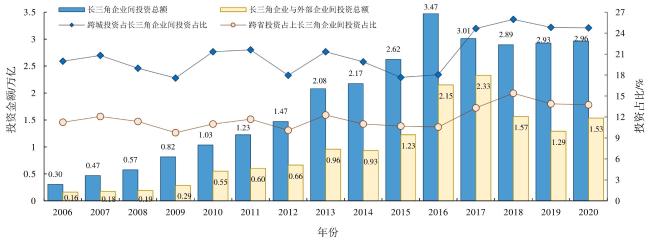
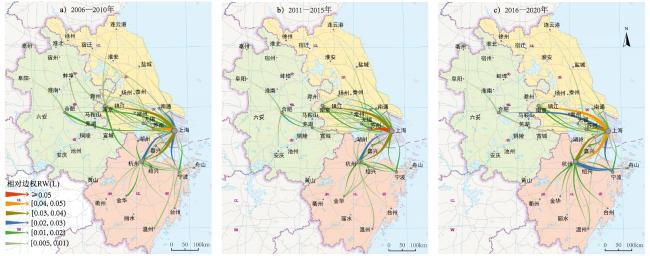
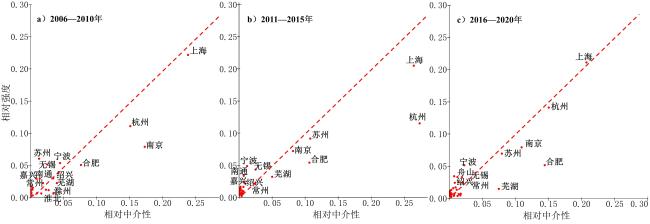
Off-site investment relations among enterprises often bring the flow of capital, logistics, talent, information, and technology across cities, representing a new avenue for studying the urban network. Therefore, an increasing number of studies are investigating urban networks from the perspective of firm relations. Most of these studies mainly use data from intra-firm branches or mega firms' investment to quantify the linkages among cities. However, these studies have neglected the linkages among small-sized enterprises that are often located in small and medium-sized cities, resulting in the lack of authenticity in establishing urban networks. Recently, a small amount of research has begun to use wholesale enterprises' off-site investment data to construct urban networks. However, such research has neglected the indirect linkages and transit effects on enterprise investment routes. Therefore, this study uses investment data of all-industry enterprises from the Industrial and Commercial Enterprise Registration Database to propose a new method for establishing a directed weighted urban network by identifying off-site investment routes among enterprises, which could fill the gap in constructing urban networks from the perspective of micro capital flow. To verify the evolutionary characteristics of urban network structure before and after the implementation of major policies, this study considers the Yangtze River Delta as the empirical study area. Wholesale enterprise investment data from 2006 to 2020 in the Yangtze River Delta are used to construct three urban networks in three time stages. The main conclusions are as follows: (1) The growth model of the urban network scale shows that the growth of off-site investment routes drives the growth of off-site investment scale. The scale of enterprise nodes linked by off-site investment relations significantly increased from 2011 to 2015. However, after 2016, the proportion of off-site investment in the total investment of the Yangtze River Delta increased accordingly. (2) From the perspective of spatial patterns, the urban network of the study area has shifted from a polygonal network structure of interconnected core cities to a V-shaped structure centered around Shanghai, and then to a Z-shaped structure centered around Shanghai and Hangzhou. (3) In terms of network centrality, the cities exhibit a clear hierarchical structure. Although the network is evolving, the hierarchical structure has not changed significantly. However, the linkages between cities show a trend of clustering from low- to high-level cities. (4) In terms of network betweenness, the betweenness of most cities matches their centrality. Notably, the betweenness of Hefei and Wuhu is significantly stronger than their centrality. At different stages of the urban network evolution, cities with high betweenness, such as Shanghai, Hangzhou, and Hefei, play different intermediary roles in the network. This study constructs urban networks from a micro scale perspective of capital flow, thereby filling the gap in existing research. Additionally, unlike previous studies on urban networks that focus on static network structures, this study analyzes the structural evolution of urban networks based on long-term comprehensive data and verifies the characteristics of changes in the network structure, which has certain theoretical value and practical significance.

Zhouping Li , Chun Fu , Yuangang Li , Xiaoyu Liu . Structure Evolution of Urban Network Through Enterprise Investment Routes: A Case Study of Yangtze River Delta[J]. Tropical Geography, 2024 , 44(7) : 1236 -1248 . DOI: 10.13284/j.cnki.rddl.20230815
表1 长三角企业投资路径变化情况 (条)Table 1 The changes of enterprise investment route in the Yangtze River Delta |
| 年份 | 跨城投资路径数 | 跨省投资路径数 | 投资路径总数 |
|---|---|---|---|
| 2006—2010 | 24 439 | 12 943 | 132 916 |
| 2011—2015 | 95 693 | 54 419 | 257 965 |
| 2016—2020 | 226 122 | 142 907 | 436 642 |
表2 城市节点相对强度的等级划分Table 2 The rank division of node-cities by relative strength |
| 等级 | 2006—2010年 | 2011—2015年 | 2016—2020年 |
|---|---|---|---|
| 等级一 | 上海0.22 | 上海0.21 | 上海0.21,杭州0.14 |
| 等级二 | 杭州0.11,南京0.08,苏州0.06 | 杭州0.12,苏州0.09,南京0.07 | 南京0.08,苏州0.07 |
| 等级三 | 宁波0.05,无锡0.05,合肥0.05,南通0.03, 绍兴0.03,嘉兴0.03,芜湖0.02,常州0.02 | 合肥0.05,宁波0.05,无锡0.04,芜湖0.03, 南通0.03,嘉兴0.02,绍兴0.02,常州0.02 | 宁波0.05,合肥0.05, 嘉兴0.03,无锡0.03,舟山0.03, 常州0.02,南通0.02,绍兴0.02 |
| 等级四 | 29个城市 | 29个城市 | 29个城市 |
表3 不同等级城市间相对边权的演化情况Table 3 The evolution of linkage weights between node-cities of different levels |
| 城市联系 | 2006—2010年 | 2011—2015年 | 2016—2020年 |
|---|---|---|---|
| 上海与副中心城市间 | 0.158 | 0.177 | 0.190 |
| 3个副中心城市间 | 0.027 | 0.028 | 0.033 |
| 4个中心与核心城市间 | 0.317 | 0.283 | 0.304 |
| 核心城市之间 | 0.047 | 0.050 | 0.041 |
| 中心与边缘城市 | 0.257 | 0.280 | 0.263 |
| 核心与边缘城市 | 0.148 | 0.141 | 0.123 |
| 边缘城市之间 | 0.046 | 0.041 | 0.046 |

1 http://www.qstheory.cn/dukan/qs/2020-10/31/c_1126680390.htm
2 https://www.gov.cn/zwgk/2010-06/22/content_1633868.htm
3 https://www.ndrc.gov.cn/xxgk/zcfb/ghwb/201606/t20160603_962187_ext.html
4 https://www.gov.cn/gongbao/content/2019/content_5462503.htm
李周平:论文选题与构思,研究方法与模型设计,初稿部分内容撰写,论文审阅与修改;
傅 春:数据采集、整合与处理,初稿部分内容撰写,论文审阅与修改;
李元刚:研究模型的论证与完善,论文审阅与修改;
刘小钰:数据整合与处理,论文审阅与修改。
|
Castells M. 2011. The Rise of the Network Society. New Jersey: Wiley-Blackwell Publishers.
|
|
Capello R. 2000. The City Network Paradigm: Measuring Urban Network Externalities. Urban Studies, 37(11): 1925-1945.
|
|
高鹏. 2021. 长三角地区城际投资时空演化:多尺度网络分析的视角. 上海:华东师范大学.
Gao Peng. 2021. Spatio-temporal Evolution of Intercity Investment in the Yangtze River Delta: Based on Multi-Scale Network Analysis. Shanghai: East China Normal University.
|
|
高鹏,宁越敏,何丹,张凡. 2023. 企业异地投资视角下长三角城市经济增长的网络外部性研究. 地理科学,43(7):1216-1226.
Gao Peng, Ning Yuemin, He Dan, and Zhang Fan. 2023. Network Externalities of Urban Economic Growth in the Yangtze River Delta from the Perspective of Enterprises' Non-Local Investment. Scientia Geographica Sinica, 43(7): 1216-1226.
|
|
高随祥. 2009. 图论与网络流理论. 北京:高等教育出版社.
Gao Suixiang. 2009. Graph Theory and Network Flow Theory. Beijing: The Higher Education Press.
|
|
国家发展改革委. 2010. 长江三角洲地区区域规划. (2010-05-20)[2023-05-20]. https://www.gov.cn/gzdt/att/att/site1/20100622/001e3741a2cc0d8aa56801.pdf.
National Development and Reform Commission. 2010. The Yangtze River Delta Regional Plan. (2010-05-20) [2023-05-20]. https://www.gov.cn/gzdt/att/att/site1/20100622/001e3741a2cc0d8aa56801.pdf.
|
|
国家发展改革委. 2016.长江三角洲城市群发展规划. (2016-05-11)[2023-05-20]. https://www.ndrc.gov.cn/xxgk/zcfb/ghwb/201606/W020190905497826154295.pdf.
National Development and Reform Commission. 2016. The Yangtze River Delta Urban Agglomeration Development Plan. (2016-05-11) [2023-05-20]. https://www.ndrc.gov.cn/xxgk/zcfb/ghwb/201606/W02019090549 7826154295.pdf.
|
|
Hoyler M and Watson A. 2018. Framing City Networks Through Temporary Projects: (Trans) National Film Production Beyond 'Global Hollywood'. Urban Studies, 56(5): 943-959.
|
|
黄沣爵,杨滔. 2022. 珠三角城市空间联系及社会网络——基于“流空间”的分析. 热带地理,42(3):422-430.
Huang Fengjue and Yang Tao. 2022. Exploring the Spatial Structure of Pearl River Delta: Based on "Space of Flows". Tropical Geography, 42 (3): 422-430.
|
|
胡国建,陈传明,金星星,王强. 2019. 中国城市体系网络化研究. 地理学报,74(4):681-693.
Hu Guojian, Chen Chuanming, Jing Xingxing, and Wang Qiang. 2019. Research Progress of Networking of Urban Systems in China. Acta Geographica Sinica, 74(4): 681-693.
|
|
胡国建,陆玉麒.2020. 基于企业视角的城市网络研究进展,思考和展望. 地理科学进展,39(9):1587-1596.
Hu Guojian and Lu Yuqi. 2020. Progress, Thoughts, and Prospect of Urban Network Research Based on Enterprise Perspective. Progress in Geography, 39(9): 1587-1596.
|
|
蒋金亮,鲁嘉颐,戈大专,孙东琪. 2023. 长三角地区城市经济网络的时空演化特征. 长江流域资源与环境,32(1):24-39.
Jiang Jinliang, Lu Jiayao, Ge Dazhuan, and Sun Dongqi. 2023. Research on Spatial-Temporal Evolution Characteristics of Urban Economic Networks in Yangtze River Delta. Resources and Environment in the Yangtze Basin, 32(1): 24-39.
|
|
Limtanakool N, Dijst M, and Schwanen T. 2007. A Theoretical Framework and Methodology For Characterising National Urban Systems on The Basis of Flows of People: Empirical Evidence For France and Germany. Urban Studies, 44(11): 2123-2145.
|
|
李哲睿,甄峰,傅行行. 2019. 基于企业股权关联的城市网络研究——以长三角地区为例. 地理科学,39(11):1763-1770.
Li Zherui, Zhen Feng, and Fu Xingxing. 2019. Mapping Urban Network Through Inter-firm Investment Relationship: A Case Study of Yangtze River Delta. Scientia Geographica Sinica, 39(11): 1763-1770.
|
|
李艳,孙阳,姚士谋. 2020. 基于财富中国500强企业的中国城市群城市网络联系分析. 地理研究,39(7):1548-1564.
LI Yan, Sun Yang, and Yao Shimou. 2020. Urban Network Linkages of Chinese Urban Agglomerations Based on An Analysis of The Fortune China Top 500 Enterprises. Geographical Research, 39(7): 1548-1564.
|
|
李聪,卢明华,张金哲,余加丽. 2022. 京津冀城市群产业投资网络演变及影响因素研究. 人文地理,37(5):162-170.
Li Cong, Lu Minghua, Zhang Jinze, and Yu Jiali. 2022. Evolution and Influencing Factors fo Industrial Investment Network in Beijing-Tianjin-Hebei Urban Agglomeration. Human Geography, 37(5): 162-170.
|
|
李涛,张伊娜. 2017. 企业关联网络视角下中国城市群的多中心网络比较研究. 城市发展研究,24(3):116-124.
Li Tao and Zhang Yi'na. 2017. The Comparison of Polycentricity of Urban Agglomerations in China from the Perspective of Firm Interlocking Network. Urban Development Studies, 24(3): 116-124.
|
|
刘耀彬,胡伟辉,骆康,李硕硕,邓伟凤. 2023. 流空间视角下企业异地投资网络结构演化研究—以环鄱阳湖城市群为例. 长江流域资源与环境,32(5):916-927.
Liu Yaobin, Hu Weihua, Luo Kang, Li Shuoshuo, and Deng Weifeng. 2023. Structure Evolution of Enterprise Remote Investment Network from Perspective of Flow Space: A Case Study of Urban Agglomeration Around Poyang Lake. Resources and Environment in the Yangtze Basin, 32(5): 916-927.
|
|
Martinus K, Sigler T J, Searle G, and Tonts M. 2015. Strategic Globalizing Centers and Sub-Network Geometries: A Social Network Analysis of Multi-Scalar Energy Networks. Geoforum, 64: 78-89.
|
|
Neal Z. 2011. Differentiating Centrality and Power in the World City Network. Urban Studies, 48(13): 2733-2748.
|
|
Newman M E. 2005. A Measure of Betweenness Centrality Based on Random Walks. Social Networks, 27(1): 39-54.
|
|
Pan F, Bi W, Lenzer J, and Zhao S. 2017. Mapping Urban Networks Through Inter-firm Service Relationships: The Case of China. Urban Studies, 54(16): 3639-3654.
|
|
盛科荣,杨雨,孙威.2019. 中国城市网络中心性的影响因素及形成机理——基于上市公司500强企业网络视角. 地理科学进展,38(2):248-258.
Sheng Kerong, Yang Yu, and Sun Wei. 2019. Determinants and Mechanisms of Degree Centrality in The Urban Network in China: A Study Based on Corporate Networks of The Largest 500 Listed Companies. Progress in Geography, 38(2): 248-258.
|
|
Taylor P J. 2001. Specification of The World City Network. Geographical Analysis, 33(2): 181-194.
|
|
Taylor P J, Hoyler M, and Verbruggen R. 2010. External Urban Relational Process: Introducing Central Flow Theory to Complement Central Place Theory. Urban Studies, 47(13): 2803-2818.
|
|
王波,雷雅钦,易丹然,薛德升. 2021. 广东省国有企业空间组织网络演化——基于有向加权网络的分析. 经济地理,41(12):142-148.
Wang Bo,Lei Yaqin, Yi Danran, and Xue Desheng. 2021. Spatial Organization Network Evolution of State-Owned Enterprise in Guangdong Province: An Empirical Analysis Based on Directed Weighted Network. Economic Geography, 41(12): 142-148.
|
|
文超,詹庆明,刘达,米子豪. 2021. 基于有向转变中心性与控制力的长三角城市网络空间结构分析. 地理科学,41(6):971-979.
Wen Chao, Zhan Qingming, Liu Da, and Mi Zihao. 2021. Urban Network Structure Analysis of the Yangtze River Delta Based on Directed Alternative Centrality and Power. Scientia Geographica Sinica, 41(6): 971-979.
|
|
汪菲,罗皓,王长建,叶玉瑶,张虹鸥,林晓洁,陈静.2023. 金融联系视角下粤港澳大湾区城市网络空间结构及其影响因素. 热带地理,43(4):581-595.
Wang Fei, Luo Hao, Wang Changjian, Ye Yuyao, Zhang Hong'ou, Lin Xiaojie, and Chen Jing. 2023. Spatial Structure and Influencing Factors of Urban Network in the Guangdong-Hong Kong-Macao Greater Bay Area from the Financial Relationships Perspective. Tropical Geography, 43 (4): 581-595.
|
|
Yeung H W C. 2005. The Firm As Social Networks: An Organisational Perspective. Growth And Change, 36(3): 307-328.
|
|
中共中央、国务院. 2019. 长江三角洲区域一体化发展规划纲要. (2019-12-01)[2023-05-20]. https://www.gov.cn/gongbao/content/2019/content_5462503.htm.
The Central Committee and the State Council of the People's Republic of China. 2019. Outline Plan for Integrated Regional Development of the Yangtze River Delta Region. (2019-12-01) [2023-05-20]. https://www.gov.cn/gongbao/content/2019/content_5462503.htm.
|
|
张晓明,汪淳. 2008. 长江三角洲巨型城市区城镇格局分析:高级生产者服务业的视角. 城市与区域规划研究,1(2):43-64.
Zhang Xiaoming and Wang Cun. 2008. Spatial Structure of Yangtze River Delta Mega-City Region in the Perspective of APS. Journal of Urban and Regional Planning, 1(2): 43-64.
|
|
赵渺希,陈晨. 2011. 中国城市体系中航空网络与生产性服务业网络的比较. 城市规划学刊,(2):24-32.
Zhao Miaoxi and Chen Chen. 2011. A Comparison Between Airline Passenger Network and Advanced Producer Service Network in the Urban System of China. Urban Planning Forum, (2): 24-32.
|
/
| 〈 |
|
〉 |