A Comparative Study on the Type Recognition and Spatial Organization Characteristics of Sea-Related Enterprises Based on Machine Learning in Cities
Received date: 2023-05-18
Revised date: 2023-07-04
Online published: 2024-08-09
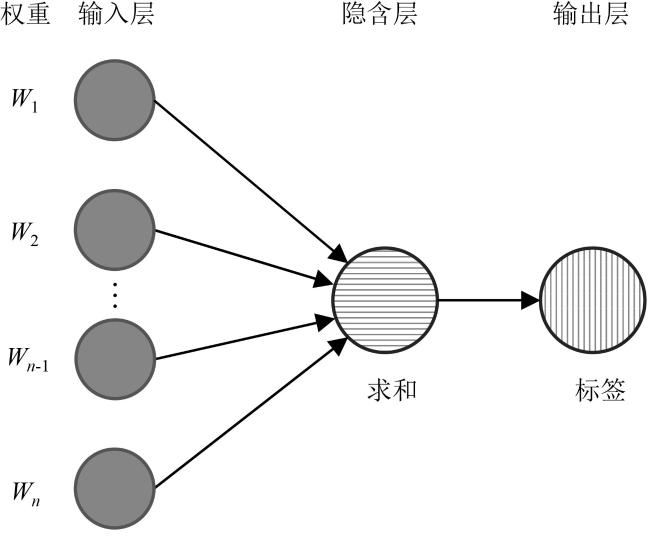
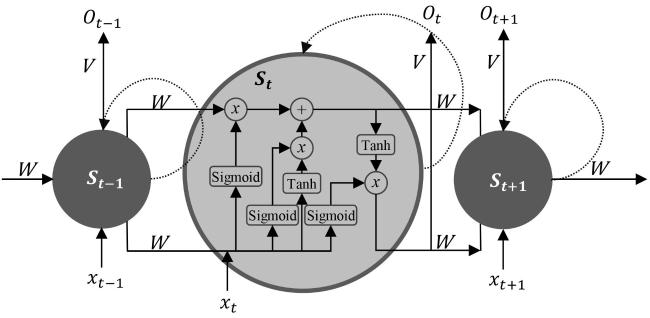
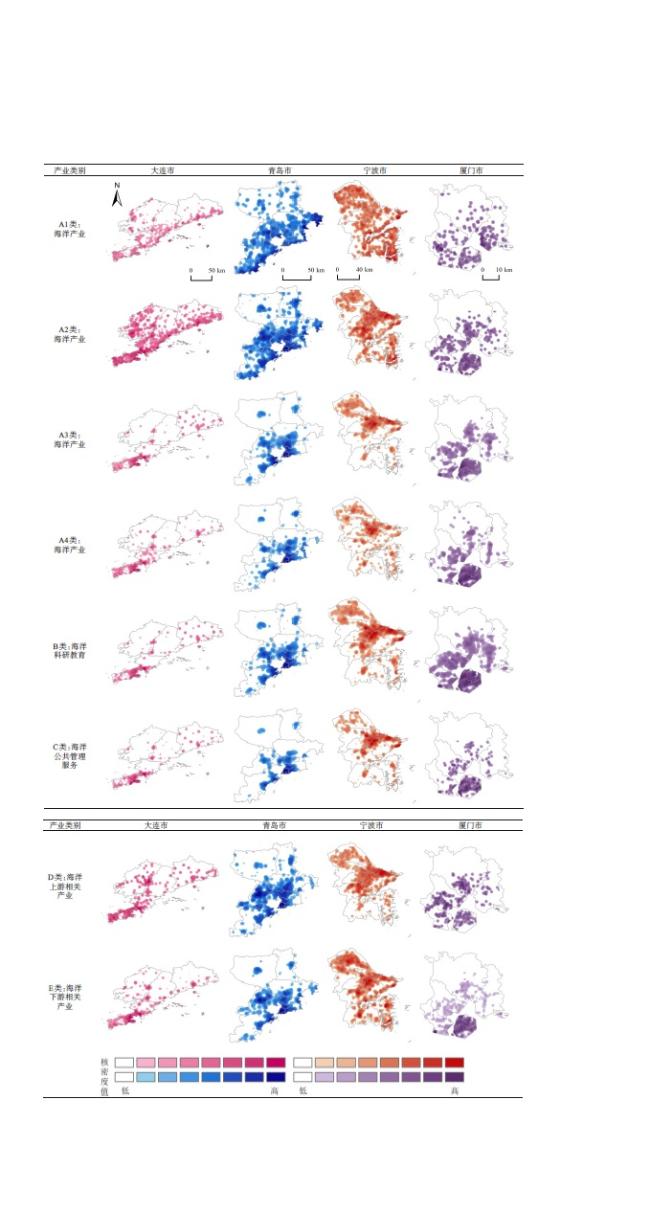
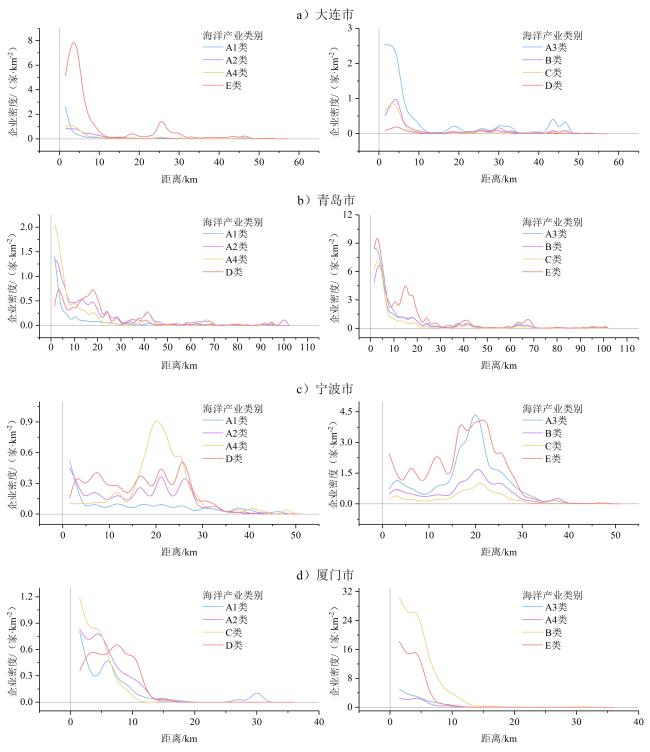
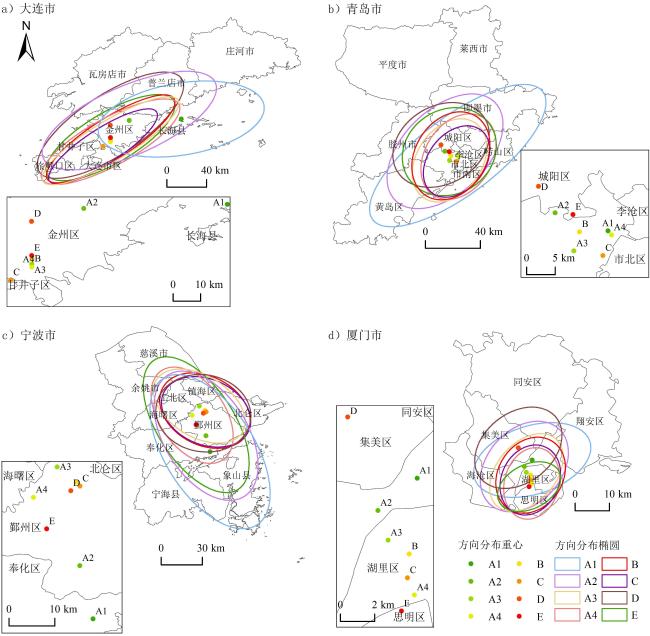
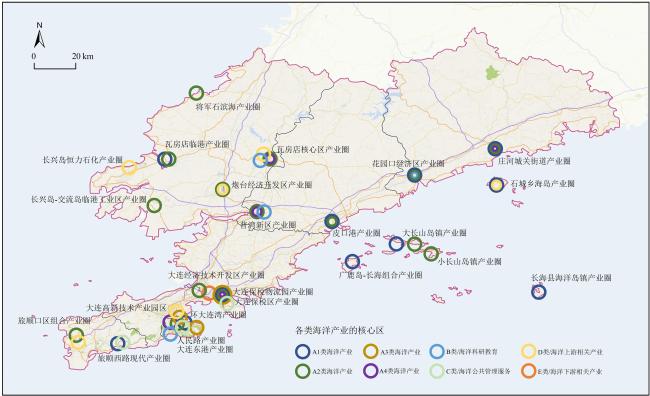
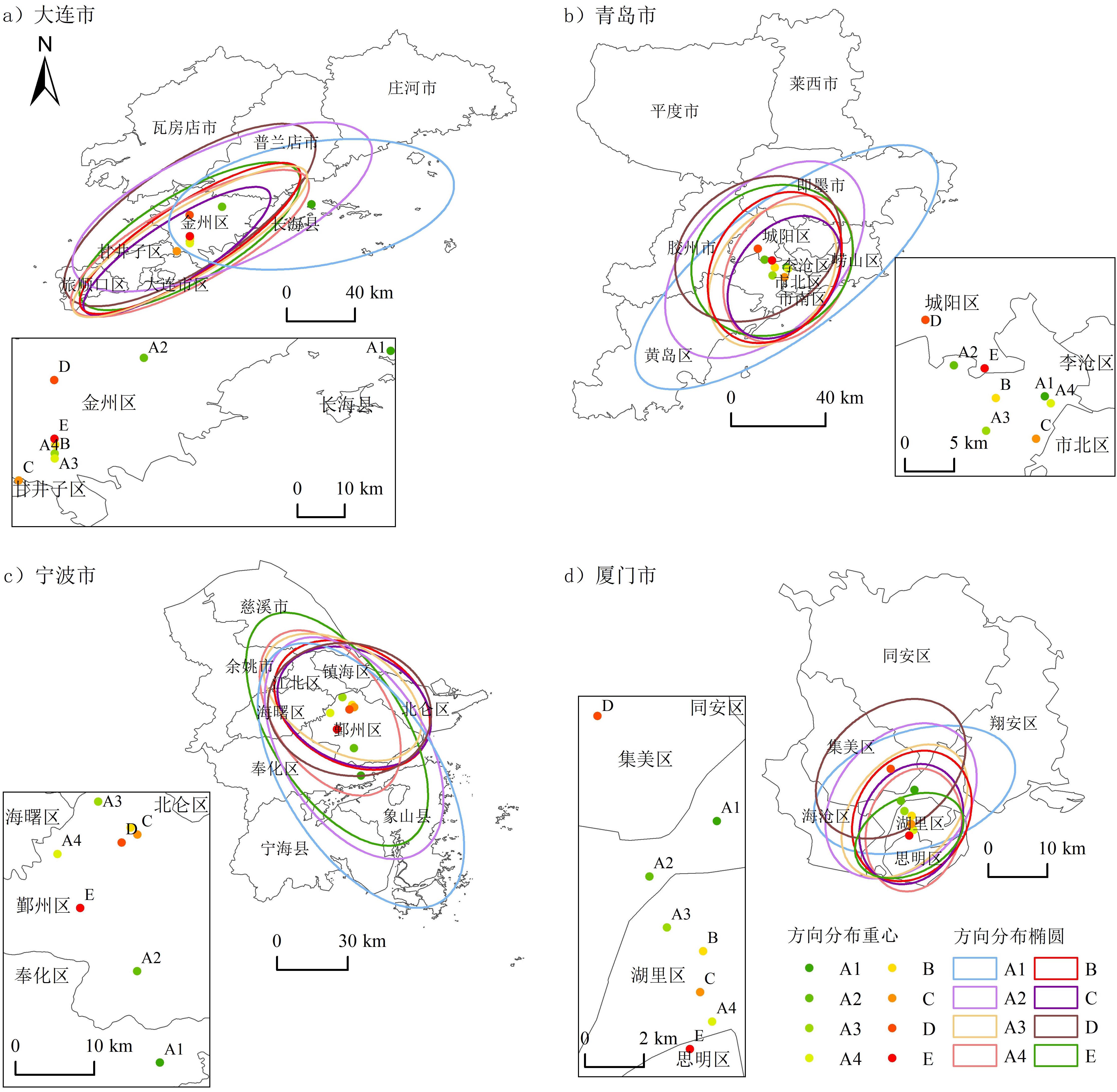
Maritime Power has gradually increased as a national strategy. In this process, gross marine products continue to grow, and the marine industry has become the most fundamental and critical object. The spatial layout and industrial organization of maritime enterprises are fundamental related tasks. Domestic research can be divided into two main categories, based on the data used. One is to use economic and social statistical data, which have a large spatial scope but large granularity and cannot reflect the details of the industrial layout. The other is to use point-of-interest data, which are often not fully mined owing to the heavy workload of data processing. Therefore, there is little relevant content on departmental and urban comparisons in the existing research. Four representative cities-Dalian, Qingdao, Ningbo, and Xiamen-were selected as the research areas. According to the Industrial Classification for Ocean Industries and Their Related Activities, the research objects were identified as the marine core layer, marine support layer, and marine peripheral layer industries and further refined into eight subcategories. This study is based on the information of maritime enterprises registered for business registration, and uses Python to crawl geographic coordinates to improve the spatial information of enterprises. An innovative task is to identify the industry categories of enterprises. This task was performed using fastText, Convolutional Neural Networks, and Recurrent Neural Network. Thus, a spatial enterprise information database, including multiple marine industry departments, was established. Kernel density analysis, standard deviational ellipse analysis, buffer analysis, and other methods were used. Finally, by comparing the visualization results of the marine industrial spatial layout in the four cities, we delved into the marine industrial spatial differentiation patterns. In the experiment, machine learning models, such as artificial neural networks, exhibited high accuracy and recall when completing human recognition tasks, and these methods were effective. Empirical research on the spatial layout and industrial organization of maritime enterprises revealed the following: 1)From the perspective of spatial pattern, the overall pattern is a balanced pattern of "large dispersion and small agglomeration." By comparing the distribution and organization of different types of marine industries, we found that there is industry agglomeration in the location selection of enterprises, resulting in industry agglomeration characteristics. The land sea relationship is reflected in the high-density single peak or "coastal zone-city center" Multimodal distribution pattern. 2) From the perspective of spatial organization mode, industrial clusters have multilevel hierarchical characteristics corresponding to population size and administrative levels. In addition to single core structures, multi core structures generally exhibit a "primary-secondary dual core" or "primary core-multiple radial" pattern, with spatial connections between core intervals forming a multi node axis or network structure. 3) From the perspective of spatial matching relationships, the elliptical area is positively related to the urban area, the direction of the long axis is close to the coastal direction, and the industrial distribution has a clear matching relationship with the urban center, ports, and other transportation hubs, bay terrain, coastline, and other spatial elements.
Tianbao Liu , Guangpeng Ma , Haiyu Zhang , Guixiang Zhang . A Comparative Study on the Type Recognition and Spatial Organization Characteristics of Sea-Related Enterprises Based on Machine Learning in Cities[J]. Tropical Geography, 2024 , 44(8) : 1460 -1474 . DOI: 10.13284/j.cnki.rddl.20230362
表1 基于《海洋及相关产业分类》的研究对象确定Table 1 Determination of research objects based on Industrial Classification for Ocean Industries and Their Related Activities |
| 研究分类 | 代码 | 大类名称 |
|---|---|---|
| A1直接从海洋中 获取产品的生产和 服务活动 | 01 | 海洋渔业 |
| 04 | 海洋油气业 | |
| 05 | 海洋矿业 | |
| 06 | 海洋盐业 | |
| A2直接从海洋中 获取产品的加工 生产和服务活动 | 03 | 海洋水产品加工业 |
| 09 | 海洋化工业 | |
| 10 | 海洋药物和生物制品业 | |
| A3直接应用于海洋和海洋开发活动的 产品生产和 服务活动 | 07 | 海洋船舶工业 |
| 08 | 海洋工程装备制造业 | |
| 11 | 海洋工程建筑业 | |
| 14 | 海洋交通运输业 | |
| A4利用海水或者 海洋空间作为生产 过程的基本要素所 进行的生产和 服务活动 | 02 | 海洋滩涂种植业 |
| 12 | 海洋电力业 | |
| 13 | 海水淡化与综合利用业 | |
| 15 | 海洋旅游业 |
表2 二分类问题可能的预测结果Table 2 Possible outcomes of binary classification |
| 预测结果 | 正类Positives,P | 负类Negatives,N |
|---|---|---|
| 预测为正类 | True Positives,TP 正类判定为正类 | False Positives,FP 负类判定为正类 |
| 预测为负类 | False Negatives,FN 正类判定为负类 | True Negatives,TN 负类判定为负类 |
表3 模型在测试集上的表现结果Table 3 Performance results of models on test set |
| 评价指标 | CNN | RNN | fastText | |
|---|---|---|---|---|
| 模型训练时间/min | 8.3 | 9.2 | 0.2 | |
| 文本预测速度/(个·s-1) | 16.2 | 15.1 | 1 897 | |
| macro avg | Precision | 0.910 | 0.924 | 0.928 |
| Recall | 0.914 | 0.907 | 0.922 | |
| F 1-score | 0.912 | 0.915 | 0.925 | |
| weighted avg | Precision | 0.928 | 0.933 | 0.938 |
| Recall | 0.927 | 0.933 | 0.937 | |
| F 1-score | 0.928 | 0.932 | 0.937 | |
|
表4 四城市海洋产业空间结构类型划分Table 4 Classification of spatial structure of marine industries in Dalian, Qingdao, Ningbo & Xiamen |
| 结构类型 | 大连市 | 青岛市 | 宁波市 | 厦门市 |
|---|---|---|---|---|
| 单核心结构 | A3、E | — | — | E |
| 多核心结构 | A4、B、C | A3、A4、C | A3、A4、C | A1-A4、D |
| 轴线结构 | A1 | A1、E、B | B | C |
| 网状结构 | A2、D | A2、D | A1、A2、D、E | B |

1 天眼查:https://www.tianyancha.com/
2 高德地图:https://ditu.amap.com/
3 清科研究中心:https://www.pedata.cn/
刘天宝:选题指导,研究框架设计,课题支撑;
马广鹏:数学建模,文稿撰写,图件制作;
张海瑜:逻辑梳理,结构优化;
张贵祥:技术指导,论文修改指导。
|
Adkins D. 2021. The Governance of Maritime Clusters and the Impact on Sustainable Development and Social Capital. Plymouth: University of Plymouth.
|
|
蔡卫民,曾铭,李冬杰. 2020. 中国会展城市旅游微博时空分布特征及其影响因素. 经济地理,40(8):185-193. [Cai Weimin, Zeng Ming, and Li Dongjie. 2020. Spatial-Temporal Characteristics and Influencing Factors of Tourism Microblogs to China's MICE City Based on Sina Microblog Data. Economic Geography, 40(8): 185-193.
|
|
陈晓峰,张二震. 2020. 中国海洋产业协同集聚的空间格局及其作用机制研究. 福建论坛(人文社会科学版),(10):132-143.
Chen Xiaofeng and Zhang Erzhen. 2020. A Study on the Spatial Pattern and Mechanism of Collaborative Agglomeration of China's Marine Industry. Fujian Tribune (Humanities and Social Sciences), (10): 132-143.
|
|
Colgan C S and Scorse J. 2020. Ocean Climate Policy: Building the Blue Economy in the Twenty-First Century. In: Robert Brears. The Palgrave Handbook of Climate Resilient Societies. Cham: Palgrave Macmillan, 1-22.
|
|
Crespo J, Boschma R, and Balland P A. 2017. Resilience, Networks and Competitiveness: A Conceptual Framework. In: Huggins Robert and ThompsonPiers.. Handbook of Regions and Competitiveness. Cheltenham: Edward Elgar Publishing, 271-286.
|
|
Di Qianbin and Dong Shaoyu. 2017. Symbiotic State of Chinese Land-Marine Economy. Chinese Geographical Science, 27(2): 176-187.
|
|
Doloreux D, Shearmur R, and Figueiredo D. 2016. Québec' Coastal Maritime Cluster: Its Impact on Regional Economic Development, 2001-2011. Marine Policy, 71: 201-209.
|
|
Doloreux D. 2017. What is a Maritime Cluster? Marine Policy, 83: 215-220.
|
|
国家质量监督检验检疫总局,国家标准化管理委员会. 2021. 中华人民共和国国家标准/海洋及相关产业分类(GB/T20794-2021). 北京:中国标准出版社.
General Administration of Quality Supervision, Inspection and Quarantine, Standardization Administration of China. 2021. National Standards of P.R.C/ Industrial Classification for Ocean Industries and Their Related Activities(GB/T20794-2021). Bejing: Standards Press of China.
|
|
韩增林,胡伟,李彬,刘天宝,胡渊. 2016. 中国海洋产业研究进展与展望. 经济地理,36(1):89-96.
Han Zenglin, Hu Wei, Li Bin, Liu Tianbao, and Hu Yuan. 2016. Progress and Prospect on the Research of Marine Industry in China. Economic Geography, 36(1): 89-96.
|
|
Hochreiter S and Schmidhuber J. 2012. Long Short-Term Memory. Neural Computation, 9(8): 1735-1780.
|
|
纪玉俊,李振洋. 2016. 地区区位优势、海洋产业集聚与区域海洋经济分异——基于新经济地理学中心-外围模型的研究. 中国海洋大学学报(社会科学版),(2):33-40.
Ji Yujun and Li Zhenyang. 2016. Regional Advantage, Marine Industry Agglomeration and Regional Differences of Marine Economy: A Study Based on Center-Peripheral Model of New Economic Geography. Journal of Ocean University of China(Social Sciences), (2): 33-40.
|
|
Koliousis I G, Papadimitriou S, Riza E, Stavroulakis P J, and Tsioumas V. 2018. Scarcity Theory and Maritime Clusters: From Paradox to Modelling. Marine Policy, 93: 40-46.
|
|
Langen P W. 2002. Clustering and Performance: The Case of Maritime Clustering in The Netherlands, Maritime Policy & Management, 29(3): 209-221
|
|
李博,曹盖. 2022. 基于涉海A股上市公司的中国沿海地区海洋经济网络结构韧性演化研究. 地理科学进展,41(6):945-955.
Li Bo and Cao Gai. 2022. Structural Resilience Change of China's Marine Economic Network Based on the Data of Sea-Related A-Share Listed Companies. Progress in Geography, 41(6): 945-955.
|
|
Liao Qingmei, Zhen Hong, and Zhou Dequan. 2022. A Study on the Industrial Symbiosis in Maritime Cluster Considering Value Chain and Life Cycle-Case of Dalian, China. Maritime Policy & Management, 49(7): 1043-1058.
|
|
刘天宝,马广鹏. 2023. 陆海统筹背景下产业统筹发展的研究框架及关键议题. 资源开发与市场,39(5):513-518,546.
Liu Tianbao and Ma Guangpeng. 2023. Research Framework and Key Issues of Industry Coordinative Development under the Background of Land-Marine Coordination. Resource Development & Market, 39(5): 513-518, 546.
|
|
罗成书. 2021. 沿海地区产业布局海陆统筹研究——以浙江省为例. 特区经济,(10):12-17.
Luo Chengshu. 2021. Research on the Industrial Layout of Land-Sea Coordination in Coastal Areas: A Case Study of Zhejiang Province. Special Zone Economy Issue, (10):12-17
|
|
马仁锋,李加林,赵建吉,庄佩君. 2013. 中国海洋产业的结构与布局研究展望. 地理研究,32(5):902-914.
Ma Renfeng, Li Jialin, Zhao Jianji, and Zhuang Peijun. 2013. Progress on the Research of Maritime Industry Structure and Layout in China. Geographical Research, 32(5): 902-914.
|
|
马仁锋,候勃,陈鹏,窦思敏. 2018. 浙江海洋企业时空集聚区位特征研究. 浙江大学学报(理学版),45(5):617-624,646.
Ma Renfeng, Hou Bo, Chen Peng, and Dou Simin. 2018. A Study on the Spatio-Temporal Agglomeration of Locations of Zhejiang Marine Enterprises. Journal of Zhejiang University(Science Edition), 45(5): 617-624, 646.
|
|
Mikolov T, Chen K, Corrado G, and Dean J. 2013a. Efficient Estimation of Word Representations in Vector Space. (2013-01-16) [2023-07-01]. https://arxiv.org/abs/1301.3781.
|
|
Mikolov T, Sutskever I, Chen K, Corrado G, and Dean J. 2013b. Distributed Representations of Words and Phrases and their Compositionality. (2013-10-16) [2024-07-01]. https://arxiv.org/abs/1310.4546.
|
|
Paul Longley, Michael Goodchild, David Maguire, and David Rhind. 2015. Geographic Information Science & System. New York: John Wiley & Sons.
|
|
秦曼,梁铄,万骁乐. 2020. 青岛市海洋生物产业空间布局与区位选择. 地域研究与开发,39(1):76-82.
Qin Man, Liang Shuo,and Wan Xiaole. 2020. Location Choice and Spatial Pattern Evolution of Marine Biological Enterprises in Qingdao City. Areal Research and Development, 39(1): 76-82.
|
|
Rumelhart D, Geoffrey E, and Ronald J S. 1986. Learning Representations by Back Propagating Errors. Nature, 323(6088): 533-536.
|
|
沈体雁,施晓铭. 2017. 中国海洋产业园区空间布局研究. 经济问题,(3):107-110.
Shen Tiyan and Shi Xiaoming. 2017. Study on the Spatial Distribution of Marine Industrial Parks in China. On Economic Problems, (3): 107-110.
|
|
Shinohara M. 2010. Maritime Cluster of Japan: Implications for the Cluster Formation Policies. Maritime Policy & Management, 37(4): 377-399.
|
|
Silva Monteiro J P V, Neto P A, and Noronha M T. 2014. Understanding the Ways and the Dynamics of Collaborative Innovation Processes: The Case of the Maritime Cluster of the Algarve region(Portugal). Urban, Planning and Transport Research, 2(1): 247-264.
|
|
孙才志,李博,郭建科,彭飞,闫晓露,盖美,刘天宝,刘锴,王泽宇,狄乾斌,赵良仕,刘桂春,钟敬秋,孙康. 2021. 改革开放以来中国海洋经济地理研究进展与展望. 经济地理,41(10):117-126.
Sun Caizhi, Li Bo, Guo Jianke, Peng Fei, Yan Xiaolu, Gai Mei, Liu Tianbao, Liu Kai, Wang Zeyu, Di Qianbin, Zhao Liangshi, Liu Guichun, Zhong Jingqiu, and Sun Kang. 2021. Progress and Prospect of China's Marine Economic Geography Since the Reform and Opening-up. Economic Geography, 41(10): 117-126.
|
|
孙久文,高宇杰. 2021. 中国海洋经济发展研究. 区域经济评论,(1):38-47.
Sun Jiuwen and Gao Yujie. 2021. Research on China's Marine Economic Development. Regional Economic Review, (1): 38-47.
|
|
童心,谭春兰,朱清澄. 2019. 长三角地区海洋战略性新兴产业布局评价和优化. 海洋开发与管理,36(10):47-51.
Tong Xin, Tan Chunlan, and Zhu Qingcheng. 2019. Industrial Distribution Evaluation and Optimization of Marine Strategic Emerging Industries in the Yangtze River Delta. Ocean Development and Management, 36(10): 47-51.
|
|
王逸文,徐建刚,刘迪. 2023. 基于产业发展大数据的南京都市圈建成区扩张时空特征分析. 热带地理,43(5):821-836.
Wang Yiwen, Xu Jian'gang, and Liu Di. 2023. Spatial and Temporal Analyses of the Expansion of Built-Up Areas in Nanjing Metropolitan Area Based on Industrial Big Data. Tropical Geography, 43(5): 821-836.
|
|
汪永生,李玉龙,王文涛. 2022. 中国海洋生态经济系统韧性的时空演化及障碍因素. 生态经济,38(5):53-59.
Wang Yongsheng, Li Yulong, and Wang Wentao. 2022. Spatial and Temporal Changes and Obstacle Factors of Marine Ecological-Economic Resilience in China. Ecological Economy, 38(5): 53-59.
|
|
吴震,冉晓燕,苗权,刘纯艳,张栋,魏娜. 2022. 基于fastText算法的行业分类技术. 北京航空航天大学学报,48(2):193-198.
Wu Zhen, Ran Xiaoyan, Miao Quan, Liu Chunyan, Zhang Dong, and Wei Na. 2022. Industry Classification Technology Based on fastText Algorithm. Journal of Beijing University of Aeronautics and Astronautics, 48(2): 193-198.
|
|
杨羽頔. 2015. 环渤海地区陆海统筹测度与海洋产业布局研究. 大连:辽宁师范大学.
Yang Yudi. 2015. Assessment of Land-Sea Coordination and Distribution of Marine Industry in Bohai Sea Rim Area. Dalian: Liaoning Normal University.
|
|
袁莹莹,韩增林,彭飞. 2017. 中国海洋产业安全研究综述. 太平洋学报,25(4):94-101.
Yuan Yingying, Han Zenglin, and Peng Fei. 2017. Review of Researches on Marine Industry Security in China. Pacific Journal, 25(4): 94-101.
|
/
| 〈 |
|
〉 |