Spatial-Temporal Patterns and Driving Factors of Population Aging in China at the County Level during 2000-2020
Received date: 2023-08-16
Revised date: 2023-10-31
Online published: 2024-08-09
A comprehensive understanding of the distribution pattern and driving factors of population aging at the country level in China is fundamental for enhancing the governance capacity of the governing authorities and implementing a national strategy to actively cope with the aging society. On the basis of the 2000, 2010, and 2020 census data on the Chinese population, we determined the distribution pattern of population aging in China over the past 20 years at the county level and adopted a fractional response model to identify the main influencing factors of such spatial distribution from three perspectives: the natural environment, socioeconomic factors, and population migration. The following observations were made: 1) During the past 20 years, most counties in China have entered into an "aging society," some counties have entered into an "aged society," and counties in the Chengdu-Chongqing region, central Inner Mongolia, and peripheral Yangtze River Delta have entered into a "hyper-aged society." 2) The spatial structure of the distribution of population aging exhibited various patterns. Overall, the Hu Line is a clear demarcation for the distribution, with the degree of aging of the counties in the southeastern half of the line being generally higher than that of the counties in the northwestern half and maintaining a certain degree of stability. During the past 20 years, the aging population has shown a gradient diffusion of the characteristics of the Eastern monsoon region―Northwest arid region―Qinghai-Tibet Plateau region. From a local perspective, population aging presents various structural characteristics, such as "homogenization," "reverse core-edge," and "core-edge" spatial structures. 3) Significant regional differences exist in population aging. Vast differences in population aging between different ecological regions, between urban and rural areas, and between ethnic and non-ethnic autonomous regions are obvious, and these differences tend to expand further. 4) Natural factors have laid the macro pattern of the distribution of population aging. Socioeconomic factors are the main driving force of the aging process, and population migration has played an important role in restructuring the aging space pattern. This study provides a scientific basis for optimization of the spatial allocation of pension resources, and different regions can actively respond to the formulation and improvement of differentiated policies for population aging.
Rongwei Wu , Houyin Wang , Yuanxin Wang , Li Chen . Spatial-Temporal Patterns and Driving Factors of Population Aging in China at the County Level during 2000-2020[J]. Tropical Geography, 2024 , 44(8) : 1500 -1512 . DOI: 10.13284/j.cnki.rddl.20230643
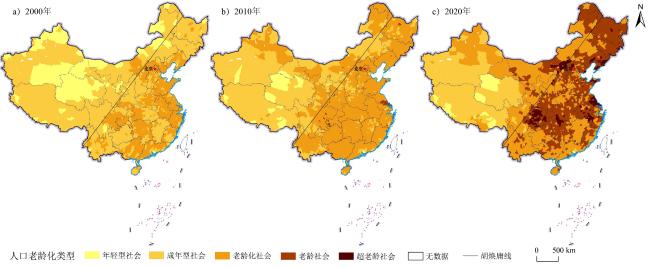
图2 2000、2010和2020年中国人口老龄化类型分布 Fig.2 Distribution of population aging types of China in 2000, 2010, and 2020 |
表1 2000—2020年全国县域老龄化类型变化 (个)Table 1 The changes of the population aging types in China at the county level during 2000-2020 |
| 老龄化类型(占比/%) | 2000年 | 2010年 | 2020年 |
|---|---|---|---|
| 年轻型社会(0,4] | 113 | 27 | 14 |
| 成年型社会(4,7] | 1 325 | 477 | 149 |
| 老龄化社会(7,14] | 1 110 | 2 019 | 1 110 |
| 老龄社会(14,20] | 4 | 29 | 1 108 |
| 超老龄社会(20,100] | 0 | 0 | 171 |
表2 11类生态地区间人口老龄化程度比较分析Table 2 Comparison of population aging in 11 ecoregions |
| 生态地区 | 老龄化/% | 变异系数 | |||||
|---|---|---|---|---|---|---|---|
| 2000年 | 2010年 | 2020年 | 2000年 | 2010年 | 2020年 | ||
| 东北生态地区 | 6.37 | 8.91 | 16.03 | 0.255 8 | 0.231 0 | 0.159 4 | |
| 华北生态地区 | 7.63 | 9.06 | 14.25 | 0.159 3 | 0.171 1 | 0.179 5 | |
| 内蒙古高原生态地区 | 5.88 | 7.77 | 12.50 | 0.263 8 | 0.296 1 | 0.383 1 | |
| 西北干旱生态地区 | 4.62 | 6.64 | 8.45 | 0.188 0 | 0.287 9 | 0.350 1 | |
| 黄土高原生态地区 | 5.90 | 7.95 | 13.03 | 0.203 2 | 0.173 6 | 0.205 6 | |
| 川渝生态地区 | 7.55 | 10.65 | 16.21 | 0.166 3 | 0.186 8 | 0.216 6 | |
| 长江中下游生态地区 | 8.06 | 9.98 | 15.23 | 0.247 6 | 0.231 3 | 0.234 5 | |
| 华南生态地区 | 6.89 | 8.09 | 10.96 | 0.200 6 | 0.212 4 | 0.214 2 | |
| 云贵高原生态地区 | 5.94 | 7.94 | 10.88 | 0.192 0 | 0.181 1 | 0.221 6 | |
| 青藏高原高寒生态地区 | 4.24 | 5.15 | 6.43 | 0.221 1 | 0.244 8 | 0.310 6 | |
| 横断山区生态地区 | 5.70 | 6.83 | 9.02 | 0.144 7 | 0.202 9 | 0.318 8 | |
表3 中国城镇与乡村地区人口老龄化程度比较Table 3 Comparison of population aging in urban and rural areas of China |
| 年份 | 分类 | 老年人/万人 | 总人口/万人 | 老龄化/% |
|---|---|---|---|---|
| 2000 | 城镇 | 2 946.52 | 45 877.10 | 6.42 |
| 乡村 | 5 880.88 | 78 384.12 | 7.50 | |
| 城区 | 2 310.55 | 33 426.36 | 6.91 | |
| 县域 | 6 516.85 | 90 834.87 | 7.17 | |
| 2010 | 城镇 | 5 225.42 | 67 000.55 | 7.80 |
| 乡村 | 6 667.29 | 66 280.53 | 10.06 | |
| 城区 | 3 472.98 | 41 887.05 | 8.29 | |
| 县域 | 8 419.72 | 91 389.32 | 9.21 | |
| 2020 | 城镇 | 10 028.24 | 89 999.12 | 11.14 |
| 乡村 | 9 035.29 | 50 978.76 | 17.72 | |
| 城区 | 6 193.62 | 57 517.08 | 10.77 | |
| 县域 | 12 869.90 | 83 460.78 | 15.42 |
表4 中国民族自治地区与非民族自治地区人口老龄化程度比较Table 4 Comparison of population aging in ethnic minority autonomous regions and other regions of China |
| 年份 | 地区分类 | 总人口 | 老龄人口 | 老龄化 程度/% | |||
|---|---|---|---|---|---|---|---|
| 数量/万人 | 占全国比例/% | 数量/万人 | 占全国比例/% | ||||
| 2000 | 民族自治区 | 9 359.55 | 7.67 | 571.25 | 6.59 | 6.10 | |
| 其他地区 | 112 736.41 | 92.33 | 8 100.75 | 93.41 | 7.19 | ||
| 2010 | 民族自治区 | 10 149.22 | 7.76 | 806.75 | 6.91 | 7.95 | |
| 其他地区 | 120 617.82 | 92.24 | 10 881.59 | 93.09 | 9.02 | ||
| 2020 | 民族自治区 | 11 981.97 | 7.83 | 1 207.81 | 6.36 | 10.99 | |
| 其他地区 | 129 313.90 | 92.17 | 17 770.46 | 93.64 | 13.74 | ||
表5 模型估计结果Table 5 Results of regression model |
| 变量 | OLS | FRM | |||||
|---|---|---|---|---|---|---|---|
| 2000年 | 2010年 | 2020年 | 2000年 | 2010年 | 2020年 | ||
| 人均GDP | 0.004***(-7.26) | 0.002***(-3.19) | 0.011***(-6.79) | 0.036***(-8.62) | 0.018***(-4.47) | 0.056***(8.20) | |
| 城镇化水平 | -0.029***(-16.03) | -0.029***(-9.80) | -0.068***(-10.80) | -0.185***(-13.05) | -0.136***(-7.32) | -0.164***(-5.76) | |
| 千人卫生院床位数 | -0.001(-0.78) | 0.003***(-3.47) | 0.010***(-4.84) | -0.009*(-1.91) | 0.015***(-2.98) | 0.013(1.52) | |
| 受教育年限 | 0.008***(-6.52) | 0.019***(-8.21) | 0.047***(-6.58) | 0.072***(-7.58) | 0.151***(-9.75) | 0.353***(10.96) | |
| 平均海拔 | -0.003***(-15.39) | -0.003***(-13.17) | -0.006***(-13.95) | -0.021***(-14.99) | -0.017***(-12.68) | -0.025***(-13.36) | |
| 1月与7月温差 | -0.011***(-15.14) | -0.012***(-12.14) | 0.018***(-9.52) | -0.096***(-18.23) | -0.084***(-14.18) | 0.052***(6.09) | |
| NDVI | 0.013***(-6.66) | 0.027***(-11.51) | 0.085***(-18.90) | 0.093***(-6.17) | 0.187***(-12.38) | 0.375***(17.66) | |
| 流入率 | -0.031***(-17.88) | -0.043***(-20.88) | -0.040***(-15.48) | -0.542***(-17.37) | -0.418***(-20.53) | -0.502***(-22.57) | |
| 流出率 | 0.056***(-15.91) | 0.097***(-36.33) | 0.022***(-11.02) | 0.399***(-15.75) | 0.593***(-37.61) | 0.091***(12.45) | |
| 生育状况 | -0.038***(-19.61) | -0.066***(-23.62) | -0.074***(-17.06) | -0.320***(-21.44) | -0.417***(-24.27) | -0.365***(-18.95) | |
| 常数项 | 0.117***(-31.01) | 0.102***(-17.24) | -0.02(-1.23) | -1.088***(-37.10) | -1.321***(-34.76) | -2.006***(-27.51) | |
| AIC | -142 40.69 | -12 951.48 | -9 359.444 | -14 399.98 | -13 128.88 | -9 647.582 | |
| BIC | -14 177.35 | -12 888.39 | -9 296.937 | -14 330.88 | -13 060.05 | -9 579.393 | |
|

1 https://www.resdc.cn/
武荣伟:论文选题、方案设计、逻辑梳理、论文写作与修改;
王堠崟:数据整理,数据分析,初稿写作;
王远鑫:图表制作;
陈 利:论文写作、概念构思、基金支持。
|
敖荣军,常亮. 2020. 基于结构方程模型的中国县域人口老龄化影响机制. 地理学报,75(8):1572-1584.
Ao Rongjun and Chang Liang. 2020. Influencing Mechanism of Regional Ageing in China Based on the Structural Equation Model. Acta Geographica Sinica, 75(8): 1572-1584.
|
|
Becker S O, Cinnirella F, and Woessmann L. 2010. The Trade-Off between Fertility and Education: Evidence from before the Demographic Transition. Journal of Economic Growth, 15(3): 177-204.
|
|
Browning M H E M, Rigolon A, and McAnirlin O. 2022. Where Greenspace Matters Most: A Systematic Review of Urbanicity, Greenspace, and Physical Health. Landscape and Urban Planning, 217(1): 104233.
|
|
陈明华,郝国彩. 2014. 中国人口老龄化地区差异分解及影响因素研究. 中国人口·资源与环境,24(4):136-141.
Chen Minghua and Hao Guocai. 2014. Decomposition of Regional Differences and Influencing Factors of Aging Chinese Population. China Population, Resources and Environment, 24(4): 136-141.
|
|
陈蓉,王美凤. 2018. 经济发展不平衡、人口迁移与人口老龄化区域差异——基于全国287个地级市的研究. 人口学刊,40(3):71-81.
Chen Rong and Wang Meifeng. 2018. Regional Differences in Unbalanced Economic Development, Population Migration and Population Aging: Based on 287 Prefecture-Level Cities in China. Population Journal, 40(3): 71-81.
|
|
陈新明,萧鸣政,张睿超. 2020. 城市“抢人大战”的政策特征、效力测度及优化建议. 中国人力资源开发,37(5):59-69.
Chen Xinming, Xiao Mingzheng, and Zhang Ruichao. 2020. Policy Characteristics, Effectiveness Measurement and Optimization Suggestions of Urban "War for People". Human Resources Development of China, 37(5): 59-69.
|
|
陈淑云,李琪. 2022. 人才政策对流动人口落户决策的影响——基于全国199个地级市的证据. 江汉论坛,(5):32-42.
Chen Shuyun and Li Qi. 2022. The Influence of Talent Policy on the Settlement Decision of Floating Population: Based on the Evidence of 199 Prefecture-Level Cities in China. Jianghan Tribune, (5): 32-42.
|
|
段成荣,谢东虹,吕利丹. 2019. 中国人口的迁移转变. 人口研究,43(2):12-20.
Duan Chengrong, Xie Donghong, and Lyu Lidan. 2019. Migration and Transformation of Chinese Population. Population Research, 43(2): 12-20.
|
|
段成荣,黄凡,毕忠鹏,巫锡炜. 2021. 中国大陆1982—2010年各民族人口转变研究. 民族研究,(2):39-56,140.
Duan Chengrong, Huang Fan, Bi Zhongpeng, and Wu Xiwei. 2021. Study on the Demographic Transition of Various Ethnic Groups in Chinese Mainland from 1982 to 2010. Ethno-National Studies, (2): 39-56, 140.
|
|
符宁,向梦航,程显通. 2020. 人均预期寿命影响因素研究——基于193个国家相关数据的分析. 人口学刊,42(5):47-56.
Fu Ning, Xiang Menghang, and Cheng Xiantong. 2020. Research on the Influencing Factors of Life Expectancy: An Analysis Based on Relevant Data from 193 Countries. Journal of Demography, 42(5): 47-56.
|
|
国家统计局城市社会经济调查司. 2001—2021. 中国城市统计年鉴. 北京:中国统计出版社.
Department of Urban Socio-Economic Surveys, National Bureau of Statistics. 2001-2021. China City Statistical Yearbook. Beijing: China Statistics Press.
|
|
国家统计局国民经济综合统计司. 2001—2015. 中国区域经济统计年鉴. 北京:中国统计出版社.
Department of Comprehensive Statistics of National Economy, National Bureau of Statistics. 2001-2015. China Regional Economic Statistical Yearbook. Beijing: China Statistics Press.
|
|
国家统计局农村社会经济调查司. 2001—2021. 中国县域统计年鉴(县市卷). 北京:中国统计出版社.
Department of Rural Social and Economic Survey, National Bureau of Statistics. 2001-2021. China Statistical Yearbook (County-Level). Beijing: China Statistics Press.
|
|
胡湛,彭希哲. 2018. 应对中国人口老龄化的治理选择. 中国社会科学,(12):134-155,202.
Hu Zhan and Peng Xizhe. 2018. Governance Options for Coping with Aging Chinese Population. Social Sciences in China, (12): 134-155, 202.
|
|
胡述聚,李诚固,申庆喜,马佐澎. 2018. 长春市人口老龄化时空演变及空间类型研究. 人文地理,33(3):104-111.
Hu Shuju, Li Chenggu, Shen Qingxi, and Ma Zuopeng. 2018. Spatial and Temporal Evolution and Spatial Type of Population Aging in Changchun. Human Geography, 33(3): 104-111.
|
|
孔令文,陈珍珍. 2015. 人口、经济因素对中国人口老龄化的影响——基于省际面板数据的经验分析. 东北大学学报(社会科学版),17(3):252-259.
Kong Lingwen and Chen Zhenzhen. 2015. The Impact of Population and Economic Factors on the Aging of Chinese Population: An Empirical Analysis Based on Interprovincial Panel Data. Journal of Northeastern University (Social Science), 17(3): 252-259.
|
|
Li J M, Han X L, Zhang X X, and Wang S X. 2019. Spatiotemporal Evolution of Global Population Ageing from 1960 to 2017. BMC Public Health, 19(1): 127.
|
|
冷晨昕,周晓时,吴丽丽. 2021. 人力资本对农业劳动供给的影响——基于分数响应模型和无条件分位数回归模型. 经济问题探索,(2):38-48.
Leng Chenxin, Zhou Xiaoshi, and Wu Lili. 2021. The Influence of Human Capital on Agricultural Labor Supply: Based on Fractional Response Model and Unconditional Quantile Regression Model. Inquiry into Economic Issues, (2): 38-48.
|
|
李婷. 2019. 中国成年人口预期寿命的地区差异分析——基于生命力死亡模型的分解. 中国人口科学,4:102-113,128.
Li Ting. 2019. Regional Differences in Life Expectancy in China: Decomposition Based on Vitality Death Model. Chinese Journal of Population Science, (4): 102-113, 128.
|
|
林宝. 2018. 人口老龄化城乡倒置:普遍性与阶段性. 人口研究,42(3):38-50.
Lin Bao. 2018. Urban-Rural Inversion of Population Aging: Universality and Stage. Population Research, 42(3): 38-50.
|
|
刘涛,齐元静,曹广忠. 2015. 中国流动人口空间格局演变机制及城镇化效应——基于2000和2010年人口普查分县数据的分析. 地理学报,70(4):567-581.
Liu Tao, Qi Yuanjing, and Cao Guangzhong. 2015. The Evolution Mechanism of Spatial Pattern of China's Migrant Population and Its Urbanization Effect: An Analysis Based on the Data of 2000 and 2010 Population Census by County. Acta Geographica Sinica, 70(4): 567-581.
|
|
刘涛,张家瑞,曹广忠. 2022. 人口流动对区域老龄化进程的影响——一个方法论探讨. 地理研究,41(10):2680-2696.
Liu Tao, Zhang Jiarui, and Cao Guangzhong. 2022. The Impact of Population Mobility on Regional Aging Process: A Methodological Discussion. Geographical Research, 41(10): 2680-2696.
|
|
Balestat G, Paolantonio G D, and Lorenzoni L. 2020. Health Status. In: OECD/World Health Organization. "Ageing", in Health at a Glance: Asia/Pacific 2020: Measuring Progress Towards Universal Health Coverage. Paris: OECD Publishing.
|
|
Papke L E and Wooldridge J M. 2008. Panel Data Methods for Fractional Response Variables with an Application to Test Pass Rates. Journal of Econometrics, 145(1/2): 121-133.
|
|
戚伟,赵美风,刘盛和. 2017. 1982—2010年中国县市尺度流动人口核算及地域类型演化. 地理学报,72(12):2131-2146.
Qi Wei, Zhao Meifeng, and Liu Shenghe. 2017. Accounting of Floating Population at County and City Scale and Evolution of Regional Types in China from 1982 to 2010. Acta Geographica Sinica, 72(12): 2131-2146.
|
|
Rogers A and Woodward J A. 1992. Tempos of Elderly Age and Geographical Concentration. The Professional Geographer, 44(1): 72-83.
|
|
宋健,张晓倩. 2021. 从人口转变到家庭转变:一种理论分析思路. 探索与争鸣,(1):129-136,180.
Song Jian and Zhang Xiaoqian. 2021. From Population Transition to Family Transition: A Theoretical Analysis. Exploration and Free Views, (1): 129-136, 180.
|
|
唐家龙,马忠东. 2007. 中国人口迁移的选择性:基于五普数据的分析. 人口研究,(5):42-51.
Tang Jialong and Ma Zhongdong. 2007. Selectivity of Chinese Port Migration: An Analysis Based on Wupu Data. Population Research, (5): 42-51.
|
|
United Nations. Department of International Economic and Social Affairs. 1956. The Aging of Populations and Its Economic and Social Implications. Population Studies, 26 (XIII): 6.
|
|
王录仓,武荣伟,刘海猛,周鹏,康江江. 2016a. 县域尺度下中国人口老龄化的空间格局与区域差异. 地理科学进展,35(8):921-931.
Wang Lucang, Wu Rongwei, Liu Haimeng, Zhou Peng, and Kang Jiangjiang. 2016a. Spatial Pattern and Regional Differences of Chinese Population Aging at County Scale. Progress in Geography, 35(8): 921-931.
|
|
王录仓,武荣伟. 2016b. 中国人口老龄化时空变化及成因探析——基于县域尺度的考察. 中国人口科学,(4):74-84,127.
Wang Lucang and Wu Rongwei. 2016b. Spatial-Temporal Changes and Causes of Aging in Chinese: An Investigation Based on County Scale. Chinese Journal of Population Science, (4): 74-84, 127.
|
|
王青,付雪婷,薛静,葛淼. 2004. 青藏高原气候与健康. 国外医学(医学地理分册),(2):92-94,98.
Wang Qing, Fu Xueting, Xue Jing, and Ge Miao. 2004. Climate and Health of the Qinghai-Tibet Plateau. Foreign Medical Sciences(Section of Medgeography), (2): 92-94, 98.
|
|
王志宝,孙铁山,李国平. 2013. 近20年来中国人口老龄化的区域差异及其演化. 人口研究,37(1):66-77.
Wang Zhibao, Sun Tieshan, and Li Guoping. 2013. Regional Differences and Evolution of Chinese Population Aging in Recent 20 Years. Population Research, 37(1): 66-77.
|
|
韦鑫,尹珂. 2022. 重庆市主城都市区人口老龄化与养老服务资源配置空间错位研究. 热带地理,42(12):2020-2030.
Wei Xin and Yin Ke. 2022. Study on Population Aging and Spatial Dislocation of Elderly Care Service Resource Allocation in Chongqing's Main Metropolitan Area. Tropical Geography, 42(12): 2020-2030.
|
|
邬林果,武荣伟. 2023. 中国人口老龄化多尺度区域差异及动态演进. 资源开发与市场,39(3):328-336.
Wu Linguo and Wu Rongwei. 2023. Multi-Scale Regional Differences and Dynamic Evolution of Chinese Aging Population. Resource Development & Market, 39(3): 328-336.
|
|
邬林果,武荣伟,杨德刚. 2024. 2000—2020年中国人口老龄化时空演变及影响因素研究. 世界地理研究,33(5):163-176.
Wu Linguo, Wu Rongwei, and Yang Degang. 2023. Spatial-Temporal Evolution and Influencing Factors of Chinese Population Aging from 2000 to 2020. World Regional Studies, 33(5): 163-176.
|
|
吴连霞,吴开亚. 2018. 中国人口老龄化时空演化特征的比较分析——基于固定年龄与动态年龄指标的测算. 人口研究,42(3):51-64.
Wu Lianxia and Wu Kaiya. 2018. Comparative Analysis of Spatial-Temporal Evolution Characteristics of Chinese Aging Population: Based on Fixed Age and Dynamic Age Indexes. Population Research, 42(3): 51-64.
|
|
谢高地,张昌顺,张林波,苏德,曹淑艳,冷允法,肖玉. 2012. 保持县域边界完整性的中国生态区划方案. 自然资源学报,27(1):154-162.
Xie Gaodi, Zhang Changshun, Zhang Linbo, Su De, Cao Shuyan, Leng Yunfa, and Xiao Yu. 2012. China's Ecological Zoning Scheme to Maintain the Integrity of County Boundaries. Journal of Natural Resources, 27(1): 154-162.
|
|
许昕,赵媛,张新林,张秀改. 2017. 江苏省人口老龄化空间分异演变及影响因素. 地理科学,37(12):1859-1866.
Xu Xin, Zhao Yuan, Zhang Xinlin, and Zhang Xiugai. 2017. Spatial Differentiation Evolution and Influencing Factors of Population Aging in Jiangsu Province. Scientia Geographica Sinica, 37(12): 1859-1866.
|
|
许昕,赵媛,夏四友,武荣伟,张新林. 2020. 中国分县城乡人口老龄化时空差异与机理. 经济地理,40(4):164-174.
Xu Xin, Zhao Yuan, Xia Siyou, Wu Rongwei, and Zhang Xinlin. 2020. Spatial and Temporal Characteristics and Mechanism of Urban and Rural Population Ageing in China. Economic Geography, 40(4): 164-174.
|
|
习近平. 2022. 高举中国特色社会主义伟大旗帜 为全面建设社会主义现代化国家而团结奋斗——在中国共产党第二十次全国代表大会上的报告. 中华人民共和国国务院公报,(30):4-27.
Xi Jinping. 2022. Hold High the Great Banner of Socialism with Chinese Characteristics and Strive in Unity to Build a Modern Socialist Country in All Respects-Report to the 20th National Congress of the Communist Party of China. State Council Gazette, (30): 4-27.
|
|
于涛方. 2013. 中国城市老龄化空间特征及相关因素分析——基于“五普”和“六普”人口数据的分析. 城市规划学刊,(6):58-66.
Yu Taofang. 2013. Analysis of Spatial Characteristics and Related Factors of Urban Aging in China: Analysis Based on Population Data of "the Fifth Population Census of China" and "the Six Population Census of China". Urban Planning Forum, (6): 58-66.
|
|
原新,刘士杰. 2009. 1982—2007我国人口老龄化原因的人口学因素分解. 学海,(4):140-145.
Yuan Xin and Liu Shijie. 2009. Decomposition of Demographic Factors of Population Aging in China, 1982-2007. Academia Bimestris, (4): 140-145.
|
|
於嘉,谢宇. 2019. 中国的第二次人口转变. 人口研究,43(5):3-16. [Yu Jia and Xie Yu. 2019. China's Second Demographic Transition. Population Research, 43(5): 3-16.]
|
|
张航空. 2015. 人口流动对中国不同省份人口老龄化的影响. 人口学刊,37(1):95-102.
Zhang Hang. 2015. The Impact of Population Migration on Population aging in Different Provinces of China. Population Journal, 37(1): 95-102.
|
|
张丽萍,王广州. 2020. 女性受教育程度对生育水平变动影响研究. 人口学刊,42(6):19-34.
Zhang Liping and Wang Guangzhou. 2020. The Influence of Female Education Level on Fertility Level Change. Population Journal, 42(6): 19-34.
|
|
张伟,蒲春蓉,黎芳,范紫琳. 2021. 中国人口老龄化城乡倒置现象的时空演变特征及其驱动机制. 热带地理,41(5):928-942.
Zhang Wei, Pu Chunrong, Li Fang, and Fan Zilin. 2021. Spatial-Temporal Evolution Characteristics and Driving Mechanism of Urban-Rural Inversion Phenomenon of Aging in Chinese Mouth. Tropical Geography, 41(5): 928-942.
|
|
张震. 2022. 新中国人口健康转变:卫生治理与健康策略协同演进的成就. 中国人口科学,(5):32-47,126-127.
Zhang Zhen. 2022. New Chinese Health Transformation: Achievements of the Collaborative Evolution of Health Governance and Health Strategy. Chinese Journal of Population Science, (5): 32-47, 126-127.
|
|
赵东霞,韩增林,任启龙,刘万波,裴倩. 2018. 市域人口老龄化空间特征与养老资源匹配关系研究——以东北三省为例. 资源科学,40(9):1773-1786.
Zhao Dongxia, Han Zenglin, Ren Qilong, Liu Wanbo, and Pei Qian. 2018. Study on the Relationship between Spatial Characteristics of Urban Population Aging and Matching of Pension Resources: A Case Study of Three Northeast Provinces. Resources Science, 40(9): 1773-1786.
|
|
赵东霞,韩增林,王利. 2017. 中国老年人口分布的集疏格局及其形成机制. 地理学报,72(10):1762-1775.
Zhao Dongxia, Han Zenglin, and Wang Li. 2017. Distribution Pattern and Formation Mechanism of Elderly Population in China. Acta Geographica Sinica, 72(10): 1762-1775.
|
|
周晓蒙,裴星童. 2022. 高等教育对女性生育水平的影响机制研究. 人口与发展,28(6):46-58.
Zhou Xiaomeng and Pei Xingtong. 2022. Research on the Influence Mechanism of Higher Education on Female Fertility Level. Population and Development, 28(6): 46-58.
|
|
周皓. 2023. 我国流动人口年龄别流动率模式及其演变. 华东师范大学学报(哲学社会科学版),55(1):185-201,206.
Zhou Hao. 2023. Age-Specific Mobility Rate Model and Its Evolution of Migrant Population in China. Journal of East China Normal University(Humanities and Social Sciences), 55(1): 185-201, 206.
|
|
朱宇,林李月,柯文前. 2016. 国内人口迁移流动的演变趋势:国际经验及其对中国的启示. 人口研究,40(5):50-60.
Zhu Yu, Lin Liyue, and Ke Wenqian. 2016. The Evolution Trend of Domestic Migration and Migration: International Experience and Its Implications for China. Population Research, 40(5): 50-60.
|
/
| 〈 |
|
〉 |