The Nonlinear Influence of Built Environment on Multi Period Running Activities in Streets Based on Random Forest Model: A Case Study of Shenzhen
Received date: 2024-07-11
Revised date: 2024-11-26
Online published: 2025-09-12
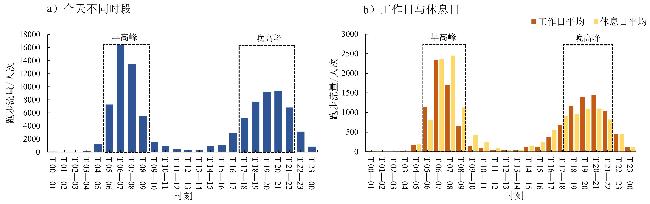
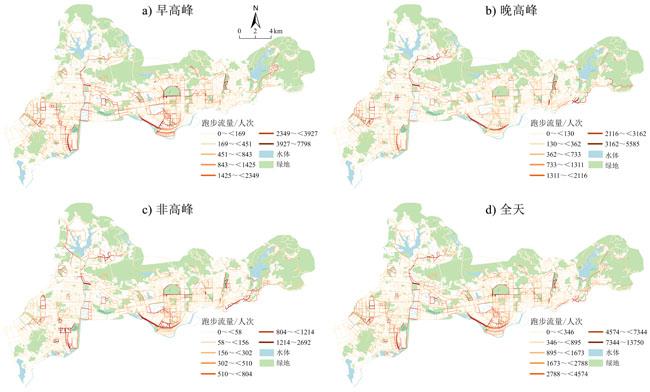
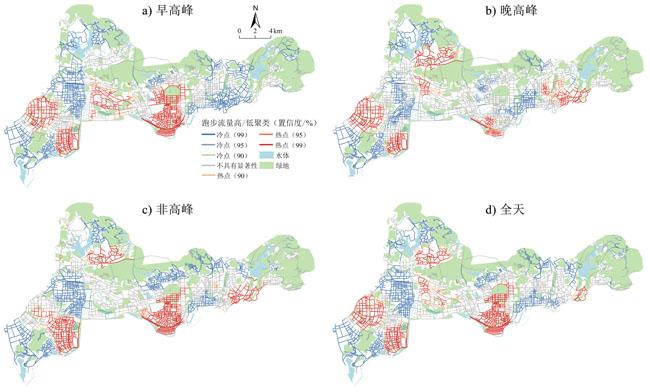
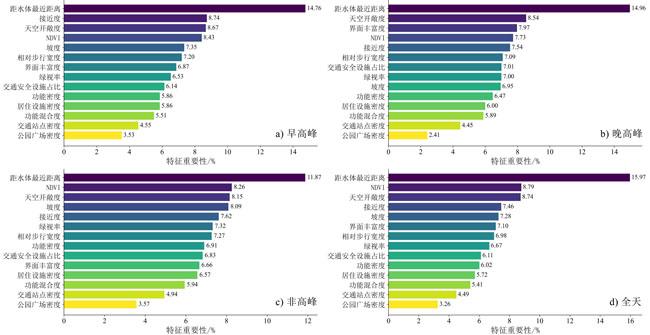
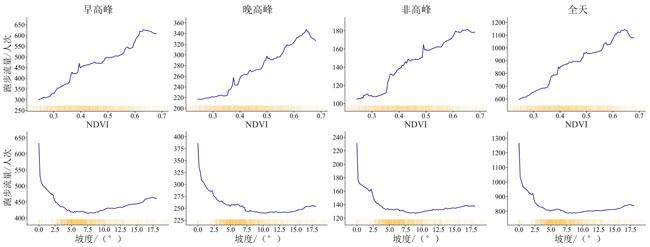
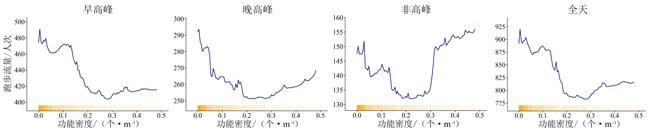
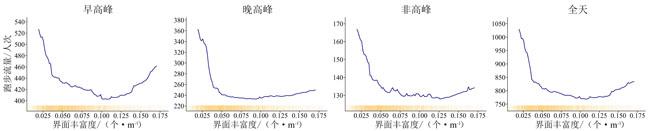
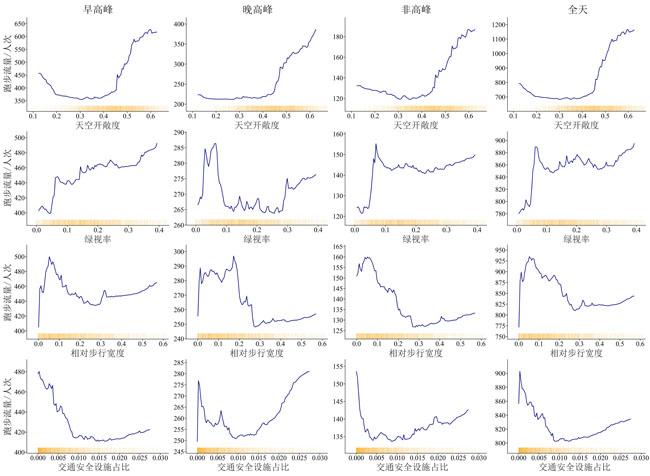
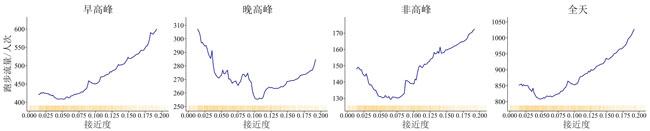
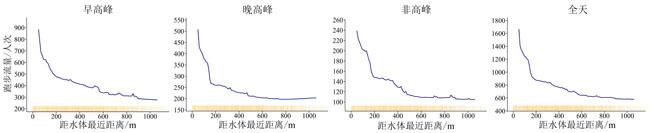
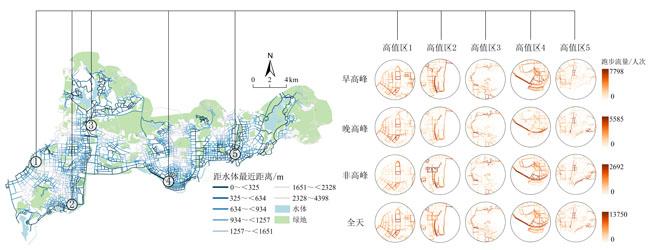
Investigating the spatiotemporal characteristics of how a built environment influences street-running activities is crucial for advancing public health and constructing healthy cities. However, existing research lacks a detailed analysis of the mechanisms between the built environment and running behavior, particularly from a spatiotemporal perspective, often assuming a singular linear relationship. Taking Shenzhen as a case study, this research employed various urban spatial data sources, including running trajectories, street views, and POI data, to analyze the spatiotemporal differentiation characteristics of street-running activities. Random forest analysis was used to explore the non-linear relationship and threshold effects between street-running flow and the built environment, which consists of six dimensions: natural environment, density, diversity, street design, transportation convenience, and landscape accessibility. The results indicate that (1) there are significant differences in the spatiotemporal distribution of street-running flow in Shenzhen. Temporally, residents' running behavior on the streets was characterized by distinct morning (T 05:00-09:00) and evening (T 17:00-22:00) rush hours, with the most notable activity occurring around 7:00. Spatially, the street-running flow in Shenzhen exhibited a pattern of "scattered points and continuous lines." (2) Among the variables influencing street-running flow, the distance to water, sky openness, and the NDVI had the most significant impacts. The average importance scores for these three factors across the four time-period models are 14.39%, 8.53%, and 8.30%, respectively. Conversely, the impact of transportation facility density and park or square density is minimal, averaging below 5% across the four time-period models. (3) A pronounced nonlinear relationship and a threshold effect were evident between the built environment variables and street-running flow across the four time periods. NDVI and sky openness exhibited a nonlinear positive correlation with the overall street-running flow across various time periods, with thresholds of 0.4 for sky openness. A non-linear negative correlation was noted between slope, interface richness, distance to water and street-running flow in different time periods. A complex nonlinear relationship was observed between functional density, green vision rate, relative walking width, proportion of flow safety facilities, NQPDA and street-running flow, and the impact effects of the five variables vary at different time periods. This research addresses the limitations of prior studies that primarily considered singular temporal features and single relationships when examining the relationship between the built environment and running behavior. By identifying the optimal built environment range that influences street-running flow using random forests, this study offers nuanced guidance for shaping fitness spaces and designing pedestrian-friendly streets in Shenzhen. For example, reasonably optimize the ecological space of street landscapes, reduce the inhibitory effects of street terrain and interfaces, and finely adjust street functional facilities and interface layout.
Zhenhai Xiang , Jie Sheng , Qing Li , Pengfei Ban . The Nonlinear Influence of Built Environment on Multi Period Running Activities in Streets Based on Random Forest Model: A Case Study of Shenzhen[J]. Tropical Geography, 2025 , 45(8) : 1329 -1343 . DOI: 10.13284/j.cnki.rddl.20240462
表1 建成环境指标体系Table 1 Evaluation indicators of built environment |
| 维度 | 变量 | 计算方法 |
|---|---|---|
| 自然 环境 | NDVI | 利用ArcGIS Pro平台的以表格显示分区统计工具计算街道缓冲区内的平均NDVI,反映街道自上而下的绿化水平 |
| 坡度/(°) | 利用ArcGIS Pro平台的以表格显示分区统计工具计算街道缓冲区内的平均坡度,反映街道的地形条件 | |
| 密度 | 居住设施密度/个 | 利用ArcGIS Pro平台的网络分析工具求解街道中点步行500 m范围的服务区,并计算该范围内的居住设施 数量 |
| 功能密度/(个·m-1) | 街道缓冲区范围内的功能设施总数/街道长度 | |
| 多样性 | 功能混合度 | 街道缓冲区范围内的POI功能多样性。采用区位熵公式进行计算(项振海 等,2024b),公式为: (1) 式中: 是单元 的POI混合度; 为缓冲区 内第 类POI数量占该单元POI总数的比重; 为该缓冲区的POI种类数。 |
| 界面丰富度/(个·m-1) | 街道内可视空间元素数量/街道长度,反映街道视觉丰富程度 | |
| 街道 设计 | 天空开敞度 | 街道内的平均天空像素占比,反映空间的视觉开敞程度 |
| 街道绿视率 | 街道内的平均绿色植物像素占比,反映空间的绿化程度 | |
| 相对步行宽度 | 街道内步行道占比/马路占比的均值,反映步行空间尺度 | |
| 交通安全设施占比 | 街道内栏杆和柱占比总和的均值,反映交通安全程度 | |
| 交通 便利 | 交通设施密度/个 | 利用ArcGIS Pro平台的网络分析工具求解街道中点步行500 m范围的服务区,并计算该范围内的公交、地铁站点数量 |
| 接近度 | 利用ArcGIS 10.8中的空间网络分析(sDNA)模型计算800 m半径内的接近度(古恒宇 等,2018),反映街道的中心性与可达性。公式为: (2) 式中: 为街道段的权重; 为搜索半径R内节点y的权重; 的取值在0至1之间,若在离散空间分析中,取值则为0或1; 为节点x到节点y的最短拓扑距离。 | |
| 景观 可达 | 公园广场密度/个 | 利用ArcGIS Pro平台的网络分析工具求解街道中点步行500 m范围的服务区,并计算该范围内的公园、广场 数量 |
| 距水体最近距离/m | 利用ArcGIS Pro的最近设施点分析工具计算街道中点至最近水系的实际距离,反映目的地的设施便利性 |
表2 各时段随机森林模型最优超参数Table 2 Optimal hyperparameters of Random Forest in different time periods |
| 超参数 | 分时段模型结果 | |||
|---|---|---|---|---|
| 早高峰 | 晚高峰 | 非高峰 | 全天 | |
| n_estimators | 1 000 | 700 | 200 | 900 |
| max_depth | 20 | 20 | 40 | 50 |
| max_features | 4 | 2 | 2 | 3 |
表3 两个模型评价指标比较Table 3 Comparison of evaluation indicators between two models |
| 分时段 | RMSE | MAE | R 2 | |||||
|---|---|---|---|---|---|---|---|---|
| 线性 回归 | 随机 森林 | 线性 回归 | 随机 森林 | 线性 回归 | 随机 森林 | |||
| 早高峰 | 650.911 | 589.436 | 416.232 | 366.628 | 0.134 | 0.290 | ||
| 晚高峰 | 452.217 | 409.308 | 258.637 | 233.131 | 0.112 | 0.273 | ||
| 其他时段 | 234.299 | 220.399 | 139.127 | 130.364 | 0.106 | 0.209 | ||
| 全天 | 1 151.028 | 1 034.457 | 741.800 | 647.876 | 0.151 | 0.315 | ||
1 www.openstreetmap.org
2 http://lbsyun.baidu.com
3 https://search.asf.alaska.edu
|
Breiman Leo. 2001. Random Forests. Machine Learning, 45(1): 5-32.
|
|
Campbell Michael J, Dennison Philip E, Butler Bret W, and Page Wesley G. 2019. Using Crowdsourced Fitness Tracker Data to Model the Relationship between Slope and Travel Rates. Applied Geography, 106: 93-107.
|
|
Cheng Long, De Vos Jonas, Zhao Pengjun, Yang Min, and Witlox Frank. 2020. Examining Non-Linear Built Environment Effects on Elderly's Walking: A Random Forest Approach. Transportation Research Part D: Transport and Environment, 88: 102552.
|
|
Dong Lin, Jiang Hongchao, Li Wenjing, Qiu Bing, Wang Hao, and Qiu Waishan. 2023. Assessing Impacts of Objective Features and Subjective Perceptions of Street Environment on Running Amount: A Case Study of Boston. Landscape and Urban Planning, 235: 104756.
|
|
Ettema Dick. 2016. Runnable Cities: How Does the Running Environment Influence Perceived Attractiveness, Restorativeness, and Running Frequency? Environment and Behavior, 48(9): 1127-1147.
|
|
古恒宇,沈体雁,周麟,陈慧灵,肖凡. 2018. 基于GWR和sDNA模型的广州市路网形态对住宅价格影响的时空分析. 经济地理,38(3):82-91.
Gu Hengyu, Shen Tiyan, Zhou Lin, Chen Huiling, and Xiao Fan. 2018. Measuring Street Layout's Spatio-Temporal Effects on Housing Price Based on GWR and sDNA Model: The Case Study of Guangzhou. Economic Geography, 38(3): 82-91.
|
|
Huang Dengkai, Jiang Bin, and Yuan Lei. 2022. Analyzing the Effects of Nature Exposure on Perceived Satisfaction with Running Routes: An Activity Path-Based Measure Approach. Urban Forestry & Urban Greening, 68: 127480.
|
|
Huang Dengkai, Tian meng, and Yuan Lei. 2023. Sustainable Design of Running Friendly Streets: Environmental Exposures Predict Runnability by Volunteered Geographic Information and Multilevel Model Approaches. Sustainable Cities and Society, 89: 104336.
|
|
黄沣爵,汤俊卿,林华丽,韩颂,赵鹏军. 2023. 基于多尺度地理加权回归模型的城市建成环境对共享单车空间分布影响研究. 地理研究,42(9):2405-2418.
Huang Fengjue, Tang Junqing, Lin Huali, Han Song, and Zhao Pengjun. 2023. Research on the Influence of Urban Built Environment on the Spatial Distribution of Shared Bicycles Based on Multi-Scale Geographically Weighted Regression Model. Geographical Research, 42(9): 2405-2418.
|
|
Huang Xiaoyan, Lu Gaigai, Yin Jiangbin, and Tan Weibao. 2021. Non-Linear Associations between the Built Environment and the Physical Activity of Children. Transportation Research Part D: Transport and Environment, 98: 102968.
|
|
Jiang Hongchao, Dong Lin, and Qiu Bing. 2022. How are Macro-Scale and Micro-Scale Built Environments Associated with Running Activity? The Application of Strava Data and Deep Learning in Inner London. ISPRS International Journal of Geo-Information, Multidisciplinary Digital Publishing Institute, 11(10): 504.
|
|
Karusisi Noëlla, Bean Kathy, Oppert Jean Michel, Pannier Bruno, and Chaix Basile. 2012. Multiple Dimensions of Residential Environments, Neighborhood Experiences, and Jogging Behavior in the RECORD Study. Preventive Medicine, 55(1): 50-55.
|
|
Lee I Min and Buchner David M. 2008. The Importance of Walking to Public Health. Medicine and Science in Sports and Exercise, 40(S7): S512-S518.
|
|
Li Bo, Liu Qiuhong, Wang Tong, He He, Peng You, and Feng Tao. 2022. Analysis of Urban Built Environment Impacts on Outdoor Physical Activities—A Case Study in China. Frontiers in Public Health, Frontiers, 10: 861456.
|
|
刘晔,何嘉锐,王若宇,李志刚. 2023. 城市绿色空间对心理健康的影响:研究进展与展望. 热带地理,43(9):1747-1759.
Liu Ye, He Jiarui, Wang Ruoyu, and Li Zhigang. 2023. The Impact of Urban Green Space on Mental Wellbeing: Research Progress and Recommendations. Tropical Geography, 43(9): 1747-1759.
|
|
Liu Jixiang, Wang Bo, and Xiao Longzhu. 2021. Non-Linear Associations between Built Environment and Active Travel for Working and Shopping: An Extreme Gradient Boosting Approach. Journal of Transport Geography, 92: 103034.
|
|
Liu Lexuan, Li Ye, Gruyer Dominique, and Tu Meiting. 2024. Non-Linear Relationship between Built Environment and Active Travel: A Hybrid Model Considering Spatial Heterogeneity. International Journal of Transportation Science and Technology, 20(1): e0314050.
|
|
Liu Yong, Hu Jie, Yang Wei, and Luo Chang. 2022. Effects of Urban Park Environment on Recreational Jogging Activity Based on Trajectory Data: A Case of Chongqing, China. Urban Forestry & Urban Greening, 67: 127443
|
|
刘霄泉,莫燕,张纯,王莎莎. 2023. 抖音“新农人”主播空间格局及乡村文旅转化潜力研究:基于蝉妈妈网站数据. 地理科学进展,42(8):1636-1650.
Liu Xiaoquan, Mo Yan, Zhang Chun, and Wang Shasha. 2023. Spatial Pattern of Tiktok "New Farmer" Anchors and the Transformation Potential of Rural Cultural Tourism: Based on the Data of the Chanmama Website. Progress in Geography, 42(8): 1636-1650.
|
|
Munshi Talat. 2016. Built Environment and Mode Choice Relationship for Commute Travel in the City of Rajkot, India. Transportation Research Part D: Transport and Environment, 44: 239-253.
|
|
申犁帆,王烨,张纯,姜冬睿,李赫. 2018. 轨道站点合理步行可达范围建成环境与轨道通勤的关系研究——以北京市44个轨道站点为例. 地理学报,73(12):2423-2439.
Shen lifan, Wang Ye, Zhang Chun, Jiang Dongrui, and Li He. 2018. Relationship between Built Environment of Rational Pedestrian Catchment Areas and URT Commuting Ridership: Evidence from 44 URT Stations in Beijing. Acta Geographica Sinica, 73(12): 2423-2439.
|
|
深圳市人民政府. 2022. 深圳市人民政府关于印发深圳市全民健身实施计划(2022-2025年)的通知. (2022-02-21)[2024-07-09]. https://www.sz.gov.cn/zfgb/2022/gb1230/content/post_9583009.html.
The People's Government of Shenzhen Municipality. 2022. Notice of the People's Government of Shenzhen Municipality on the Issuance of the Shenzhen National Fitness Implementation Plan(2022-2025). (2022-02-21) [2024-07-09]. https://www.sz.gov.cn/zfgb/2022/gb1230/content/post_9583009.html.
|
|
Wang Ruoyu, Lu Yi, Zhang Jinbao, Liu Penghua, Yao Yao, and Liu Ye. 2019. The Relationship between Visual Enclosure for Neighbourhood Street Walkability and Elders' Mental Health in China: Using Street View Images. Journal of Transport & Health, 13: 90-102.
|
|
Wang Wenxiao, Zhang Yi, Zhao Chunli, Liu Xiaofei, Chen Xumei, Li Chaoyang, Wang Tao, Wu Jiani, and Wang Lanqing. 2021. Nonlinear Associations of the Built Environment with Cycling Frequency among Older Adults in Zhongshan, China. International Journal of Environmental Research and Public Health, 18: 10723.
|
|
项振海,李青,洪良,盛杰,班鹏飞. 2024a. 城市建成环境对共享单车出行影响的时空特征——以深圳市为例. 热带地理,44(2):236-247.
Xiang Zhenhai, Li Qing, Hong Liang, Sheng Jie, and Ban Pengfei. 2024a. Effects of Built Environment on the Spatio-Temporal Trajectories of Shared Bicycles: A Case Study of Shenzhen. Tropical Geography, 44(2): 236-247.
|
|
项振海,盛杰,班鹏飞,李青. 2024b. 武汉市主城区建成环境对街道活力影响的时空特征——基于多尺度地理加权回归. 现代城市研究,(7):7-16.
Xiang Zhenhai, Sheng Jie, Ban Pengfei, and Li Qing. 2024b. Spatio-Temporal Characteristics of the Impact of Built Environment on Street Vitality in the Main Urban Area of Wuhan City: A Study Based on Multi-Scale Geographically Weighted Regression. Modern Urban Research, (7): 7-16.
|
|
芽郁. 2021. 用户在变轻,Keep在变重. 大数据时代,(5):42-50. [Ya Yu. 2021. Users are Getting Lighter, but Keep is Getting Heavier. Big Data Time, (5): 42-50. ]
|
|
杨林川,喻冰洁,梁源,赵桂林. 2023. 多源大数据支持下的共享单车出行与空间品质耦合研究. 西部人居环境学刊,38(4):47-54.
Yang Linchuan, Yu Bingjie, Liang Yuan, and Zhao Guilin. 2023. Research on Coupling of Shared Bicycle Travel and Spatial Quality Supported by Multi-Source Big Data. Western Journal of Human Settlements and Environment, 38(4): 47-54.
|
|
Yang Linchuan, Ao Yibin, Ke Jintao, Lu Yi, and Liang Yuan. 2021. To Walk or Not to Walk? Examining Non-Linear Effects of Streetscape Greenery on Walking Propensity of Older Adults. Journal of Transport Geography, 94: 103099.
|
|
Yang Wei, Li Yingpeng, Liu Yong, Fan Peilei, and Yue Wenze. 2024a. Environmental Factors for Outdoor Jogging in Beijing: Insights from Using Explainable Spatial Machine Learning and Massive Trajectory Data. Landscape and Urban Planning, 243: 104969.
|
|
Yang Wei, Fei Jun, Li Yingpeng, Chen Hong, and Liu Yong. 2024b. Unraveling Nonlinear and Interaction Effects of Multilevel Built Environment Features on Outdoor Jogging with Explainable Machine Learning. Cities, 147: 104813.
|
|
Zhang An, Song Liuyi, and Zhang Fan. 2022. Perception of Pleasure in the Urban Running Environment with Street View Images and Running Routes. Journal of Geographical Sciences, (12): 2624-2640.
|
|
Zhong Qikang, Li Bo, and Chen Yue. 2022. How Do Different Urban Footpath Environments Affect the Jogging Preferences of Residents of Different Genders? Empirical Research Based on Trajectory Data. International Journal of Environmental Research and Public Health, Multidisciplinary Digital Publishing Institute, 19(21): 14372.
|
|
Zhou Wanyun, Liang Zhengyuan, Fan Zhengxi, and Li Zhiming. 2024. Spatio-Temporal Effects of Built Environment on Running Activity Based on a Random Forest Approach in Nanjing, China. Health & Place, 85: 103176.
|
|
Zhu Dian, Song Dongjing, Zhu Beiyao, Zhao Jianan, Li Yunlong, Zhang Chenqi, Zhu Di, Yu Cong, and Han Ting. 2024. Understanding Complex Interactions between Neighborhood Environment and Personal Perception in Affecting Walking Behavior of Older Adults: A Random Forest Approach Combined with Human-Machine Adversarial Framework. Cities, 146: 104737.
|
/
| 〈 |
|
〉 |