



From Folk Memory to National Symbol: The Identity Construction of Hainan Fishermen's Vernacular Names in the Genglubu for the South China Sea Islands
Received date: 2025-08-23
Revised date: 2025-10-14
Online published: 2025-12-25
Genglubu is a nautical manual passed down through generations among Hainan fishermen that contains a large number of Hainan fishermen's vernacular names for the South China Sea Islands. This paper combs through the origin and development of these local names, and then cross-verifies them with relevant records in documents such as the 16th-century Portuguese transliterated names and Britain's The China Sea Directory (1868). This process rules out the possibility that other forces held early naming rights to the South China Sea Islands. However, in the contemporary context, digital technologies such as satellite coordinates have gradually obscured the fishing season patterns and oral history behind these local names. Meanwhile, Western media have simultaneously implemented a "de-historicization" strategy by systematically using Vietnamese and Philippine-designated names, attempting to deconstruct China's sovereignty narrative over the South China Sea. As geographical names serve as important symbols of national sovereignty, the historical value and practical significance of these local names urgently require in-depth exploration. This study adopts various methods, including field surveys, literature reviews, and toponymic textual research. By systematically investigating the trajectory of the identity construction of Hainan fishermen's vernacular names for the South China Sea Islands in Genglubu—from a carrier of folk memory to a symbol of national sovereignty— this study explores their value in contemporary South China Sea governance and sovereignty protection. Hainan fishermen's vernacular names for the South China Sea Islands in Genglubu were guided by three core naming principles: functionality, oral inheritance, and cultural metaphors. These names embody the Hainan fishermen's maritime survival wisdom and collective identity of "maritime homeland", and also serve as living historical evidence of Hainan fishermen's early development of the South China Sea. With the deepening of national border governance, local names have gradually transformed from folk experiences into symbolic tools of territorial governance. The historical rights embedded in them through judicial transformation and international communication have become key evidence for China to safeguard its sovereignty over the South China Sea. The evolution of Hainan fishermen's vernacular names for the South China Sea Islands, from a carrier of folk memory to a symbol of national sovereignty, demonstrates the vitality of local knowledge and provides a "memory-identity-sovereignty" practical paradigm for contemporary maritime governance. Today, the contemporary value embodied in the Hainan fishermen's vernacular names for the South China Sea Islands in Genglubu is unfolding before us with unprecedented urgency and richness. From the perspective of sovereignty protection, their transformation from "historical evidence" to "the core of legal narrative" represents the practical implementation of the "memory-identity-sovereignty" interactive logic in international games. From the dimension of building a maritime power, the "maritime homeland" identity contained in these names serves as a core carrier of the "memory-identity-sovereignty" logic in fostering public maritime awareness. From the perspective of border governance and cultural confidence, these Hainan fishermen's vernacular names stand as a typical practice of the "memory-identity-sovereignty" logic in maritime border governance.
Guofang Zhu . From Folk Memory to National Symbol: The Identity Construction of Hainan Fishermen's Vernacular Names in the Genglubu for the South China Sea Islands[J]. Tropical Geography, 2025 , 45(12) : 2145 -2155 . DOI: 10.13284/j.cnki.rddl.20250559
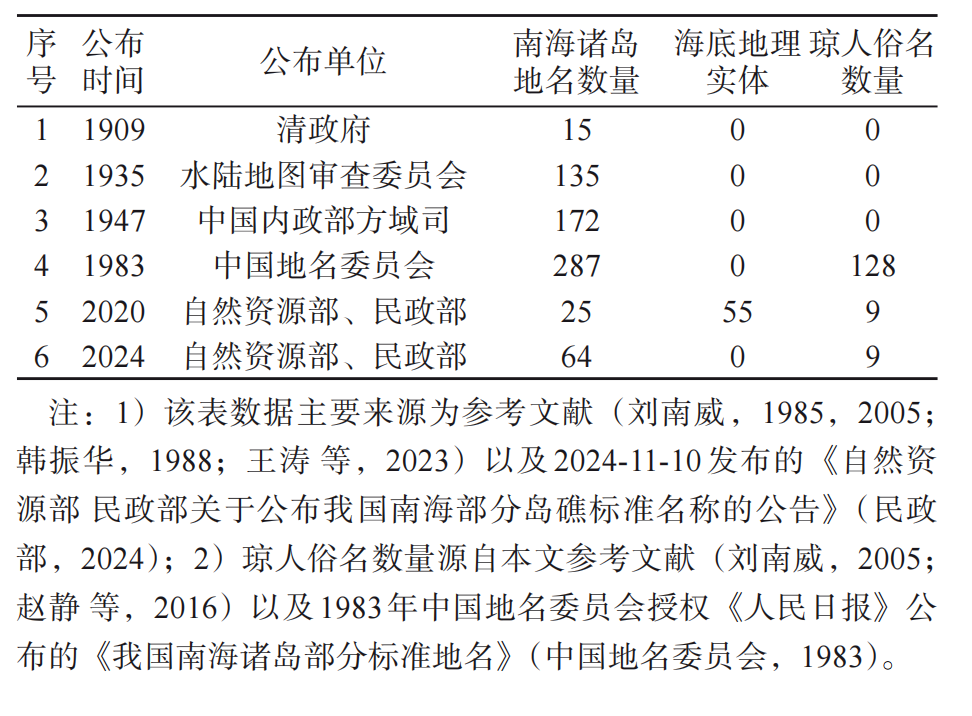
表1 中国政府对南海诸岛的6次命名 (个)Table 1 The six naming events of the South China Sea Islands by the Chinese government |
| 序 号 | 公布时间 | 公布单位 | 南海诸岛地名数量 | 海底地理实体 | 琼人俗名数量 |
|---|---|---|---|---|---|
| 1 | 1909 | 清政府 | 15 | 0 | 0 |
| 2 | 1935 | 水陆地图审查委员会 | 135 | 0 | 0 |
| 3 | 1947 | 中国内政部方域司 | 172 | 0 | 0 |
| 4 | 1983 | 中国地名委员会 | 287 | 0 | 128 |
| 5 | 2020 | 自然资源部、民政部 | 25 | 55 | 9 |
| 6 | 2024 | 自然资源部、民政部 | 64 | 0 | 9 |
1 刘南威在2005年6月发表在《热带地理》的《现行南海诸岛地名中的渔民习用地名》中给出说明:中业群礁西环礁北面有3个珊瑚礁成串,位居海面附近,时隐时现,远望如水中铁链,渔民称之为“铁链”。
2 即琼人俗名,其标准地名为牛轭礁。
3 括号内为南海诸岛标准名称。
4 八辛郎为琼人俗名,其标准地名为湛涵滩。
5 刘南威曾指出,该地名因渔民曾在此捡到520块银锭而得。
6 鸟仔峙为琼人俗名,在1983年中国地名委员会受权公布的南海诸岛部分标准地名中,将其命名为“南威岛”。
7 因环礁有6个缺口而得名。
本文的成稿特别感谢导师次仁片多教授的鼓励与教导,衷心感谢西藏大学王正宇教授的指点与帮助,诚挚感谢编辑老师和评审专家对本文提出了极具建设性的修改意见,使本文获益匪浅。
|
陈天锡. 1928. 西沙岛东沙岛成案汇编. 香港:商务商务印书馆,63.
Chen Tianci. 1928. Compilation of Historical Cases Concerning the Xisha and Dongsha Islands. Hong Kong: Commercial Press, 63.
|
|
范文静,刘碧娴,霍斯佳. 2025. 地名文化景观基因识别与遗传演化机制研究——以北京为例. 干旱区资源与环境,39(6):59-67.
Fan Wenjing, Liu Bixian, andHuo Sijia. 2025. Study on Gene Identification and Genetic Evolution Mechanism of Toponymic Cultural Landscape: Taking Beijing as a Case Study. Journal of Arid Land Resources and Environment, 39(6): 59-67.
|
|
韩振华. 1988. 我国南海诸岛史料汇编,北京:东方出版社.
Han Zhenhua. 1988. Compilation of Historical Materials on China's South China Sea Islands. Beijing: Oriental Publishing House.
|
|
何沛东. 2022. 中国海域地名的源流与时空特征. 地理研究,41(3):777-793.
He Peidong. 2022. Study on the Origin, Evolution and Spatio-Temporal Characteristics of Place Names in China's Maritime Areas. Geographical Research, 41(3): 777-793.
|
|
康澄. 2006. 文化符号学的空间阐释——尤里·洛特曼的符号圈理论研究. 外国文学评论,(2):100-108.
Kang Cheng. 2006. Spatial Interpretation in Cultural Semiotics: A Study of Yuri Lotman's Semiosphere Theory. Foreign Literature Review, (2): 100-108.
|
|
李瑞敏,吴雪涛,张扬,陈嘉婷. 2025. 文化融合区域地名及空间分布特征研究. 地理空间信息,23(8):45-50.
Li Ruimin, Wu Xuetao, Zhang Yang, andChen Jiating. 2025. Study on Regional Place Names of Cultural Integration and Their Spatial Distribution Characteristics. Geospatial Information, 23(8): 45-50.
|
|
刘南威. 1985. 南海诸岛琼人俗名考. 华南师范大学学报(自然科学版),(2):24-34.
Liu Nanwei. 1985. A Study on Hainan Fishermen's Vernacular Names for the South China Sea Islands. Journal of South China Normal University(Natural Science Edition), (2): 24-34.
|
|
刘南威. 2005. 现行南海诸岛地名中的渔民习用地名. 热带地理,25(2):189-194.
Liu Nanwei. 2005. Fishermen's Customary Toponyms in Current Use for the South China Sea Islands. Tropical Geography, 25(2): 189-194.
|
|
刘南威,张争胜. 2017. 海南《更路簿》解读. 南海学刊,3(1):22-26.
Liu Nanwei andZhang Zhengsheng. 2017. Interpretation of Hainan's "Genglubu". Journal of Nanhai Studies, 3(1): 22-26.
|
|
刘连安. 2022. 开启我国地名管理的新时代——写在新《地名管理条例》颁布之时. 人民日报,2022-04-24(12).
Liu Lian'an. 2022. Ushering in a New Era of China's Toponymic Management: On the Promulgation of the New Regulations on Geographical Names. People's Daily, 2022-04-24(12).
|
|
民政部. 2020. 自然资源部 民政部关于公布我国南海部分岛礁和海底地理实体标准名称的公告. (2020-04-19)[2025-10-04]. https://www.mca.gov.cn/n152/n165/c39062/content.html.
Ministry of Civil Affairs. 2020. Announcement of the Ministry of Natural Resources and the Ministry of Civil Affairs on Publishing the Standard Names of Certain Islands, Reefs, and Submarine Geographical Entities in the South China Sea. (2024-04-19) [2025-10-04]. https://www.mca.gov.cn/n152/n165/c39062/content.html.
|
|
民政部. 2024. 自然资源部 民政部关于公布我国南海部分岛礁标准名称的公告. (2024-11-10)[2025-10-04]. https://www.mca.gov.cn/n152/n165/c1662004999980002326/content.html.
Ministry of Civil Affairs. 2024. Announcement of the Ministry of Natural Resources and the Ministry of Civil Affairs on Publishing the Standard Names of Certain Islands and Reefs in the South China Sea. (2024-11-10) [2025-10-04]. https://www.mca.gov.cn/n152/n165/c1662004999980002326/content.html.
|
|
莫里斯·哈布瓦赫. 2002. 论集体记忆. 毕然,郭金华,译. 上海:上海人民出版社.
Maurice Halbwachs. 2002. On Collective Memory. Bi Ran and Guo Jinhua, Trans. Shanghai: Shanghai People's Publishing House.
|
|
尼古拉斯·斯皮克曼. 1943. 和平地理学. 俞海杰,译,上海:上海人民出版社.
Spykman Nicholas. 1943. The Geography of Peace. Yu Haijie, Trans. Shanghai: Shanghai People's Publishing House.
|
|
裴渊. 2007. 广州记//乐史. 太平寰宇记:卷156·岭南道一. 北京:中华书局.
Pei Yuan. 2007. Records of Guangzhou. In: Yue Shi. Universal Geography of the Taiping Era: vol.156·Lingnan Circuit I. Beijing: Zhonghua Book Company.
|
|
王崇敏. 2018. 海洋文化研究. 海口:海南出版社.
Wang Chongmin. 2018. Studies on Maritime Culture. Haikou: Hainan Publishing House.
|
|
王飞. 2024. 竞争、颠覆与重构:西方在中亚“去俄殖民化”的记忆政治. 新疆大学学报(哲学社会科学版),52(6):58-67.
Wang Fei. 2024. Competition, Subversion and Reconstruction: Memory Politics of Western "De-Russian Colonialization" in Central Asia. Journal of Xinjiang University (Philosophy and Social Sciences Edition), 52(6): 58-67.
|
|
王涛,武友德,李君,叶帅,崔红茶. 2022. 南海诸岛海域地名国别地缘环境解析. 热带地理,42(7):1050-1060.
Wang Tao, Wu Youde, Li Jun, Ye Shuai, and Cui Hongcha. 2022. Analysis of the National-Geopolitical Environment of Geographical Names in the Waters of the South China Sea Islands. Tropical Geography, 42 (7): 1050-1060.
|
|
王涛,武友德,李灿松,李君,陈长瑶,葛旭瑞,刘宇斯. 2023. 地名文化景观基因信息链与仿生模型构建——以南海诸岛地名为例. 世界地理研究,32(10):28-40.
Wang Tao, Wu Youde, Li Cansong, Li Jun, Chen Changyao, Ge Xurui, andLiu Yusi. 2023. Construction of Genetic Information Chain and Bionic Model of Geo-Graphical Names and Cultural Landscapes: An Example of Geographical Names of the South China Sea Islands. World Regional Studies, 32(10): 28-40.
|
|
吴士存. 2025. 南海历史与现实昭示中国主权无可争议. 环球时报,2025-07-11(15).
Wu Shicun. 2025. History and Reality of the South China Sea Demonstrate that China's Sovereignty is Indisputable. Global Times, 2025-07-11(15).
|
|
阎根齐,吴昊. 2021. 海南渔民《更路簿》地名命名考. 社会科学战线,(6):142-149.
Yan Genqi andWu Hao. 2021. A Study on the Toponymy in Hainan Fishermen's "Genglubu" Navigation Manual. Social Science Front, (6): 142-149.
|
|
扬·阿斯曼. 2015. 文化记忆:早期高级文化中的文字、回忆和政治身份. 金寿福,黄晓晨,译. 北京:北京大学出版社.
Assmann Jan. 2015. Cultural Memory: Writing, Remembrance and Political Identity in Early Civilizations. Jin Shoufu and Huang Xiaochen, Trans. Beijing: Peking University Press.
|
|
吴士存. 2022. 南沙争端的由来与发展:南海纷争史国别研究. 北京:中华书局.
Wu Shicun. 2022. The Origin and Evolution of the Nansha Dispute: A Country-Specific Study of the South China Sea Conflicts. Beijing: Zhonghua Book Company.
|
|
邬志野. 2024. 越南建构的南海历史地名叙事及其存在的逻辑问题. 南洋问题研究,(2):104-120.
Wu Zhiye. 2024. Vietnam's Constructed Narrative of Historical Place Names in the South China Sea and the Logical Problems Therein. Journal of Southeast Asian Studies, (2): 104-120.
|
|
张争胜,石成,赵霞,刘玄宇,牛姝雅. 2017. 刘南威教授对南海诸岛地名研究的重要贡献. 热带地理,37(5):742-746.
Zhang Zhengsheng, Shi Cheng, Zhao Xia, Lliu Xuanyu, and Niu Shuya. 2017. Prof. Liu Nanwei's Significant Contributions to the Toponymic Research of the South China Sea Islands. Tropical Geography, 37(5): 742-746.
|
|
中国地名委员会. 1983. 我国南海诸岛部分标准地名,人民日报,1983-04-24(04).
Chinese Committee on Geographical Names. 1983. Some Standard Geographical Names of China's South China Sea Islands. People's Daily, 1983-04-24(04).
|
|
周伟民,杨卫平. 2019. 风帆岁月:老船长老渔民口述史. 海口:海南出版社.
Zhou Weimin andYang Weiping. 2019. Years Under Sail: Oral Histories of Veteran Captains and Fishermen. Haikou: Hainan Publishing House.
|
|
赵静,张争胜,陈冠琦,南文龙. 2016. 文化生态学视角下的南海诸岛地名文化. 热带地理,36(6):1045-1056.
Zhao Jing, Zhang Zhengsheng, Chen Guanqi, andNan Wenlong. 2016. The Culture of Place Names of South China Sea Islands from the Cultural Ecology Perspective. Tropical Geography, 36(6): 1045-1056.
|
|
周尚意. 2025. 文化地理学嵌入人文地理学体系的逻辑框架的整合探索. 人文地理,40(2):1-9.
Zhou Shangyi. 2025. An Integrated Exploration of the Logical Framework for Embedding Cultural Geography into the Human Geography System. Human Geography, 40(2): 1-9.
|
|
周俊. 2023. 海南疍民与南海历史文化. 秦皇岛:燕山大学出版社.
Zhou Jun. 2023. Hainan Dan People and the Historical Culture of the South China Sea. Qinhuangdao: Yanshan University Press.
|
/
| 〈 |
|
〉 |